Search This Blog

Showing posts with label mornings. Show all posts

Thursday, March 14, 2024

Morning Is Breaking More Gently


This morning I heard robins near the house. Pretty-pretty-pretty, they seem to boast proudly. Sparrows trill in the popple grove, crows call raucously from a distance, the heart-lifting sound of a sandhill crane comes from far overhead, and the woods rings with sounds of the busy cleanup crew, woodpeckers in dead and dying trees. 


Spring’s arrival varies from year to year and can be quite teasing with its advances and retreats. We may yet have another blizzard. But if we do have a big snow in April, as I used to tell the Artist, “It will be a spring blizzard!” And sooner or later the seasonal page will be turned for good, and there will be only memories with which to answer the inevitable Up North spring question, “How was your winter?”


Mornings are easier and more pleasant with less cold wind and more birdsong as Sunny Juliet with her nose, I with my eyes, both of us with our ears explore a morning world that never grows stale. No two mornings –no two moments! -- are ever identical.


Reading her morning newspaper


I’ll keep this short today. One bookish thing on my mind is the idea of a ‘page-turner.’ You know, a book you can’t stop reading until the end. It strikes me now (and I have not taken time to develop this thought) that page-turners are of at least two different sorts. Some are consumables: That kind of page-turner is like a deep tub of popcorn at a movie theatre, a near-mindless reading binge. Such books serve a purpose in our lives. They provide a day’s distraction and relief. Tomorrow we will be ready to face our own life situations again. 


The second kind of page-turner is a life-changer, or at least a mind- or heart-changer, as well as a page-turner. We find ourselves totally immersed in a new world, seeing life through freshly opened eyes. Even familiar elements encountered in such a book evoke a new surge of love from us. We can’t stop reading because we are spellbound, enchanted.


Those in the second group are likely to burrow into our lives for good, as precious as old friends of whom we never tire. At least, that’s how I see things this morning on the eve of the Ides of March. How about you? And what's going on in your neck of the woods?


Will there be more? Stay tuned!


For what I learned in a very, very important new film, tap here. For a comforting soup, winter or summer, tap here. Thank you for sharing links with anything you find worth sharing.


Tuesday, December 21, 2021

Gift or Grind: It’s All in the Receiving

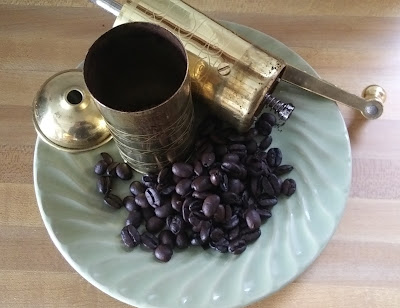
Although I do it every day, grinding coffee beans is not a "grind" at all!


When I was (belatedly) in graduate school at the University of Illinois, there was a wonderful coffee shop west of the main campus called the Daily Grind. “See you at the Grind,” we might say to a friend. “Oh, I was at the Grind.” Etc. Socializing did take place there, but usually only in the late afternoon. Earlier in the day, regardless of the number of people sitting at any given table, most heads were bent over books and notebooks, everyone reading and underlining and scribbling away. All of us regularly spent hours studying at home (some people until after midnight; my own preference was to get up at 4 or 5 a.m.), and there was no end to studying, but when we needed the comforting presence of others, the Grind was more help than distraction, so much so that when I think of my graduate school days, much of my nostalgia centers on the Daily Grind. You wouldn’t think that from the name alone, would you? 


This morning, the beginning of the day of the winter solstice, I was beset by all kinds of feelings, but I woke from dreams with a single thought: “We’re alive. We won’t always be alive.” It was not a new thought, not shocking or frightening. It didn’t even have a lot of feeling attached to it. Just truth. We’re alive. We won’t always be alive. The feelings came later, quite a jumble of them, when I looked at Facebook and saw a friend’s memory of her late son, then another friend’s memory of her late mother. May their memories be blessings to those left behind, I thought, and a third friend came to mind, one who is (as we all are, but she is close to the end and aware of it) in the process of dying, even as Christmas comes near. Our beautiful friend, so full of life and laughter!


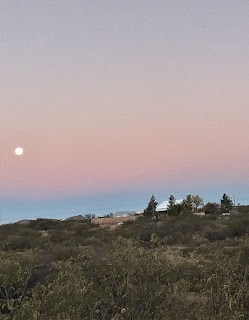
Full moon, morning before solstice

solstice moon


On laundromat morning, I don’t get up any earlier than usual, but I certainly get dressed and ready to go to town earlier. As the pack made its way from ghost town to “civilization,” the full moon of the previous morning was fading on its right-hand curve, and, as always, I thought of Ahmed (another departed friend), who taught me to distinguish waxing moon from waning moon with the words ‘premier’ and ‘dernier.’ It is the curves of the miniscule ‘p’ and ‘d’ that hold the clue. So this morning’s no-longer full moon is beginning to wane, although the solstice means that our days now begin to lengthen again toward spring.


But before we were on the road, there was already Peasy.


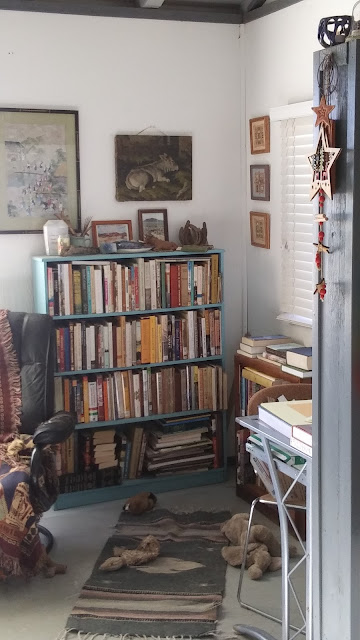
the corner I share with Peasy


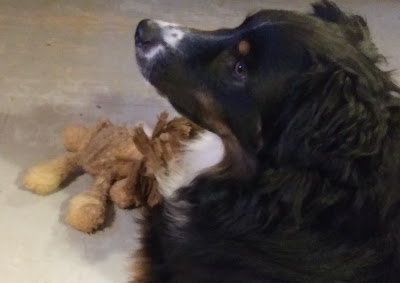
Peasy has half a dozen stuffed animals, which I try to keep corralled in my little book corner so we won’t be tripping over them everywhere in the small cabin, so when I told him this morning, “Go get your lion,” he first ran to the corner where most of his toys were gathered. But the lion wasn’t there, and he ran back to find it in the Artist’s corner. Has he learned the word ‘lion’ -- or is it simply that the lion, as the only toy still retaining (so far) its squeaker, is more fun than the other toys, his most valuable possession? Squeak, squeak, squeak! Joyously, proudly, he ran back and forth with his lion!


Peasy with lion, taking a break from running and squeaking


No morning is ever a “grind” to Peasy! He doesn’t care that one morning is pretty much like another. To him, each one is a gift. Another day! He’s alive! He’s with us! Life is fantastic! His enthusiasm is boundless and infectious, and we can’t help laughing and feeling grateful ourselves – for each other, for this crazy dog, for another day of life.


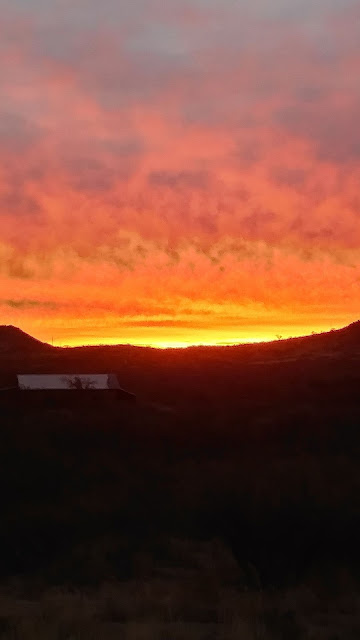
another glorious desert sunrise


Originally I had it in mind to write about grinding and milling – various methods from stones to mechanics – but really, do you want to read about that? Somehow I doubt it. You are basking in memories of Hanukkah or celebrating the winter solstice and/or looking forward to Christmas and a new year. And just maybe you have sadness, too, because someone you love is no longer with you or soon will not be. Turn, turn, turn – the seasons and the years. "Everything is temporary!" (my favorite line from the movie "Moonstruck"), I remind myself.


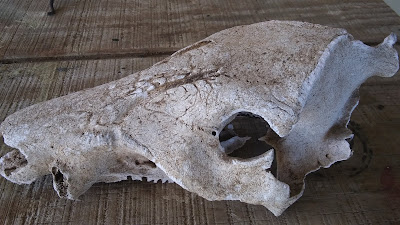
death in the desert (as everywhere)


Is life pointless because it is limited and ends, always, in death? Some people think so. Yet when it comes to gold and silver and diamonds and such, their value lies in their relative scarcity. For each of us, with one precious life to live, what could be more valuable?


All around us, even here in the desert, we are surrounded by life. I should say, by life and death, all mixed up. The earth teems with life and death, as do our days. Would you be a pioneer on another planet, given the opportunity? Not I. The way I see it, our species grew up on this planet and has adapted to it -- and tried to adapt it to ourselves, sometimes with disastrous results, but that is not part of my thought for today. Today I’m thinking only of what a gift our brief tenure is in this wonderful adventure. Not a single human being or even the minds of all human beings who ever lived, all those minds together, could ever have dreamed up such a vast, complex, incredibly fascinating set of wonders! 


So whether you give gifts or not or send holiday cards or not or bake cookies or light candles or have a decorated tree or do none of those things, I wish you joy in and of your life. Our future together -- as friends, as a species -- is, as our individual futures are, always uncertain, but if you are reading these words you are alive right now, and while we cannot hope to be joyful every moment we’re alive, intermittent joy is a recurring gift, n’est-ce pas? And gracious receiving can be as important as generous giving, I do believe. So if you possibly can, take a leaf from Peasy's book.


And Merry Christmas!!!


happy dog!!!


Books read since last listed (and who knows if I’ll squeeze in any more before year’s end?):


169. Sisman, Robyn. Weekend in Paris (fiction)

170. Wizenburg, Molly. A Homemade Life: Stories and Recipes from My Kitchen Table (nonfiction) 

171. Duncklee, John. Coyotes I Have Known (nonfiction)

172. Palka, Kurt. The Hour of the Fox (fiction)

173. Hudson, Virginia Cary. Flapdoodle, Trust & Obey (???)


Wednesday, August 12, 2020

Beautiful Morning, Best Dog, Wonderful Life


The other day I told the Artist I was going to do an online search for “best dog” to see if it turned up Sarah. Kidding, of course. Every dog deserves to be thought the best dog in some human’s life, right? But Sarah outdid herself on this morning.


I was sitting outdoors with my first cup of coffee, talking by phone with my son, Sarah companionably nearby. A monarch drifted past. It was a lovely, peaceful summer morning. Suddenly Sarah stood up, gazing alertly at something in the distance. She started trotting off, then broke into a lope. 


The animal I saw emerging from the weeds was too big and slow to be a rabbit. Oh, please, let it not be a skunk! No, duller in color….


I yelled, “Stop! Stop! Leave it!” She stopped. “Leave it! Come! Come!” A bit reluctantly but without any fuss, she came back to me -- as the porcupine waddled down toward the little, hidden-away, no-name stream. Porcupine! I had successfully called her off a porcupine! No need for an emergency trip to the vet and anaesthetic and a horrid quill-pulling session. Well, I’ve called her off deer more than once, and she’s always come back. What a good dog! No, a great dog! The best!


Later, on our way to one of the quiet back roads where Sarah and I go for morning walks before beginning our bookstore day, we passed a neighbor’s farm and saw him and a helper hurrying a new crop of Holstein feeder cattle out of the barn. Love to see those big, young ones in the open air! Stopped and watched a while, taking a couple photos to share with a ranching friend out in Arizona, and then continued a couple miles more to park by the side of the road and have a good dog walk. I walked, anyway. Sarah trotted, stopping frequently to sniff. I would love to know what she knows about who’s been there before us!


Time before my bank errand in Northport for a stop at Adelade’s roadside stand for a couple of Lori’s homemade scones and then another stop across from the playground by the marina to photograph the gorgeous summer morning, sun blindingly bright on the water.


Best of all, at the post office, a wonderful surprise waited! A letter from Copper Canyon Press and two copies of Jim Harrison’s Collected Ghazals, the first in “The Heart’s Work” series that is bringing all Jim’s poetry back into print. I am happy, happy, happy and can’t wait for the Artist to arrive (I’ve already turned his gallery lights on) so I can share with him all the glories of this glorious Wednesday morning. Not all days begin so auspiciously, but this is one for the memory book.


Sunday, May 19, 2019

Kitchens, Morning Coffee, and a Bit More

Stepping back into my Paris kitchen in our old northern Michigan farmhouse after several months far away was no big adjustment, any more than had been walking back into the one-room ghost town cabin in mid-December. Neither place is fancy or glamorous, which is probably why both feel like home. And that is how they are alike, but in other ways they are very different. 

My little kitchen in Michigan is a small galley, what one of my family members calls a “one-butt kitchen,”  which is why I began calling it a Paris kitchen in the first place. (Space is at a premium in Paris.) A second person can squeeze in, but it is difficult then for either person to move and work freely. — Well, moving and working are difficult, moving and working freely impossible. 

In the ghost town kitchen, there are steps to take across open space between stove and counter, sink and refrigerator. In my (Michigan) Paris kitchen, standing at one counter, I turn turn 180 degrees to face the sink, turn back and take a single step to the stove, and stretch an arm out to open the refrigerator. Only high shelves are a challenge. Everything else is within reach. 

In the ghost town cabin, as in Michigan, I was often up before dark or, when spring arrived, at least by first light. Both places, my morning begins with making coffee. 


This morning, for some reason, I thought of long-ago mornings in Paris, France, waking to the cooing and fluttering of pigeons, clink of spoons against china, and sounds of French conversation and singing through the open windows. That was in May, and I am now in May here, in northern Michigan. Is that what reminded me of the rue de Vaugirard and dear Hélène, the landlady who became a cherished friend? She, I remember now, made only instant coffee. (Does that seem strange?) Red wine she bought in bulk and kept a bottle filled for me on my shelf in her refrigerator. Her kitchen was somewhat larger than mine here in the farmhouse, but it was not large enough for a table, and our eating and drinking was all done in the apartment’s largest room, a combination parlor/dining room, the walls crowded with crowded bookshelves and an eclectic assortment of art work, courtyard window sill lined with herbs in pots. 

The largest kitchen I have ever had was in my graduate student apartment in Champaign, Illinois. It was an old sleeping porch on the third floor of an enormous Victorian house at the opposite end of a large city park from the downtown shopping district. Once a month, on the day I got my graduate assistant paycheck, I would get off the bus downtown and treat myself to fresh flowers from a little jewel of a florist shop (much like similar shops in Paris, France), next picking up a baguette from an Italian restaurant and bakery on my walk home, cutting through the park. My sleeping porch kitchen was enormous and filled with light. Also, and despite its generous size, because it was on the third floor and there were mature trees right outside the window, it felt like living in a treehouse.

I was alone then, without even a dog until — but that is another story. My point is that, living alone in Champaign, a single pot of French press coffee was enough to get my day started. Later in the morning, out in the world, near campus, I could stop in at a coffee house (say, the Daily Grind) or, toward the end of the long pay period when funds were running low, the basement cafeteria of the Newman Center. All that was a lifetime ago. Two dogs ago.

The ghost town coffee maker, one we bought new in early 2018, made the first pot of the morning quickly. During its operation I had time for a routine of yoga stretches but never enough time to become impatient.

Here in Michigan, in my little Paris kitchen, our equally modern but aging coffee maker takes its sweet time, even after a day-long ritual cleaning. Sometimes, not wanting to wait for the glass to fill, I pull it out ahead of time and pour a premature cup — always too strong, but the addition of hot milk makes it café au lait, thus more palatable. This morning another idea occurs to me, however, and I hunt through cupboards until I find a pair of seldom-used espresso cups and saucers.  

Yesterday I came to the last page of Darwin’s Voyage of the Beagle, beginning at bedtime a Swedish novel recommended by a friend, Bear Town, by Fredrik Backman. I am generally careful what I choose to read before sleep, and so I saved for morning another book brought by another friend, a book of nonfiction by poet Carolyn Forché entitled What You Have Heard Is True: A Memoir of Witness and Resistance, a story of modern-day El Salvador. That story begins with one I have heard before: the seizure of indigenous people’s lands for the cultivation of cash crops, profits reaped by the cultural thieves. In this case, the first such crops were indigo and sugar cane, as the campesinos were pushed up into the mountains. Then came the realization that the mountain slopes were perfect for coffee plantations. 

I get up and go to the freezer to look at the bag of coffee beans. The contents are claimed to be “eco-friendly,” but I see no mention of here of “fair trade,” and I remember that when my sister gave me the bag (we were visiting sister and brother-in-law on our way back to Michigan), she commented that it wasn’t what she usually buys. I remember too a piece in the latest New York Review of Books discussing slavery in the United States and quoting William Lloyd Garrison, who wrote that slavery was “not a southern, but a national institution, involving the North as well as the South,” and I recall one of my guest authors in the 2018 Thursday Evening Author series at my bookstore, Rachel May, the woman who wrote American Quilt: Unfolding a Story of Family and Slavery, who came on her own to the same conclusion as she researched a piece of material culture. 

My original review of Rachel May’s book is here. One of the questions I note that May asked was how we, the United States, came to be where we are today, in terms of race relations. I think of that this morning because Carolyn Forché’s book seeks to answer, among other questions, how we Americans came to be where we are today in relation to Latin America, especially Central America. We cannot understand why so many refugees are streaming north to our borders without realizing what they are fleeing — and if we understand the role of our own government in creating the intolerable situations in their native countries, we cannot help feeling as responsible for their lives as we feel for the lives of our fellow United States citizens. 

When a Salvadoran man with two young daughters showed up at her door and said he had come because she was a poet, Forché had no idea that a few days later he would invite her to spend her poetry fellowship time and money by coming to spend time in his country. He said that war was coming to El Salvador and it was her chance to see something like Vietnam from the very beginning. Besides, he asked, what else did she have in mind? “Write poetry about yourself for the rest of your life?” 

What are we going to do for the rest of our days on earth? What are we going to challenge ourselves to learn, and how might what we learn change our lives? It takes courage to learn and even more courage to change. I am not unmindful of the strong coffee that accompanies my reading this morning. I’m thinking of this year’s garden, also, and wondering how it would go if I dropped seeds of corn, beans, and squash into little hills surrounded by straw mulch from last year’s gale garden — a natural thought, given my morning’s reading. 

Saturday, February 16, 2019

Cold Does Not Keep Us Indoors

Hard frost. Temperature at 19 degrees Fahrenheit, with a reported “feels like” effect in single digits. Brrr! But the sun is coming up, and Sarah and I are going out, meeting neighbor friends Therese and Buddy and Mollie for a dog walk — cross-country, up the wash, back down the road. I bundle up. Sarah, of course, is always ready.


(My camera battery was low, almost but not quite at the point where it needed to be removed and recharged, so the camera stayed home on the 19-degree morning, and photos today are a composite from various other mornings.) 

For the duration of our winter stay here, Therese has loaned me her extra Camelbak©, a handy lightweight backpack with its own waterbag, complete with flexible drinking — or squirting — tube. No need to mess around with a bottle of water, either carrying it in the hand or having to extract it from a backpack and uncap it for every drink. The gentle squirting function makes it possible to refresh dogs, too, as they quickly learn to catch water in their mouths. I also packed along dog treats for Sarah and, for myself, a fresh lemon and plastic-sheathed knife for cutting the lemon. Water is necessary in the desert and at high altitudes but not always sufficient. As I learned from my experience in the Dragoon Mountains, electrolytes can be crucial, and juicy fresh lemon does the job.

Buddy and Mollie have accepted Sarah, and she is comfortable with them now, too. The three don’t engage in much direct interaction (after the initial tail-wagging and you-know-what-sniffing), but that’s okay. (Parallel play is good enough.) On our first walk together, Sarah took on the role of Boss Dog, but Mollie has gotten over being intimidated. Now the girls take turns — though with Mollie challenging Sarah regularly, my old girl might just be content soon to play second fiddle. We'll see!


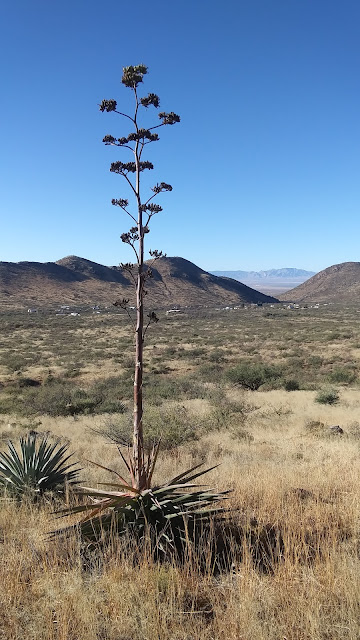
Nothing is blooming yet, but the desert is always interesting nonetheless, and we did spot new green growth -- not only the thistle below but other plants that will have flowers in a month or two.


Cowpaths make the land seem homelike, domestic, while a bleached bone, a memento mori, says something very different. To my great satisfaction and gratitude, Sarah obeys the “Leave it!” command immediately when tempted to sniff around a small cave where javelina den up for the day. Good dog! Notice how the wind is blowing her ears and tail, too.


Last year Therese and I and her dogs — without Sarah — were out one morning for two hours. I like having Sarah as part of the larger pack on walks this year, but it’s pretty clear that one hour is more than enough for her. 


She keeps up and has a wonderful time, but on our first cold morning, when we got back to the cabin she was barely in the back door before she crashed. 


Well, I don’t mind a quiet interlude myself and sit down for a few minutes with poetry books to read. Another  winter day has started well in Dos Cabezas.


Saturday, July 7, 2018

Inspired to Take a Different Road -- Slowly


We are now in “high season.” This very week was 4th of July and, of course, still is Cherry Festival in Traverse City. Cherry harvest is a little late here in the northernmost part of Leelanau County, due to an unusually cold April. We’ve certainly had warm weather lately, though, and the summer people and tourists are swarming to restaurants, shops, tasting rooms, and beaches. High season is the busiest time of year for almost everyone in Leelanau County. 


But Kim Schneider, my July 5 TEA guest, must have inspired me, because on Friday morning I jumped the traces for a modest morning adventure. 


After hanging laundry out before sunrise, I made it to the farm market before official opening hour (most of the vendors ready for business), did bank and post office errands, and then took myself, with Sarah, out for a slow drive to Peterson Park and a stroll around the grounds for — hard to believe — my first visit of the year. Peterson Park looks different with the old dead trees taken down and new little trees of various species planted. Probably a lot like the early days, one third-generation local observed, except that this time a monoculture planting was avoided, which bodes well for the park’s future. With more open area, the views are longer and wider. There is a shaded picnic shelter and also tables in the sun, so take your pick. Whenever I go up there in the morning, with coffee or without, I think what a lovely vacation breakfast gathering spot the place would make, especially on summer Fridays. Fruit and croissants from the farm market, fresh coffee, maybe cook up some bacon and eggs on one of the park grills. 


Sarah and I didn’t take the rustic stairs down to the beach. (That much time we didn’t have.) Peterson Park beach, though, is my favorite place to send people who want to hunt along the shore for Petoskey stones. Kim Schneider asked people who came to her TEA event for their suggestions of ideas she could add if 100 Things to Do in Traverse City Before You Die goes to a second edition. (Would an enlarged second edition have to be called 150 [or however many] Things to Do, etc.? I don’t know.) I’d definitely have Peterson Park on my list, and my other suggestion would be the pow-wow in August in Peshawbestown, an event I sometimes find difficult to fit into my calendar — so much going on all summer! — yet whenever I get there, the chance to relax under the trees and watch the dancers brings peace to my spirit. I call it “that pow-wow feeling,” and it’s another way for me to slow down and simply be here. Important to take advantages of quiet moments and hours along the way, isn’t it?

Back in town, I did my last pre-opening errand on foot, pausing on the corner of Mill and Nagonaba to appreciate what I've always called my "lipstick" roses. I rescued the bush when I was working in a friend's garden business and one client wanted all his old roses dug out and replaced with new hybrid teas. Unable to throw these old-fashioned darlings on the compost pile, I put the bush in my car instead to take up to Northport and plant next to my bookstore, back when Dog Ears was housed in the little bark-covered building on that corner that is now the home of Porcupine. They bloom still, my lipstick roses, with their brilliant shade that reminds me of the lipstick my mother used to wear when I was a little girl. 

My mother's lipstick, working in my friend's garden business, the early days of my bookstore -- to me, all this history is contained in these colorful blooms. 


Tuesday, July 3, 2018

Time Also to Think


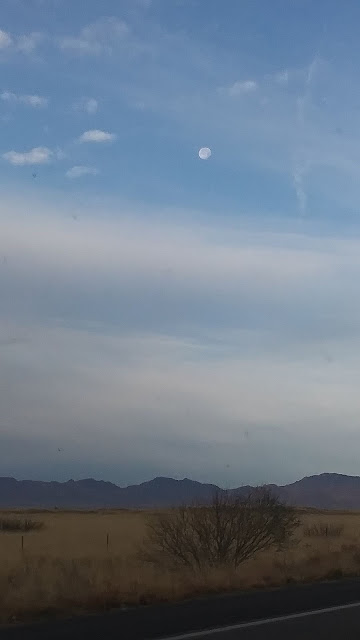
The image above (not a very good one) doesn't show this morning's sky. I referred to the moon over the barn on June 30 but was unable to upload my image then, so here it is on July 3. Sadly, I remain unable to upload the image from Fleda Brown’s TEA event at Dog Ears Books. The moon was on my phone, Fleda on the Artist’s camera. Technical challenges continue. 

But each night continues to give way to another day, and up at 4:30 a.m. on this day before the 4th of July, I picked up a book set aside a year ago or more, about halfway through, The Physicist & the Philosopher: Einstein, Bergson, and the Debate That Changed Our Understanding of Time. One reason I set it aside was my inner editor’s constant carping: I wanted more smoothly flowing sentences, cleared of unnecessary obstructions, and I found repetitions annoying, jumbled chronology confusing. My other reason was more personal: Since first making the acquaintance of Henri Bergson’s work, I have loved him, and to read an account of the “controversy” during his lifetime, controversy fomented by interested philosophers, scientists, and journalists who pitted him against Einstein as if the two were boxers in a ring — well, it was just too, too sad. Bergson and Einstein had very different concerns,  therefore different thought objects, definitions, and arguments, and neither was vitally interested in the other’s chief concern. How does a downhill skier compete with a figure skater? Skiers will judge for one, skaters for the other, ¿claro?

Philosophy stimulates thought in ways different from the stimulation of fiction. My mornings this summer more often begin with novels, but life used to be very different. Back in graduate school days, all my mornings began with philosophical arguments. One night, I recall, I slept not at all, so furious was I with Bertrand Russell’s clumsy attack on Bergson, whom he had completely failed to understand. I spent that night spent writing furiously, arguing with one dead philosopher for his failure to comprehend another! 

During my first year of graduate work, in fact, the only way I could go to sleep at all most nights was to turn to the familiar novels of Jane Austen. I had all of them lined up at the head of my bed, so that when I reached the last page of one I could pick up the next, working my way to the end the line and then starting over at the beginning. Jane Austen was a comfort. Bertrand Russell was not. 

But mornings — ah, it is not such a bad thing to have one’s mind jolted awake by thought in the morning! And today it occurred to me long before sunrise that while certain philosophers have criticized what they disdainfully call “the god’s-eye view,” a perspective they say human beings often try to assume but can never realistically inhabit, the “subatomic view” is just as much outside human experience. Solid objects are not solid, the physicist tells us. Solidity does not exist! Accepting that there are gaps and spaces between atoms, what has this to do with life as we live it? With the “too, too solid” nature of our bodies and floors and the earth itself in terms of our experience (though we gardeners know healthy living soil to be full of earthworms and fungi and bacteria — anything but “rock solid”)? My question is, why is the subatomic view to be preferred? Why is it any more legitimate than the view from heaven? If one of those perspectives is suspect for being outside our experience, surely the other is, also.

Then, unbidden, an image of a doe and fawn comes to my mind. Not bothering their heads with philosophy, they stand motionless by the side of the road, the fawn obedient to its mother’s signals. Be still. Watch me. Listen. Follow me when I let you know it’s time. In some ways we share a world with deer, and in other ways we inhabit very different realms. Venn diagrams, our lives are, intersecting only at one edge, forming a delicate lentil of overlap. 

After a while the sky to the west takes on a rosy tinge, reflecting sunrise, and Sarah and I stroll out into the grass. She takes off like a shot toward the barn. Must have seen a rabbit. Thing is, she often doesn’t see the rabbits if they don’t move.

Dog, rabbits, deer. They are closer to my notice and understanding than gods and atomic particles, but even to pay attention to these other creatures means taking a break from the books. Not just “the books,” as in novels and philosophy, history, economics, and such, but “the books” in terms of the profit-and-loss thinking necessary to running a largely seasonal business during “high season.” 

And it occurred to me also this morning that running an essentially one-person business, as I have for 25 years now, is a lot like conducting a second marriage alongside and simultaneously with the first. There is the anticipation stage, preparation for the initial launch (engagement). Then one goes public (wedding), followed by the leap into a honeymoon, the nature of which can never be precisely foreseen, and further surprises of life together. If the business is successful, one year follows another, but none is ever just like the previous, as each brings new challenges to be met. Children? Well, as a bookseller, though my guest authors are adults, I have almost family feelings for the authors and books I choose to promote.

My husband, as friends and regular readers know, is an artist — “the Artist,” I have taken to calling him lately — and so he too has another “marriage” on the side. Art has been his life for over half a century, while I have been married to a bookstore for only a quarter-century. How does that work out for us? Are we jealous of each other’s other partners? In a word, no. There are occasions when one of us, in fact, gives priority to the other’s other partner over our own. At those times we are each other’s support system. At other times, I go my way with the books, the Artist goes his way with painting, and we come back together with new stories to share, and that’s good, too. 

All these marriages — that of two human beings, of one with a business, of the other with his art — also involve many more people. Some friendships blossom and fade, others persist and deepen, but every single one of them has a place in the rich marriage history. 

These are some of my thoughts this morning, before sunrise, when I have time to think, to let my mind roam.

Happy 4th of July, everyone! And don’t forget, our TEA guest (Thursday Evening Author) this week, on July 5, is Kim Schneider. That’s at 7 p.m. on Waukazoo Street, so join us if you can — and bring your visiting relatives! They’ll pick up all kinds of ideas for how to entertain themselves when they visit you.

Photo of long-ago photo. Who remembers that place and time?