Search This Blog

Showing posts with label Henri Bergson. Show all posts

Sunday, February 1, 2026

Good News, Good Deeds, Neighbors


Saturday morning glory!

Happy News: Sunshine and Standing Up


Last Thursday was very cold, but it was also sunny. Friday, sunny morning, cloudy afternoon with heavy snow. Saturday, cold and sunny again. Two and a half sunny days in a three-day streak is something to write home about in January, but I am already home, so I’m writing it to all of you who are elsewhere to let you know what you’re missing in your winter perches in Arizona, New Mexico, Mexico, south Florida, etc. Now on Sunday, the first day of the year's shortest month, sunshine again! Sunshine on pristine, glistening, sparkling snow!


Sunny day, Sunny!

Do you envy those of us back here in northern Michigan? A friend sent me a link to a video about a 4-year-old girl who received a gift pony and whose parents allowed her to show the pony her bedroom. My friend asked me, “Are you jealous?” and I answered, “Yes!” But right now I wouldn’t be anywhere else these days than northern Michigan, because my little personal life here is very happy, outside of my anguish over attacks on democracy and the rule of law all over our country, and even there, more and more Americans are standing up and taking brave public positions, so that is reason to be encouraged. Or, as a friend would have it, enCOURAGEd.


Homemade sign. NOT a "paid protester"!

(Graphic design is obviously not my forte. There are more snow and protest images and thoughts, however, in my previous post.)


Happy Book News


In my work as a bookseller (one aspect of my little personal life), I was thrilled to hear on Saturday from Robert Carlos Fuentes, author of The Vacation: A Teenage Migrant Farmworker’s Experience Picking Cherries in Michigan, that his book has won a Michigan Notable Book Award for 2026. Carlos wanted to thank me again for nominating his book, but I told him all I had to do was to call the committee’s attention to it (which was my honor and privilege), and his book did all the rest. I’ll let you know when the author (from Lansing), whose story takes place in Lake Leelanau, will next be in Northport. Author Tim Mulherin, who spoke at Dog Ears Books in late 2025, also received an award for his book, This Magnetic NorthMy authors! Bravo!


So there was all that sunshine--my final count for the month of January was four and one-half days--and there was the wonderful Michigan Notable Book news.


Then, Serendipity: From Other Books


Surrounded by books, both at work and at home, it’s easy for me to open covers and turn pages at random and find just the words I need. In a volume called Sister Outsider: Essays and Speeches, by Audre Lorde, in an interview with poet Adrienne Rich, Lorde says, “You become strong by doing the things you need to be strong for.” I find that wonderful! It’s when you are afraid that you need courage. It’s when life challenges your strength that you need to be strong, and you become strong. 


At home, from my favorite philosopher, I found these words:


Between the closed soul and the open soul there is the soul in process of opening. Between the immobility of a man seated and the motion of the same man running there is the act of getting up, the attitude he assumes when he rises.


-      Henri Bergson, The Two Sources of Morality and Religion


What We’re All Doing Here


In Minneapolis, citizens observe and video-record action in the streets; hold vigils and demonstrations; organize to shop for and delivery groceries to people afraid to leave their homes. Here in little Northport, far from the fray, we oldsters take turns standing outdoors with signs. We send checks. We use our platforms (this blog is one of mine; my bookstore is another) to share facts and support. A kindly bookshop customer brought me a piece of delicious homemade cake on Thursday, and I ran library errands for someone else. A cherry farmer keeps my driveway plowed, and I delivered a book order to a customer not feeling well enough to venture out. 


Friends and neighbors. And everyone in need is a neighbor, whether next door or a thousand miles away. Help however you can.


Thursday, October 2, 2025

In and Out of Our Cages

Get ready. Get set.


The Big Day


Leelanau UnCaged! Such a happy day! Weather this year was perfect, too, but even a little drizzle in one or two past years didn’t manage to dampen spirits much. This is a day when everyone comes home to Northport. Or comes out. Or comes up! From wherever you start, our village is the destination on the last Saturday in September. Streets are closed off to traffic, so a little walking is involved. It’s good for you! You’ll notice big smiles on faces. Even the many dogs on leashes seem to be smiling. Note also that these shots were made before the start of the festivities.


12:30 p.m. The drums, the drums! Their hypnotic beat invites dancing and hand-clapping. The sun is shining, and the sky is blue over Northport….


Now it's underway....


…A woman buys a book on learning French, and when I ask if she’s going to France, she says, somewhat sadly, that she doesn’t think she’ll ever get there. I recommend Montreal (“You can drive there!”) and tell her a little about the trip the Artist and I made the year I turned 50, including an unprepossessing little town in the countryside that had the most beautiful Parisian pastries imaginable. She likes the idea and thanks me enthusiastically. 


A Canadian visitor … friends from Traverse City … A pair of women in the street on stilts with mushroom hats and bags ….


6 p.m. So many old friends, repeat customers, and newer acquaintances. Good conversations and good sales. Happy noises from the street. Now and then someone comes in looking frazzled, needing only to sit down quietly for a few minutes. I slowed down one young woman (not frazzled) long enough to photograph her book bag from NYC. I was at the Strand once!


Sorry for blurry image. I was hurrying.


What started to feel like a brief lull (interrupted several times—no problem) gave me a chance to eat the salad I’d brought from home and rehydrate with some Vernor’s. Have I mentioned that it was a summery day? That it felt like June? I barely got past my bookshop door all day but didn’t feel confined at all; with so many people flowing through the door and so many conversations, I felt very much a part of the day, so happily occupied that it was impossible to keep continuing tabs on the day hour by hour….


What Came After That?


I must admit Saturday was a long day, though. For me it began with a meditative minivacation in the interior of the county, because I knew it would be a long day for Sunny, too. (You can see scenes from one of our three Saturday morning walks here.) The next two days, also summery, were also very busy but more Sunny-focused, with dog park, extensive and relentless raspberry cane pruning, and grass mowing on Sunday, followed by our agility session with Coach Mike on Monday morning, afternoon autumn olive eradication (a never-ending program), and more mowing in the cool of the evening after dinner with a friend at the Happy Hour. Whatever yard work I do, you must understand, is done in spells alternating with tennis ball play, so my dog girl is not neglected.


Do all photos of Sunny look the same?
But cute, right?


We here in Leelanau are enjoying our “second summer” of 2025, this blessed respite—without humidity!—before cooler temperatures arrive and stronger winds strip the trees, preparing the scene for winter—.  Ah, but we have fall color yet to come, so let’s not run ahead of ourselves. 


Indoors


Outdoors


Reading It Differently


It appears that I have rejoined the old Ulysses Reading Circle after absenting myself from meetings for over three years. Recently we got together to talk about The Stranger, by Albert Camus, and naturally I needed to reread that slim classic, as it had been several years since Meursault and I were last together. Here is what I wrote about the novel nine years ago, as well as what I wrote about another novel springing from the first, the second one imagining the story continuing from an Arab perspective


The only thing different in how I read The Stranger this year was that I now see it as the work of a young writer. Looking into that, I found that Camus was only 28 when he wrote the novel, 29 when it was published, so perhaps—I really don’t know—he had yet to come to his humanist conclusion, a conclusion based on the premise of absurdity but not resting there. What do you think? I can imagine that. I can imagine a young man deciding that life is absurd and that nothing matters and then, as he matures, realizing that absurdity is not a conclusion but only the first step on the path of affirming the value of life. He was 39 when he published The Rebel: An Essay on Man in Revolt. Whether or not the author based the character of Meursault on someone he knew, and whether or not that someone had Asperger’s Syndrome is really peripheral to the argument that took Camus, eventually if not right from the start, from absurdity to humanism. If only my friend Hélène were still alive! She knew Camus in North Africa during World War II.


O, the Irish!


Doesn't this scene look Irish?


My literary love affair with Irishman Niall Williams continued through History of the Rain. Can anyone deny that no one does words like the Irish? As for affirming the value of life, all the novels of Niall Williams that I have read so far do that, and what better reason to read fiction in these troubled and troubling days?


Thinking About Thinking


One of the privileges of having a bookshop is the opportunity to engage in conversations that go beyond small talk. Early this morning I was thinking about an exchange from last week. In the course of that conversation, a customer-friend whom I greatly respect expressed concern that today’s students don’t know how to think. I forget what led us to the topic, but I took exception to his tentative statement. Admittedly, my example was from a previous decade. Would results be different today?


My example: I was teaching a class of university freshmen. The assigned reading, which we discussed over several weeks, was John Locke’s Second Treatise on Government, which Locke presented in a series of numbered paragraphs. Anyone unaccustomed to 18th-century writing would find the English of the Treatise somewhat challenging, so when one student asked if they could have it “in translation,” the rest of the class laughed appreciatively. Locke, however, is far from incomprehensible. It is simply that readers of his work have to do more than let their eyes take in a series of printed lines. Recognizing individual words is not sufficient. It is necessary to think along with the writer to understand his words. 


When the student asked his humorous question, I was moved to expand the assignment. For each numbered paragraph, I required my students condense its meaning into a single sentence. The shorter and simpler the sentence the better, as long as the one-sentence summary fully expressed the meaning of the paragraph. Each of these written assignments, as I recall, was given credit but not graded. 


The results? Excellent. My students could think. They could understand. Most of them would not have bothered if not required to do so, but they had the ability. 


No one picks up a musical instrument for the first time and is immediately able to play music. It takes work. It takes practice. Those who can’t be bothered to work will not achieve competence, let alone excellence. Not everyone will become a virtuoso, but anyone can make progress. 


The sentences generated by some of my students were elegant. Some were pedestrian. Some were awkward. But for every, say, twenty paragraphs, most students were able to get a pretty good idea of the author’s meaning, and when there was a particularly difficult paragraph, usually several students stumbled over it, and so we worked through it together. 


(Will “Artificial Intelligence” do away with the human need to think, in somewhat the way the internal combustion engine has done away with our need for horses, which in their time did away with our need to walk long distances? Already there are “thinkers” who tell us that AI is smarter than we are and that we should hand over the reins. Talk like this makes me happy to be closer to the end of my life than I am to the beginning, and I could digress endlessly on that point, but will resist the temptation….)


Yes, a different morning, but not long ago.


So this morning, thinking again about thinking and why we humans so often resist it, I decided that part of the answer could be called laziness, but I think that label puts an unnecessarily negative spin on the matter. As members of the animal kingdom, we are primarily creatures of action. To survive and flourish requires that we provide ourselves with nourishment and shelter, avoid danger, and cooperate on projects that none of us could accomplish alone. (It is that way with other social mammals like wolves and elephants. The longer the gestation period, the longer the dependence of young on adults, the greater the need for cooperation.) In the natural world—forest or plains, jungle or mountains—avoiding danger often means judging and acting quickly, and our brains and what we think of as our 'intellect' developed for those situations. (I wanted to give a link here to Henri Bergson and his explanation of the task of the intellect, but nothing I found online put what I wanted in a nutshell. You just need to read a whole book. I recommend Time and Free Will.) Now, facing the complex situations of advanced societies, it should not be surprising that we resist long trains of argument and want to “cut to the chase” and “get on with our lives.”


So without calling it laziness, let’s give as one reason that people—not only young but people of any age—resist deep thinking: They have lives to live


But that can’t be the whole story. I think often, especially these days, thinking is not only difficult but can be threatening. Again, our brains evolved to avoid threats, not to embrace them. So if some person or institution gives me simple answers and lays out my role, isn’t it safer for me to accept and follow? Who knows where independent thought might lead? Some of my most cherished beliefs and loyalties could be thrown into question! I could even find myself banished from my tribe!


I’d gotten that far in my thinking about thinking this morning when I found, by happenstance, an email message bearing on the very subject I’d been exploring. David Shapiro, in his most recent Substack, has identified another cognitive bias to be added to those put forward by Kahneman and Tversky a few decades ago and expanded on by others since thenShapiro calls his new addition ‘apprehension bias.’ Put simply, if we don’t understand something, we tend to assume it must be wrong. In his words,


Apprehension bias is the mental shortcut where one equates intelligibility with truth and unintelligibility with falsehood. It’s a metacognitive miscalibration: confusing my ability to understand with the actual validity of the claim.


Shapiro opens his discussion with an example from the history of science, Alfred Wegener’s 1912 theory of continental drift, the first scientific statement of what later developed as plate tectonics. People, even in the scientific community, could not make sense of continental drift and ridiculed Wegener. They didn’t understand what he was saying, so they concluded, at that time, that he must be wrong.


Does this return us once again to my students and their desire to be able to read 18th-century Englishman John Locke “in translation,” i.e., simplified? Are we going around and around like squirrels in a cage? “Thinking” the same “thoughts” over and over and making no headway?


Postscript:


Coincidentally, a followup conversation later this morning with the same customer-friend as last week sparked for me the realization that ‘apprehension’ itself has a useful double meaning, which Shapiro probably intended but did not point out explicitly. In the word 'apprehension' are united ‘comprehension’ (understanding) and ‘fear.’ Can fear block comprehension? Can understanding do away with fear? Or can a person manage to avoid the bias and both understand and fear at the same time? If so, what is the payoff? 


Think about itif you dare!


In closing, some shop scenes on this sunny Thursday, October 2, 2025:


Wednesday, July 31, 2024

Incidents and Intervals from My Summer Life

Country morning scene

Dog and Gardens and Local Happenings


It’s been a beautiful summer so far and a busy one, too, but Sunny and I got to our agility session on Monday with Coach Mike and did better than we had done the week before. Mike says a lot of people don’t want to believe that when the dog makes a mistake, it’s almost always the handler who is at fault. I believe it! I know "our" mistakes are almost always mine!


The flying puppy!

Sunny doesn’t make mistakes when I give her the right cues. The problem is that every little move I make is a “cue” for her. But it’s a good workout for us both.


It's time for phlox and daisies in my front yard, while the backyard garden peas are finishing up and purple-podded beans coming on strong. I like the purple beans because the flowers are pretty and the beans easier to see when it’s time to pick but turn green when cooked.


Color contrast is helpful sometimes.

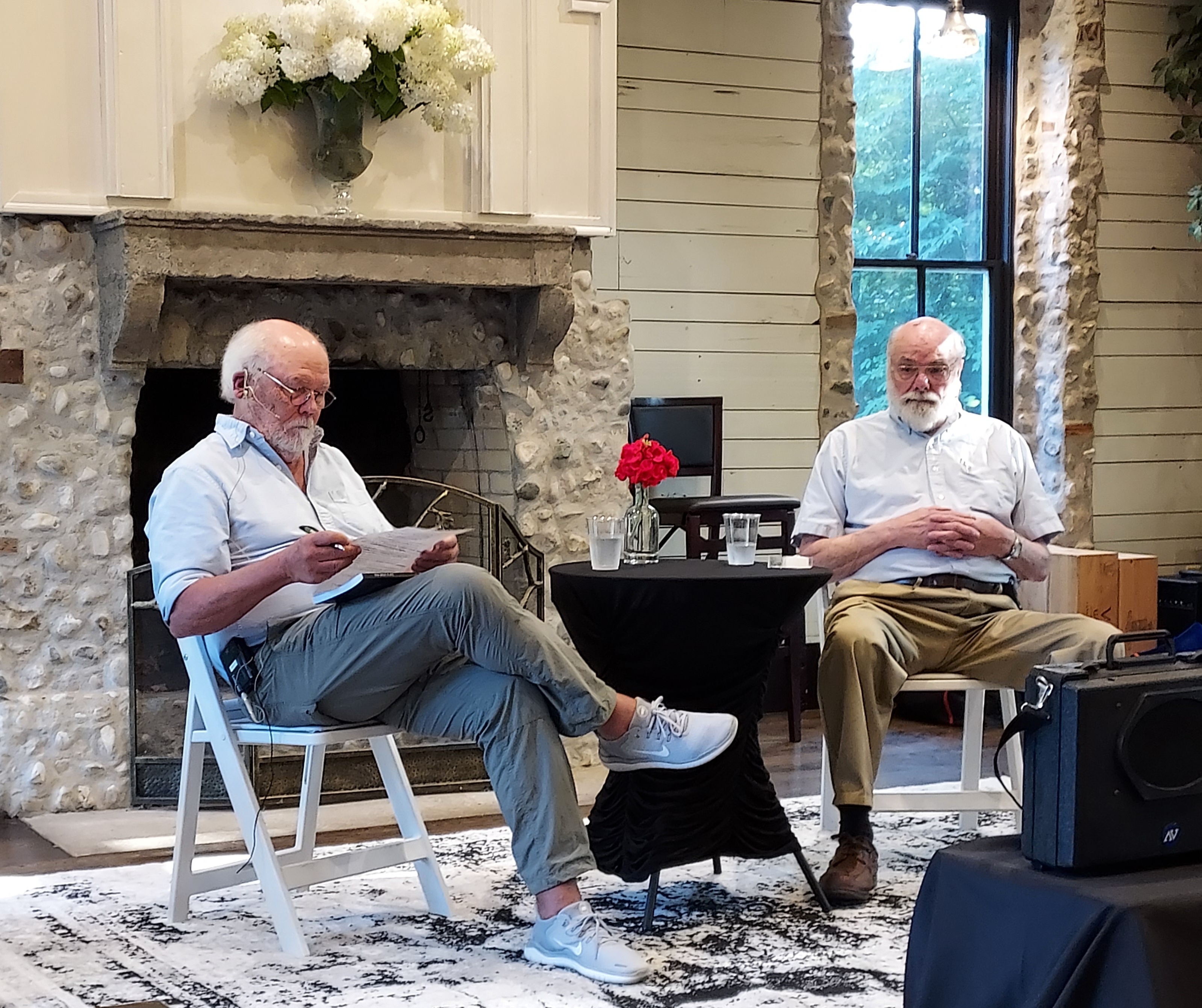
Tuesday evening was the last of four events in the Summer Writers Series sponsored by the Friends of the Leelanau Township Library, all held at the beautiful Willowbrook Mill in Northport. Featured author this week was Stephen Lewis, his latest book a historical novel set in 17th-century New England, From Infamy to Hope. 

Once more at the lovely
Willowbrook Mill - before the event

Stephen Lewis and sound guy Al Noftz - great silent exchange!

Author-interviewer Greg Nobles and guest author Stephen Lewis


Stephen Lewis pointed out that many of the issues of pre-Revolutionary America face us again today, the large, overarching one that of the separation of church and state. Anne Hutchison was found guilty of heresy, excommunicated, and banished from Massachusetts for daring to argue (intelligently) with Governor John Winthrop. Our Founding Fathers thought they had protected us from a return to religious autocracy, but time and the November ballot box will tell if their plan for our freedom will endure.


Meanwhile, Bookstore Daze


One day last week a little boy seemed entranced when given a bookmark to go in his newly purchased book. He told me solemnly, “I never had a bookmark before” and thanked me profusely. On his way out the door, he called back another hearty “Thank you!” Who would have thought such a little thing could make such an impression? His first bookmark!


On Saturday, when a woman asked me for a book of poetry with woodcut engravings, I pulled something right off the shelf that suited her to a T. “You made my day,” she told me, adding, “and I hope I made yours.” I replied, “Your saying that made my day!”


Then there was the man whose wife looked dubiously at the book he had selected and asked him, “Couldn’t you find it online?” Did she think it would be cheaper online? I kept my mouth shut. He bought the book.


When was it that I started reading Antifragile: Things That Gain From Disorder, by Nassim Nicholas Taleb? My reading was done in stolen moments between bookstore customers, so it took me quite a while, but it was a most satisfying experience! I was also quite satisfied to find for myself the exact quote from Henri Bergson that Taleb could not give word-for-word on page 308 of Antifragile. Taleb says he often “follows” what he calls “Bergson’s razor,” as if it is a rule, when actually it is a description of a lifetime search for clarity of an idea. What would these two have made of each other, Bergson and Taleb, had they been able to sit down over dinner for conversation? Thoughts like this, along with literary quests, keep my mind active – as does figuring sales tax in my head, which would be harder except that it's been 6% ever since 1993 when I started in business.


The very day after the foregoing thoughts, I discovered a copy of The Black Swan and dove into it, finding in the prologue another Bergsonian idea: namely, in Taleb’s words, 


What are our minds made for? It looks as if we have the wrong user’s manual. Our minds do not seem made to think and introspect…. Consider that thinking is time-consuming and generally a great waste of energy, that our predecessors spent more than a hundred million years as nonthinking mammals….


Bergson had this insight over a century ago. As active creatures, we did not evolve brains for metaphysics but for survival. Alas! Again I find no entry for ‘Bergson’ in the index to The Black Swan, which is a minor quibble but only goes to illustrate Taleb’s point that individuals who “got it right” are often not remembered for their prescient contributions when labels of “greatness” are being distributed ex post facto.


And as a matter of randomness, a random thought occurs to me about a woman who was just here looking for one specific title she hoped to find (always a long shot). She asked about it, and when told I had never seen that book, she left without so much as a glance at the books all around her – depriving herself of the opportunity to meet with the unexpected and wonderful. Some people are on such narrow missions (while on vacation!) that they deny themselves the possibility of serendipity.


But then there was the young woman who told her father, as he was paying for her book along with his own, “Libraries and used bookstores are the backbone of our country.” At my urging, she wrote her spoken words in my guestbook. When I sometimes feel discouraged, it’s good to read comments left behind by real book people. And really, I've had more words of appreciation this summer that ever before. "This is the highlight of my vacation," another customer told me, and that kind of mutual satisfaction makes my life's work worthwhile.


But now, without further ado, my Books Read list for July 2024. July is busy in the shop in Northport and busy at home in the yard, and while the days are long, there are never enough hours in them for reading, so these books are only #110 through #116 on my list for the year. 


Books Read, July 2024


Woolley, Edward Mott. Roland of Altenburg (fiction). Heir to the throne of a small European principality comes to America disguised as a commoner and falls in love with a young woman who is already engaged to someone else. No one knows the prince’s true identity. He is loathe to return to his constrained and formal life but must when his uncle, the reigning monarch, dies. Fast forward: The young engaged woman comes to visit Altenburg. Any reader can see that she and the prince will end up together, but who could have foreseen all the melodramatic cliff-hangers that precede the happy ending? Published inb 1904 by Herbert S. Stone & Co. in Chicago, my copy was printed by R. R. Donnelly & Sons, famous for their Lakeside Press editions. There are “classic” paperback reprints available online, but who would want one of those?


Patterson, Susan & Susan DiLallo with James Patterson. Things I Wish I Told My Mother (fiction). When I am buried alive in old books in Northport and have (beloved) weekend company and have, besides, a couple of editing jobs at home for understandably eager (not to say impatient) clients, I look for easy bedtime reading, and this novel filled the bill, although when I started reading it, I had been expected a memoir and was surprised by the style. Oh, well, it was very entertaining. Good way to end a summer day after an afternoon at the beach with my sisters. Can you say "minivacation"?


Hannah, Kristin. The Women (fiction). Hannah knows how to tell a gripping story and does so in this novel. The central character is a young woman who enlists in the Army to follow her brother to Vietnam, having not a clue what awaits her there. American re-entry after two tours of duty as a nurse is almost as traumatic as was her time “in-country,” but when she looks for help she is told over and over that “There were no women there”! This story could hardly have been told better if the writer had been through it all herself. It reads as though she had been.


Yourcenar, Marguerite. A Coin in Nine Hands (fiction). Is this a novel or a collection of interlocking short stories? The semirealistic setting is Rome in the eleventh year of Mussolini’s dictatorship. There is an assassination attempt. A ten-lira coin passes from hand to hand and links one character to another, sometimes tangentially, other times in more essential ways. Yourcenar, first woman admitted to the French Academy, also wrote Memoirs of Hadrian, an amazing fictional tour de force that no serious reader should miss.


Perelman, S.J. The Last Laugh (nonfiction). Ah, yes, the humor books of yesteryear! What wonderful comfort reading they make, especially when the writer is as witty as Perelman!


Adams, Katharine. Red Caps and Lilies (fiction). Historical fiction ‘romance’ (in the broad sense) was good bedtime reading during a busy, busy week. Remarkably light reading, considering the time period – the French Revolution! Also remarkable was the author’s ability to sympathize with both aristocrats and revolutionaries, though not with the Terror.


Taleb, Nassim Nicholas. Antifragile: Things That Gain From Disorder (nonfiction). Although my beloved Henri Bergson rates only the briefest of mention in Taleb’s book, I cannot overemphasize my fascination with and appreciation for the ideas expressed in Antifragile. It would have helped me in the early pages had I realized there was a glossary at the end of the book (I have not yet read Taleb’s bestselling earlier work, The Black Swan, and so was unfamiliar with much of his terminology), but I persevered and feel enriched and -- in a sense, in some aspects of my life – even vindicated by not only his insights into risk management, but also his expressions concerning the choices all of us make in our lives. Despite his analytic approach, this author does not believe that if something is legal (read, “not illegal”), nothing can be said against doing it. He believes in courage, and he believes in shame. What a breath of fresh air in these times of so many shameless cowards in public life! But read the book! Please! And/or any of his others, which I will be reading, also. 


For now, remember the idea of antifragility. (I wrote about books as antifragile in a previous post.) That idea pervades Taleb’s work, as duration pervaded the work of Henri Bergson, the philosopher who wrote, 


A philosopher worthy of the name has never said more than a single thing: and even then it is something he has tried to say, rather than actually said. And he has said only one thing because he has seen only one point: and at that it was not so much a vision as a contact: this contact has furnished an impulse, this impulse a movement, and if this movement, which is as it were a kind of swirling of dust taking a particular form, becomes visible to our eyes only through what it has collected along its way, it is no less true that other bits of dust might as well have been raised and that it would still have been the same whirlwind. Thus a thought which brings something new into the world is of course obliged to manifest itself through the ready-made ideas it comes across and draws into its movement; it seems thus, as it were, relative to the epoch in which the philosopher lived; but that is frequently merely an appearance. The philosopher might have come several centuries earlier; he would have had to deal with another philosophy and another science; he would have given himself other problems; he would have expressed himself by other formulas; not one chapter perhaps of the books he wrote would have been what it is; and nevertheless he would have said the same thing. 

― Henri Bergson, The Creative Mind: An Introduction to Metaphysics


Sunrise,


Sunset....

Friday, October 6, 2023

Please forgive me for going on and on about this.

Call this a spoonful of sugar.
 

Someone who read my previous blog post said that current political conflicts are nothing new and that they are “nothing that a simple healing patch of behavior can end.” Whoever suggested the divisions in our country could be ended with a Bandaid? Not I. There is no magic pill or, God forbid, silver bullet, either.


The hate-filled divisions are real and heartbreaking. The cruelty is heartbreaking. And yes, the seeds of division and hate have always been there, from the beginning of our history, and – let’s admit it – there is no way for all Americans to come together completely and permanently


Storm clouds!

Where does that leave us, though? Having faced that reality, what are our choices? What do we do now? 


- Continue to scream at each other and escalate the domestic arms race – until what happens? 


- Or give up and retreat into bitterness, each of us, for the rest of our lives? 


Please forgive me if I reject those as viable options. 


Let’s me make the question personal for myself. Who am I going to be for the remainder of my life on earth? Do I want, while alive, to add to the world’s storehouse of love or to its arsenal of hate? Will I be grateful for my life or choose to be miserable and blame my misery on evolution and world history? Take the most selfish view possible, if you like: As far as I see, it points in the same direction as altruism. 


Both sides now --


This morning (still dark, these long mornings of autumn’s waning daylight, and I am in the autumn of my life, too, my time growing ever shorter), it occurred to me that America’s present crisis is deepened, if not entirely driven, by grief. We have all experienced loss, and it hurts, and we don’t know what to do with that pain. Readers of this blog, as well as my close friends, know that personal grief has been with me for a while now. Grief. Shock. Paralysis. Disbelief. Mourning. Life torn apart, never again to be a shining whole, the companion of my days and nights forever gone. 


“He was my North, my South, my East and West,” wrote the poet Auden in his own grief. He ends his poem with, “For nothing now can ever come to any good.” Is that what you feel about your country? The world? Your life? 


(Had Auden been wrong, as he writes in this poem, to think that love would last forever? What do you think?)


For myself, I can’t afford to let myself feel that “nothing now can ever come to any good.” Two seven-year-old boys, great-grandsons of the man I loved, are at the beginning of their lives, as are so many little children whose lives are only now beginning. It’s too big a job, yes – I can’t control the course of the future, true – but I can’t give up and crawl into a hole and die, either.


I live in a beautiful place.


I realize that I am a lucky woman, spared the anger that many people suffer in the throes of grief. My husband was 85 years old and had followed his passion and found success as an artist. The beauty of his work lives on. The two of us had a second chance to make a rich life together, to make our dreams come true, even (priceless gift!) to grow old together. And at the end, we had time to say goodbye. So Fate spared me anger and resentment and gave me gratitude, and I am grateful to have had that through the grief his death brought. 


But despair? Heavens, yes! Grief goes on and on, and despair, while it doesn’t fill every hour, lurks around every corner, ready always (especially in those first, early, dark hours of morning) to jeer sarcastically, “What’s the point? Why bother? He is never coming back!” And that, my friends, is hard.


Like a wounded animal, I needed to be alone before I could face the world again, and I still need time alone even now, but already in those first weeks a demanding puppy did not allow me to stay in bed with my head under the covers, and once back in Michigan there was my bookstore to open, David’s gallery to arrange, grass to mow, the puppy to exercise and train. Looking back at May 2022 from October 2023, I see now that it was good for me not to have available the escape of total isolation.


Anger. Despair. Pain. What about exhaustion? Grief is exhausting. So much of life can be exhausting! The ongoing crisis mode of American politics is exhausting. So yes, we all need to take time out when we need to, when we can. 


And then? What?


Even under cloudy skies, with winter coming --

Whatever it takes. Whatever it takes not to give up, to keep living. Whatever it takes not to be cruel, not to be mean, not to seek revenge. A cat to feed, a dog to walk. Grass to mow, books to sell. Books and poems to read and write. Flowers and trees to plant and tend. Other people with their own griefs, who need an understanding listener as they struggle. Whatever it takes. One day, sometimes one hour at a time – which is the only way we ever truly live, anyway.


Not simple. Not easy. Often – let me say a challenge. (Let me say challenge rather than a struggle. Though either word is descriptive, I seek strength in choosing my words.) 


In every era, certain words get overused and lose their power in daily speech, but consider – amazing, awesome. The gift of life is one none of us had to earn. Human beings did not invent or build this glorious planet. Who, reflecting on the gift of life, can see it as anything less than amazing? Who, looking at the beauty and force and age of the universe, can see it as otherwise than awesome?


Unquenchable life!


Let me end today with an idea from my most-beloved philosopher, Henri Bergson. (Here is an interesting take on Bergson that I hadn’t read before but found congenial.) One of Bergson’s most basic and important insights was this: 


The “road ahead” (the future) is not there. 

We build our road as we travel through life.


My images today are from the world around me. Thanks for reading.


Always renewing.