Search This Blog

Showing posts with label book recommendations. Show all posts

Sunday, February 22, 2026

Going Places

Choosing a book is like choosing a road.


Going Places In Fiction


Mutual understanding in the world being nearly always, as now, at low ebb, it is comforting to remember that it is through art that one country can nearly always speak reliably to another, if the other can hear at all.

- Eudora Welty, Place in Fiction” 


I want to pause here after this sentence, written by Eudora Welty in an essay called “Place in Fiction,” because I want to call your attention to the first thirteen words: “Mutual understanding in the world being nearly always, as now, at low ebb….” This essay of Welty’s, which I encountered in a collection entitled The Eye of the Story: Selected Essays and Reviews, was originally published in 1957. The 1950s are generally portrayed as a time of calm prosperity in America, and yet Eudora Welty, a writer from Mississippi, would have had a front row seat from which to observe battles over school desegregation

yet another reminder that there is no short, simple answer to the question of what the Fifties were “like,” those years (as was true of the Sixties and any other era in the life of our country) having been different for different people in different parts of the country with different skin color or economic status. How much “mutual understanding” was there between the races, between regions of the United States in the 1950s? 


But let us return to Welty’s discussion of place in fiction: 


Mutual understanding in the world being nearly always, as now, at low ebb, it is comforting to remember that it is through art that one country can nearly always speak reliably to another, if the other can hear at all. Art, though, is never the voice of a country; it is an even more precious thing, the voice of the individual, doing its best to speak, not comfort of any sort, indeed, but truth.


Fiction, Welty writes in the middle of the following paragraph, “is properly at work on the here and now.” Even a historical novel must transport us to “the past made here and now,” and that is because for us to enter the world of the novel “we have to be there.” And so it is that “fiction is all bound up in the local.” 


A few of my friends become impatient with descriptive passages in fiction. They want action and accept dialogue only insofar as it advances plot. Not me. For me, whether in a short story or a memoir, classic novel or murder mystery, I take pleasure in the time an author takes to draw me into the locale of the story. Alan Paton’s Cry, the Beloved Country begins with a lyrical passage:


There is a lovely road that runs from Ixopo into the hills. These hills are grass-covered and rolling, and they are lovely beyond any singing of it. The road climbs seven miles into them, to Carrisbrooke, and from there, if there is no mist, you look down on one of the fairest valleys in Africa. About you there is grass and bracken and you may hear the forlorn crying of the titihoya, one of the birds of the veld. Below you is the valley of the Umzimkulu, on its journey from the Drakensberg to the sea….


- Alan Paton, Cry, the Beloved Country


Immediately we are in a specific place. Then, downhill from the grassy hills, he takes us to a different specific place.


The path is dropping into the red land of Ndotsheni. It is a wasted land, a land of old men and women and children, but it is home. The maize hardly grows to the height of a man, but it is home.


--It is dry here, umfundisi. We cry for rain.


--I have heard it, my friend.


--Our mealies are nearly finished umfundisi. It is known to Tixo alone what we shall eat.


The path grows more level, it goes by the little stream that runs by the church. Kumalo stops to listen to it, but there is nothing to hear.


The stream, dry for a month, does not run, and the women must walk to the river every day for water.


Kumalo is the individual through whose eyes we see his home, and when he makes the long journey to Johannesburg to search for his son and his sister, we hear the noise of the city through his ears and feel his confusion and fear. It is Kumalo’s truth, at home with his wife and in his meetings with other individuals in Johannesburg, that the novel allows us to see. 


It can take you somewhere you've never been before.


...For Book Reviews


Big news in the book world is the demise of The Washington Post’s “Book World” section, with its small number of fulltime reviewers and an ever-changing cast of guest reviewers. Was it reviewer Ron Charles who commented on NPR that there are now fewer fulltime book reviewers in the U.S. than the number of people who have walked on the moon? Whether fact or hyperbole, you get the point. As the number of newspapers shrinks, fewer and fewer of the surviving papers give any space at all to newly released books. Bestselling, big-name authors have the money of their publishing houses behind them because sales of their books keep the publishers alive, but what of small publishers, new authors, books that don’t fit neatly into a genre or niche with a loud and loyal fan base?


My customers and I trade recommendations.

Where do you learn about new books? I read reviews in the New York Review of Books (an article there persuaded me to read, at last, Larry McMurtry’s Lonesome Dove) and local publications, listen to reviews and interviews on NPR, read my daily “Shelf Awareness” newsletter, and make notes of books and authors recommended to me by my friends and bookshop customers and authors (overlapping categories). 


I look over the new arrivals at our local library. Also, as a dealer in used and rare books, as well as a reader of the old, I often follow up clues, learning of an author or a title in something I’m reading and then searching out the writers or work mentioned, which is what led me to Mary Webb’s Precious Bane


...In Books and Memory


Armchair travel! How I love it! Four decades or so ago, I was obsessed with the Arctic and sought out everything I could find about that part of the globe, particularly books written by women, such as Arctic Mood, by Eva Alvey Richards; Woman in the Polar Night, by Christiane Ritter; and Spring on an Arctic Island, by Katharine Scherman. There is a wealth of armchair travel available in fiction, too, and I have loved visiting on pages of books lands I will never see in person. Thanks to reading, I have also “owned” horses!


I thought of them fondly as mine.

My memory travels are made possible by daydreams, old journals, photo albums, even by digital images stored on my phone. Looking this morning at images from three years ago in Arizona, I thought for the first time that, odd as it may sound at first, Arizona gave me something of what I longed for in my Arctic dreamsa challenging environment. The Arctic would have given me the challenge of cold and treelessness. Cochise County challenged me with relentless sun, with dry, thin air (thinner with every hundred feet of altitude), primitive roads beneath my tires, and loose, unstable gravel and rock underfoot. There were times when my endurance was tested.


Solo destination was more challenging than photo portrays.


While my yearning for the Arctic has evaporated with age, I am sometimes “homesick” for the Chiricahua and Dragoon Mountains, and reliving hikes with friends and dogs is a pleasure I feed by (besides my own writing and photographs) reading books set in the area, such as stories of Cochise and the Chiricahua Apaches, as well as J.A. Jance’s Sheriff Joanna Brady series. 


“Were you homesick for Michigan when you were in Arizona?” a friend asked. “No,” I said, “I didn’t have to be, because I knew I would be back.” Every winter in Arizona, on the other hand, was a gift I knew might not be repeated, and indeed my last winter in the ghost town was 2022-23, but I remain grateful to have had my time there and for the friends I made.


...At Home in Michigan!


“We live in a beautiful place,” the Artist used to say often, and since he’s been gone I’ve made that remark frequently to Sunny Juliet, as my dog rides shotgun with me in Leelanau County.


With dog on Michigan back road -- heaven!

Michigan’s two green peninsulas, their lakes, rivers, creeks, fields and hills, sandy beaches and rocky shores—my family fell in love with Michigan when we came camping in a heavy old canvas umbrella tent, back when I was 12 years old, and it has been my great good fortune to call Michigan home for decades since. 


What do you look for in a companion? Common values, interests, background? Sharing a love for Michigan, both the familiar places and those not yet explored, is essential to me. Then, please, let him be a woodsman. Well, okay then!


Monday, November 21, 2022

Books, Grief, Hope, and Holidays

How I live now....

Desert nights are cold, already down in the 20-degree range, and for the last two nights high winds have been battering the cabin. Saturday morning was sunny, calm, still. A good morning for a walk. Sunday was a different story, with the wind continuing relentless throughout the bright daytime hours.


No one sleeps well here on windy nights, and in what my mother always called the “wee hours,” when I would turn on the light and pick up a book, Sunny would bring me a toy and nudge me to engage in play. She can be as relentless as the wind! So I would indulge her with a little gentle wrestling on the bed and tell her she’s a good girl before picking up my book again (though often I added to myself, “Not really,” if she had trouble settling down again so I could read myself back to sleep).


And now for that long-neglected topic, books. Since I haven’t given a list of the recent books I’ve read for a while, I’ll annotate today’s to help you decide whether or not you might want to read any given title.


112. Hill, Grace Livingston. The Enchanted Barn (fiction). One of my early bookstore customers, back in 1994, was a big fan of Grace Livingston Hill and told me that Hill was a Michigan writer. I have been unable to find a Michigan connection, however, and in my bookstore no longer shelve Hill in the Michigan section. While her books are generally categorized as Christian fiction or Christian romance, religion is presented gently, as are the characters’ struggles, and The Enchanted Barn is a good example. Much as did the author herself, the main character is working to support her mother and siblings (in Hill’s own life, she had children to support from two failed marriages, in addition to her mother) and struggles to keep from becoming discouraged by poverty, to find a way to a better life. Where the story will end is obvious early on, but the details of the family’s move to the country, planting gardens, and making their home in an old barn make for a charming fictional escape from modern life. The Enchanted Barn was published in 1917. 


113. Gibbon, Lewis Grassic. Cloud Howe (fiction)

and 114. Ibid. Grey Granite (fiction).

These are the second and third titles in the author’s trilogy, A Scots Quair, which I have written about previously, novels that can only be considered “escape” in the sense that one is immersed in intriguing and sometimes lovely language because, other than that, they share with most of classic literature a clear-eyed confrontation with the hardest aspects of life. Here we see poverty not simply as one family’s temporary situation but the grinding poverty of workers in general, generation after generation, as they are caught up in the social and economic forces of history, and the author provides no deus ex machina to bring about a happy ending. But these are books (along with the first of the trilogy, Sunset Song, its story beginning in 1911) that deserve to be much more widely read and known, definitely worth a reader’s time, and I would add worth reading more than once.


115. Bythell, Shaun. Seven Kinds of People You Find in Bookshops (nonfiction). If I’m being honest – and what’s the point of being otherwise? – I have to say I was disappointed with this one. A very slim volume, it comes off more like a lengthy magazine assignment than like a continuation of the author’s delightful Diary of a Bookseller and Confessions of a Bookseller. Perhaps it was a case of a publisher pushing a writer to take advantage of previous success by getting a new title out too soon. I don’t like to say that -- and wish my impressions of Seven Kinds had been different -- but there you are. Bob’s your uncle.


116. Deutsch, Jeff. In Praise of Good Bookstores (nonfiction). Obviously not a book rushed into print, this one is worth reading carefully and lovingly, as any lover of books and bookstores will. The bookseller-writer makes a case for bookstores as something distinct from retail business. His primary example, the unabashedly scholarly Seminary Co-op Bookstore in Chicago, went from a cooperative model to a nonprofit model in 2019 (after many years of having paid no dividends), and Deutsch says the nonprofit model acknowledges the store’s “financial realities” and its privileging of “cultural value over financial dividends.” Browsing here is raised to a new level. 


While I would love to browse this store, I am not convinced that nonprofit status is the only way forward for bookstores. Seeing socks for sale in a bookstore bothers Deutsch. It doesn’t bother me. I don’t sell socks myself but have no problem with other booksellers who use such items to enhance their slim profit margin, as long as they are also stocking good, important books. Most of us in the used book trade realized early on in our eccentric “careers” that following our calling (because I agree with Deutsch that it is a calling) would demand certain financial sacrifices, and for us no price can be put on our independence, so I even wonder if a nonprofit model, with all the record-keeping and particular laws governing that model, might not put a crimp in my independence. But the book – yes, I do recommend it. 


117. Leiris, Antoine. You Will Not Have My Hate (nonfiction). The Eiffel tower on this book’s cover made me reach for it. It is broadly classifiable in the category of books on grief, a category in which I have read more extensively this past year than ever before – but with a difference. The author’s wife not only died suddenly but was murdered, gunned down in the terrible scene of mass violence at the Bataclan Theatre in Paris in 2015. The title of the book comes from something Leiris posted on the Internet, refusing victory to the killers. His book is a behind-the-scenes account of that night and days and nights following, as he had to go on with life for the sake of his very young, now-motherless son. 


118. Hill, Jemele. Uphill: A Memoir (nonfiction). An interview with Jemele Hill on NPR prompted me to buy this book. Careers in journalism are very different from life as a bookseller but also focus on words and writing. Hill is from Detroit, therefore a Michigan author. Perhaps the fact that she is a sportswriter made my choosing this book surprising because, in general, I could not care much less about sports, but Hill has always gone beyond sports in her career as a journalist, and her social insights and opinions fascinate me. (When asked to write an opinion column, she wondered why anyone would care about her opinions and was astonished by how deeply her readers cared.) Also, along the way, I picked up a couple of wonderful uses of contemporary Black English, one I’d seen before on a friend’s Facebook posts, the other a new word to me: “Ride or die” was the phrase; caucasity the new word I learned. Brilliant word!


119. Barry, Jane. A Time in the Sun (fiction). This one, like the nonfiction Empire of the Summer Moon, was a book that I both wanted and didn’t want to read. Western frontier history, whether fictionalized or not, is brutal – and often, to make it worse, it is inappropriately romanticized or has a political axe to grind, so wariness is my byword. Barry’s book, as it turned out, was of particular interest to me, as the story was set in southeast Arizona, from Apache Pass (between the Chiricahua and Dos Cabezas mountain ranges) up to Fort Grant and over to Tucson. It is hauntingly well written. Of course, it ends in tragedy, for the Apaches and for more than one of the white characters, but what else could you expect? It is worth reading, both for the historical perspective, diversity of characters, and for the lyrical writing.


120. Solnit, Rebecca. Hope in the Dark: Untold Histories, Wild Possibilities (nonfiction). This book of essays is a re-issue, and re-issuing it was a good idea. Solnit’s message is that those “in love with despair” or so given over to pessimism and cynicism that they answer any bit of good news with “Yes, but –” is that there is good news, along with the bad and that it’s important to keep hope alive and celebrate victories even while continuing to fight for a better world. Hope in the Dark is a tonic, good for what ails many of us from time to time. 


And finally --


121. Penny, Louise. A Better Man (fiction). Many of my friends and bookstore customers are devoted fans of Louise Penny’s Inspector Gamache mysteries, and yet somehow I had never gotten around to reading any of them. There it was, though, on Margaret’s counter at Readers’ Cove in Deming, New Mexico, and the time seemed right. (Note: I seldom begin to read a mystery series with the first book. Instead, whatever title comes my way is where I dive in.) And now, count me as a fan of Inspector Gamache, especially of his three questions to ask oneself before speaking: Is it true? Is it kind? Does it need to be said?


So there are the books that kept me company from Michigan to Arizona. For me, the company of books has always been essential and never more so now that my only daily companion is a very vocal but not at all verbal 11-month-old puppy. 


The Artist remembered at Source of Coffee in Willcox, AZ

This morning, doing errands in Willcox, I was struck by all the places the Artist and I used to go together. In fact, nowhere did I go that we had not gone together, and every mile of the road between the cabin and town is a mile we traveled together countless times. It was – difficult. But everywhere I went, when paying for a purchase I made a point of saying, “Happy Thanksgiving” to the cashier, because while holidays can be particularly challenging for those of us who have lost a beloved partner, whenever I think (as I so often do), There are ghosts everywhere, in Arizona as well as in Michigan, I have to stop and remind myself that there are friends in both places, too, and that I have much for which to give thanks. 


Happy Thanksgiving, friends! A what have you read lately that you want to recommend?


Also how I live -- and always will.


Wednesday, August 19, 2020

I Want to Share Some of My Favorites With You

Summer Woodland, Michigan
Okay, you know I’m a devoted re-reader of my favorite books. I’ve said it often enough, and you've heard it before, so blah-blah-blah, yadda-yadda. What, however, does personal re-reading mean to me as a bookseller?

Come on in and browse!
Well, my old favorites are one reason I began my bookselling career in used books, and it’s also a reason why, when I am putting together an order for new books – things customers have asked me to get for them, as well as new titles I believe will appeal to my clientele – I often check to see which authors and titles I’ve loved are still in print so I can share them with my Northport public, locals and visitors.

For example, I’m always re-ordering Betty Smith’s A Tree Grows in Brooklyn because – well, it is a beautiful story, told with elegant simplicity, wonderfully accessible, and it also offers a window into an early time in our nation’s history, with horse-drawn peddler wagons, singing waiters, tenement buildings without elevators, and much, much more, all seen through the wide eyes of a young girl. It is a coming-of-age story, not a children’s book, and one I would list as an American classic. Have you read it yet? – A young woman came in as I was writing a draft of this post and asked if I had the book! It should arrive today! She’ll come back! This is the kind of thing that makes me so glad I am a bookseller!

Monarch time
Mark Rashid is a very different kind of author, and his nonfiction books are worlds away from fictional Brooklyn. Since I’ve written extensively about him already, I only want to say today that I am expecting delivery of a couple more of his books soon – and that you don’t have to have a horse (though how I wish I did!) or be training a horse, and maybe you don’t even have to be horse-crazy, to get a lot out of Rashid’s anecdotes and lessons about working with horses. When I read about Rashid working with horses, I am flooded with a feeling that the world is beautiful, not only because it has horses in it (see the poem by Alice Walker – and I need to re-order that book, too!) but also because there are good, decent people in it like Mark Rashid.

Now for another switcheroo: from fiction to horse training to interpersonal communication. Does the name Suzette Haden Elgin mean anything to you? I have handled and recommended and sold many copies of her original book, The Gentle Art of Self-Defense, which I absolutely love because it teaches us (1) how to recognize sneaky, indirect verbal attacks and (2) how to deflect the attack without going on a counter-attack. Brilliant! I don’t have that first title in stock and couldn’t order it new, but thank heaven The Last Word on the Gentle Art of Verbal Self-Defense was not the last word, because here are books I was able to stock, and I think the one on …Communicating with Kids will be one all parents will want to reference. 

Defend yourself gently without counter-attacking

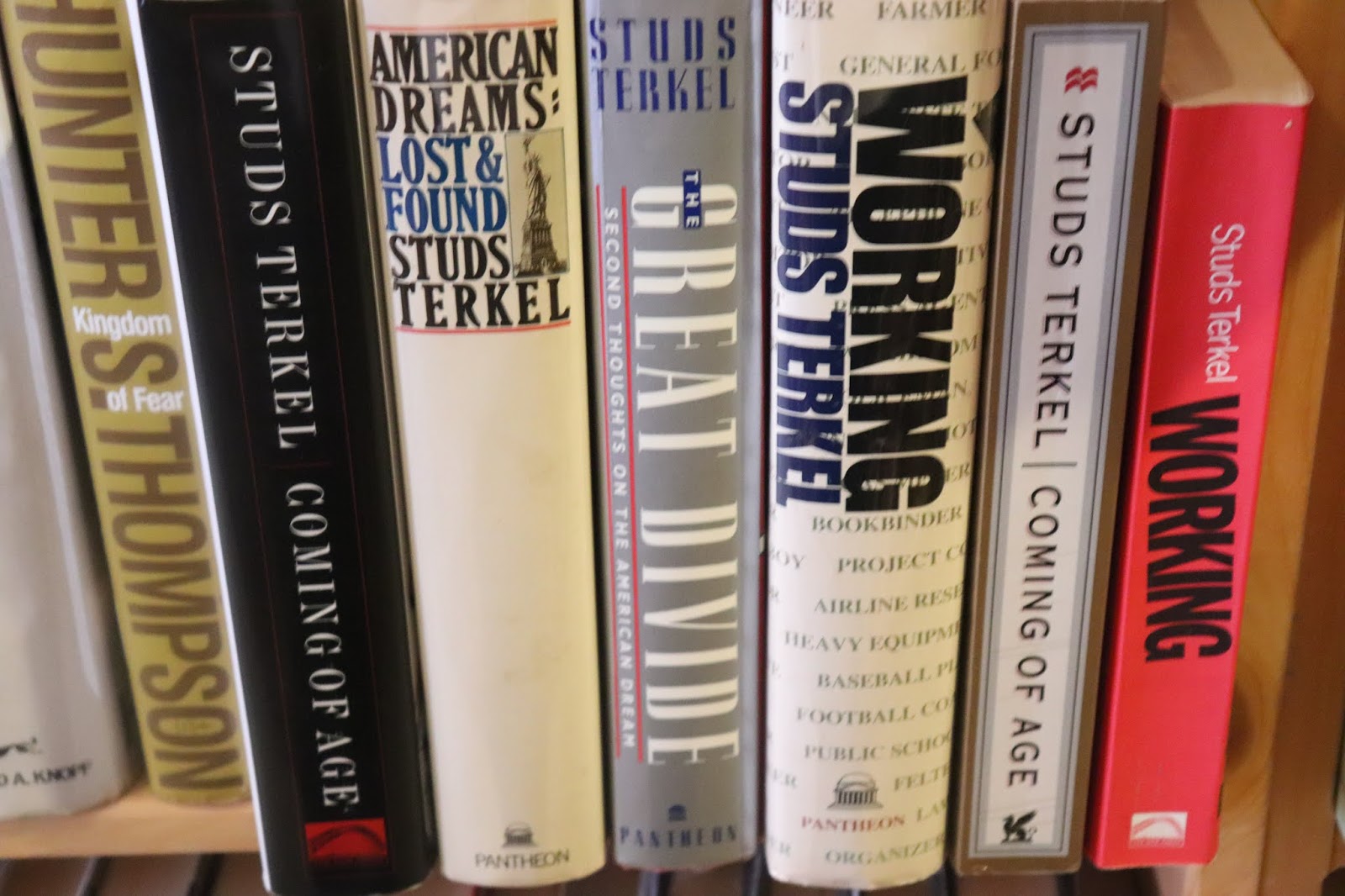
But a full and complete discussion of books I’ve read more than once and highly recommend would be a book in itself. Do you live in or live elsewhere but love Michigan? If so, and you have yet to read Bruce Catton’s history of Michigan and his memoir, Waiting for the Morning Train, put those on your list today! What about anything by Studs Terkel? All his books of interview with Americans, on a variety of subjects, are worth your time. 

Michigan's own Bruce Catton

Chicago's own Studs Terkel

Mildred D. Taylor’s novels are too good to be restricted to YA readers. Historians and lovers of good essays should not miss books by Tony Judt. If I were to begin listing books from the past decade alone, we would be here all day, though, and I know you have other things to do. Whatever you read, do make time for reading, because especially in this glorious summer of our discontent, getting lost in a good book (outdoors if possible) is good medicine for us all. As for me, I'm happy to realize that my bookshop is a Treasure Island, and if you are a booklover and know how to browse, you will never have to leave empty-handed. Only this morning, a repeat customer from Wisconsin told me, "The best part of the trip is coming to this bookstore." 

Just before this morning opening "bell"

But now -- oh, my goodness, the UPS delivery came! Another box of treasures have arrived!

And we are off to the races!


Friday, June 14, 2019

Tree-Hugger Travels

[Re 'tree-hugger' - Since the term is so often used as an epithet, I've decided to embrace it as part of my identity.]

You’d think I’d have had enough road travel to last a while, having settled back home less than a month ago after another Odyssean cross-country adventure stretched out over nine grueling days. But that was just the trouble: by the time we got to southern Michigan we were feeling the bite of the calendar urging us homeward, with the result that I had nowhere near enough time there with my son and none at all with a couple of my oldest friends.

One of the best things about June, though, is the length of the days, long enough that even someone who on the job until 5 p.m. can set out after work and have hours of daylight driving time. So that’s what I did last Saturday — and had a beautiful, sunny trip over the rivers, through the woods, and across the counties of Michigan from Leelanau to Kalamazoo.

Dark was falling by the time I arrived at the home of the friends who had offered to put me up, and by morning the rain had arrived. My friends’ home is surrounded by woods. The sky was overcast. All day long, therefore, morning, afternoon, and evening, the light was the same, a murky, underwater green, overabundant foliage pressing in like tangles of seaweed or like a jungle intent on devouring everything human. Mayapples were happy, though, and azaleas and peonies in riotous bloom. And it was ideal weather for sleeping late and catching a nap later on still.

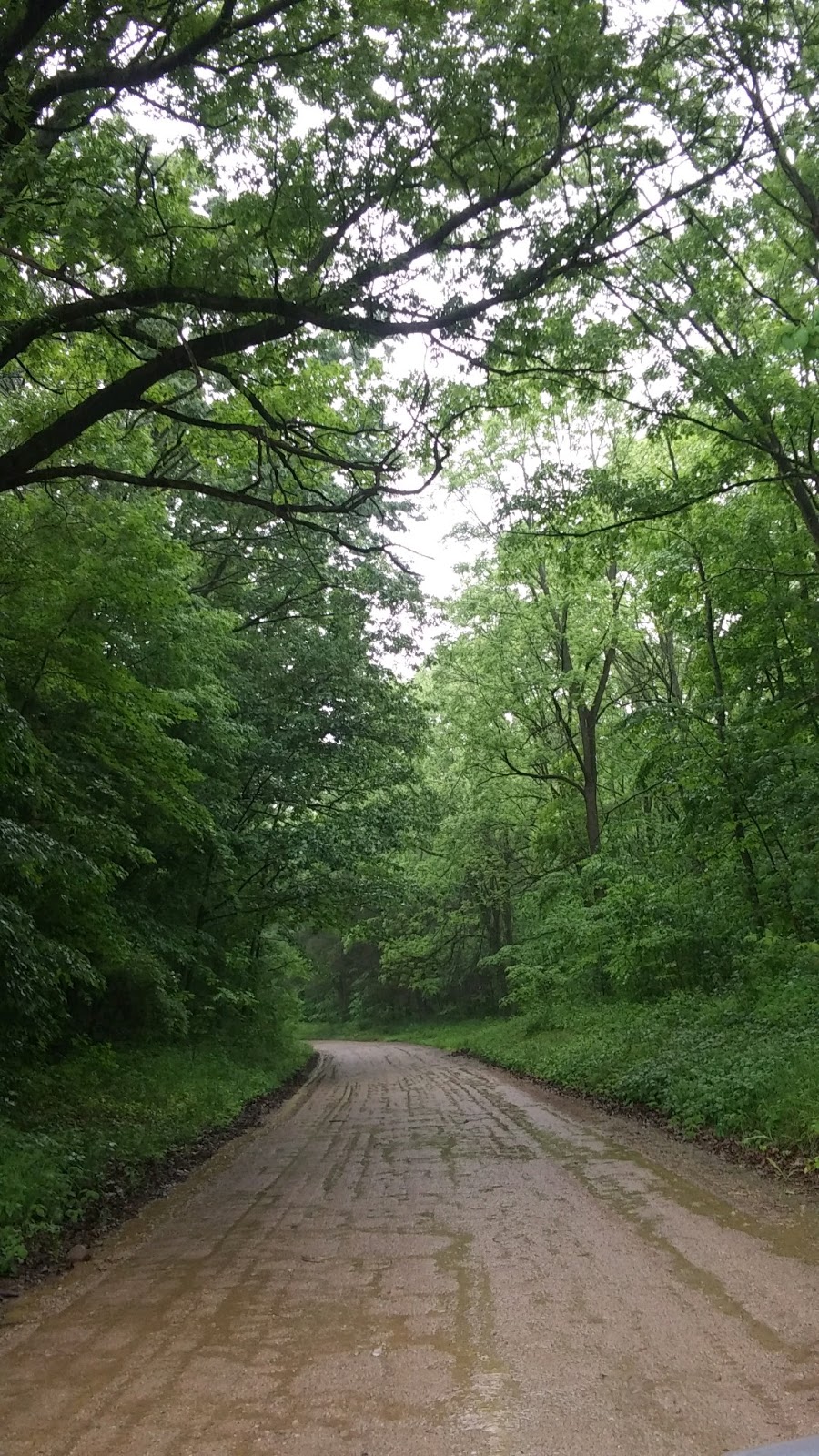
When I was fully conscious at last, my son took me out to breakfast downtown at the very hip and trendy Food Dance. It’s a Kalamazoo institution, I’m told, though I’ve been gone so long that it was new to me. After our leisurely breakfast, we left town behind to venture up into Barry County, aiming first for our old farmhouse to see how tall the pine trees had grown. We continued north after that stop and proceeded to lose ourselves for at least half an hour — and maybe a full hour, because we lost track of time, too — on Barry County back roads. We wandered slowly and wonderingly through old forest, past secret, hidden-away lakes and ponds and wetlands, all of it undeveloped land, much of it open to public hunting. At one point a great blue heron swooped low across the road in front of us, followed minutes later by a flash of oriole. The forest was tall and far-reaching, without cabins or paths other than the roads that would around and around and uphill and down dale. It was a magical world, and we were under its spell. 


Before starting back on Monday I visited other friends, and their old country home too was wild with vegetation. Trees I remembered as new plantings had shot up like green and blue-green skyscrapers, the view of the lake across the road had almost vanished behind a thick screen of maple branches, and in the gardens out past the dining room windows, shouts of color brought hummingbirds.

After all my forest visitation, I could not face the high-speed expressway maze through Grand Rapids and chose instead to come back north closer to the Lake Michigan shoreline, from Kalamazoo to Allegan to Holland and north past Grand Haven and Pentwater. Old, familiar paths and names. Beautiful, overflowing rivers. A pair of young steers running and frisking in their pasture. Two horses standing with their rumps to the road, tails swishing flies away. A turtle crossing the pavement between one pond and another. These were paved roads, but they were roads less traveled nonetheless. 

I thought a little bit about the perennial question of where Downstate leaves off and Up North begins. Which is Holland? Which is Muskegon? What about North Muskegon? But quickly my thoughts turned to more general musings, i.e., what a wonderful state Michigan is from north to south and west to east. Prairies, farm fields, pastures, orchards — forests, shorelines, and dunes — lakes, ponds, and wetlands — a lifetime of exploring will never be enough to experience it all. 

Two book recommendations for today, reflecting my recent travel and reflections on the state of Michigan, come to you from your bookseller here in “Treeland” Up North. They are:

The Overstory, a novel by Richard Powers with characters whose lives are affected in one way or another by the great trees and forests of the United States;

and 

The Marsh King’s Daughter, by Karen Dionne, a novel set in our own beloved, wooded and wild Upper Peninsula.


Thursday, January 17, 2019

Reading in Place


The roadrunner has a rather drab dress of indiscriminate pattern. The feathers are dark brown laced with white, and the tail has a greenish tinge. His wings are stubby, their principal function being to increase the speed of his running should he be in a hurry. His eyes are encircled with rings of an orange color. When he pauses to look at you, he opens his mouth, the crest atop his head rises; the impression is left that the sight of you has brought upon him a condition of great astonishment and shock. Then, recovering quickly from his near collapse, he will go jauntily on his way. -  
- Herbert V. Young, Water By the Inch: Adventures of a Pioneer Family on an Arizona Homestead

Despite several excellent books begun and not yet begun, recommended and picked up on impulse, it is books having to do with the Southwest that take priority right now. I vowed to get back to The Frontier in American History, waiting for me on the little table between our two reading chairs (finally finished that book, begun many weeks before in 2018, two weeks into 2019), and then was seduced at the library by Water By the Inch, with its memories of the desert around Phoenix before urban and suburban development, tales of moving cattle on horseback, digging and falling down wells, close calls with rattlesnakes, and a happy family with five children living in a two-room shanty without running water. Before that there was Voice of the Borderlands, poetry sometimes sweet, sometimes harsh, but always evocative, vignettes narrating the lives of cowboys and horses, rodeos, cattle drives, drug runners, desert deaths, and the dying of old ways. My gratitude for the sun’s warmth I found contained in the Mexican description of “el sobre de los pobres,” the overcoat of the poor,, and I alternated my reading of Drum Hadley’s soul-searing poetic narratives with a novel by Phyllis de la Garza, Railroad Avenue, set on the familiar streets of Willcox, long before those streets were paved. One of the winter’s first temptations, however, had come with My Heart Lies South, irresistible to me not only for its Mexican setting but also for the author’s signature on the inside front cover, along with an indication that one of the book’s previous owners had been Helen Riggs, from an important ranching family down Chiricahua way. You’ll see that book listed in my 2018 Books Read list.


And now, continuing my latest Arizona desert reading, I am deeply grateful to have discovered the nature writing — and much more — of Ken Lamberton. 

I look to the stars for confirmation that I’m not stuck in one place. From one hour to the next I can tell by marking the counterclockwise motion of Ursa Major that the earth moves beneath my feet. I’m spinning with it at 700 miles an hour. From season to season I can feel the earth coursing against a backdrop of constellations, summer’s Scorpio and winter’s Orion. I’m circling the sun at 66,000 miles an hour, a million and a half miles a day. I am not in prison; I am a traveler. I am a galactic tourist, visiting the sun and moon and gas giants. I watch the universe pass by from the window of this fenced plot of ground. I should have motion sickness.  
- Ken Lamberton, Time of Grace: Thoughts on Nature, Family, and the Politics of Crime and Punishment (2007)

In fact, Ken Lamberton was in prison, serving a 12-year sentence as a convicted sex criminal. In his late twenties, a veteran five-year teacher and married father of two (with a third on the way), he had fallen for one of his eighth-grade students and run away with her, presumably to “start a new life,” according to fantasies governing the relationship — on both sides — at that time. Lamberton coped with prison by continuing to read, write, and teach. He was remorseful and desiring of forgiveness but understood that his remorse could never change the past and that forgiveness might never come, especially from his wife, the person he had hurt the most and by whom he most desired to be forgiven. 

In the pages of this, his third book written and published during his incarceration, it seems almost as if his wife, Karen, suffers more from being married to a convicted sex criminal than Ken does from being in prison. Karen also found productive ways to cope with the consequences of her husband’s betrayal, going back to school and earning a paralegal degree, as well as a B.A. in political science. She was hired by a Tucson law firm. She sued the Department of Economic Security and won not only her initial class action lawsuit but prevailing over the six years of appeals against her by the State of Arizona. She visited her husband regularly, bringing their daughters as often as possible. His relationships with the girls seem good, despite the odds. 

And yet, prison exacts a grievous toll on the marriage. 

Readers new to Lamberton’s work, as I was, may be surprised by how much of his life in prison focuses on nature and wildlife, though it was nothing new for him. His book Wilderness and Razor Wire was awarded the John Burroughs Medal for outstanding nature writing in 2002. In Time of Grace, he notes carefully and almost compulsively the annual visitations of various courting and migrating birds and insects and the blooming and leafing-out of trees, emergence of ground plants, sightings of tadpoles (after the rains), a brooding mother duck, many bats, and once, excitingly, a ringtail. Snakes, butterflies, even flies or a broken eggshell — nothing in the natural world is beneath his notice, and everything in his walks around the perimeter of the yard contributes to his sanity.

…I adjust my calendar to the metronome transgressions of birds. For now, they cue me to after summer’s ebb: shorter days as the desert gradually cools and dries. Grasses beyond the perimeter fence bleach and go to seed under scattered cholla cacti, tiaras of light caught among their blond spines. 

But Lamberton is no disembodied angel behind the razor wire. Acutely aware of his own sins, he is no less blind to the sins of others, whether they be wardens, prison guards, wealthy and politically powerful unpunished criminals, or American society at large. It would be difficult to read this book and not be angry at the widespread injustice Lamberton recounts. Not, I add, that he feels his sentence was unjust. No, he says he deserved it. But he sees that the system is not geared basically toward justice at all. In his “Author’s Note” at the book’s beginning, he writes:

Like many people, I believed the justice system was a vehicle for truth. I discovered that truth is irrelevant and politics is not, that our adversarial system favors the affluent, that judges have become redundant, that a plea bargain is not a compromise but a surrender. That justice is a contest with winners and losers…. I also discovered that prison is a society  with a caste system based on the types of crimes committed and those ranked a the top — murderers, drug offenders, gang members — prey on those at the bottom . . . and I was at the bottom. 

And yet, as important as the revelations of injustice — is it wrong of me to see it this way? — are the author’s views of the natural world around him and the beautiful language in which they are expressed. So whether your interest is in law, prison reform, natural science, or literature, this book will command your attention from the first page to the last. I’ll go further and say that this would be an excellent choice for a book club, particularly if members of the group come to discussion with some diversity of experience.