Search This Blog

Showing posts with label forests. Show all posts

Friday, June 14, 2019

Tree-Hugger Travels

[Re 'tree-hugger' - Since the term is so often used as an epithet, I've decided to embrace it as part of my identity.]

You’d think I’d have had enough road travel to last a while, having settled back home less than a month ago after another Odyssean cross-country adventure stretched out over nine grueling days. But that was just the trouble: by the time we got to southern Michigan we were feeling the bite of the calendar urging us homeward, with the result that I had nowhere near enough time there with my son and none at all with a couple of my oldest friends.

One of the best things about June, though, is the length of the days, long enough that even someone who on the job until 5 p.m. can set out after work and have hours of daylight driving time. So that’s what I did last Saturday — and had a beautiful, sunny trip over the rivers, through the woods, and across the counties of Michigan from Leelanau to Kalamazoo.

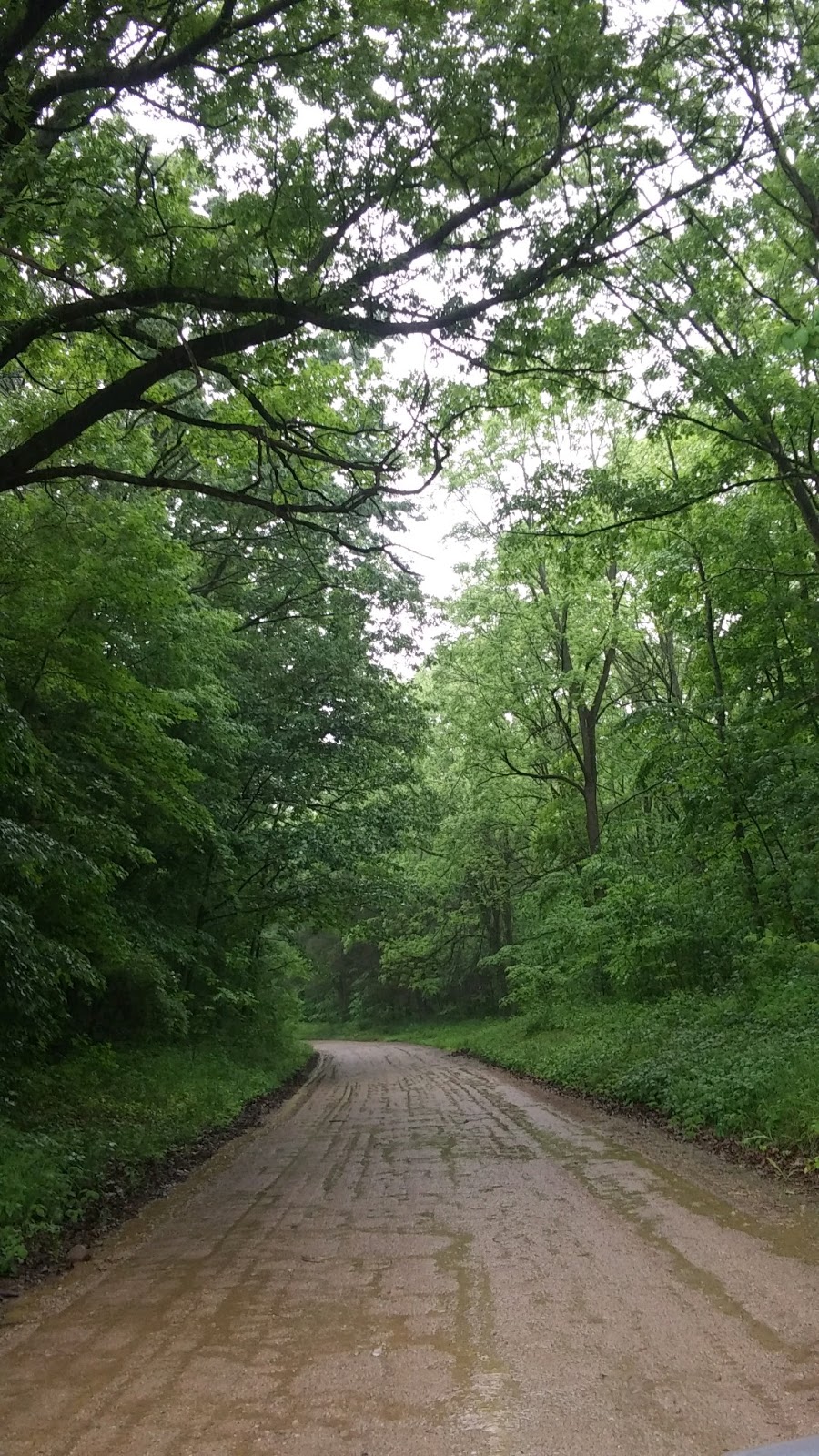
Dark was falling by the time I arrived at the home of the friends who had offered to put me up, and by morning the rain had arrived. My friends’ home is surrounded by woods. The sky was overcast. All day long, therefore, morning, afternoon, and evening, the light was the same, a murky, underwater green, overabundant foliage pressing in like tangles of seaweed or like a jungle intent on devouring everything human. Mayapples were happy, though, and azaleas and peonies in riotous bloom. And it was ideal weather for sleeping late and catching a nap later on still.

When I was fully conscious at last, my son took me out to breakfast downtown at the very hip and trendy Food Dance. It’s a Kalamazoo institution, I’m told, though I’ve been gone so long that it was new to me. After our leisurely breakfast, we left town behind to venture up into Barry County, aiming first for our old farmhouse to see how tall the pine trees had grown. We continued north after that stop and proceeded to lose ourselves for at least half an hour — and maybe a full hour, because we lost track of time, too — on Barry County back roads. We wandered slowly and wonderingly through old forest, past secret, hidden-away lakes and ponds and wetlands, all of it undeveloped land, much of it open to public hunting. At one point a great blue heron swooped low across the road in front of us, followed minutes later by a flash of oriole. The forest was tall and far-reaching, without cabins or paths other than the roads that would around and around and uphill and down dale. It was a magical world, and we were under its spell. 


Before starting back on Monday I visited other friends, and their old country home too was wild with vegetation. Trees I remembered as new plantings had shot up like green and blue-green skyscrapers, the view of the lake across the road had almost vanished behind a thick screen of maple branches, and in the gardens out past the dining room windows, shouts of color brought hummingbirds.

After all my forest visitation, I could not face the high-speed expressway maze through Grand Rapids and chose instead to come back north closer to the Lake Michigan shoreline, from Kalamazoo to Allegan to Holland and north past Grand Haven and Pentwater. Old, familiar paths and names. Beautiful, overflowing rivers. A pair of young steers running and frisking in their pasture. Two horses standing with their rumps to the road, tails swishing flies away. A turtle crossing the pavement between one pond and another. These were paved roads, but they were roads less traveled nonetheless. 

I thought a little bit about the perennial question of where Downstate leaves off and Up North begins. Which is Holland? Which is Muskegon? What about North Muskegon? But quickly my thoughts turned to more general musings, i.e., what a wonderful state Michigan is from north to south and west to east. Prairies, farm fields, pastures, orchards — forests, shorelines, and dunes — lakes, ponds, and wetlands — a lifetime of exploring will never be enough to experience it all. 

Two book recommendations for today, reflecting my recent travel and reflections on the state of Michigan, come to you from your bookseller here in “Treeland” Up North. They are:

The Overstory, a novel by Richard Powers with characters whose lives are affected in one way or another by the great trees and forests of the United States;

and 

The Marsh King’s Daughter, by Karen Dionne, a novel set in our own beloved, wooded and wild Upper Peninsula.


Monday, February 15, 2016

Another Wild Spirit


Dog Man: An Uncommon Life on a Faraway Mountain
by Martha Sherrill
NY: Penguin, 2008

What did I expect when the title Dog Man caught my eye? Some yeti-like legend of northern Michigan? Perhaps at first glance, but when I picked up the book that expectation had to be quickly discarded. The dog man of the title was an Akita breeder in the snow country of Japan.

So, a tale of dogs set in the North -- much more appealing....

At home I began reading and found the book once again exceeding expectations, taking me not only far from home but back in time and to a part of Japan that was itself far behind the times in Tokyo and other large cities. Dog Man is as much about the man’s wife, Kitako, and their life together as it is about Morie and his dogs. The couple marry in 1940 in a Shinto ceremony held at the grand former residence of General Maresuke Nogi and his wife, 

held as paragons of virtue for killing themselves on the evening of Emperor Meiji's funeral.

Immediately after the wedding, Morie and Kitako, a 20-year-old city girl raised all her life in comfortable circumstances (she is college-educated with a teaching degree), set off on a 22-hour train ride to the north where Morie was raised. Kitako feels out of place in the midst of Morie’s big, noisy family (he is the youngest boy in a family of five boys and five girls) but is even more confused by the snow country itself and its primitive isolation, far from the nightclubs of Tokyo.
...”Where do we go tonight?” she’d asked Morie, who looked at her with an expression she didn’t understand. It was so cold—still winter, with snow everywhere, as though spring was hesitant to arrive in such a serious place. And so dark—no streetlights or city lights, nothing but black sky and looking black mountains.
To Kitako’s dismay, Morie turned down a job in Tokyo, choosing instead an assignment in distant Manchuria, then a new colony of imperial Japan. Had Morie been happy there, Kitako would have had to endure life in Manchuria much longer, but neither of them was immune to the resentment of the local population.
The Japanese expansion into Manchuria had been particularly violent and the Manchurians, beleaguered and beaten down, carried a strong, lingering resentment of their conquerors, who were now immigrating in great numbers into their towns and cities. Kitako was shocked by the way her countrymen behaved in Manchuria, treating the Chinese like lesser beings, “as if they weren’t really human,” she says. And when she went to the market, she felt self-conscious, suspecting that she was hated by the local vendors simply for being Japanese, and for having money....
Their first child is born in Manchuria, but after only two years Morie and Kitako, still without dogs, return to Japan, where Morie will be in charge of building and running a power plant in snow country, not far from his family home.

The place name “Pearl Harbor” does not come into this story, but the war does. Due to circumstances, Kitako must make the long, difficult return trip to Japan alone with her baby. Resettled at last in snow country, a place of hardship and poverty, she finds the dialect hard to understand. A young mother, she has no friends or family in the cold winter world. And life in the north, never luxurious or easy, is made more challenging by war and rationing. No electricity, no gas, no hot water – a woodstove for cooking (all kindling and firewood to be gathered in the woods behind the house) and kerosene lamps for light. But when the firebombing of Tokyo begins, Morie brings members of Kitako’s family to the north to live with them, and Kitako sells her wedding kimono for enough money to buy three days’ worth of rice.

But into these dark, hard times of struggle comes Morie’s first dog.
Nobody talked about the thing in the woodshed—the creature that was now eating six pounds of food a day—or said anything directly to Morie about his dog. Morie never raised the subject either. He fed it quietly, walked it quietly [in the dark of morning and dark of evening], and tried to keep it out of sight. Actually, he wasn’t sure if his in-laws even knew about it. But they knew. They all knew. And they were speechless with disgust. You weren’t supposed to feed dogs when people were starving. You weren’t supposed to give dogs rice when your family got only potatoes.
It went beyond that: possession of dogs was illegal at that time in Japan. But Morie, who had never had a dog in his life, was seized by a “sense of mission.” He made discreet but careful investigations and estimated that only sixteen Akitas, so long the pride of the snow country, had survived the years of extreme hardship and prohibition against dogs. The breed was close to extinction. His mission, as he saw it, was to save the breed and return it to its former glory.

Who can say what inspired his love for these dogs? Something in them called to something in him.

After the war, life became easier and more pleasant. Morie applied his engineering inventiveness to the growing family’s wilderness home, bringing hot water into their lives. Their traditional Japanese soaking tub with hot water was available to all guests and neighbors. The hospitality of the house became legendary, and Kitako learned from local women how to prepare regional dishes life was no longer lonely. Her life was no longer lonely.

As for Morie, a Mitsubishi supervisor, who earns his salary by electrifying rural Japan, his passion, more and more, is dogs. Akitas. Acquiring dogs and puppies, learning about them, breeding and raising and showing and talking about Akitas with other dog owners and breeders. Had his character been different, Morie’s obsession might have become, as it did for so many others in Japan at this time, all about increasing his personal wealth and prestige.

But Morie made a decision early on: he would never sell a dog. He gave dogs away, he traded a puppy for stud service, and he loaned dogs--sometimes for the dog’s lifetime. But he would not sell a puppy or a dog, nor would he let one go to a stranger.

Each chapter in Dog Man has for a focus one particular dog. Anyone whose life has been blessed by dogs will understand the reason: the succession of dogs marks epochs in the owner’s life. There was Manchuria, without dogs. There were the war years, bringing the first dog. And so on. The author understands and builds on this way of marking time so that Morie’s engineering career, his wife’s life at home, their growing family, additions and expansions to the family home – an entire way of life in the faraway snow country at that time in rural Japan – are all, beautifully and naturally, revealed and integrated into the story. The early illustrations in the book show only dogs, later ones a few people, but the houses and forests and mountains of the snow country life we must (and do) imagine from the author’s richly detailed descriptions.

One of my favorite individuals in the story is Uesugi, the matagi, or migratory hunter-forager and “forest inspector” in a tradition older than samurai. Uesugi becomes a regular visitor to Morie and Kitako’s home in Kamaguchi, where Morie’s work had taken them in that period of their lives.
Uesugi came by quite often that autumn, until the deep winter snows in December drove him away, farther south. He traveled all the way to Osaka then, on foot, in his tabi and snowshoes, migrating from snowy forest to snowy forest, sleeping in abandoned bear caves and beside fallen trees. His clothing grew heavier and more eccentric: fox pelts around his neck, wool scarves wrapping his head, a wide-brimmed hat with rabbit fur earflaps. He carried a shotgun inside his coat, a knife at his waist, and a fishing hook and line curled in a pocket. And in the fabric pouches that he slung over his shoulder, he kept dry rice, miso, toasted green tea, shavings of ginseng, and chunks of kumanoi—the dried gall bladder of a Moon Bear.
Only Uesugi can still find wild ginseng in the forests. Uesugi has the best kumanoi to slice sparingly into green tea. And other than visits to the various mothers of his children, the only house he sleeps in that of Morie and Kitako. Although Uesugi is practically a wild man, Kitako feels a connection to him from the first, and he recognizes both husband and wife as kindred spirits from the start.

Morie himself, a native of snow country, becomes more at home in the wilderness every year, with Uesugi as his mentor. Although largely responsible for the region’s modernization, as time goes by Morie values more and more the wildness of the country that is becoming increasingly difficult to find.
...He’d be gone for days sometimes. He slept in snow dens and built fires in caves. He pole-vaulted across creeks and ponds with tree branches. He studied the differences between poisonous wild mushrooms and the edible varieties.... He tracked rabbits and deer and learned to catch fish using the maggots inside the bark of a beech tree for bait. 
Everybody else had gotten faster and busier. Morie had gotten slower and more single-minded. And while modern life seemed more complicated but more convenient, Morie had gravitated to the essential and the difficult. He craved the natural world, the mysteries of its woods and groves and meadows, the primal focus of the hunt, and the company of dogs. 
His life was changing as much as anybody’s had, but seemed to have gone in the reverse direction.
His life altered by dogs and the matagi, Morie becomes more and more himself with the passing years.

At the book’s beginning, we found Morie and Kitako rising in the dark, at 2:15 a.m. on a morning in late May to “open the mountain,” an old religious tradition now become part of popular culture. They have gotten up earlier on this festival day every year, because Morie likes to be first at the snow line, and this year Kitako, his 83-year-old wife, will be with him, along with Shiro, a 13-year-old Akita.

I write this post before reaching the end of the book. If Morie is still alive today, in 2016, he would be 100 years old. Not impossible.

Eventually, I will reach the last page and close the book, and sometime later I’ll search online to see if I can find anything about Morie and Kitako after 2008. But for now I am content, in the dark of my own northern winter morning, to be sharing one couple’s unfolding life with dogs in the wilderness of the legendary Japanese snow country. I am in no hurry to come to the end of their fascinating story.


Monday, November 29, 2010

Forest, Farm and Wildlife, From the Perspective of 100 Years Ago (More or Less)


The forest is as beautiful as it is useful. The old fairy tales which spoke of it as a terrible place are wrong. No one can really know the forest without feeling the gentle influence of one of the kindliest and strongest parts of nature. From every point of view it is one of the most helpful friends of man. Perhaps no other natural agent has done so much for the human race and has been so recklessly used and so little understood.

- A Primer of Forestry, Part I—The Forest, by Gifford Pinchot (1900)

The grasses are of great importance in our agriculture.... A feature of the grasses which makes them valuable pasture plants is the location of the growing point of the leaf. This is near the base, so that the tip may be grazed or clipped off several times and the leaf still continue to grow. The forage grasses add variety to the rotation, supplying crops which may be used as meadows or pastures, or short-season crops such as millet, which may be used to occupy the land when an earlier-planted crop fails. The perennial varieties add a mass of vegetable matter to the soil. They thus improve its physical condition and their decay increases the yield of annual crops which follow. They also form a cover which prevents the loss of fertility by washing and other means of erosion.

- Field Crops (revised), by A. D. Wilson & C. W. Warburton (1912, 1918, 1923)

I have twenty-seven guns—and I have used them all. I stand condemned as having done more than my share toward extermination. But that does not lessen the fact that I have learned, and in learning I have come to believe that if boys and girls and men and women could be brought into the homes and lives of wild birds and animals as their homes are made and their lives are lived we would all understand at last that wherever a heart beats it is very much like our own in the final analysis of things.

- James Oliver Curwood, in his preface to Baree, Son of Kazan (orig. pub.1917)

Thursday, November 18, 2010

The Land Beneath Our Feet, Part III


The third book in my three-part review miniseries covers general land stewardship and responsibility, with most of the essays focusing on wilderness. Before reading this post, you may want to go back a few days and read some of the quotations I pulled from Sacred Trusts: Essays on Stewardship and Responsibility, edited by Michael Katakis, that will not reappear today.

It is not a criticism of any essay in the book to say that the anthology as a whole lacks balance. The number of essays on fly-fishing could have been reduced to allow for a wider range of topics, producing a collection more representative of different regions and different kinds of stewardship. Farming, sadly, is not represented here at all, the state of Montana heavily overrepresented. That said, there is some excellent writing in these pages, and many important issues are raised and explored. I am not going to try to cover them all. Instead I want to select a few writers and ideas that are important to me and connect them to my two previous posts.

The only farmer contributor to Sacred Trusts is Wendell Berry, and his essay here is not about farming but about Christianity--and, I would add, Judaism, though he does not say so--and stewardship. Basically, Berry argues that the Bible makes a clear case that all of Creation is holy, all life holy, and that only misuse of the Bible leads to abuse of nature. Modern Christianity, he claims, does misuse the Bible with its narrow emphasis on the salvation of individual souls, counting larger Creation and smaller community as unimportant and disposable. A case against Judaism’s failure of stewardship would take a different direction, and I will neither make the case nor attempt to refute it but will stick to Berry’s argument.

There was at least one other essay in this book that mentioned a lack of stewardship teaching in--I’m sure the writer said--Sunday school. This struck me. I took note of the charge because my own religious experience growing up was very different. Ours was a fairly conservative German Lutheran congregation (my parents chose this church over my father’s upbringing in Methodism and my mother’s mother’s Catholicism), and I recall distinctly the references to stewardship, constant reminders that the earth and everything on the earth was the Lord’s, ours to use but also to protect and care for, and this teaching occurred not once but repeatedly--as did the old Lutheran minister’s warnings about “half-baked professors” who would tempt young college students away from their faith! That was the first time I heard the term “half-baked,” and to this day whenever I hear it I remember that first reference. But the same is true whenever I hear the term “stewardship.” I was taught the concept in Sunday School long before hearing of it in a college environmental ethics class.

Well, a small point. I do agree with Berry that saving individual souls for heaven is a terribly narrow concern, hardly geared toward taking earthly responsibilities seriously, and he is right to say that many draw a sharp line between Creator and Creation, claiming to worship the first while feeling free to denigrate the second. Honestly, though, I would rather have had one of Berry’s essays on farming in this book. As the collection stands, it is woefully incomplete, lacking any discussion of agriculture or food production.

On to the strengths.

The opening essay, “Into the Trees,” by Mary Catherine Bateson, is outstanding. Bateson’s subject is death, the changes that medical technology has brought to dying and the danger of our apparent “victories” over death. Her subject is also forests, their complexity, the necessary presence of death in their midst and the terrible possibility that we could lose them.
I knew people in my childhood who died, and I saw their bodies laid out for mourners. I learned something of death by reading the poems of a friend who committed suicide and from the death soon after birth of a premature son. But I did not begin to learn about dying until the death of my father. He had been impatient for years of medical and dental care, so his body was a clear testimony to aging. At the end, his death was expected and accepted, awaited without tubes and monitors, shared as an extraordinary gift. If my own aging brings me closer to him, does it bring me closer to the trees and to the forest?

Every tall tree is my father now.

That sentence, “Every tall tree is my father now,” is repeated through the essay like a response to more detailed thoughts, almost like “We pray to the Lord,” spoken by a congregation at various points in a longer spoken prayer. Every other sentence occurs but once--for example, “Death is like gravity, shaping and balancing our lives.”

Last Sunday’s “Quotation Potluck” included Bateson’s observation that a forest is unthinkable without death, and later in her essay she refutes the idea that the simple replanting of trees by lumber companies ensures the continuation of a forest.
In this system no trees will be allowed to mature like the ancients, and the elders of the forest will not be permitted to die and melt into the ground.

Some of my photographic images on Sunday may have seemed strange to anyone who missed the connection to Bateson’s words about death. I had photographed broken limbs, fallen trees, rotting stumps, fungi and dead leaves.
It is hard to imagine how those who live by the rejection of mortality and fallibility can care for and protect our natural landscapes. Surely they may be tempted to turn them into manicured parklands, to remove the signs of decay.... Surely the temptation to cut and clear and destroy, the assertion of power, is a rejection of the inevitability of death....

In the life of the forest, nothing is lost. One day, I too want to be a tree.

My time will come to die, the writer says. Death comes to all things in turn, in time, and from death new life springs.

Another essay that stands out is, I’m glad to say, by a writer I know, poet and native Michigan son Dan Gerber. Dan begins “Walking in Tierra del Fuego” with a series of questions. Perhaps the most penetrating question he asks, and the one his essay attempts to answer is this: “What does stewardship mean in a world in which change is not only the condition but the definition of life?” Gerber points out, as did Bateson, the consequences of human beings’ failure to limit their sacrosanct “right to reproduce, to overreproduce.” He tells of his realization that places he first loved as wild country or simply as quiet human habitats (Key West on his first visit) had looked very different fifty years before and would look different to people coming upon them fifty years later. He writes of Sleeping Bear National Lakeshore, the northernmost part of it a short walk from the house he lived in at the time he wrote the piece, and he recognizes the importance of having this beautiful shoreline accessible to anyone seeking even “the illusion, at least, of a little solitude.” I have written before of Sleeping Bear, Good Harbor Bay, and the old farms and woodlands now within the Lakeshore boundaries and how grateful I am to have that expanse of ungated, condo-free natural beauty.

Gerber brings another critical facet to the discussion, however, and that is the mind of the seeker of wilderness.
Often when I walk out from my house into the hills surrounding it, I discover after twenty minutes or so that I have taken the house with me, have taken the unanswered letters and telephone calls, the windows that need caulking, the slights I suffered last week, the things I should have said but didn’t, the things I plan to say next week but probably won’t. ... It doesn’t matter whether the ground I’m walking over is planted alfalfa or wild knapweed, whether the trees are virgin or second growth. If I am not aware of them, not conscious of their consciousness, nature doesn’t exist for me, though I may be walking in Tierra del Fuego.

Oh, doesn’t this hit home? The times I have left the house to walk across fields and through woods and realized to my dismay that “I have taken the house with me”! And yet, I also find a happier possibility here. In the same way that I might fail to be aware of nature’s existence in Tierra del Fuego or the most magnificent virgin forest, I can also lose myself in nature though it be only an old two-track between orchard and woodlot or a well-worn trail through a tract of public land. What are those lines from William Blake’s poem? “To see the world in a grain of sand, and heaven in a wild flower”?

Since 1993 when these essays were published (coincidentally, the year Dog Ears Books first sprang to life on Waukazoo Street in Northport), Dan Gerber has left Michigan for Montana and is, I’m sure, very happy there, but for those of us still here, Michigan continues to offer a host of opportunities to experience nature’s power to those who bring an open heart to it.


Another writer in this book whom I know somewhat (and why not single out those whose lives have crossed mine?) is Guy de la Valdene, who tells here of the 800 acres of northern Florida land he manages for bobwhite quail. (His full-length book with the same title, For a Handful of Feathers, was published by Atlantic Monthly Press in 1955.) In former times this rolling land produced cotton, cattle, tobacco, peanuts and corn. What Guy plants now is not intended for market but to enrich bird habitat. He uses heavy equipment or fire, as necessary, to accomplish desired changes; his land, though tailored to the needs of wild birds, is managed, modified, “sculpted,” and he makes no apology for what he does.
When all is said and done, it boils down to this: the farmer in me grows an annual crop of wild flying delicacies, and the hunter in me harvests a percentage of this fruitage; the businessman in me recognizes a losing proposition, and the child in me doesn’t give a damn.

Here is a lover of nature who plans and works (and hires others to work) like a farmer but with very unfarmerlike attitudes. I am not passing judgment: There are many varieties of stewardship, and I would love a chance to visit these semi-wild red hills, where it seems likely that this writer comes face to face with nature on his managed acreage.

Many contributors to this anthology, if not all, seek solitude and crave wilderness. The reader discovers one after another who desires to live without neighbors and to be the only fly fisherman on a stretch of wild river. But such solitude is increasingly rare, particularly as a way of life, and so, while one form of stewardship is devoted to preserving wild tracts of land, these writers also realize the paradoxical irony of doing so. Any preserved wilderness will attract great numbers of solitude seekers, and crowds of visitors, however well-intentioned and well-behaved, would seem to mitigate against a solitary wilderness experience, especially if we cannot manage to “leave the house behind” and “see eternity in a wild flower” and not get all bent out of shape when we encounter others in the same “wild” space, looking for the same experience we are there to find.

When I mentioned Sacred Trusts to a friend the other day and observed that there was an awful lot in it about Montana and fly-fishing, he smiled and said that fly-fishermen are in the forefront of wilderness preservation. Okay, I won’t argue. I do think, however, that “stewardship and responsibility,” the purported subject of the anthology, is much broader than wilderness preservation and requires more than that civilized human beings set aside preserves and refrain from despoiling nature.

I think back to the farmers and ranchers in Lisa M. Hamilton’s Deeply Rooted: Unconventional Farmers in the Age of Agribusiness and to the urgency of the case for topsoil conservation made by David R. Montgomery in Dirt: The Erosion of Civilizations. I reflect on farming’s essential role in the continuation of human life. And I remember the necessary intermingling of life and death in productive, fertile land. Yes, I too love forests and wild, uncultivated, unmanicured landscapes, but when it comes to stewardship and responsibility, the acceptance of cycles of life and death and rebirth, the importance of letting land rest and welcoming wild plants and animals to fencerows, it seems to me that the best farmers and ranchers in the world, those men and women committed to caring for their land as their grandchildren’s legacy and committed to their communities as permanent neighborhoods, are the foremost exemplars of those virtues. Who is more a steward of the land than the responsible farmer? And what greater responsibility to the earth and to life can there be?