Search This Blog

Showing posts with label walking. Show all posts

Tuesday, September 5, 2023

We Turned the Corner, Walking


The north wind blew for a couple of days, and Leelanau residents and visitors closed their windows against the chill night air. When the wind shifted around and came back from the south, it wasn’t any longer a summer breeze but pleasantly balmy again, as September winds and breezes can be (even with rainclouds above), and so the windows were opened again. Now along county roadsides, pinkish lavender of spotted knapweed and cornflower blue of chicory share the stage with the whites of Queen Anne’s lace umbels and white sweet clover racemes, and there are peaches and nectarines in the markets and on roadside stands.


Is September an exciting beginning to a new year for you, or does it signal a bittersweet, melancholy season? Opinions are divided, but I’m wondering if it can’t be both. So few things in life are cut and dried, black or white, don’t you find? The very idea of bittersweetness captures the absence of a clear-cut distinction, and I’m all for the William James’s non-static view of life: 


It is, the reader will see, the reinstatement of the vague and inarticulate to its proper place in our mental life which I am so anxious to press on the attention. (Principles of Psychology, 254) 


We don’t pass from one “state of mind” block to the next, with a sharp dividing line between them. Thoughts and feelings can be hazy, fringed at the horizon, spreading into one another. Certainly that sounds like the bittersweet feeling Susan Cain describes in her book, Bittersweet: How Sorrow and Longing Make Us Whole, about which I wrote a bit last winter.


September 2000 took us to Paris, France.


Whether you find September exciting or melancholy or maybe a bit of both or something else altogether (What else? Pray share!), summer’s end is a good time for poetry. Not that there is a bad time, but September’s apple-scented air seems to call for poetry in a special way, and I’ve been reading High Water Mark: Prose Poems, by David Shumate, rationing the pages so as not to run through the slim volume too fast – and then Fleda Brown’s Flying Through a Hole in the Storm, with its marvelous poem, “Milkweed,” in which these lines appear: 


            The stalks remain upright

in spite of their hollowness. Everything is hollow

      in a good way. Everything has finished its job

            and has moved on to the next thing.


Brown writes of milkweed’s “bliss of shedding.” Can we learn to do that? To shed blissfully? I need to think about whether or not I want to shed and if so, what....


After reaching the end of a very unsatisfying murder mystery on Saturday, I was ready for a dose of good nonfiction and turned to Rebecca Solnit, who never disappoints me. Her book Wanderlust: A History of Walking had a title that called my name. Solnit writes of pilgrimages and labyrinths and has this to say of the latter:


In such spaces as the labyrinth, we cross over; we are really traveling, even if the destination is only symbolic, and this is in an entirely different register than is thinking about traveling or looking at a picture of a place we might wish to travel to. For the real is in this context nothing more or less than what we inhabit bodily. A labyrinth is a symbolic journey or a map of the route to salvation, but it is a map we can really walk on, blurring the difference between map and world. If the body is the register of the real, then reading with one’s feet is real [travel] in a way that reading with one’s eyes alone is not. (p. 70)


A friend of mine who is a labyrinth facilitator (guide?) would probably appreciate this book, although I suspect she would be impatient with the way the author uses ‘labyrinth’ and ‘maze’ interchangeably, but Solnit did acknowledge on the following page that “many” people distinguish mazes from labyrinths (as does my friend), the former intending to confuse, the latter having only one possible route.


On Sunday morning, the day before Labor Day, I drove down to Cedar. There are many possible routes to take from my house to Cedar and back, and the Artist and I seldom returned north on the same roads we took south. I did not on Sunday morning, either. But, as always, I missed his presence acutely on all the familiar county roads, and so these words of Solnit’s struck a chord with me:


…Just as writing allows one to read the words of someone who is absent, so roads make it possible to trace the route of the absent. Roads are a record of those who have gone before, and to follow them is to follow people who are no longer there…. (p. 72)


Solnit had in mind “shepherds, hunters, engineers,” etc., but I had in mind my own past and a shared life. We did a lot of “riding around” and “county cruising.” Far from home, too, we sought out back roads, those less traveled, where we might explore at a slower pace than people anxious to get “from Point A to Point B” (as another friend of mine likes to travel). Most of my long walks, on the other hand, not only now that he’s gone but also in the last years of my life with the Artist, were taken with a dog or a friend or friends and dogs (example: in Arizona). He and I didn’t do a lot of walking together, I was thinking, so it’s no wonder my associations are stronger on county roads.


But as the book slipped out of my hands and I began to doze (there on the porch, a sweet breeze through the open windows and the dog lying quietly on the floor nearby), memories surged back. Walking home from downtown Kalamazoo, uphill, holding hands, past old historic houses, noticing architectural details. Long-ago nighttime walks through sleepy, dark, summer Leland. On Lake Michigan beaches and along the Lake Superior shore. Wading in the Crystal River (and picking off leeches afterward). A Christmas Day walk through deep snow in Houdek Dunes, having it all to ourselves, our footsteps the first. Strolling in Paris, in Avignon, and oh-so-memorably in Blesle, that sweet medieval village! And, of course, our last long walk through the dear meadow bordering Shell Lake.


In the Yoop


Avignon


Aux Crozes-Hauts -- and still alive!


An unexpected dream come true --

We had many, many memorable walks together over the years, I realize, and seeing them again in my mind, eyes closed, I re-read those happy days, my hand in his, the world sparkling around us.


In the meadow, two years ago --


September is a good month for walking, as well as for reading. 


And so, now that the season has turned the corner, I’ll be shortening up my open hours to take advantage of “locals’ summer,” adding Tuesday to Monday’s “by chance or appointment” on the schedule line: 


Dog Ears Books

FALL HOURS

September-October 2023


Monday-Tuesday: by chance or appointment

Wednesday – Saturday: 11 a.m. – 5 p.m.

Sunday: Closed


Time for "Locals' Summer"


Monday, February 6, 2023

She Took No Books!


On Sunday I woke up crabby. The heater had gone off in the middle of the night, and the house was cold. Getting up to deal with that, I remembered another reason to be crabby: my coffee house in Willcox is closed. Not “on vacation,” but closed, its future dim with mystery. Source of Coffee, my David place in Willcox! The name, Source of Coffee, soon had me thinking about the Marcel Pagnol character Jean de Florette and his back-breaking and ultimately fatal trials in  Provence [movie review here but note an error in the telling: Ugolin is not Papet's son but his nephew]: When conniving neighbors block up his spring and all his farming efforts fail, he rages against God. It was, after all, the livelihood of his family, he had struggled manfully to succeed, and then, to be deprived of his source (spring)! All right, I know, I know – his deprivation and mine are hardly equal, but it was not yet 5 a.m., and I’ve already admitted to crabbiness.


With heat back on and fresh, home-brewed coffee in mug in hand, my livelihood not facing any new or unusual threats during seasonal retirement (just for the winter: I’ll be back at work in late spring), I felt better when I took Sunny Juliet out on her leash in the dark and saw a perfect moon preparing to set in the west and heard, at the same time, a mockingbird singing in the dark, not even waiting for sunrise to begin rejoicing in the day. 


It was early. I was up. But not in a reading mood. Scanned through a few Facebook posts, listened to a little news on the radio. I was probably as impatient as Sunny on Saturday to get outdoors for our morning walk, so once the sun was up, we started out east on the range. East from the cabin means uphill, then down into what I call Peasy’s Gulch. Then we usually go north to the wash and follow it east. 


It’s a fine walk, one that can stretch to an hour easily, what with investigations along the way (mine mostly visual, SJ’s mostly with her nose). But I was in the mood for a change of scenery, and Sunny is always amenable to a change of plan, as long as we’re still having a good time.


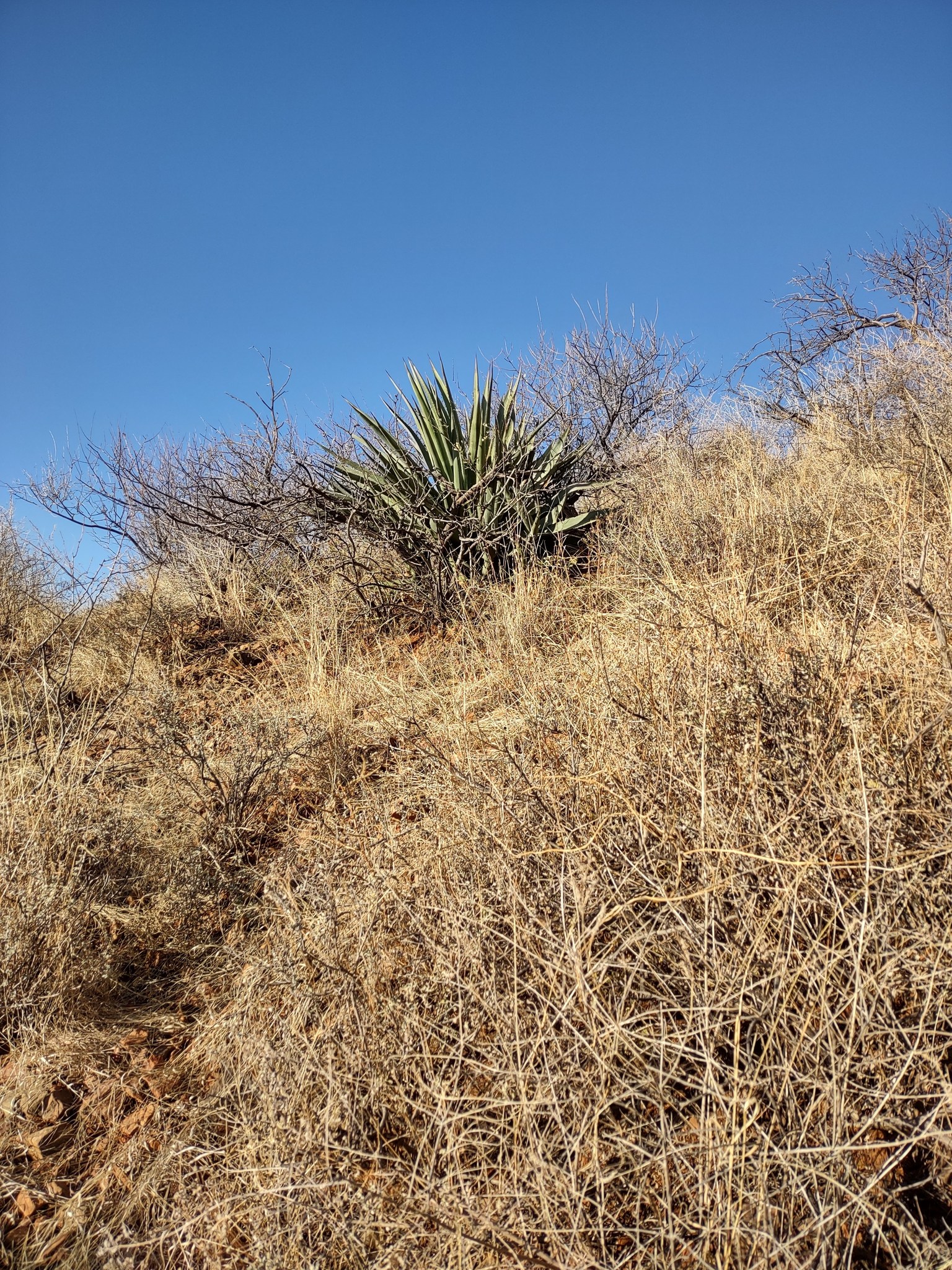
See the arrow in the image above, pointing to a little tree on the distant slope? Doesn’t look very high, does it? Not much of a challenge? Actually, there is no simple and direct path, and while the tree is much higher than it looks from afar, I’d always had it in mind as a destination “someday.” This, I decided, would be the day. 


My morning preparations for the walk had been nothing more than the usual list: leash, treats, water, keys, phone, hat. That’s it. I added gloves, since it had been chilly when we started out, but camera stayed home, as did all field guides. No books on hikes! One thing I learned about field guides when I hiked the Dragoons years ago with a friend is that they become increasingly heavy with every step. I can’t live without field guides – don’t get me wrong – but I’ve learned to photograph whatever I want to identify and look it up in my guides afterwards. Sometimes I carry a camera, as on New Year’s Eve for the Town Hill climb; otherwise, my phone has to serve camera duty.


In Dos Cabezas, in the mountains, foothills, and the ghost town itself, everything (as my hiking partner noted one day as we were driving the straight, flat Kansas Settlement Road) is “up and down.” In summer, when monsoon rains come to the Southwest, water floods the washes and carries downstream rocks, trees, and anything (or anyone) else that it catches up in its torrential flow. On lower ground, the washes in winter are broad, sandy, and relatively clear of obstacles, as if designed for walking, whereas on higher ground and steep slopes, the story is vastly different. There a wash originates as a gully, and there will be several gullies to every slope. Moreover, there is loose rock everywhere, along with shrubs with thorns and spines. -- And I'm coming back to add that there are also gopher holes, holes made by rooting "pigs" (javelina), and now, another neighbor warns me, abandoned mine shafts!


My destination that small dark tree to the northwest


Dark shade is first gully, from the destination side.


Having gone farther east than necessary before making the decision to climb, I had two major gullies to clamber down into and up out of on my way to that tree. Sunny negotiated them easily, but then, she has four legs and four feet and is only a year old. The second gully, in particular, gave me pause. (No, not paws! Please!) Could I do it? Without falling? I put on the gloves I’d taken off when feeling too warm in order to be able to grab handy branches along the way. On the upside of the gully, there was a cow path (quite surprising how good cows are at climbing steep slopes), and I made cautious use of their bovine wisdom. 


For reference: cows on a different hillside on a different day

For scale: same cows as above without the magic of zoom


On Saturday: my cowpath, up out of the second gully
 

My report, in brief: The climb, la montée, Ã§a en valait la peine! Definitely worth the effort! The view of my little ghost town down there in the distance – even, between two local hills, a view out across the playa to the Dragoon Mountains and Cochise Stronghold – was worth every cautious, foot-dragging step that got me there, and it was very satisfying to stand under a tree I’d been looking at from my winter back door and imagining meeting “in person” since 2015.


View attained.

Tree up close.


From my new, lofty vantage point, I could see an easier route to take down than the one I’d used coming up. I’ll remember that for the next time I climb to the tree. I have also installed an altimeter on my new phone now, so when I make the climb again I’ll know exactly how much higher the tree is than the cabin down below, which stands at a mere 5,030 feet above sea level. – Not quite a mile high, the cabin, but that almost explains our freezing temperatures during these winter nights. 


Yes, a very satisfying adventure – and I rationed the water supply carefully so that a certain energetic little doggie would not have to go thirsty, either. We had a terrific time!


Monday, January 23, 2023

Another Exhilarating, Exhausting Mountain Adventure!

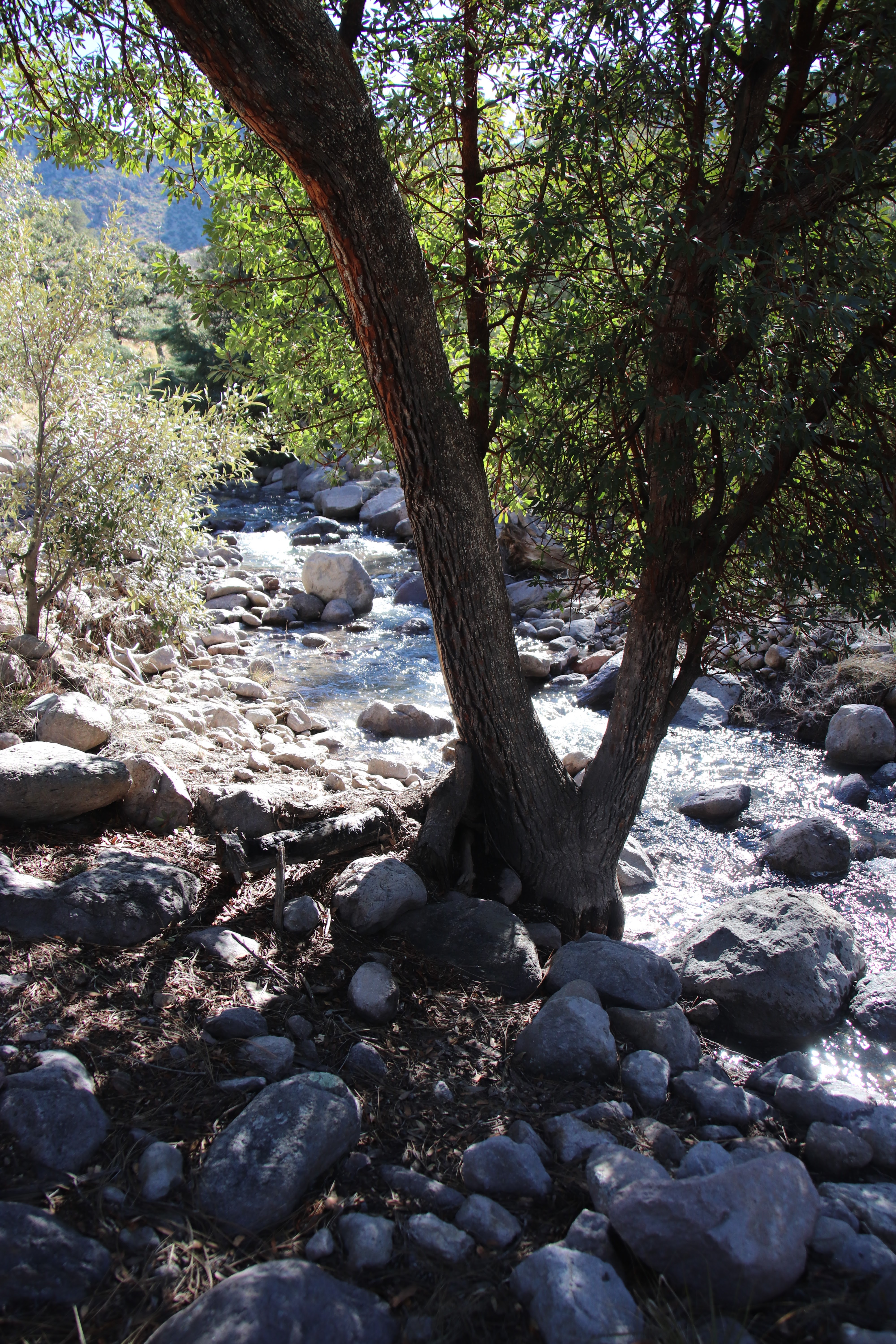
Bonita Creek at visitors center parking lot, 1/22/23


My hiking partner wanted to introduce her new puppy to the Chiricahua National Monument and invited me to come along. We would hike a short trail, the one between Faraway Ranch and the visitors center, a trail that more or less follows Bonita Creek, does not involve climbing, and where dogs on-leash are allowed – in short, an easy trail that shouldn’t give a three-month-old puppy any trouble at all.


Over the years following our first introduction to the place, the Artist and I made countless visits to the CNM, an easy drive from the ghost town, down one of the most beautiful Cochise County roads. We picnicked along rocky Bonita Creek (bone-dry in December of 2021) and explored lovely Faraway Ranch and its history. We had walked about a mile of the trail beginning at the other end, too; however, although the trail between its two end points is only 1.2 miles, I had never walked the entire length at one go. 


My friend and I, having decided to begin our round-trip walk at the visitors center end, were delighted to see water in the creek. Not just a thin trickle, either. The park is a treasure even when the creek is dry, but running water, in Arizona, is always exciting and adds to outdoor experience.


Creek below, peak above


We stopped often, pointing out to each other particular stunning vistas and giving the puppy a chance to explore with her nose. My appreciation of the trail’s beauty was somewhat tempered by sorrow that the Artist was no longer with me, as memories of being there together came at every turn. But it was a beautiful day, and I was glad to be in the mountains. 


This is the trail???


My first challenge came when our trail, familiar to me in this stretch, took on a very unfamiliar look: I had never seen this much water in the creek that crossed the trail at right angles. My friend picked her puppy up in her arms and stepped bravely from rock to rock. I tried, but the necessary steps between rocks were too long for me to take them in stride, as it were. As I saw it, I had two choices: 


Wading the creek: The water was icy cold, and my boots not water-proof. My feet would get wet and cold. 


On the other hand –


Taking the rock route: If I slipped and fell, more than my feet would get wet, and falling on rocks could mean getting a lot more than wet. What if I slipped and fell and hit my head? No cell phone signal! Very few people on the trail that day. (The whole time we were on the trail, we saw only four other people, one couple from each direction, and all turned back from what was for us the third creek crossing.)


So I scouted out the shallowest path I could see, hiked up my jeans, and waded across. Yes, it was very cold!


Having taken the plunge already, our second creek challenge was easier for me. The creek was wider and shallower there. Again, my friend carried her puppy.


Does not look challenging You are not looking at it with cold, wet feet.


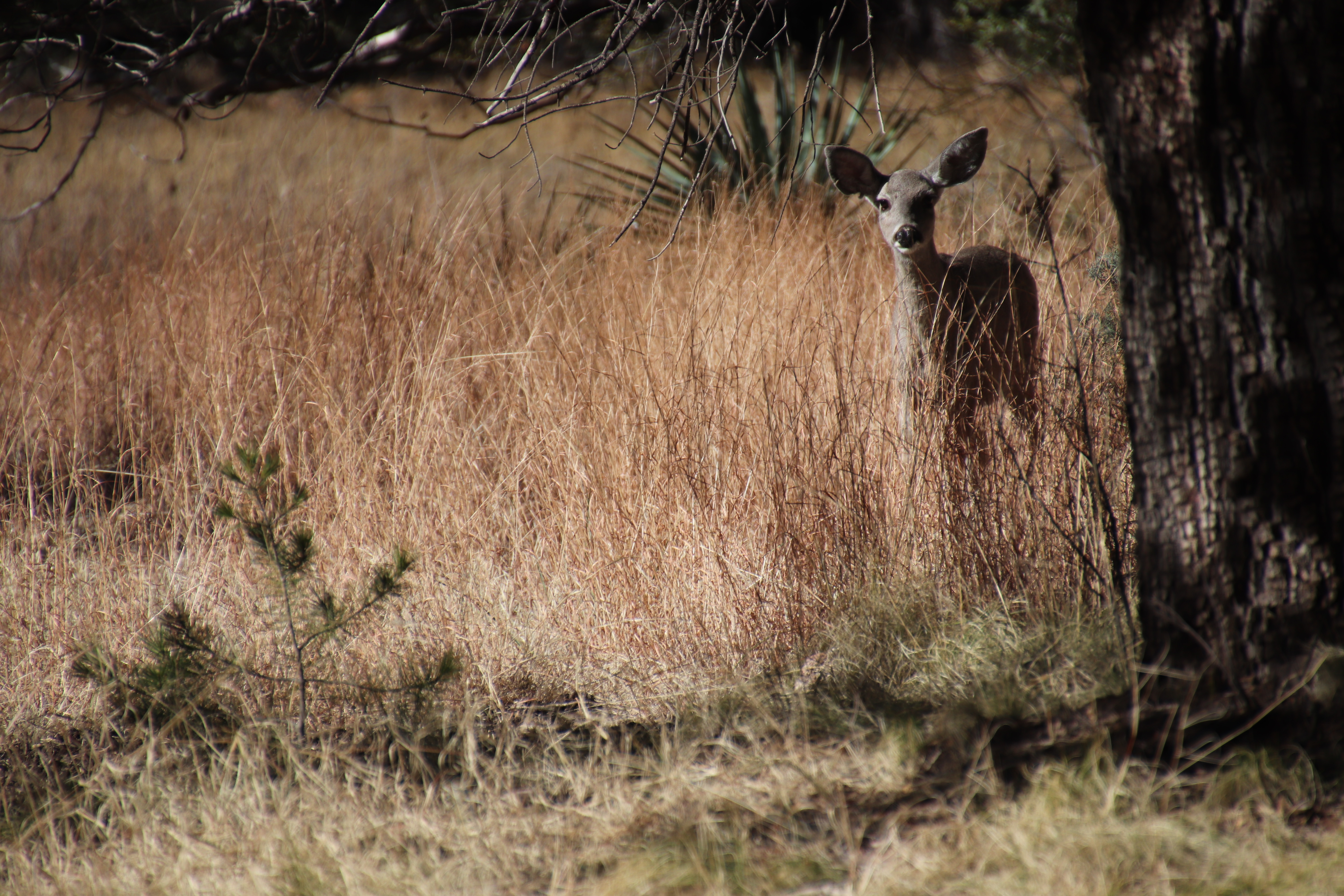
We were hoping to see coati, and those hopes were not realized on Sunday, but approaching Silver Spur meadow we saw deer and stopped to watch their lovely, easy, flowing trot across our path and up into the woods. As you might guess, the puppy was mesmerized by the sight. My year-old puppy would have barked, had she been with us.


Farther along came Challenge #3. Intrepid wader by now, I crossed pretty much with the submerged path, while my friend explored downstream for solid rocks, and a couple who had caught up with us on the trail explored upstream. The other people turned back, but my friend made a daring and successfully dry crossing while I held my breath, praying that she would not lose her footing. 


Exploring upstream before turning back


My fearless friend!

Pup in arms!

Still high and dry!


On dry land once more, we came to one of my friend’s favorite trees. It turns out she is, literally, a tree hugger! The puppy found greater interest in a trunk hollowed out by fire, as we humans admired the grain of its wood.


Oops! Puppy moved out of shot....


Now we had gone beyond my former explorings, and soon we came to something I had never seen before: the Stafford Cabin. Sweet! You can read about its history and the family who lived in the cabin here.


From there it was an easy walk to beloved Faraway Ranch, where we walked around the old house, renewed familiarity with its history, and visited with a group of people from Alaska before turning back in the direction of the visitors center, taking a slight detour from the house to go by a ranger’s cabin. One of the things I always think about at Chiricahua is how one of the grandsons, a forester with experience in public works forestry, would love the place. In my mind’s eye, I can see him here, living in this cabin and enjoying the views. 


Ranger cabin

Looking back at Faraway Ranch

Savannah-like open area

The biggest surprise of the day was manzanita in bloom – in January! 


Manzanita flowers


There were, of course, three more crossings of Bonita Creek to make on our way back – three more times for me to wade through icy water in boots and socks already soaked through, three more times for my friend to negotiate a dry, rocky crossing with puppy I her arms. End of tale: I was wet halfway up to my knees, my friend slipped and got one foot wet, the puppy managed to get into fresh, black mud, but otherwise all three of us did just fine. 


Being on the trail Sunday was definitely worth wet feet. I thought of Washington Irving on his expedition through Oklahoma territory (A Tour on the Prairies) and how important it was for their party to find a camping spot near water each night. By contrast, I would soon be back in my comfortable, warm cabin, where I could put on dry socks and relax with my own puppy. But to have seen so much water in the creek, sparkling in the sunlight, was a thrill. 


Reaching home, tired but contented, I went out for a ramble with Sunny Juliet before even changing my footwear, because my puppy needed some fun in the sun, too! -- You’re probably wondering why Sunny Juliet was not included on the adventure. She and Yogi have met each other and have compatible energy levels and play styles, so we anticipate they will be great pals soon, but Yogi is so little right now that my friend and I don’t want to stress her out too much or take a chance that she will be hurt accidentally by a rowdy, much bigger dog. The good news is that Yogi will be bigger every week, and we look forward to playtime together with the two of them. As for trail hikes with the two of them, two excited puppies on-leash, that might be more than I could handle, even with dry feet.


My girl on Big Rock (one of them)!


Wednesday, November 30, 2022

Here and Now, Our Time in the Sun

Can you see the dog?


In a recent post with my annotated list of books read in previous weeks, included was Jane Barry’s A Time in the Sun, set right here (i.e., where I am at present) in Cochise County, Arizona. When I finished the novel, I passed it along to a neighbor (who is now captivated as I was by all the familiar locales in Barry’s historical novel), so I can’t look this morning to see where the title appears in the story, but I remember it was near the end. The idea is that all of us alive have our time in the sun, limited by mortality. 


As the end of the year (with more holidays) approaches, I’ve been reading old journal entries from a year and two years ago and am struck, despite all the COVID and political horrors, by the happiness the Artist and I found in our most ordinary days, and I think what a blessing it was that we could not then see into the future. The love of my life is gone now, along with our last two beloved dogs -- a long-established pack and a pack with only a brief history -- but we did all have time together in the sun. And now it’s Sunny’s turn.


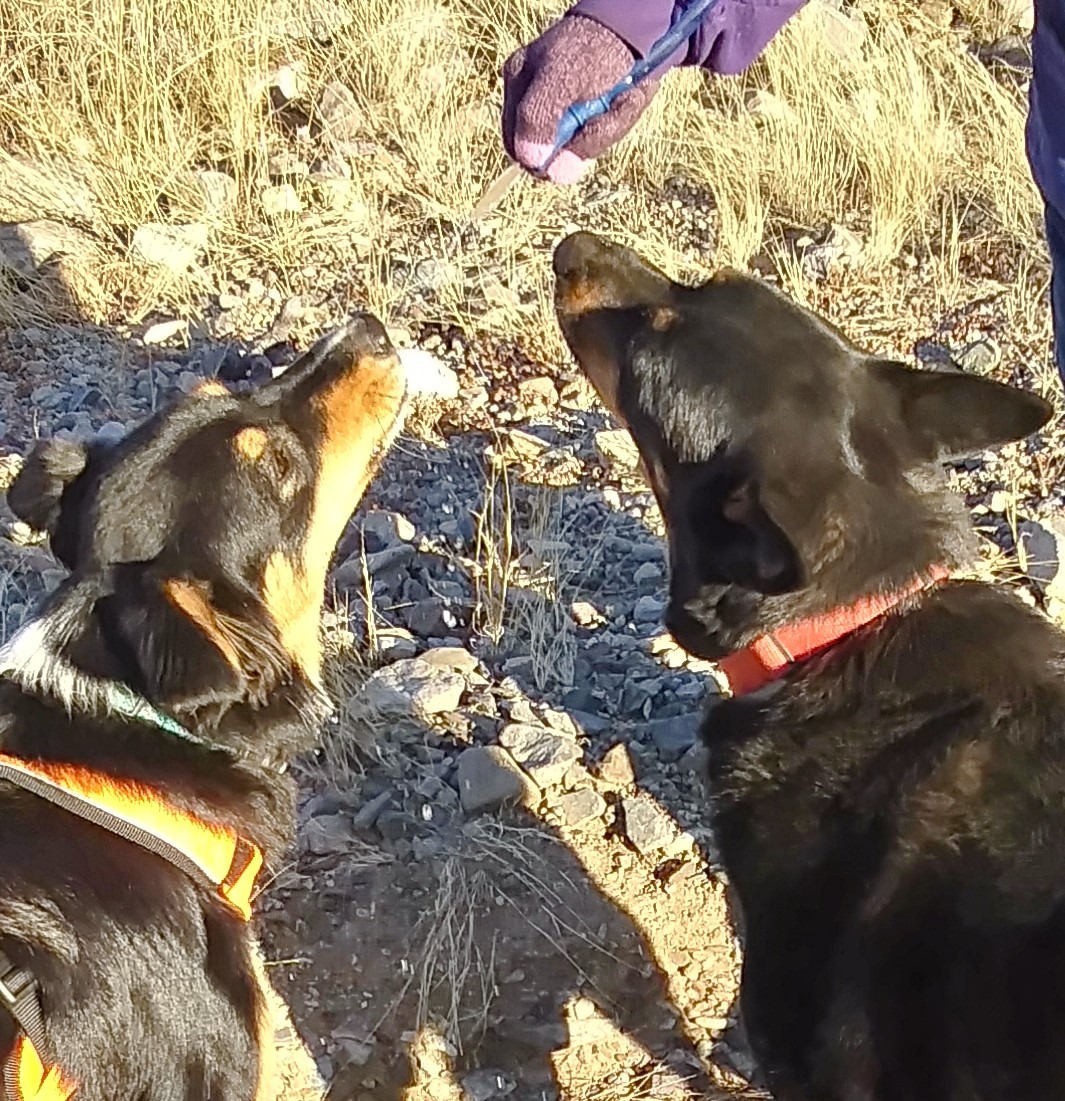
Sunny Juliet and I go out for a ramble on the range most mornings, joining a neighbor and her dog. The year-round resident canine is Boss Dog, Sunny the teasing youngster who sometimes needs to be reminded of her place, but in general they get along well, so while SJ and I also take walks on our own, we enjoy most of all being part of a ghost town foursome. 


Although I’ve only finished reading three more books since publishing the last list, I’ll add them in here, so as not to fall so far behind until the next time. 


122. Caputo, Philip. The Voyage (fiction). Honestly, I probably would not have chosen this book to read except that it was urged on me by a friend – and because both of us had met the author, separately, through another mutual friend who was also a well-known author. That said, this is a must-read novel for sailors, fresh- or saltwater! I am not a sailor, and so the detail of every move the captain and crew made went far, far over my head, but for those who understand it all, the picture would be riveting. The story, anyway, is riveting even for a non-sailor. Three teenage brothers and the friend of the oldest set off from Maine to sail to the Caribbean in the year 1901. The brothers have been seen off, unceremoniously, by their father, who tells them he doesn’t care where they go, except they are not to come home until the end of the summer. The reason for the patriarch’s abrupt dismissal and other family secrets are revealed only gradually in the course of a story of adventure on the high seas. Highly recommended for those who love adventure, mystery, and exotic locales in their reading, and especially for sailors.


123. Willard, Nancy. Telling Time: Angels, Ancestors, and Stories – Essays on Writing (nonfiction). Serendipity brought this book to my notice. I was browsing in Readers’ Cove, Deming, New Mexico, and bookseller Margaret had just happened to leave Willard’s book on the shelf facing out. “Nancy Willard!” I exclaimed. “She’s a Michigan writer!” Willard was a poet and a storyteller, and these essays are saturated with her gifts, as she writes about teaching, about her mother’s last days, about the couple who illustrated her children’s books, and about storytelling in general. Highly recommended for poets, storytellers, essayists, and anyone who loves and appreciates these literary forms.


124. Smith, Alexander McCall. Heavenly Date and Other Flirtations (fiction). Stopping in at the Friendly Bookstore in Willcox the other day, I was in the mood for something comforting, and since I am always comforted by reading McCall’s stories featuring Mma Ramotswe, the name “Bulawayo” in the table of contents of short stories in the collection led me to believe that this book would comforting, too. It was not. Publishers Weekly (on the back cover) cited the collection’s “light humor,” but I found it, for the most part, downright bleak. Not that the stories weren’t well written. They simply were not what I expected or wanted them to be. Make up your own mind on this one.


The book I’m reading now is Francisco Cantú’s The Line Becomes a River: Dispatches From the Border, a nonfiction book that anyone with questions and/or an opinion about the border with Mexico should read. His mother is distressed and worried when her son, a recent college graduate, takes a job with the Border Patrol. He explains that in his classes, everything was theory, and he feels he needs to be “on the ground” to understand what’s really going on. You grew up on the border, she tells him, but he says it’s different and that he feels he needs to do this, at least for a while. About halfway through the book now, I am not looking at the last page to see where it ends. (People really do that???). I can tell you, though, that this true story does not loosen its grip on a reader as it moves along….


And so goes our life, Sunny Juliet’s and mine, here in the high desert as November 2022 draws to a close. The nights are cold, the days bright and clear. Down toward town, the wind stirs up dust on the playa. The puppy makes me laugh. The sun rises, the sun sets.


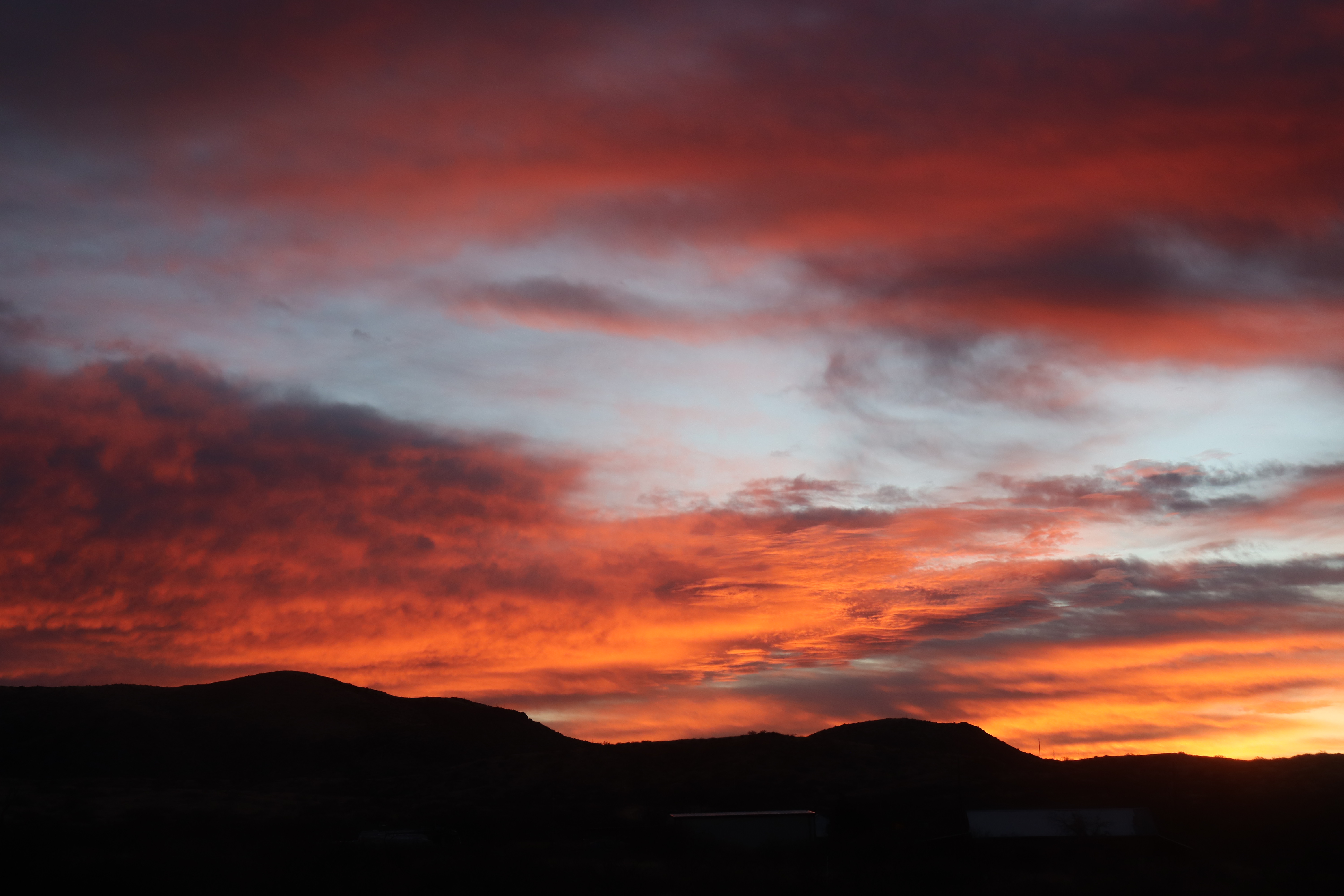
This morning's glorious sunrise!