Search This Blog

Friday, August 21, 2015

Small, Deeply Satisfying Portions


Some books are heavy and formal, veritable seven-course meals. Impossible to rush through, they demand long stretches of attention. This is not a criticism: such books ask a lot of a reader, but they give a lot in return.

Others are teasing little tasting menus, light bites good with a single bottle of wine. Pleasurable and relaxing, they’re easy and fun, and you get through them quickly. And pretty soon you're hungry again!

Then there are slim, surprising volumes with gem-like lines that stop you in your tracks. Whether you read a book like this in a day or two or savor it in tiny, disciplined sessions over a longer period of time, the reading makes a deep impression.

The novel, for a long time, 
has been over-furnished.

With this simple sentence Willa Cather begins her essay “The Novel Démeublé.” A few pages later she stopped me in my tracks again:
The novelist must learn to write, and then he must unlearn it; just as the modern painter learns to draw, and then learns when utterly to disregard his accomplishment, when to subordinate it to a higher and true effect.
Learn to write – and then unlearn. “How wonderful it would be,” Cather goes on, “if we could throw all the furniture out of the window....”

She rails not against the telling detail but the meaningless piling up of detail. Later, writing of the work of Stephen Crane, she applauds his Wounds in the Rain and Other Impressions of War, sketches from Cuba, noting that Crane
... didn’t follow the movement of troops there much more literally than he had in The Red Badge of Courage. He knew that the movement of troops was the officers’ business, not his. He was in Cuba to write about soldiers and soldiering....
Cather admonished writers not to let writing get in the way of their stories. Too much “furniture,” too many “realistic” details, too much stage-managing all detract from fiction as art.

Learn – and then unlearn. A diamond of advice.


Thursday, August 20, 2015

Three Light Meals


  • Recipes for a Beautiful Life (nonfiction), by Rebecca Barry
  • Encyclopedia of an Ordinary Life (nonfiction), by Amy Krouse Rosenthal
  • The Readers of Broken Wheel Recommend (fiction), by Katarina Bivald


I don’t think it’s too much of an exaggeration for me to claim that my reading in general is catholic. Catholic: “broad or wide-ranging in tastes, interests, or the like; having sympathies with all; broad-minded; liberal” (Webster’s New Universal Unabridged Dictionary, Fully Revised and Updated, 1996). A tiny exaggeration, maybe, that “all” part. You’d have to look through several years of my lists of books read to find much if any science fiction or fantasy, and a lot of bestsellers never make it to my nightstand, either. But “wide-ranging” seems a fair claim.

What the three books I’m putting together in this post have in common is that all are (1) light reading and (2) written by women. (Clive Cussler fans, be forewarned!) One was sent to me as an Advance Reading Copies (ARC), another the final published version, and the third (not in the order they are listed above) I initially opened only to see where to shelve it in my bookstore.

Here’s how I’ll refer to them: Recipes; Encyclopedia; Broken Wheel.

(1) Recipes confounded me. The author and her husband decide to move their family from New York City to a small town upstate. With a much smaller income, they become owners of an old building that needs major repair and renovation. The “simple life” is never simple except when looked at from the outside. The author’s proposal for a novel is accepted, however, and if she can get it written in a year they’ll have enough to live on until the money starts rolling in.

This is an entertaining book. The children, as children will, say lots of funny things. (Very funny. I was reminded of Jean Kerr's The Snake Has All the Lines.) Rebecca and her sisters have that sister thing going on, and I relate to that, of course. Friends share meals and wine and worries and laughs. The writer tries to find time to write and struggles to find inspiration, while children and small town life keep catching her up in a giddy swirl.

Some of the “recipes” in the title are things to fix for meals, but most are fixes of a different kind: “Recipe: How to Heal Your Heart,” for example, or “Recipe: Get Kids to Listen to You.” Like most of us, the writer of this books “learns” a few lessons, passes them along to us – then forgets them and has to re-learn them a few days and a few pages later.

Most baffling to me, though, is that this book is basically a book about how the author did not get her book written. The novel proposal? Advance spent, but author and editor agree the draft of the novel is, in the author’s own (unspoken) words, “unpublishable.” So Simon & Schuster published this story from her real life instead? From diary, blog, whatever? Well, clearly she had to work to give it a shape, but all I could think was that writers who spend their advances and fail to meet their deadlines are very seldom so fortunate! I didn’t know what to think, in the end. I still don’t.

(Am I simply blinded by envy? Not completely, I don’t think. I want to get my novel written!)

(2) Encyclopedia is the book I picked up to figure out where to shelve it. Glancing at a few pages, I was slightly annoyed at first. Is a collection of slightly quirky lists worthy of being a book? I was dubious, resistant, but the book pulled me in. Finally I sat down with it and kept reading. Soon I was smiling – and then laughing out loud, to the alarm of a few silent browsers in the stacks.

We are warned on the cover that the author of this memoir has “not survived against all odds” or “witnessed the extraordinary.” This is an ordinary life. Here, under H, is a typical entry:
HAPPINESS  
I’m turning left. Look, everyone, my blinker is on, and I’m turning left. I am so happy to be alive, driving along, making a left turn. I’m serious. I am doing exactly what I want to be doing at this moment: existing on a Tuesday, going about my business, on my way somewhere, turning left. There is nothing disconcerting or unpleasant or unfortunate about this moment. It is exceptionally nice, plain, and perfect.
Not everything is perfect, even in an ordinary life. There are ordinary annoyances and ordinary worries. But Amy has a way of dealing with those, too:

RETURNING TO LIFE AFTER BEING DEAD  
When I am feeling dreary, annoyed, and generally unimpressed by life, I imagine what it would be like to come back to this world for just a day after having been dead. I imagine how sentimental I would feel about the very things I once found stupid, hateful, or mundane. Oh, there’s a light switch! I haven’t seen a light switch in so long! I didn’t realize how much I missed light switches! Oh! Oh! And look—the stairs up to our front porch are still completely cracked! Hello, cracks! Let me get a good look at you. And there’s my neighbor, standing there, fantastically alive, just the same, still punctuating her sentences with you know what I’m saying? Why did that used to bother me? It’s so . . . endearing.
This is a charming book! Well, I found it so, anyway. I finished the last page wishing the author would walk in my bookstore door so we could meet. But then -- quite honestly, I am nowhere near as light-hearted and fun as she is. No, I’m sure it’s best to keep our friendship one-sided, within the covers of her book.

(3) Finally, the ARC of Broken Wheel. How can a bookseller resist a book about a bookstore? How can a bookseller in a small town in the northern Midwest resist a story about a bookstore in a dying town in the cornbelt? Can a bookstore “save” the town?

Despite the hope and excitement I felt when opening to the first page, it took me a long time to enter fully the world of Broken Wheel. I kept turning back to the author’s name on the cover, wondering if English might be her second language and why, even so, no one in the publishing house had corrected sentence moods that so obviously should have been in the subjective, e.g.,
There were only two other customers in the entire bar. One looked as though he was sleeping....
Well, was he sleeping, or did he simply look as though [counterfactual] he were? I did not keep track of how many times this error found its way into the book – and I know it is a small nit to pick – but it happened over and over again, and every time it distracted me, my inner editor pulling me out of the story where I wanted to lose myself, so I was halfway through the book before being finally able to stop obsessing over was/were. I hate when that happens! I don't want my inner editor springing into action when all I want to do is immerse myself in a story.

Back to the novel --

A stranger comes to town. It’s a classic setup. In this case, the stranger is Sara, come from Sweden to visit Amy, who has just died. The town itself seems very near a final death gasp. So....

Will Sara get together in the end with Tom, the character so obviously meant for her? That’s one question we ask as we read this novel, though we’re pretty sure what the answer will be, given the kind of book it clearly is. Will the townspeople ever go in the bookstore? Will they ever buy books? Will they read books? Most importantly, for all concerned, will people’s lives change because Sara came to Broken Wheel and opened a bookstore? You can pretty much guess the answers, but that doesn’t take away the pleasure of the story. This book is one Sara herself would have shelved under “Happy Ending Guaranteed.”

Hot, humid, busy summer days call out for the relief of light reading. Chick-lit fiction and humorous memoir can be very healthy choices for the sun- or work-addled summer brain. The perfect prescription, however, must be tailored to the individual, so the final choice, as always, is up to you.


Monday, August 17, 2015

What Does Monday Mean to You?


For students and teachers, September is back-to-school time. For an independent bookseller in a summer tourist town, September is more often vacation. Not sure how that’s going to work out this year, with other things going on, but generally speaking fall brings at least a pleasant slow-down in the pace of life and work. Very different from my life years ago: when I worked in an office Monday through Friday and had weekends off (what a concept!), Monday meant a return to the 8-to-5 grind after kicking back -- or kicking up my heels, as I did more often back then.

Well, there are no “weekends” in my summer life. Except for opening an hour later on Sundays, every day is pretty much the same, in terms of hours worked. But after the rush of weekend tourist business and a Sunday afternoon author event, this Monday, even in the bookstore, feels pretty relaxed. I’m betting it will stay that way, too, as the hot, humid weather sends people to the beach to cool off.

My sister and friend were with us Friday, Saturday, and Sunday evening, and Sunday we were joined by a friend for Traverse City. It is front porch and outdoor table weather. Even when a minor migraine sneaked up on me Saturday and David had to get take-out pizza for our dinner, I managed to recover sufficiently to enjoy the stars with my company. And Sarah was in heaven all weekend: Sarah loves company!

On Sunday my guest author at Dog Ears Books was Ross Biddiscombe, sharing the story in his book Ryder Cup Revealed: Tales of the Unexpected. I’m not a golfer. I’m not very interested in golf. I had not read his book. And yet I was as fascinated by his presentation as anyone else in the audience. His book is not about the various games, year by year, but the history of this particular professional challenge, and he related it to the economic and social history of the United States and the United Kingdom in ways that made perfect sense. Golfers will know that the U.K. team is now a European team, while the U.S. team remains strictly U.S. Ross did acknowledge the different respective sizes of the countries involved but still thinks the U.S. golf pros could learn a lot from the Europeans about how to take ownership of their participation in the Ryder Cup.


And now – can you believe? – despite the fast-approaching Labor Day holiday, I have two more big author events scheduled before then! I’ve been wanting to get Luisa Lang Owen on the calendar for months, and that has finally come together for a week from Thursday. If you haven’t before, take a look at my review of her book, Casualty of War: A Childhood Remembered, and you’ll definitely want to join us on the evening of August 27.

Luisa Lang Owen is the mother of Erik Owen, owner with his wife Deirdre of the Northport Inn, and my other book evening coming the week before Labor Day also involves people in Northport. Susan Gilbreath Lee is the sister of the Fearless Leader of our intrepid Ulysses band, both Steve and Susan the great-great-grandchildren of Erasmus Corwin Gilbreath, who was not only only involved in most of the major battles of the Civil War but also left behind journals of his military service in the Civil War and beyond, which Susan found, transcribed, and edited, and which have now been published by the Pritzker Military Museum and Library in Chicago. Steve and Susan will be co-presenters of the resultant book, The Dignity of Duty: The Journals of Erasmus Corwin Gilbreath, 1861-1898. Anyone with an interest in American history, the Civil War, and/or preservation of family history will want to be sure not to miss this event on Thursday evening, September 3.

[Sold my first copy of the book before taking its picture! Waiting for more to arrive soon!]

As for my personal summer reading, I finished Harriet Beecher Stowe’s Uncle Tom’s Cabin, which our little group will be discussing on Wednesday evening, and have been spending many early mornings and late evenings with Hermann Hesse’s Magister Ludi: The Glass Bead Game. I expect to finish that soon.

At the bookstore, between customers and when I’m not working on book orders or other correspondence I’ve been enjoying an ARC of The Readers of Broken Wheel Recommend, by Katarina Bivald, about as far from Hermann Hesse as it’s possible to get with a book also written as fiction. A shy Swedish bookworm, Sara, comes all the way from Europe to spend two months with Amy, whom she has never met but knows as a kind of pen pan (they bonded over books), but when she reaches the sad, dying little town of Broken Wheel, Iowa, she finds that Amy has died. The townspeople, however, insist that she must stay -- in Amy’s house. And then, looking for something to do with her time (besides read books every waking minute), she discovers that Amy also owned an empty downtown storefront. She will open a bookstore! She’s going to open a bookstore in a nearly empty town where people don’t read books and where the local diner often has only one customer, sitting alone drinking coffee. How is this going to work?

Gradually Sara comes out of her shell, as more and more the townsfolk rally around the bookstore, if only so a neighboring, more prosperous town can’t keep looking down on them, and when the town realize that Sara’s visa is about to expire, they hatch a plan to keep her there.

I’m still 100 pages from the end of the book – and I never (unlike some people I know) peek ahead at the last page to see how a story is going to turn out, so I can’t tell you where it will all end. And you know I wouldn’t, anyway, don’t you? I never do spoilers!

It's Monday, a quiet day after a busy, fun weekend, and "partly cloudy" is elbowing its way into the picture, too. The smart vacationers went to the beach this morning while the sun was shining. But this afternoon and evening will be perfect weather for reading.


Thursday, August 13, 2015

My Retreat From the World


Our intrepid Ulysses reading group is getting together next week to discuss Harriet Beecher Stowe’s famous but much neglected novel, Uncle Tom’s Cabin. We don’t usually meet in “high season” but decided to have a couple summer sessions this year. 


It isn’t easy -- scheduling an evening in July or August when eight people are all free. Somehow we managed it last month to talk about Steinbeck’s East of Eden, despite the perennial Up North summer truth, which is that everyone is busy. Working people are employed seven days a week, some of them barely sleeping, and retired people and summer folks have streams of company, some of them barely sleeping. Musicians’ calendars are full. Groups of writers have annual retreats, authors go on book tours, and then there are all the family reunions, fairs, festivities, celebrations, concerts, and parades. And bookstore events! I have had three already this month, have another on Sunday, and just scheduled a fifth for the last Thursday of August!

And yet, despite the nonstop pace of summer life – or maybe in part because of it – our little band decided to clear a space during this high season for our literary “support group.” A reading group (or book club, if you prefer that term), like a group of writers meeting over a long period of time, develops an intimate character with the years. We miss each other when we don't get together. Along with conversation and goodwill grounded on discussion of books, an emotional depth has developed that goes beyond books while always remaining rooted there. Speaking openly, sharing opinions without fear, agreeing and disagreeing, we have come to trust and rely on one another. 

It doesn’t happen overnight. Like marriage, there’s no shortcut to a long relationship.

One thing our group has never been is organized for the long-term future. Whether we spend only one evening or eight sessions on a particular work, at the end we look around at one another expectantly, asking, “What should our next book be?” This time, one participant suggested, we should each come to the session with at least one recommendation. Good idea!


Okay, so what haven’t we read yet? Besides works in English, our group has read translations from French, Italian, Spanish, and Russian, covering a lot of the Western canon, but we have read no German classics, I realized uneasily, and since the omission mirrors a lacuna in my personal reading history, I somewhat reluctantly resolved to remedy the neglect for myself, even if the group voted to choose something different.

And so, for myself, I took home Magister Ludi, by Hermann Hesse, otherwise known as The Glass Bead Game. It was the latter title that intrigued me. A foreword by Theodore Ziolkowski confirmed me in choosing Hesse’s final novel, Ziolkowski noting that
...Joseph Knecht [the main character[ ends by defecting from Castalia, a conclusion that was far from Hesse’s mind when he first dreamed of this new version of the spiritual kingdom.... At least two factors contributed to change Hesse’s attitude toward the ideal which he had been striving to portray in so many works for almost twenty years. First, the sheer reality of contemporary events—the disintegration of the Weimar Republic, the rise of Hitler, the horrors of Nazism—opened Hesse’s eyes to the failure of the intellectuals and convinced him of the futility of any spiritual realm divorced wholly from contemporary social reality. ... Secondly, Hesse’s growing uneasiness regarding an absolute spiritual kingdom was substantiated by his study of Burkhardt’s writings.
Knecht’s life as presented in The Glass Bead Game, then, according to Ziolkowski, “represents the radicalization of the intellectual....”

As a novel, The Glass Bead Game moves slowly. The author is “telling” rather than “showing,” even through his use of a narrative voice not his own. Halfway through the book, as I am now, I still sometimes have the feeling that I’m reading a prologue. That is to say, I don’t know if our reading group would cotton to this book at all or if I even want to suggest imposing it on them. But I’m glad I’m reading it.


You know the whole “slow food” movement? Years ago I suggested something similar in reading, i.e., “slow books.” The Van Wyck Brooks works on American literary history qualify as slow books, as does – of course! – Remembrance of Things Past. A slow book is one in which one becomes immersed, one which alters time, transporting the reader to another, more leisurely age. Conflicts arise in slow books, but we view them from a distance, rather than experiencing them immediately. Does this sound paradoxical? That one is transported and immersed and yet viewing the past from a distance? Very well, I contradict myself.

Slow books, I want to say, are peaceful reading. They are like a day of gentle rain, an opportunity to breathe more slowly, to stop doing for a while.

I will have more to say in future about this Hermann Hesse book. My point for today is simply that amid the bustle of summer, the time I spend reading Magister Ludi early in the morning and before falling asleep is a retreat from the busy, nonstop world of summer. It’s a quiet preview of fall.


Saturday, August 8, 2015

Twenty Years (20) of Dog Parades in Northport (or is it 21?)


Ho-hum. Another day in the bookstore....

What's this? Dogs going by?


While kids look at books, Sarah checks out sidewalk traffic.

Whose car is this? Cool plate!
Anticipation....
Then, somehow, I missed the very beginning of the parade! Missed the dog parade banner coming down the street! Did it mention "20 Years"? I don't know. I'm still working on the calculation myself, starting with the age of my bookstore (22), subtracting the three summers it was in Traverse City (19), adding back the two dog parades I know we missed (2) -- 21 years? I'm confused. Who's got the count?

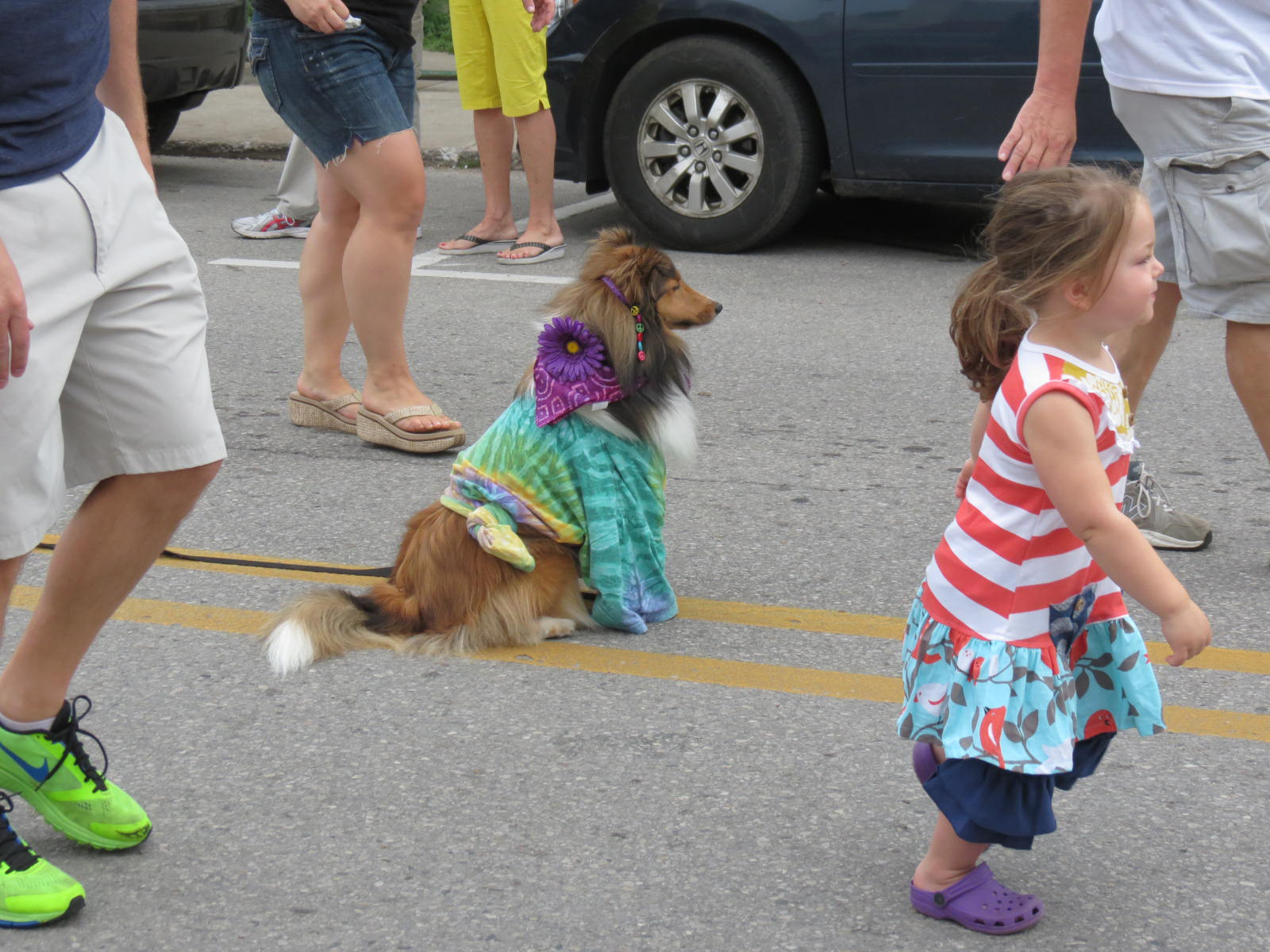
Never mind. Here come dogs! This year's theme, "Woofstock," was truly inspired -- and inspiring.


Not all of my pictures turned out great, but I'm including a couple fuzzy ones nonetheless, because they are important parts of village life.

Northport Promise

Northport Wildcats!!!


Along the way, with dogs, dogs, dogs, were people marching with a Coming Attraction, the Leelanau UnCaged street fair the last Saturday in September.


The street fair is as much fun as the dog parade -- maybe more, in that it lasts all day long. But right now it's still August, and today was the day Northport went to the dogs. Beneficiaries of this year's parade fees were the Cherryland Humane Society, Black Sheep Crossing, and Silver Muzzle Cottage.

Sarah had a good time watching the parade, especially when she saw dogs she knows, like Laddie and Nessie.

Laddie

Nessie

We were also excited and pleasantly surprised to see Sarah's former groomer, Jamie. She is only Sarah's "former" groomer because she, Jamie, moved down to Grand Rapids. We miss her!

It's Jamie!!!

Omena has a big doggie presence. (Their mayor is a dog.)
And the dogs and hippies just kept comin'


Our librarian and her entourage and the Friends of the Library in the Stanley Steamer took the prize for bending Sixties slogans to their own agenda, and since it's an agenda I share, I loved their signs. 


Big dog makes big shadow!
It isn't a parade without a band

Neighbors and neighbor dogs

I hope someone counted all the dogs in this year's parade -- and then, too, all the dogs like Sarah along the parade route, enjoying the scene from the sidelines. 

Then the parade was over for another year, leaving behind smiles and memories. What a wonderful tradition! In Northport, we love our town, and we love our dogs.

Kirk in t- and bandana


Thursday, August 6, 2015

Where Did the Blue Moon Go?


Already in the past


It seems the moon was full only a couple of days ago, and now it's half-gone already. Where did that full moon go, the second one we had in July? For that matter, where did July itself go? The peak of cherry harvest? One morning, early, I wrote the following lines:
Grunting, snorting, grumbling like  
An angry old sow:  
Harvest machines shaking fruit.
This morning, already, quiet reigned again outside the farmhouse. Strange, hearing quiet....

Another long-awaited event arrived at last: Wednesday evening’s reading and conversation with author Barbara Stark-Nemon, whose novel, Even in Darkness, is based on the true story of her great-aunt in Germany. In the discussion, Barbara directly addressed her decision to write the story as fiction, rather than memoir or biography: “I didn’t want that distance. I wanted readers to be in the story.” 

Her novel certainly succeeds in meeting that objective. One audience member remarked that she stayed up all night, telling herself at the end of each chapter that she would read “just one more” and finding herself unable to stop. Another of my customers (the one who memorably addressed me the day after she bought the novel as “Goddess of Books!” -- a real first for me!) had told me that she had not wanted the book to end at all. 

Barbara Stark-Nemon

It was thrilling for me to have Barbara and her book in my bookstore at last, since I think it was three years ago that she first told me some of her aunt's story. It's wonderful the way her audience has expanded since then -- and continues to expand, as the book reaches more and more hands.

Now on we go, plunging into another day and toward another weekend, this coming Saturday the day of Northport’s (1) annual wine festival at the marina park and (2) the annual dog parade, beginning at 11 a.m. – this year’s theme is “Woofstock,” so think tie-dye and beads – plus (3) Leelanau’s reigning photographer Ken Scott signing copies of The Back Pages at Dog Ears Books, beginning at noon.


Then the very next day, Sunday, from 1 to 3 p.m. we'll have Jerry Dennis and Glenn Wolff here to sign their exciting and beautiful new book (another Big Maple Press Indie Bookstore Edition), A Walk in the Animal Kingdom.


We were very, very lucky here at the north end of the peninsula to be spared the terrible storm last Sunday that hit from Leland south. Glen Arbor got the worst of it, but Leland, Lake Leelanau, Cedar, and Maple City all lost power and had trees down and cars and buildings damaged, as was true in Traverse City, as well. One woodlot owner lost two-thirds of his trees, and photographs I’ve seen remind me of the aftermath of the tornado we lived through in our Kalamazoo neighborhood years ago. Jerry and Gail Dennis, out on Old Mission peninsula, lost several large trees, including one very big maple, but not, everyone will be relieved to know, the Big Maple for which their publishing venture is named. 

Here Up North, we’re used to snow, but not winds up to 100 miles an hour and skies that don’t even look real in the photographs. Many businesses and even Sleeping Bear National Lakeshore were closed on Monday. One of the reasons I heard given for closing the Lakeshore was that no personnel were available for rescuing foolhardy dune-climbers, everyone busy elsewhere with real rather than potential emergencies.

Phew!

So much has happened from full moon to a waning half, it doesn’t seem possible that so little time has elapsed. Sometimes change is gradual, and sometimes it’s sudden and cataclysmic. Many Leelanau and Grand Traverse scenes will never be the same in our lifetime. But the main character of Even in Darkness, like her real-life counterpart, saw more devastating changes and went on to build a new life, and so must we all, whatever befalls us from one moon to the next.

And so our summer life goes on, from storm to author event to author event to dog parade, a very mixed bag indeed. C'est la vie, mes amis. La vie au nord et partout.