Search This Blog

Showing posts with label insects. Show all posts

Monday, November 29, 2021

Who Lives Here? And How?

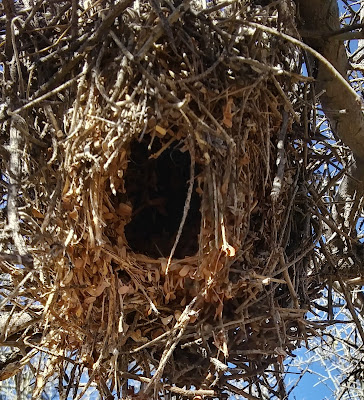
Who lives here? Or lived here?


My high desert day usually begins in the dark, 5:30 a.m. on average. I like making coffee before first light and watching dawn break a while later over the low mountains to the east. Nights now are in the 30-degree range, so some mornings there is a thin skin of ice on the birdbath. The birds know when a sunny day is coming and are out calling and singing by the time the sun comes over the horizon. But that comes later. 


With almost a full year’s experience under his nonexistent belt, Peasy knows we won’t be rushing outdoors at first light or even sunrise, and he waits patiently (mostly) while I drink my coffee and read or write a letter or journal entry or catch up online with distant friends. But he is certainly ready for adventure and exploration the minute he senses that I am! The Artist will be ready, too, by the time Pease and I get back from our morning rambles, usually about an hour later.
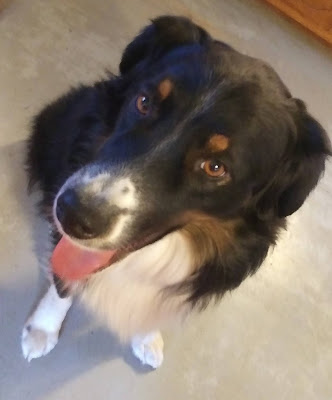

Ready to go!

But Mom needs to bundle up first.

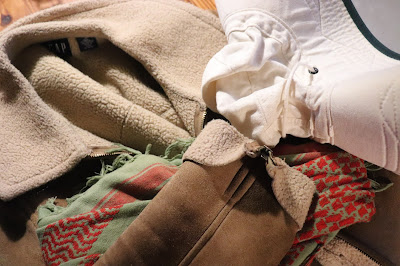
The sun is bright, but the air is cold when we first go out in the morning, and I bundle up accordingly. A jacket I found in a Traverse City, Michigan, Goodwill store in 2015, on the $1 sale rack because of a tear at the end of one sleeve, still works for me perfectly in Dos Cabezas, the rough leather brushing off thorns the way an umbrella sheds rain. Old dog-chewed shoes work, too (Peasy did that, not Sarah), as does a terribly unflattering wide-brimmed hat. Here one must protect against both cold and sun on early mornings -- go out without a brim in the morning, and walking east is walking blind.
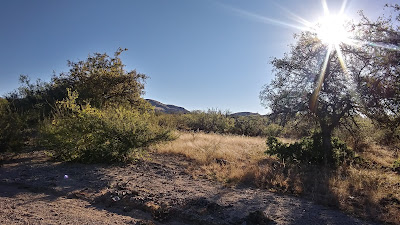


A wash tells the story of summer rains, or monsoons, as some here call them. During a monsoon, washes turn from dry, sandy beds to torrential rivers in minutes. “Do not enter when flooded,” say signs along the roads, and even now, many weeks later, ghostly images of currents remain to show paths taken by relentless, rapidly flowing water.
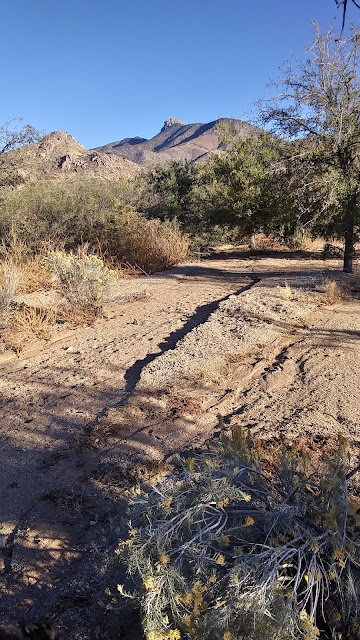


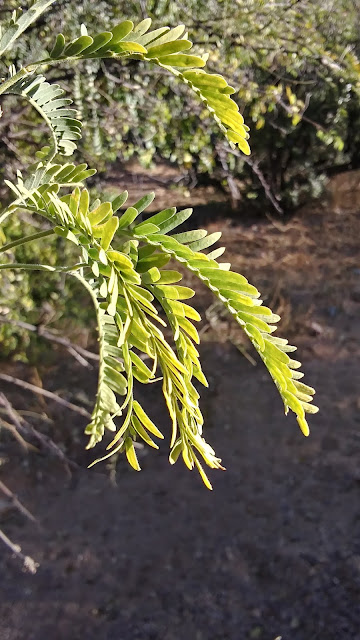
The color green also tells of plenteous summer rains. So much green still, in November!


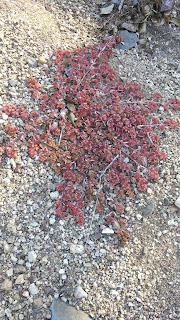
But there is red, also, and I need to learn the name of this ground-hugging plant, which can also be found along the edges of the highway, breaking through the pavement. 


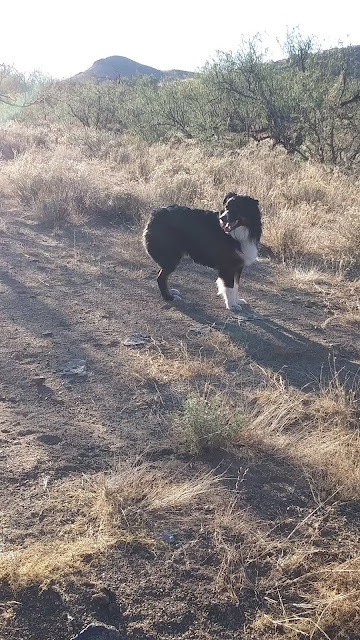
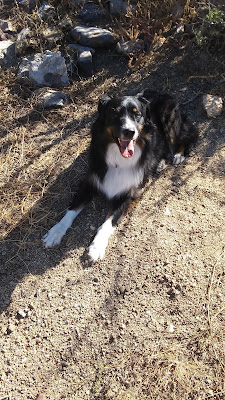
And here is Peasy again. Because you never tire of Peasy pictures, do you? Isn't he a pretty boy?


As the desert day continues, it will often include a trip into our nearby town of Willcox, but I’ll save Willcox for another day and tell you now about evening and night in the high desert. In late afternoon, an insect chorus starts up and continues into dusk. Are the singers crickets or cicadas or a blended choir of both? Whatever they are, they settle down as darkness falls. Everything goes quiet then unless a dog barks in the distance. It is then that stars take ownership of the desert – stars, jets high overhead, too far away to hear, and maybe a silent satellite zipping and blinking by. Once in a while coyotes yip, that familiar sound that reminded me of our Michigan home the first winter we spent here in the ghost town.


Morning, afternoon, evening -- I feel very peaceful here. No doubt part of my contentment is the freedom of seasonal retirement: no schedule to keep, no daily obligations except to care for my little family. I haven't yet finished the exciting book about the steeplechase riding woman in Czechoslovakia. So many possibilities present themselves every hour, it's hard to settle down! 


Who lives here in this ghost town, delighting in open space and in friendly neighbors? For now, the Artist and I and our special needs dog are right at home. I'll tell you more about desert dog's behavior here in my next post. Or the one after that, maybe. Because who knows what the future holds?
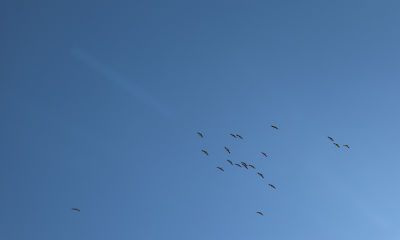

The sandhill cranes have come for the winter, too.


Monday, May 13, 2013

An Urgent Plea for Bees


You say you’re not a farmer? Well, do you have a lawn? We need to stop killing bees! PLEASE READ ON!

The April 2013 issue of Acres USA magazine (Vol. 43, no. 4), “the Voice of Eco-Agriculture” in this country, has an article by Donald Sutherland entitled “The Silent Spring.” The title should sound familiar: Rachel Carson’s 1962 book, Silent Spring, was an indictment of the American attempt to dominate nature with chemistry, poisoning the environment with DDT. It was a wake-up call. Have we gone back to sleep? Looks like it.

Sutherland’s article in Acres focuses on widely used pesticides called neonicotinoids that get their name from their relation to nicotine. They are “in a class of insecticides that attack the central nervous system of insects,” and they are “toxic through the entire growing season.” Corn, soybeans, other vegetables, soil, seeds, timber, animal pests, fruit and nut crops –scarcely anything grown by American farmers is not treated with neonicotinoid, although all fruits, vegetables and trees depend on bees to pollinate their blossoms to produce seeds, vegetables and fruits!


Well, it must be safe, right? If the EPA and USDA allow its use? Think again.

A Purdue University study published in January 2012 concludes that the use of this class of insecticides is killing pollinating bees and can hang around in the soil for years. A study from Harvard School of Public Health links the pesticides with colony collapse disorder (CCD). France, Italy, and Germany have banned their use since 2008, and now the entire European Union is on board with the ban. The company producing the insecticide is a German company, and yet Germany banned the product, which is now banned throughout Europe. Not the U.S., though. While Europe was deciding to institute a continent-wide ban, our own EPA chooses to grant approval of the bee-killing poison.

If you’ve read this far, whether or not you have followed the links – which I urge you to go back and do if you haven’t – you should be getting an inkling of how how bad the situation is, but it’s worse than that, because who more than Americans has such a fetish for perfect lawns? Yes, lawn and garden products also contain neonicotinoids, so if you’re spraying your lawn or hiring a lawn care company that is spraying your lawn, please take time today to look into what you’re doing or having done in your name. Writes Sutherland:
Read the ingredients and look for any of these substances: clothianidin, acetamiprid, dinotefuran, nitenpyram, thiacloprid and thiamethoxam.
Please boycott products containing these toxins and tell everyone you know to do the same. You will be doing what you can at home to safeguard your country’s food supply, and isn’t that more important than a synthetic-looking green carpet around your house? Beyond the boycott, we need to harass our so-called representatives in Congress about this danger.

Water, soil, bees – we're dependent on them for survival. Why is a government agency set up to protect citizens not doing its job? Another five-year study required? Will there be any bees left by then? 
If the Bill of Rights contains no guarantee that a citizen shall be secure against lethal poisons distributed either by private individuals or by public officials, it is surely only because our forefathers, despite their considerable wisdom and foresight, could conceive of no such problem. - Rachel Carson


Sunday, April 24, 2011

Easter Morning Walk in the Woods (Corrected) and Spring Gardening Ideas


Everyone in and around Northport watches the spot along the highway south of town where a large colony of bloodroot (Sanguinaria canadensis, a member of the poppy family) blooms in early spring, but how did one lone plant come to be in the woods near my home, where I’ve never seen bloodroot before? Did it hitchhike in the body of a deer? I went back on Easter morning to check on my new neighbor again. The flowers weren’t any closer to opening, but this time I had my camera with me, so you can see my other blog for more photos of the little darling. But thanks to Gerry Sell at Torch Lake Views for setting me straight: this is not bloodroot! At Gerry's nudge, I checked out another possibility, and she was right, I was wrong.

Here is part of the description of round-leafed hepatica given by Harry C. Lund (Michigan Wildflowers in Color):
Usually many individual flowers per plant, each with many thread-like stamens in its center, and each borne single on a hairy flowerstalk; 3 hairy bracts that resemble sepals below each blossom.

Leaves are smooth with 3 rounded lobes; leaves persist through winter. At blossom time these overwintered leaves are present and have a brown-purple color. New leaves develop after blossom time.

Round-leafed hepatica, or liverwort, Hepatica americana, is a member of the crowfoot family, Ranunculaceae. The cowslip, or marsh marigold, is also in this family, and we should start looking for it in boggy places and along streams before too long.

All of us in temperate climates find our thoughts in spring turning to the birds and the bees—and the butterflies, too--and this season I'm happy to have at Dog Ears Books a new title to inspire and excite and energize us all for the work ahead.


This book emphasizes what you as an individual can do to protect and strengthen pollinator populations by guiding you through the steps necessary to manage or enhance pollinator habitat in your backyard, farm, school campus, or natural area. However, to protect pollinators for the long term it’s important to consider these species and their ecological role in a larger context, and to enact policies that protect them on a local, national, and international level.

We stand at a crossroad. Honey beekeepers lose unprecedented numbers of their honey bee colonies each year. Once-common bumble bees are disappearing across North America and Europe. Heavily developed agricultural and urban landscapes lack the habitat to support a diversity and abundance of bees, butterflies, and other pollinators.

- Attracting Native Polinators: Protecting North America’s Bees and Butterflies. The Xerxes Society Guide. North Adams, MA: Storey Publishing, 2011


Another bad news story? No, the good news is that when it comes to pollinators and habitats to support them, you can do something, and this book tells you how. Your beautiful and entertaining butterfly garden will double as a bee garden, providing habitat for insects that do critical work to feed all of us. Presenting material clearly, with lavish color illustrations, this informative book is full of delights and surprises.


Friday, May 14, 2010

My Sister Will Like Some (Not All) of These Little Things


Sarah helped me find the remains of a little, abandoned herb garden behind an empty building in town that used to house a restaurant. (Everyone in town will know from this description just where the garden remnant is.) You know how dogs are. She was lolly-gagging around, discriminating carefully between one spot of ground and another, as if she were building a house instead of merely taking a pee, and suddenly I smelled mint. Looked and saw it. Looked some more and saw chives. Looked some more, rubbed a leaf--lemon balm. What a nice surprise!


Later in the day, when we took another break and went out to one of Sarah's favorite places to run, I was not thrilled at all to see tentworms.


If you want to know more about them, this is one of the best sites I found. I took the hose to our little plum tree a couple of weeks ago to get rid of the tentworm webs there. But this time, on municipal ground, I took a closer look. Everything is fascinating when you look closer. I look at these bits of life and remind myself that from Nature's point of view, they are as valuable as anything else. We don't want them around, but they're just trying to make a living according to the kind of beings they are.


It's easier for me to be charmed and entranced by mosses and fungi and lichens. Who could fail to love British soldiers? I can resist a man in uniform easily, but not these little guys.


And then the rainbow of life on an old, punky, rain-soaked branch fallen from one of our basswood trees:


My question is, which comes first, the fungus or the weak punkiness of the wood? Does one bring on the other?