Search This Blog

Sunday, July 5, 2015

What Do You Need, Really Need?


Oxygen, right? Air to breathe. Water is a baseline requirement, as is sufficient food, and you can’t live without sleep.  I’m sure we can agree on those.

The way psychologist Abraham Maslow looked at human needs, only after the basics were covered would anyone worry about needing more.  Maslow’s notion of a hierarchy of needs has been questioned by critics, but most of us have noticed that we have a hard time concentrating when we’re too hungry; as much as the spirit may want to soar above the body, the body is not going to stop making demands.

Okay, then, what about love? Or do you prefer power? Then, security – or excitement? Challenge – or comfort?

The other day one of my regular customers, with a heartfelt sigh, asked the rhetorical question, “What do people do who don’t read books?” For her, as for me, books are among life’s necessities. If I had never learned to read or had had no access to books, I would never have traveled to medieval China, never met Helen Keller, never had a horse – and that very short list of experiences I would have missed without reading books could obviously be extended to book length itself.

But that’s not my object at present. I’m sneaking up on my real question in roundabout fashion. Do we need poetry in our lives? Here is one explanation for the affirmative, not necessarily the one I would give but an interesting perspective.

Did you read poetry back in grade school and high school? Only because you had to, or did it give you something other kinds of reading, as well as other kinds of experience, could not provide? Have you continued reading, maybe even writing poetry in your adult life?

Sometimes I think the reading of poetry, for busy grownups, is like lying in the grass on a summer’s day to watch clouds. It’s easy to forget from day to day about clouds and poetry as the days succeed each other with increasingly ferocious speed until one day, startled, we realize that years have gone by.

To read a poem first thing in the morning or last thing at night, like taking half an hour on a summer afternoon to watch clouds, is to give ourselves valuable personal time off from otherwise over-organized lives. And we can do it. We can give ourselves the time, calm our spirits, and enrich our lives, too, by freshening our senses and understanding with poetry. 

Note to those who “don’t understand” poetry: Turning reading into work is not necessarily the answer to enjoying poetry. Just as we don't need to analyze clouds to lose ourselves in watching them drift by (and everyone sees something different in the shifting shapes of clouds), so with poetry. Let the sounds and rhythms pour down on you like warm, gentle rain. Let images arise in your mind as they will. Perhaps one small phrase, three or four words, will resonate meaningfully, and that will be the poem’s gift to you. You do not owe it the ordeal of analysis.

Note to writers of prose: All of us who write anything have as much to learn from reading poetry as from reading fiction or history or memoir. My customer-friend quoted at the beginning of this post told me that one Michigan fiction writer, a person with some literary authority, has declared line breaks to be the only difference left between poetry and prose – what is done with the line, that is. Well, if he’s right, all the more reason for prose writers to make a practice of reading poetry, but to me there remains a second difference: to me, a poem is a distillation, in a way a book (fiction or nonfiction) or even an essay never can be.

In the best of poems, each word is essential, because the poem’s central thought or emotion or image has been refined to its essence, all extraneous language pared away. And so the exercise of writing a poem is excellent practice for any writer, and reading poetry something no writer can neglect. Stephen King, in his book On Writing, stressed the importance of reading other people’s books every day, and more recently, when asked in an interview what his readers would be surprised to find on his shelves, he mentioned books of poetry. Yes, I was surprised by that, but on second thought it made perfect sense. The most economical and thoughtful use of language can be found in the work of poets.

I know I need poetry, not (like air and water and food and sleep) for bare survival but in order to flourish. Sometimes I forget for a while how necessary it is to me, but having a bookstore gives me plenty of reminders, as do my poet friends.

My next bookstore guest will be Jennifer Clark from Kalamazoo on Wednesday, July 8. She will be at Dog Ears Books beginning at 3 p.m. to read from her collection of poems titled Necessary Clearings.

Here is the first stanza from “Snake Wife” (great title!):

Skin so tight now,

every breath, a chore.

She is not sure how she

stepped into this skin that

once glistened and grooved.

Where will the poem go next from this beginning? Don’t you long to know? Please join us on Wednesday!


Saturday, July 4, 2015

Independence Day 2015 in Northern Michigan

Red, white, and blue
Benjamin Busch, a Michigan author who visited Northport in 2012 with the release of his memoir, Dust to Dust, has written some thoughts on Independence Day that I want to share with you. Follow this link to read his essay from which I excerpt the sentence below.

The strength of the wolf is the pack, one nation, and the strength of the pack is the wolf, one vote. 

Leelanau County's own Kathleen Stocking, as most of you know, also thinks deeply on important matters. Follow this link to read Kathleen's essay on what it means to her to be an American. Here is one of the points she makes there:

People talk about the horrifying poverty in third world countries, but it’s not the poverty that’s scary, it’s the lack of easy talking and thinking. 
So many brilliant and articulate people have shared their thoughts and feelings on freedom that I find I have nothing of my own to add, so I will close with these words from "America the Beautiful."

America! America! God mend thine every flaw, Confirm thy soul in self-control, Thy liberty in law! 

Wishing you all a happy, grateful, beautiful, and safe Independence Day from Northport, Michigan!

Monday, June 29, 2015

Book Review: LOVE, SEX & 4-H


It’s practically unthinkable that anyone in northern Michigan would not know the name – and the work – of Anne-Marie Oomen. Her poetry, plays, magazine essays, and especially her books of memoir have long established her as a distinctive northern voice. Her place and time come through in everything she writes, and her writing is both lyrical and accessible.

Elsewhere, a couple years ago, I addressed the question “What were the Sixties (really) like?” I will not repeat what I wrote then, but if you missed the earlier post, you might want to go back and read it, and after you do, you’ll be even more ready to dig into Anne-Marie Oomen’s latest book.

Love, Sex, & 4-H – the title alone spoke to me! Oomen joined 4-H early, at age 8, when her mother became a group leader. The oldest child in her rural farm family, little Anne-Marie sought in 4-H an escape from farm animals! My exclamation mark is very personal, because I joined 4-H in upper elementary school hoping that membership would be Step #1 to horse ownership. It wasn’t. (No one explained to me that ours was an “urban” club rather than a farm club.) The sewing projects through which Oomen progressed over the years, going all the way to fashion modeling at Michigan State University, left me cold. I stopped early on, with the horrid gathered skirt requirement. Ugh! I did not stay with 4-H past grade school. But I loved the Head, Heart, Hands & Health pledge. Anyway, enough about me....

As Oomen tells the story of her adolescent years, political awareness was far from her life. The larger world intruded only with time-stopping events; otherwise, clothes and boys dominated her personal Sixties consciousness. As I have said many times, the Sixties were different for everyone who lived through them.

Here were sex and love dressed in church clothes, shirt collar just starting to unbutton—utterly seductive, surreptitious as snakes. Except for the fierce familial love of my people, I had no authentic understanding of either of those lunatics, love and sex, as they were expressed in that time. But I had 4-H, and, because of that, I knew this much: I knew how love and sex would be dressed.
Oomen’s experience in the Sixties, then, is not the story of a young radical in the making. Questions about love and sex, however, have come to young men and women in every historical decade of American life, regardless of any larger political context, and they always will. Oomen’s story, while hardly remarkable in itself, is told with remarkable frankness, and that, along with her always beautiful writing, is its strength. She neither paints her adolescence in false colors nor glosses over occasional petty, even shameful behavior. It’s all there, from the first stirrings to the slippery “everything but” slope.


Oomen might have subtitled this book A Memoir of the Sixties, since it covers the decade 1959 to 1969, her life from age 8 to age 18, and it is very much a young Michigan farm girl’s coming of age in that decade when ordinary adolescent turbulence took place in a larger national context of social turbulence. Of the three memoir books she has written – the first two were Pulling Down the Barn, stories of her rural northern Michigan family, and House of Fields, telling of her educational journey – Love, Sex, & 4-H does the most to situate one girl’s experience in a larger perspective. Oomen has many readers who did not grow up on farms or attend one-room schools, but all of us either lived through or (for the younger readers) have known from the classroom the major events of the 1960s. We have all, too, lived through teenage confusions, hopes, and fears, trying to redefine in those years our roles as sister, daughter, friend, and girlfriend (or, for boys, obviously, brother, son, friend, and boyfriend).


New readers are still discovering Anne-Marie Oomen’s book for the first time. Two young women came by chance to the bookstore on Tuesday afternoon, and, urged by Anne-Marie and her Northport bookseller, also attended the author’s formal presentation at the Leelanau Township Library the same evening. One of them was about to embark on an M.F.A. program in creative writing; both were excited to be able to meet and “hang out with” such an accomplished book author. They planned to return to their campsite and read Uncoded Woman aloud around the campfire. “You have to read the poems in order,” I cautioned them. “No skipping around, because there is a narrative.” Anne-Marie took over then and told them something about the protagonist of the poems and the maritime signals that name each poem.

Besides memoir, essays, and poetry, Anne-Marie Oomen has written seven plays for the stage, only one of which I have seen performed – and that one much too long ago. It told the story, all in verse, of farm women in the area now part of Sleeping Bear National Lakeshore. The power of the drama, very minimally staged, surprised and moved me. I want to see it again.

What a privilege and joy it was to spend hours on Tuesday with writer Anne-Marie Oomen! Even without paid vacation or sick leave, there are some very tangible benefits to this bookselling gig. I have the pleasure of introducing my writer friends to one another, bringing writers to readers, and, always, enjoying my small place in American literature’s northern territory.


Friday, June 26, 2015

The Generosity of Writers


Of several photographs I took on Thursday of Holly Wren Spaulding during her reading at Dog Ears Books, the one above was her favorite. I liked it very much as I was framing the shot and quickly saw that it is not unlike the short forms of poetry Spaulding writes and coached us in writing.

Holly Wren Spaulding, a Michigan native and long-time Leelanau County resident, has made her home in Massachusetts for the last couple of years, earning a living as a self-employed writer, teacher, and writing coach. From that you should understand that Holly’s workshops are not generally free, that people are happy to pay good money to work with a writer of her talent and experience. Because of my own 23 years’ experience as a bookseller, however, I was not completely taken by surprise when Holly generously offered to give a little hands-on workshop on short poetry forms, gratis, following her reading at my bookstore.

So she read first, both poems from her newly published collection, Pilgrim, and poems written since Pilgrim went to press, and shared with us the excitement of working on letterpress projects, setting type by hand for a few short lines of her poetry to be printed and framed as art. The lively, engaged audience had questions about the writing process that Holly was happy to answer.

When we got to the workshop portion of the event, Spaulding began by giving an introduction to the short forms of haiku and tanka and reading a few examples of these and other short poems less rigorous with regard to number of syllables. Then we were given our assignment: Think of a single encounter with the natural world, preferably within the last 24 hours. Try to capture the moment and make a human connection to it. I’m not going to share my “finished” piece (only finished in the sense that time was up), but the encounter I chose was the one pictured below.


At first, looking for words to capture the moment I thought I had to mention the chipmunk’s stripes and its bright beady eyes. With trial after trial, however, what remained in each draft was the prayerful attitude of the tiny paws held to the chest. That for me was really the essence.

As, I think, the image of Holly’s hands at the top of this post, one hand holding a sheaf of poems on paper, the other gesturing to the audience, is the essence of her visit to Northport. 

Holly Wren Spaulding, thank you again for giving us your time. It was lovely having you here. I know the audience members who are also writers are very grateful to have had the opportunity.

Reminder: Next week, on Tuesday, June 30, Anne-Marie Oomen will be at Dog Ears Books from 3 to 5 p.m., signing her new book of memoir essays, Love, Sex, and 4-H. Please stop in and meet another generous Michigan writer making a trip clear up to Northport!

Tuesday, June 23, 2015

Bring Pencil and Paper! (Pen Okay, Too)

My most important news today is reminding everyone about Thursday's author event at Dog Ears Books in Northport. We will be hosting poet Holly Wren Spaulding, with her new collection of poems, Pilgrim. Holly will read her work and take questions from attendees, and we will have a wonderful conversation, as we always do with our visiting writers. 

Then, following all that, Holly is generously offering to lead a free workshop in short poetic forms! This is an opportunity not to be missed, for everyone from professional writers to secret, closet poets. 

Holly Wren Spaulding is a teaching artist, editor and creative coach. She is the founder of Poetry Forge (an incubator for writers and their work) and with her husband, author Matt Rigney, Holly co-directs STORYhouse Partners. Her writing has appeared in The NationMichigan Quarterly ReviewWitnessThe Ecologist, in the book We Are Everywhere: The Irresistible Rise of Global Anti-Capitalism (Verso) and elsewhere. Her most recent collection of poems, Pilgrim, was released in 2014 by Alice Greene & Co. She serves on the faculty of the Interlochen College of Creative Arts and is an advisor to the board of the Institute for Sustainable Living, Art & Natural Design.


Please mark your calendar, set your smart phone alarm, or whatever you need to do so you won't forget to come to the bookstore at 4 o'clock on Thursday afternoon


Thursday, June 18, 2015

Is It Possible to Steal Time? If So, Is There a Penalty?


Wednesday was busy. With my first author event of the season scheduled for 7 p.m., I was up and out the door early, with many errands to accomplish in Leland, Lake Leelanau, Northport, and back at the old farmhouse. All the silly fretting I’d done about the weather, though, had been so much wasted energy. It was absolutely a glorious day!

With Bruce at the bookstore helm in Northport, I returned home early in the afternoon to tend to cleaning, cooking, dog, and laundry. Then about 2 o’clock I took a deep breath and decided I’d earned a break. Took a book out on our front – what is it? a deck? a walk? – wooden walkway, where a couple of big wooden chairs now invite lounging. Having already opened a cold beer, I sat down and opened my book. How marvelous!


Scolding chipmunks (scolding Sarah, I believe, not me) had me looking up every few minutes, as did birds singing high in the trees, and then I would notice all over again the blooming flowers visited by bees and admire once more my pretty dog lying in the grass and feel a shiver of delight to be sitting there outdoors with book and beer and dog, chipmunks and flowers and sunshine and green things growing all around. It was a distractingly beautiful day. I was not, that is to say, completely focused on my book to the exclusion of the world around me. But then, I didn’t want to be. The experience made a perfect whole.

Were those stolen moments? Was it a stolen hour? I could have been pursuing household cleanliness more thoroughly, but I knew my houseguest, author Ellen Airgood, taking a couple of days out of her very busy life to come to Northport, would understand and condone my indolence. I trust her that much.


Ellen has a hard time finding 10 minutes a day to spend outdoors, so when she arrived her first request was to sit “in the sun,” and accordingly we moved from shaded walk to sunny table, and there we enjoyed a few bites and sips before coming back to Northport for Ellen’s reading and book signing.

What can I say? She is a wonder – wonderful writer, wonderful friend, wonderful worker. “Her books are about real life,” another friend of mine says with deep appreciation.

That appreciative, book-loving friend and others found time at the end of their own busy days to come to Dog Ears Books last night to hear Ellen read (from her new book, The Education of Ivy Blake, and from a personal essay in the new anthology, Here: Women Writing on Michigan’s Upper Peninsula) and to ask her questions about her writing, her books, her characters, her life. It was good conversation, relaxed and honest. Afterward, Ellen and I took the long way home via my favorite back roads, and then this morning we had more time for quiet conversation over leisurely breakfast and coffee.

I thought again – actually, several times – how fortunate I am in my rich literary life. Ellen says about her hard work at the West Bay Diner she and her husband own in the U.P. exactly what I feel about Dog Ears Books in Northport: “Without the business, look at all the wonderful people I would never have met!”

Our leisurely morning, time that could be seen as “stolen” for both of us, felt good. I felt rewarded rather than penalized for having stolen that time. I hope Ellen also feels rewarded having seized yesterday.

As we sometimes say here in the Leelanau, “Seize the carp!”


Tuesday, June 16, 2015

Upper Peninsula Comes South!


Ellen Airgood is coming to town, from the shores of Lake Superior, and I’m so happy and excited my toes are dancing in my boots! Here are Ivy Blake’s boots on the cover of The Education of Ivy Blake, Ellen’s latest novel for young people. Ivy is a 5th-grader, so if you know a 5th-grade girl who would like to meet an accomplished and very welcoming, friendly book author, bring that girl to Dog Ears Books on Wednesday for a memorable evening. Coming by yourself or with friends your own age is fine, too. You won't be sorry.

Who was the first author you met? How old were you? What do you remember of the meeting?

My photo at the top of the page shows several Airgood books. (Not all, because one anthology she appeared in seems to be no longer in print.) South of Superior was her first novel, and Prairie Evers her first novel for a younger audience. Ivy and Prairie become friends in Prairie Evers, so while it is not necessary to have read the first to enjoy the second, anyone who reads The Education of Ivy Blake first will want to go back to read Prairie Evers, too. Read or re-read, I should say. Ellen Airgood’s books are eminently re-readable – and I say this having read South of Superior all the way through four times.

The two anthologies that include Ellen Airgood pieces are excellent, as well. A couple customers just the other day were telling me how much they have been enjoying The Way North: Collected Upper Peninsula New Works, edited by Ron Riekki. Riekki also edited the new collection, Here: Women Writing on Michigan’s Upper Peninsula, which features work from several decades, both poetry and prose. Good stuff, all this!

Wednesday, June 17, 7 p.m., Dog Ears Books, 106 Waukazoo Street, Northport, Michigan: Ellen Airgood, reading from and signing The Education of Ivy Blake

Below is a glimpse of Ellen at a different kind of work. You'll have to ask her how she finds time to write books!

At West Bay Diner, Grand Marais, Michigan


Saturday, June 13, 2015

There Was Music in the Air in Northport


Friday night was the spring concert by the Leelanau Children’s Choir & Leelanau Youth Ensemble. The performance at the Northport Community Arts Center bore the title “Music That Moves You,” and the selections performed lived up to the show’s title. Let me quote from director Margaret Bell’s director’s letter at the front of the program:
Music forms such an incredibly rich backdrop for so many events in our lives. There are the traditional songs played at graduations, weddings, and holidays. There is parade music, memorial music, and music to enhance our movie experience. Some music prompts us to tap our toes, “get up and boogie,” or unabashedly “shake it all about.” Music surely seems to be all around us – everywhere and all the time. 
Some of the most poignant and powerful music is that which evokes a memory or an emotion. The song that takes you back to a summer evening in your youth, the one that takes you back to a beach vacation, the song that played when you first kissed the one you love.

The program’s popular music ran from Irving Berlin to Chuck Berry. American musical theatre was well represented, with songs from “The Music Man,” “Les Miserables,” “West Side Story,” and other shows.


Several students from the choirs came forward between numbers to read essays they had written on the topic “Music That Moves You.” Their words, like the music, were moving.


LCC&LYE concerts are always stirring, happy and also poignant occasions, as former “little ones” grow up and seniors graduate and leave (often coming back to join their successors as alumni  performers). I am always happy to be in the audience, happy to look on the eager, attentive faces of the singers as they make their hard-working director proud. Accompanist Linda Davis came in for special recognition and appreciation this year, also.

But the young voices – those are what the choir and youth ensemble are all about. This spring’s concert included many beautiful solos, duets, and trios I could not capture on camera, entranced to stillness as I was by the singing.


Leelanau County is indeed fortunate (to put it mildly) to have these musical groups for our children and youth. LCC&LYE would not have come into existence without Margaret Bell. With her continued dedication and hard work, the dedication and hard work of her students and their accompanist and all the people who work on costumes and put together the shows and support the groups financially, choral music grows stronger every year in Leelanau County.

One thing I would like to see is more Northport involvement. Having the spring concert in my little village thrills me, and I would love to see more young Northport faces onstage and more Northport families and other residents in the audience.

If you want to be moved by music, there’s no better way than to go to a concert presented by the Leelanau Children’s Choir & Leelanau Youth Ensemble! Better yet, besides attending you can be part of the group by sponsoring. Because it's all about the kids.


Friday, June 12, 2015

Revisiting “Affordable” in a Larger Context: Is There a “Common Good”?


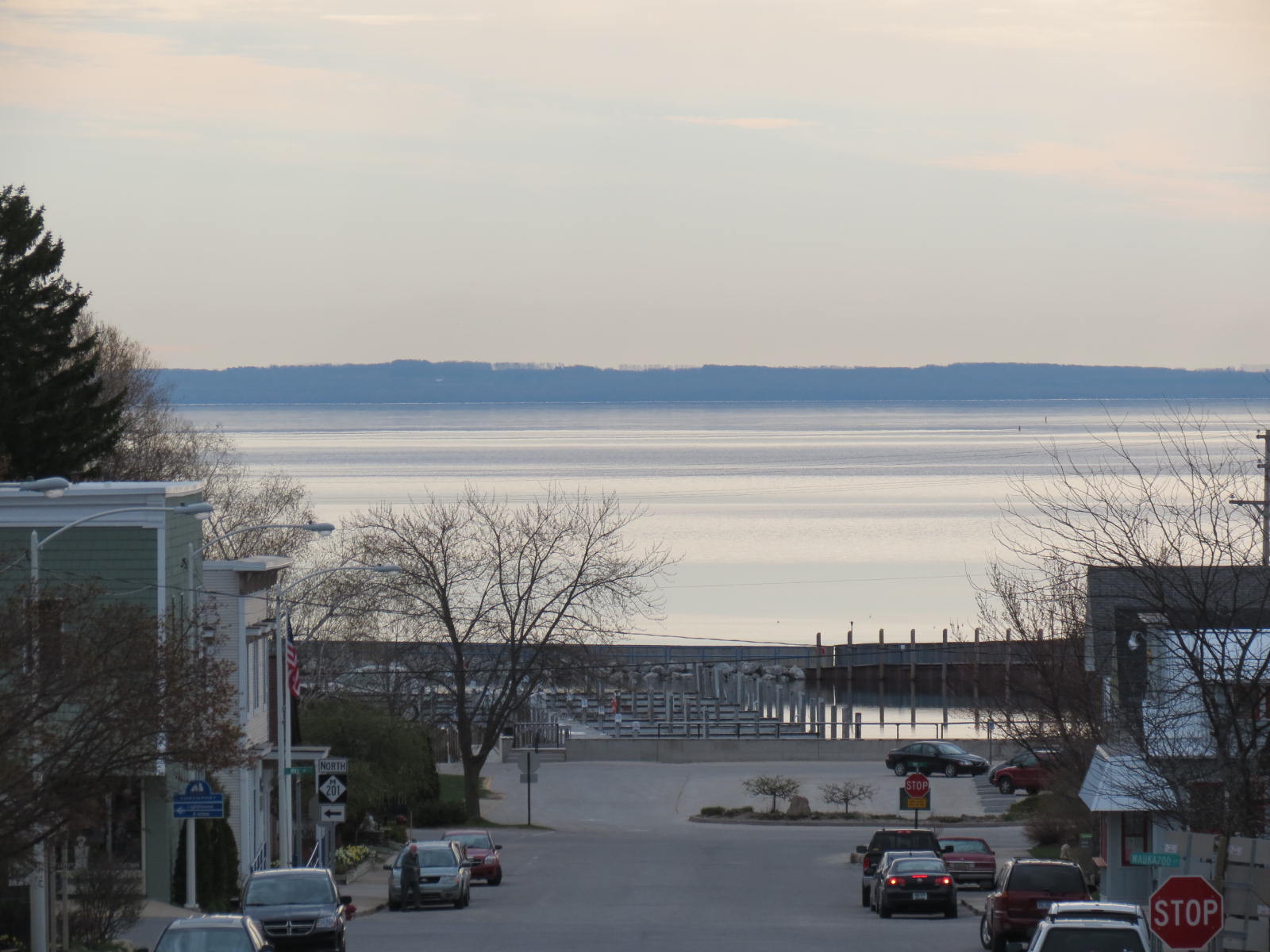
Before the leaves, before the boats


Some thoughts are like perennial itches: you can scratch and scratch away at them for years, and they never go away. One such thought, for me, is that of the common good, a venerable idea in Western philosophy but seemingly in decline in our day.

For instance, the original idea of public schools in the United States of America was that it is for the public good that all citizens of a republic be educated. Self-government demands general education for all. (The words chiseled over the proscenium of my high school auditorium were from Diogenes: “The Education of Every State is the Education of Its Youth.”) In the current American climate, parents are much more likely to see education as something they want their children to have as a competitive edge over other kids in the country. In this new discussion, I don’t hear concern for the future lives of those educated, successful children and their children in a country of increasing inequality. If this sounds like an accusation, I suppose it is, in part, but another important part is that I simply don’t understand. I don’t understand wanting that kind of world. It isn’t what I want for my kids and grandkids.

As Leelanau County tackles  the difficult and thorny issue of affordable housing (see previous post), schools are part of the discussion, but what is at stake in our little villages is not keeping poor kids out of our public schools but keeping enough kids in school to keep the schools open! What is a community without a school?

It’s probably more than coincidence  that NPR last night had a feature on a proposed affordable housing project in Marin County, California, since northern Michigan communities are far from the only ones faced with the issue. (Interesting that the headline reads “debate against [sic] affordable housing.”  A debate presents opposing arguments, not the arguments of a single side, and in fact the Californians in the story fell onto both sides of the issue, not always on the basis of who was in the boat and who was in the water.) On my way to Northport this morning, headed for my little, 23-year-old, independent bookstore, a particular word in one Marin County man’s complaint about the proposed project kept bouncing around in my head, unable to settle in a comfortable resting place. The word was sacrifices.
“I made great sacrifices to be here,” he says. “I think it's selfish to expect that someone else should be able to acquire (it) for little or next to nothing.”  
That’s only a snippet, and it doesn’t tell me much, but I can’t help wondering what the man means. I can understand parents sacrificing for their children. I can understand soldiers sacrificing for their country. But if I give up something to gain something I want more, how is that a sacrifice? Isn’t it simply a question of priorities, of knowing what is most important to me? Isn't a sacrifice something given up?

What of another household in which the homeowners’ inherited wealth enabled them to buy into the neighborhood? They could not be said to have sacrificed, could they? Do we want to say their parents made the sacrifices? Well, maybe they did, and maybe they didn’t. Who knows? And how many generations back do we want to go -- until we reach unscrupulous ancestors?

To believe that everyone with wealth earned every single penny by the sheer sweat of his or her own brow, with no help from anyone and no advantages of upbringing, and that every poor person is poor merely because he or she does not work hard is nothing but self-serving myth. No one has more than 24 hours a day in which to live, and not all those hours can be devoted to work. Sleep has to figure in. Do people with 100 times as much money work 100 times as many hours a day? I’d say not.

Back to my original thought-itch, that of the idea of the common good? What is it? A Santa Clara University site defines it as “social systems, institutions and environments on which we all depend” working in such a way as to “benefit all people,” which would surely include public safety, schools, and conservation of natural resources, at a minimum. The Santa Clara site is worth visiting for discussion of problems associated with the very idea of the common good. In a pluralistic society, individuals hold different values have different priorities. Moreover, a “common good,” by definition, is one in which everyone benefits, while some will have contributed more than others.

Some people might make an entirely different objection, not to practical problems but with the theoretical object itself. Like Socrates, questioning his friends, shredding their definitions, and deconstructing social practices to demonstrate that everything we believe is unreal (perfect “forms” existing only in some other realm), a Platonist would show you that the common good on earth is nonexistent. Have you ever seen it? Can you point to an instance of perfect benefit to all?

Some work harder, some not as hard, and some pay more dearly than others. That’s all true. It’s also true, I’d say, that all of us in this country have the advantage of certain unearned benefits, beginning with being here at all. Working toward the common good, then, toward an ideal (what else is “liberty and justice for all” but an ideal?) can be seen as making payments for what we have already received. Credit was extended to us. We need to earn, after the fact, what we received without having prepaid.

It is not individuals we are rewarding (whether “deserving” or not) but society we are paying back by ensuring its continuity. We are building a better world. And it we can only make our payments one person, one action at a time.


Thursday, June 11, 2015

Book Review: BEING MORTAL


Being Mortal:
Medicine and What Matters in the End
by Atul Gawande
NY: Henry Holt/Metropolitan, 2014
Hardcover, $24

I learned about a lot of things in medical school, but mortality wasn’t one of them. ... Our textbooks had almost nothing on aging or frailty or dying. How the process unfolds, how people experience the end of their lives, and how it affects those around them seemed beside the point. The way we saw it, and the way our professors saw it, the purpose of medical schooling was to teach how to save lives, not how to tend to their demise.
So begins Gawande’s latest book, important and well worth reading, as his writing always is, and particularly relevant to individuals in what the French call the “third age” of life (think of the riddle of the sphinx) and those who are or soon will be caring more and more for that generation as time brings about the inevitable.

Every doctor, every nurse, sooner or later must confront death, but Gawande notes that until recently few in modern medicine were given tools to deal with the situation. Instead, American medical training has focuses on testing, recording, gathering facts, prescribing drugs, and offering patients an increasing number of choices among an array of procedures with hoped-for but unclear outcomes. Death was the elephant in the living room, the one everyone knew was there but no one wanted to mention.

Medical costs in the final year of life are astronomical, as everyone knows but equally unfortunate (perhaps worse), Gawande believes, is the harm inflicted when people are “denied ... the basic comforts they most need.” And “basic comforts,” it turns out, are more than food and shelter and safety.

The most frequent complaint Gawande hears from nursing home patients is, “It just isn’t home.” However homelike in appearance (appearances often geared to appeal to residents’ adult children rather than residents themselves), in most facilities designed for care of the frail elderly, residents lack the privacy and autonomy most of us take for granted all our lives.

Gawande traces the history of the “assisted living” movement from its origin in the vision of a West Virginia coal miner’s daughter. When Keren Brown Wilson’s mother, Jessie, needed help with the basic tasks of living, there was nowhere for her to go but a nursing home. The daughter, a college student at the time, never got over her mother’s frequent plea, “Take me home,” and because of those pleas, Keren Wilson developed an interest in issues related to aging and eventually earned a doctorate in gerontology. What her mother had in mind for “home” was not a place designed for her health and safety (placement considerations important to most children of the elderly) but a place where she could be herself again, not a patient, but Jessie the person. Dr. Wilson wrote a paper to outline what such a place might look like.
The key word in her mind was home. Home is the one place where your own priorities hold sway. At home, you decide how you spend your time, how you share your space, and how you manage your possessions. Away from home, you don’t.
For a variety of reasons, Wilson’s original idea became diluted beyond recognition as “assisted living” facilities popped up all over the country, but Gawande visits and describes a few places where privacy and autonomy, key to Wilson’s original vision (rather than regimentation) are the rule.

Paramount at every stage of aging, whether or not it involves terminal illness, is “how to make life worth living when we’re weak and frail and can’t fend for ourselves....” What makes life worth living will vary from one individual to another, and the point of the “hard conversations” with family members and medical staff is to determine, in each case, what makes life worth living to this particular individual. For one man, being able to eat chocolate ice cream and watch sports on television was enough. “My dad,” Gawande tells us, in one of the passages focusing on his own experience with his frail, aging surgeon father, “didn’t think that would be good enough for him at all.”

Not surprisingly, there is a lot in Being Mortal about hospice and palliative care. The idea of offering “concurrent care” actually came from an insurance company. Instead of having to choose between hospice and other treatments, policyholders with less than a one-year life expectancy could continue their regular treatment and receive hospice care. Since they did not have to give up anything, enrollment in hospice jumped from 26 to 70 percent. More surprising were some of the other results:
They visited the emergency room half as often as the control patients did. Their use of hospitals and ICUs dropped by more than two-thirds. Overall costs fell by almost a quarter.
Gawande cites a 2010 study from Massachusetts General in which patients with stage IV lung cancer were randomly assigned to two different groups.
Half received usual oncology care. The other half received usual oncology care plus parallel visits with a palliative care specialist ... The result: those who saw a palliative care specialist stopped chemotherapy sooner, entered hospice far earlier, experienced less suffering at the end of their lives—and they lived 25 percent longer.
In other words, not only was it cheaper to add hospice care to other treatments, but terminally ill patients lived longer, had fewer emergency incidents, and their quality of life was higher. Gawande attributes much of the difference to the open conversations that hospice encourages and the focus of its staff on the person and his or her individual values and goals rather than on hope for recovery.

Conversations about end-of-life choices, he admits, are not easy. They take time and may “unleash difficult emotions” for all involved. In the end, however, they can make all the difference. The battle analogy he uses to make his point comes from the 19th century and pulls no punches:
Death is the enemy. But death has superior forces. Eventually, it wins. And in a war that you cannot win, you don’t want a general who fights to the point of total annihilation. You don’t want Custer. You want Robert E. Lee, someone who knows how to fight for territory that can be won and how to surrender when it can’t, someone who understands that the damage is greatest of all if all you do is battle to the bitter end.
The author of Being Mortal shares with readers not only his medical experience and the fruits of his research into how society deals with aging and dying, but also his own personal story, that of a loving son distressed to see his father losing ground.

My only wish – I will not call it a complaint – is that an index would have been helpful. I highly recommend this book.