Search This Blog

Showing posts with label schools. Show all posts

Thursday, October 29, 2015

The Higher and Higher Costs of Higher Education


Rainy prospect


Recently a Facebook friend posted a link about college costs, and I followed it to read the article, “Students in Debt, Professors in Poverty – What’s Going Wrong?” because I’ve thought a lot on this subject and talk to other people who think about it a lot. 

The article turned out to address a single issue: the replacing of fulltime faculty with adjunct instructors, most with equivalent qualifications in terms of degrees but paid only per course, with no benefits and no future job security. None of this was news to me. I’ve taught as an adjunct and know the reality of it from the inside. The article calls it the “subcontract business model.” Okay, but what about those students in debt? What about that part?

Focus on the orchard or focus on the trees?

Not long ago I had raised the question with another friend: “If schools are paying less for instructional employees, what’s with the astronomical and mounting tuition?” I’d wondered a long time and never gotten an answer better than the one she gave me: “States are no longer funding their so-called ‘state’ universities, except at a very minimal level.”

Once you know what to look for, the information is not hard to find. The first article I turned up in my search is very detailed and might tell you more than you want to know – but then, you don’t have to read every word. It’s definitely worth a look. The shortcoming of the picture presented there, in my opinion, is that it only looks back as far as 2007.

The second story I’ll direct you to, "State Funding: A Race to the Bottom," is more focused on state funding and goes beyond a look at “pre-recession” levels, going back to 1975 to present a much longer history. Here we learn that since 1980 48 states have reduced state funding to their own universities by anywhere from 14.8% to 69.4%. 

Extrapolation from data can be a lot of fun. Take, for example, one of my favorites, the rising number of Elvis impersonators. Extrapolating from the trend one can forecast a year in which all Americans will be Elvis impersonators. The trend in reducing state support for education is not nearly as funny. 

Colorado has reduced its support for higher education by nearly 69.4 percent, from $10.52 in fiscal 1980 (and a peak of $13.85 in fiscal 1971) to $3.22 by fiscal 2011. At this rate of decline Colorado appropriations will reach zero in 2022, 11 years from now. Projections using more recent data find that Colorado could hit zero as soon as 2019.

By the way, the phrase "race to the bottom" fits so many areas of human economic life these days, doesn't it? Work harder, accept less pay, or lose your job!

It's easy to get distracted from the big picture.

Adjunct faculty are hardly the only ones hurt by funding trends in higher education. Yes, those of us with higher degrees are exploited, but, much more to the point, states are no longer seriously investing in higher education. The term "state" university is becoming a misnomer. The school bears the name of its home state and may have a board elected by voters at the state level, but increasingly low levels of state funding shifts the burden of tuition more and more to students and their families. These are now largely private schools flying under state flags.

The cause for tuition hikes may be news, but the consequence is familiar to all informed Americans: astronomical levels of student debt. Some economists even think the idea of student loans as investment is a replay of the housing bubble. And as usual, families and students with the least are hurt the most.

Libertarians and others who have been trying to "get government out of education" have been winning the day behind the scenes, privatizing higher education behind our backs, and our children and grandchildren are paying the price. Will our entire country soon find itself paying the price, as more and more jobs requiring higher education cannot be filled by educated Americans?

How do you see this complicated picture? And were the funding facts news to you?

Where are we going? Is it where we want to go?


This is an important topic, one I'd like to discuss at greater length, but at the moment I need a break. Time to turn once again to Chaucer and his entertaining fourteenth-century pilgrims.




Friday, June 12, 2015

Revisiting “Affordable” in a Larger Context: Is There a “Common Good”?


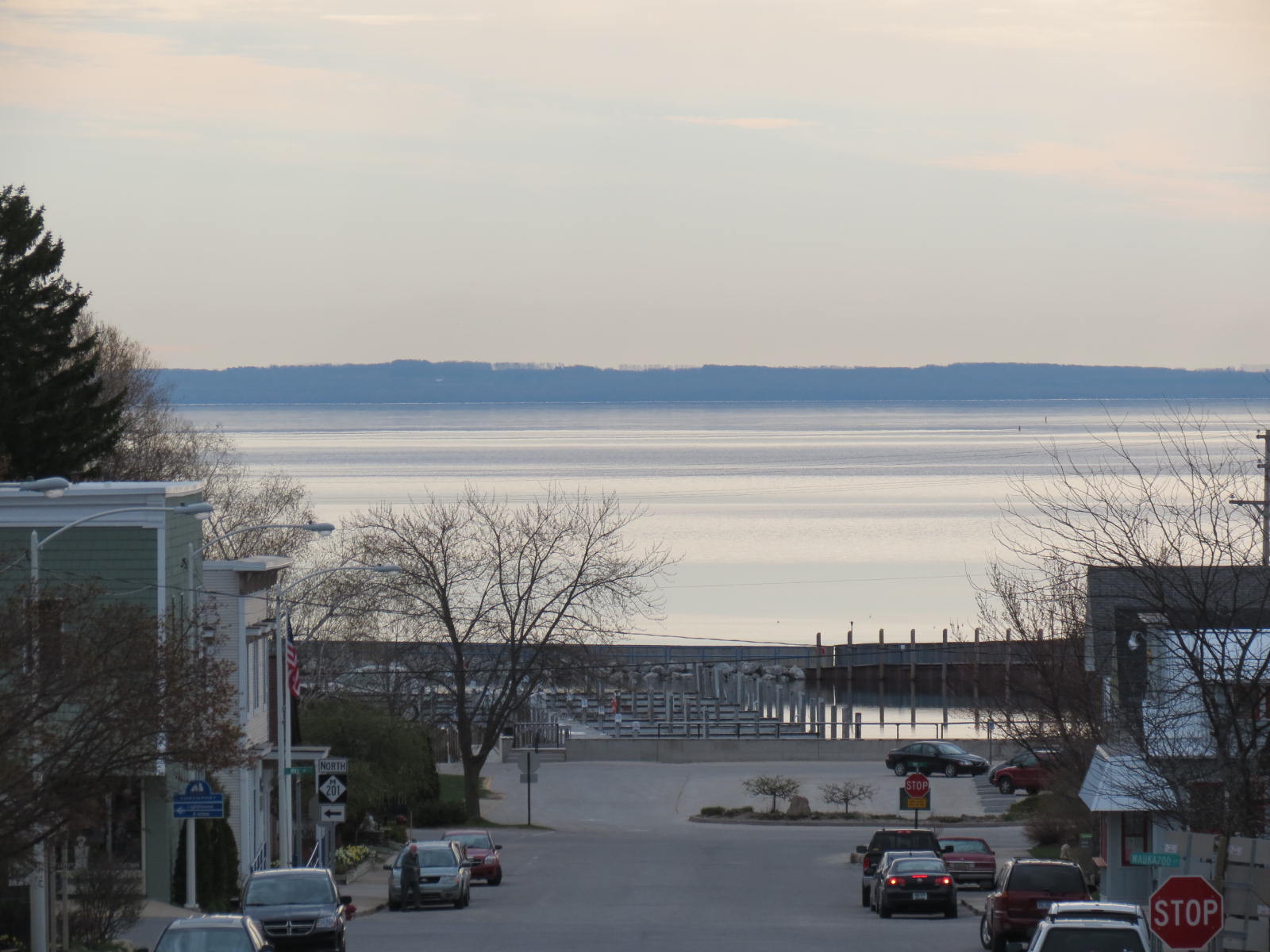
Before the leaves, before the boats


Some thoughts are like perennial itches: you can scratch and scratch away at them for years, and they never go away. One such thought, for me, is that of the common good, a venerable idea in Western philosophy but seemingly in decline in our day.

For instance, the original idea of public schools in the United States of America was that it is for the public good that all citizens of a republic be educated. Self-government demands general education for all. (The words chiseled over the proscenium of my high school auditorium were from Diogenes: “The Education of Every State is the Education of Its Youth.”) In the current American climate, parents are much more likely to see education as something they want their children to have as a competitive edge over other kids in the country. In this new discussion, I don’t hear concern for the future lives of those educated, successful children and their children in a country of increasing inequality. If this sounds like an accusation, I suppose it is, in part, but another important part is that I simply don’t understand. I don’t understand wanting that kind of world. It isn’t what I want for my kids and grandkids.

As Leelanau County tackles  the difficult and thorny issue of affordable housing (see previous post), schools are part of the discussion, but what is at stake in our little villages is not keeping poor kids out of our public schools but keeping enough kids in school to keep the schools open! What is a community without a school?

It’s probably more than coincidence  that NPR last night had a feature on a proposed affordable housing project in Marin County, California, since northern Michigan communities are far from the only ones faced with the issue. (Interesting that the headline reads “debate against [sic] affordable housing.”  A debate presents opposing arguments, not the arguments of a single side, and in fact the Californians in the story fell onto both sides of the issue, not always on the basis of who was in the boat and who was in the water.) On my way to Northport this morning, headed for my little, 23-year-old, independent bookstore, a particular word in one Marin County man’s complaint about the proposed project kept bouncing around in my head, unable to settle in a comfortable resting place. The word was sacrifices.
“I made great sacrifices to be here,” he says. “I think it's selfish to expect that someone else should be able to acquire (it) for little or next to nothing.”  
That’s only a snippet, and it doesn’t tell me much, but I can’t help wondering what the man means. I can understand parents sacrificing for their children. I can understand soldiers sacrificing for their country. But if I give up something to gain something I want more, how is that a sacrifice? Isn’t it simply a question of priorities, of knowing what is most important to me? Isn't a sacrifice something given up?

What of another household in which the homeowners’ inherited wealth enabled them to buy into the neighborhood? They could not be said to have sacrificed, could they? Do we want to say their parents made the sacrifices? Well, maybe they did, and maybe they didn’t. Who knows? And how many generations back do we want to go -- until we reach unscrupulous ancestors?

To believe that everyone with wealth earned every single penny by the sheer sweat of his or her own brow, with no help from anyone and no advantages of upbringing, and that every poor person is poor merely because he or she does not work hard is nothing but self-serving myth. No one has more than 24 hours a day in which to live, and not all those hours can be devoted to work. Sleep has to figure in. Do people with 100 times as much money work 100 times as many hours a day? I’d say not.

Back to my original thought-itch, that of the idea of the common good? What is it? A Santa Clara University site defines it as “social systems, institutions and environments on which we all depend” working in such a way as to “benefit all people,” which would surely include public safety, schools, and conservation of natural resources, at a minimum. The Santa Clara site is worth visiting for discussion of problems associated with the very idea of the common good. In a pluralistic society, individuals hold different values have different priorities. Moreover, a “common good,” by definition, is one in which everyone benefits, while some will have contributed more than others.

Some people might make an entirely different objection, not to practical problems but with the theoretical object itself. Like Socrates, questioning his friends, shredding their definitions, and deconstructing social practices to demonstrate that everything we believe is unreal (perfect “forms” existing only in some other realm), a Platonist would show you that the common good on earth is nonexistent. Have you ever seen it? Can you point to an instance of perfect benefit to all?

Some work harder, some not as hard, and some pay more dearly than others. That’s all true. It’s also true, I’d say, that all of us in this country have the advantage of certain unearned benefits, beginning with being here at all. Working toward the common good, then, toward an ideal (what else is “liberty and justice for all” but an ideal?) can be seen as making payments for what we have already received. Credit was extended to us. We need to earn, after the fact, what we received without having prepaid.

It is not individuals we are rewarding (whether “deserving” or not) but society we are paying back by ensuring its continuity. We are building a better world. And it we can only make our payments one person, one action at a time.


Thursday, February 26, 2015

Well Within Reach


Why is Sarah so excited?

Dog and Cats: A friend from Michigan is traveling the West with two cats. When Karen turned up in our yard, Sarah, who loves company, was very happy. Realizing quickly that there was at least one cat aboard (the other stayed out of sight), Sarah was fascinated. But since the cats go everywhere Karen goes, when she and I took off the next day to see the cranes, Sarah had to stay home. A dog and two cats in the vehicle? No, thank you!


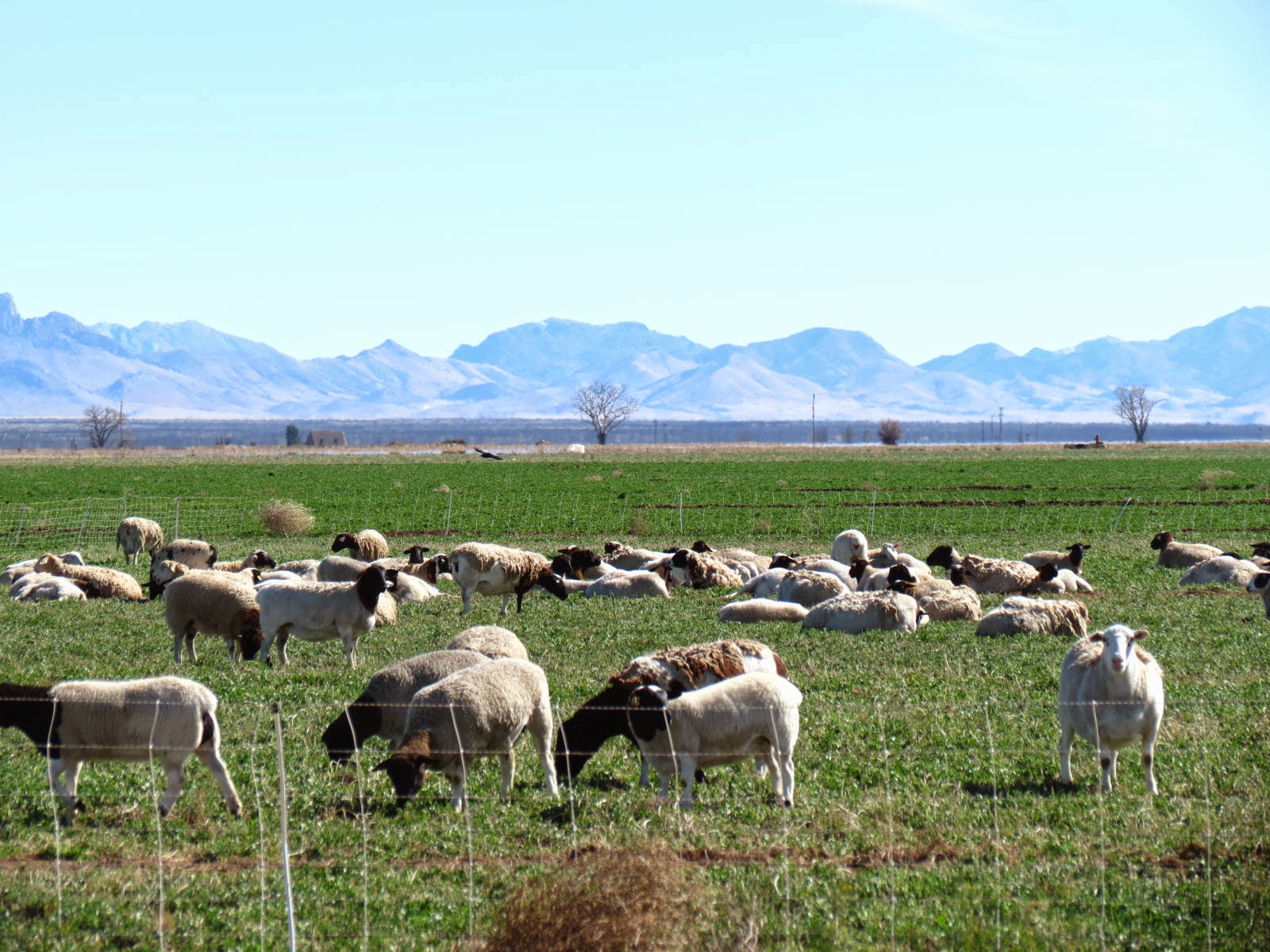
Sheep: On our way to Whitewater Draw, we stopped to sheep, the first I’d seen on that road. Did they only arrive within the last couple of days? At the sheep stop, we could hear cranes overhead and were finally able to spot them in formation but flying much too high to be visible as cranes. I could only identify them by their calls.

Cranes: We were not disappointed at the Draw, our day’s #1 objective. There were fewer people than when David and I visited in January and, thankfully, not the fierce wind we’d experienced there. Cranes were gathered in two major areas, one near the parking area and another group out far beyond the paths and water. We went all the way out to the end of the farthest path to see the latter group, highly satisfied despite the fact that no flocks wheeled overhead.


Douglas – and Lunch: Next, the restaurant I’d promised Karen along the way having been closed on Wednesdays, we agreed to drive on to Douglas, a new destination for me, an American town on the Mexican border. Douglas turned out to be quite a lovely town, full of beautiful architecture and palm trees and many houses with that hipped style of roof I so loved years ago in Georgia. There was also a street parallel to the border with small, old-looking adobe buildings that I want to take David back to see. That street looked like the 19th-century beginnings of a town that did not become a ghost town but grew “inland.”

We found a beautiful restaurant, and lunch was inexpensive and delicious. One of the taco plates, called “cabeza,” featured chopped onion and cabbage, so of course I had to order dos tacos cabezas, in honor or my winter digs – but then forgot, in my hunger and eagerness, to photograph them for the blog. Rats!


Karen wanted to walk across the border to buy a bottle of tequila, her #2 objective of the day. Initially I’d said I’d wait for her in the vehicle, with the cats. I had my passport with me but was a little nervous about going across. Then at the last minute I changed my mind. Lots of people were walking across, including plenty of kids, and my friend, a retired airline attendant, is one of the most experienced travelers I know. So why not?

Mexico: The first building that caught our eye was this one. Is it a nightclub? Wow! Talk about an eye-popping façade!


“But this is nothing like Nogales,” Karen said on the other side as we looked up and down the street for a liquor store, not seeing one anywhere in sight. “In Nogales, it’s liquor store, dentist office, eyeglasses, liquor store, dentist office, eyeglasses.” No, Agua Prieta – at least, as much of it as we saw -- is nothing like that. There were several pharmacies just inside the border, which I pointed out as likely destinations for medical tourists (I only photographed this old, closed pharmacy; others looked bright and lively), but other than that, most places looked run-down and faded. We had to watch our steps carefully, too, for changes in sidewalk elevation and crumbling curbs. There were no hordes of tourists in t-shirts, for sure -- maybe no tourists at all? I was the only person I saw carrying a camera -- and no rows of stalls selling tourist items. This was a poor border town, spritzing itself up here and there (one very pretty hotel; another big building going up a block or two away) and struggling along everywhere else.


Note: Others were open, but I couldn't resist photographing this wall

Karen kept apologizing. “It’s too bad this is your first experience of Mexico. You’d really like Nogales. It’s nothing like this.”

Okay, I’m sure it isn’t. On the other hand, having expected a completely tourist experience, I didn’t mind at all seeing an ordinary, more work-a-day town. “It feels more like a real place,” I told her. “I’m not disappointed at all.” And I wasn’t – not in the town or what I was seeing there. The only thing that disappointed me was my own memory! I felt tongue-tied, and my distracted brain kept fluttering with excitement and going into spins as I tried to remember my most rudimentary Spanish. My friend Laurie would have been very disappointed in me, I’m afraid! What, for example, is the verb for ‘to buy’? Karen doesn’t speak Spanish, and I would have liked to be able to say “My friend wants to buy tequila.” No could do.

Two men in a little party store (looking like any little U.S. party store, by the way) spoke English, however, and gave us directions to a liquor store. A block that way, another block that way. Okay, we did it. Then, tequila purchased and in the bag, we were ready to start back north.


Colorful tiles greeted us on the American side of the customs desk, and a fascinating, surprising picture greeted our eyes as we drove away from the border area: dozens of school children, loaded down with bags and backpacks, were streaming towards Mexico. They were born in the U.S., Karen explained to me, so they have the right to attend school here, but they live with their families in Mexico.


Pirtleville: The day included one more surprise, a colorful Arizona cemetery that looked as if it could easily have been in Mexico. We stopped, and I walked around with my camera but could not feel satisfied with the results. Like the desert and the mountains, it is the overall vista that is so impressive, and there was no way I could get my images close enough, far enough, wide enough, and big enough – all at once – to convey the impression of the reality.


Cows: On the way back to Dos Cabezas, we stopped to see some pretty-faced cattle in a feed lot. Sweet though their faces were, I was not moved to outrage by their plight. Why not? Am I becoming insensitive to animals, the more attention I pay to the challenges of farming and ranching, or was it the scenes of poverty in Mexico and those children crossing the border every day in hopes of a better life that had my mind more focused on human struggle?


Coyotes and Deer: It seemed that the excitement of the day was behind us as we reached the north end of the Kansas Settlement Road and turned onto Hwy. 186 toward Dos Cabezas. Then Karen exclaimed, “What’s that?” Something had run across in front of us, up ahead. Then another one! By the time the third one was crossing, we were close enough to see clearly that it was a coyote. No one behind us, so Karen stopped, and we could see all three there beyond the road, looking back at us. They look smaller and brighter in color than our Michigan coyotes. But did they wait for us to pull out our cameras and focus? They did not! Well, anyway, we saw them. “That was great!” David and I have heard coyotes here many nights, but these were the first I’d seen, and I was pleased to be able to add three coyotes to my list of six roadrunners, two mule deer, two javelinas (dead), and many Southwest birds. Then, “Look!” To our left, running along the base of a low mountain, parallel to the road, like animals in a safari film, were a herd of half-a-dozen deer. Mule deer? Whitetail? We were past them, and they were out of sight before I could be sure.

Home and Cat and Dog: David had spent most of the day at home, reading and drawing and painting, enjoying a rare day of solitude but eager to hear about our adventures. Karen and I put together a big taco spread for supper and told him all about it.

Frankie
Sarah stuck to my side like a burr all evening. “She missed you,” David said. I missed her, too. I kept thinking she was in the van with us and then remembering we had only Karen’s cats with us. (Friendly little part-Siamese Frankie was in and out of my lap all day.) But here’s a question: did Sarah simply want to be close to me that evening or to Frankie’s tantalizing scent, as well?


P.S. Look here for the weather we had on Tuesday evening....


Saturday, February 14, 2015

Little Adventures of Ordinary Days


We don’t go on long expeditions every day. Sometimes we have a day of simple errands in town and then come home to read and write. But even those ordinary days hold a drive to Willcox, which means a cruise through beautiful mountain views and past the mysterious Willcox Playa, an old lakebed from Pleistocene days, which I’ll write more about another time. Anyway, I get a lot of pleasure from our daily routines. Away from home, they take on an exotic air to me, although we, of course, are the exotic ones in this winter landscape.


First, the post office, where everyone there has been friendly and helpful from Day One. And now that we have a p.o. box, with our very own keys, I feel like a citizen of the desert when I unlock the box to look for mail every morning. Best of all, sometimes there’s mail in the box! I love that! Today, though, the box was empty. And Monday a holiday! I am momentarily crushed by disappointment but then tell myself I'll have a longer time for anticipation to build....


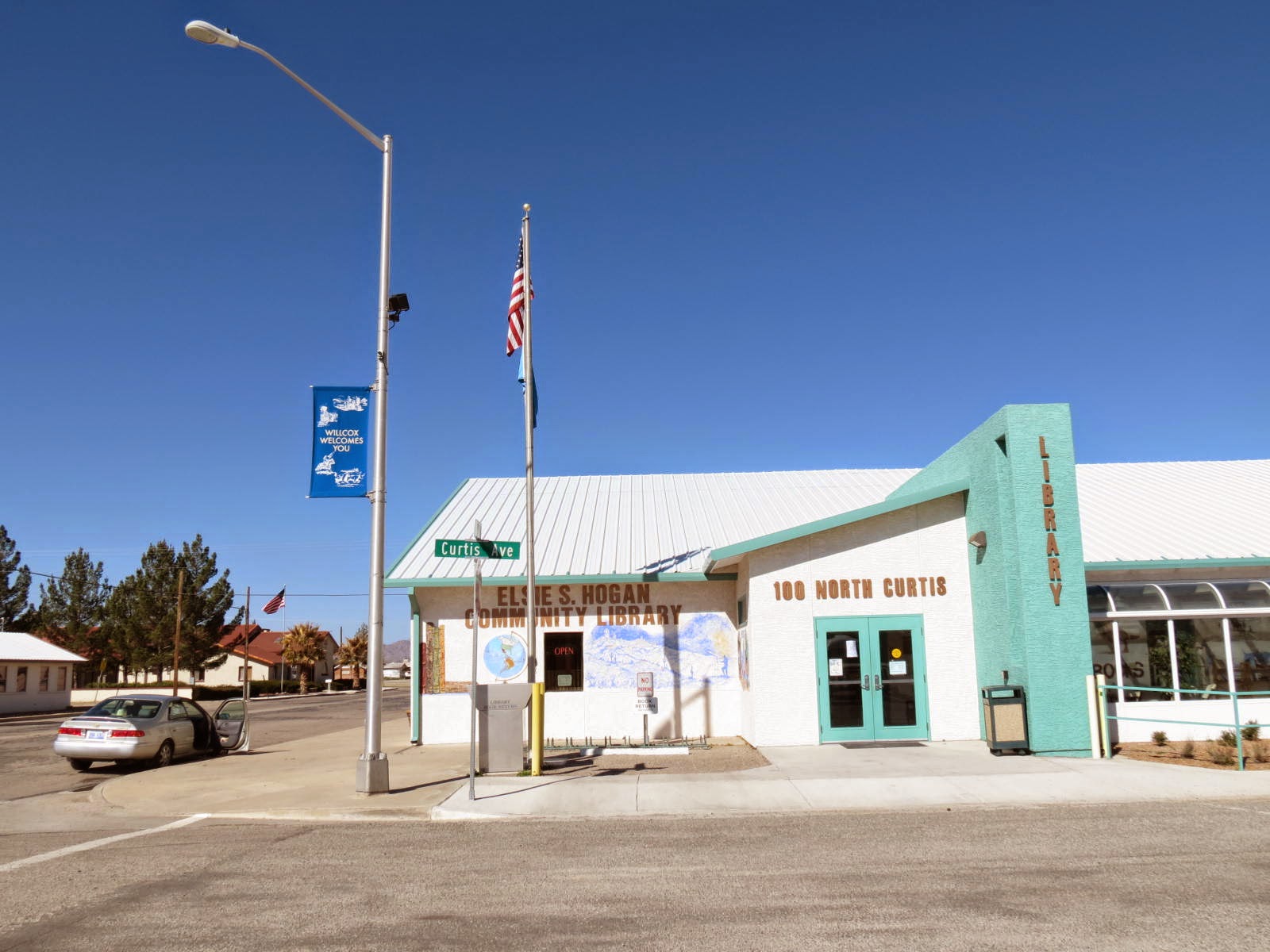
Most days we also go to the library, just one block from the p.o., where we check out books and movies, chat with the librarian, and where I update my blog and read new e-mail. It’s a very friendly library and has a wonderful large Arizona section and another large section of books in Spanish. (Unfortunately, I would not get much out of a book written in Spanish. Even the Spanish-language television programs go too fast for me to follow. A word or a phrase here and there is the best I usually do. If I get a whole sentence, I feel triumphant.) Naturally, the library also has computers of its own for patrons and the latest newspapers. The library is open every day but Sundays and holidays.

We go to Benson about once a week and have made three shopping expeditions already to Lenore’s wonderful bookstore, the modestly named Paperback Recycler, but Willcox has its own little bookstore. Run by the Friends of the Library, the Friendly Bookstore is not big or fancy and doesn’t have a curated collection, but it lives up to its name, and we usually find something to carry home. 


The first day of the 10-cent sale in the alley, we found many treasures! And yes, the bookstore really does sell local honey and jam. On the day of our first visit, I’d chosen jars of prickly pear jelly and catclaw bush honey for purchase and carried them to the counter before we even realized that the beekeeper himself was the volunteer clerk that day. We learned a lot about the agriculture of the region in conversation with him. Meeting new, interesting people far from home counts for an adventure in my book.

Before returning home, we always stop for coffee on the shaded porch across Railroad Avenue from the old train station. The business is a coffee shop, ice cream parlor, antique shop, bookstore, and more. There is a resident cat, and her name is – Sarah! There’s an old woodstove in the back, warming the indoors on chilly mornings. Our own Sarah is welcome to sit out on the porch with us and is always greeted by name by the genial proprietor.


(In my dreams, this is me.)

Coffee shop Sarah

From the porch we look across the street to the former handsome old restored train depot, now City Hall, and watch long freight trains roar through the crossing, and when we look off into the distance we see our “home” mountains. Sometimes a livestock trailer pulls up to park out front, and sometimes it holds horses and sometimes cattle, and sometimes cattle and horses, and one time one cowboy had cattle and horses and dogs – a fully-equipped cowboy outfit! Don't it turn my blue eyes green!

Horses

Border collie

Aussie

One day we had lunch down the street at Rodney’s, sitting out front with him at the sidewalk table. When the weather warms up, his patio garden out back will be shady and cool for dining. I had BBQ and beans and asked Rodney what kind of beans they were. Pinto beans, of course. Pinto beans are the beans around here. Rodney says the secret to good beans is that once they’re cooked, you never let them cool. Kind of like a French pot-au-feu, the bean pot should always be kept warm, and that way the beans stay soft and tasty. 2/15 addition: I found the cute photos of the guys that I couldn't locate the other day. Here they are:


Nearby is the old Willcox Historic Theatre, where we went recently to an evening concert given by the high school jazz band and had a wonderful time. We may go to see "Figaro" this coming week. I'll let you know if we do. Sadly, the night we went to the student concert, I left my camera at home and thus missed a killer panoramic sunset on the way to town, as well as great photo opps of all the musicians onstage. Lesson learned?


Sometimes we take a detour off the road home to see what’s happening at Willcox Lake. There are usually ducks and grebes paddling around on the water, and “my” loggerhead shrike may be perched near the water’s edge. Once a whole flock of sandhill cranes came flying in. But even without cranes, there are cattle grazing in the near distance, and it’s a lovely, peaceful scene.


I have omitted the grocery store from this litany of errands, although one of the two large grocery stores out by the expressway is quite fascinating to us, with its array of Mexican foodstuffs and an entire aisle of colorful piñatas, but will go back into town to close with the laundromat, because right next door to it is a little food truck that sells Sonoran-style hot dogs. Hot dogs not mean much to you? Didn’t mean much to me, either, until we tried them and found out what “Estilo Sonora” means: smothered in beans and sauce and hot peppers!

Sarah, we’re not in Michigan any more!