Search This Blog

Showing posts with label Anne-Marie Oomen. Show all posts

Wednesday, September 14, 2022

5 September Books Not to Miss!


Everyone has a list – newspapers, publishers, book bloggers – but mine is directed straight at you, northern Michigan, and especially you, Leelanau County, because the talented writers in our region are unstoppable. Here are five new September releases (alphabetized by authors’ last names for the sake of objectivity, because I love all these authors), and you won't want to miss a single one.


Harrison, JimThe Search for the Genuine: Nonfiction, 1970-2015 brings together classic Harrison essays and some never before published. With a deeply moving introduction by Luis Alberto Urrea, who describes the late Harrison as “a big river in flood,” and a jacket photograph by Dennis Grippentrog of Jim in leaning in his granary/writing studio doorway, this is a book no fan of Jim Harrison and his writing will want to live without. As for the delightful and insightful contents, you'll have to read the book yourself, but I say, Thank heaven for written words and their power to live beyond the grave! 


Hardcover, $28


Oomen, Anne-Marie. All you have to do, if you have any previous acquaintance with this author’s work, is read the title, As Long as I Know You: The Mom Book, and you know you’re in for an unforgettable ride. Who dares to tell the truth – that mothers and daughters are not always best friends? Anne-Marie doesn’t stop there, however, but goes on with a compelling tale of compassion, big decisions, and the loss that is, eventually, part of all love, somehow (as she always magically does) making you laugh -- and, yes, cry -- along the way.


Paper, $19.95


Perkins, Lynne Rae. Our own Leelanau County Newbery author brings us this month another charmingly written and illustrated children’s books, Violet & Jobie in the Wild. A mouse story! Mice, rather. And a chapter book, on the order of her marvelous Nuts to You! (Remember those squirrel adventures?) And lucky me, lucky us, because Lynne Rae will be at Dog Ears Books on Saturday, October 1, to sign books for customers. So mark your calendars now and watch my blog and Facebook posts for coming details. 
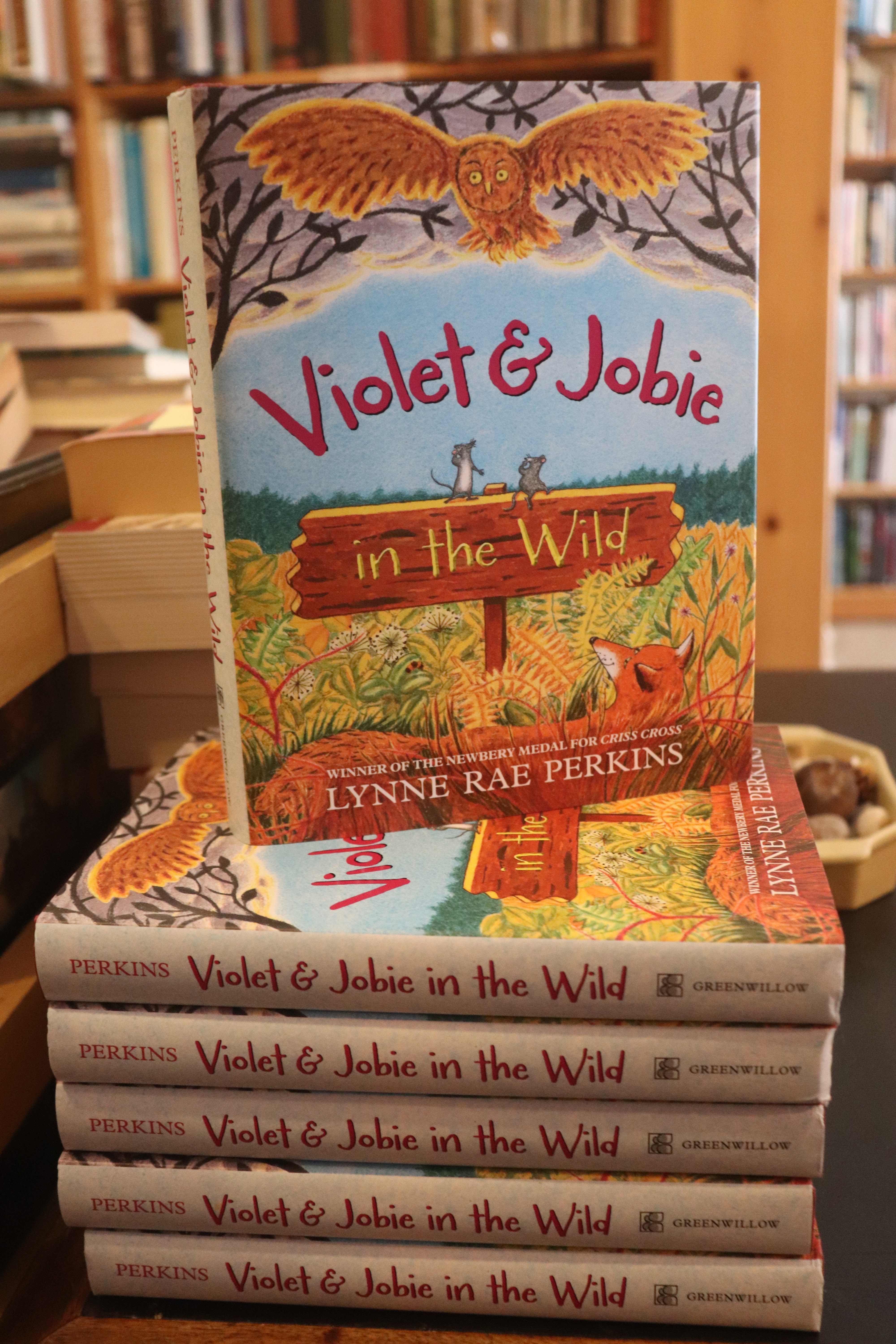

Hardcover, $16.99


Shoemaker, Sarah. By now you’ve been hearing a lot about Sarah’s historical novel, Children of the Catastrophe, but if you didn’t make it to the book launch party on September 6, never fear. I have more signed paperback copies and have restocked hardcovers (after selling out of those at the launch) that I'm sure Sarah will sign soon. Children of the Catastrophe is this year’s “Leelanau Reads” choice by our county librarians, and other book clubs will want to include it in their lists for the coming winter, too. It's both historical and timely reading -- and an engrossing family story.


Hardcover, $28.99; Paper, $17


Wheeler, Jacob. Angel of the Garbage Dump: How Hanley Denning Changed the World, One Child at a Time is nonfiction and a story that was very important for the publisher of the Glen Arbor News to tell. Hanley Denning, a former track star and the “angel” of the title, couldn’t turn away from children she saw picking through garbage in a dump in Guatemala City, hoping to find enough to eat to stay alive, and the nonprofit she set up, Camino Seguro (Safe Passage), continues to save the lives of Guatemalan children, although Hanley was tragically killed (in a road accident) in 2007. One person can make an enormous difference. 


Paper, $17.95


Dog Ears Books is open Tuesday through Saturday, 11 - 4, from now until the end of October. 

Friday, July 20, 2018

Another Beautiful Up North Day

Sunny Flower
Faces
I won’t dwell today on how the summer days are flying by, because you all know that. Instead I’ll say what a beautiful day it was here in the Leelanau on Thursday. Sunny and warm without being too hot. A light breeze, just enough to be refreshing. Hay being baled and stacked, people at the beach, gardens blooming the hearts out. 

For me, it was a noteworthy day in a couple of ways. First, I bought a new camera. Second, I hosted my fifth summer TEA event, with the ever-delightful Lynne Rae Perkins and Anne-Marie Oomen as this week’s Thursday Evening Authors. 

The camera is another Canon, this one the new Rebel SL2, and I highly recommend the Camera Shop in downtown Traverse City for all your photography needs, whatever they may be. Shopping there is a most satisfying experience. I enjoyed every minute of it. Thank you, Molly! Stopping back at the farm and proceeding on to Northport, I paused here and there to experiment with the new camera and its various settings, though it will take weeks before I become completely familiar with it. 
Chicory


Bruce at the helm

Mary Kent's flowers
An added bonus to the shopping trip was my purchase of new batteries and a roll of b/w film for a beautiful old camera bequeathed to me by a friend after her husband died. Back to film? Molly at the Camera Shop told me young people are going back to film, in the same way I have found young people going back to print books. Interesting parallels there.

Anne-Marie Oomen and Lynne Rae Perkins
TEA was pure pleasure! Anne-Marie and Lynne Rae had not planned ahead of time how they would share the stage and were, in fact, still working out the details as I was introducing them, but anyone who was there can tell you that they did a stellar job. It was as seamless as if they had done it many times before. Freshwater, saltwater, Lake Michigan, Atlantic Ocean, prose, poetry: readings and stories and answers afterward to questions were treasures added to my bookseller’s store of memories, as were the engaged and appreciative faces in the audience. It is such a treat to me to see friends gathered in the Artist’s gallery to enjoy my bookstore guests! There were several writers in the audience this week — Kathleen Stocking, Sarah Shoemaker, and next week’s scheduled TEA guest, Dennis Miller.

Michigan writers light up my life!
And afterwards — I slipped off my work treadmill entirely when my event guests invited me to have a beer with them at the Mitten. We sat at an outdoor table, and I had a dark stout and poached some of Lynne Rae’s poutine (they called it something else, but French fries, gravy, and cheese will always be poutine to me) and listened to stories of Iceland and vowed to read Independent People this coming winter, and I felt as if I were on vacation. Most of the day had been busy and productive, and I enjoyed zipping around getting other things done while Bruce tended the shop for me and David set up the gallery for the evening. The author event was a joy. Then to relax for an hour like a tourist without a care in the world? Ah! What an all-around rewarding day was my nineteenth of July!

Yum!

Anne-Marie Oomen

Lynne Rae Perkins

Bill Perkins

Monday, July 16, 2018

Busy and Challenged


Having murdered my camera by leaving it out in the rain (so maybe not murder, because not intentional), I am not 100% satisfied with the substitutes I’ve tried. Neither of the Artist’s little cameras nor my own new smart-aleck phone does what I used to do so easily with my Canon. Meanwhile, every week brings another Thursday Evening Author, which translates to another camera challenge. We did have a good time last week with poet Richard Gilmore Loftus, though, even if my photographic documentation leaves something to be desired. 


I’m camera-challenged in the outdoors, too. The baby robins with their characteristically hungry open beaks opening this post aren’t bad, but I would have liked a better, i.e., sharper, clearer image of their earlier sleepiness, seen here in less-than-optimal detail.


But on with the show, camera or no, because as bulletin board and counter attest, the summer beat goes on at Dog Ears Books, as it does everywhere Up North.


This Thursday will be very special, with not one but three authors joining us for TEA at 7 p.m. When Lynne Rae Perkins and Anne-Marie Oomen agreed to share the stage, it looked as if Anne-Marie’s co-author would not be available, but now poet Linda Nemec-Foster’s calendar has cleared, and she will be with us, too. (Linda was last here in 2014, when thirteen Michigan poets helped us celebrate the 21st anniversary of Dog Ears Books. How the last four years have flown!) So, two books, three authors — both books and all authors fabulous and pure Michigan! Please come if you can. You won’t be sorry!


Postscript 7/17: Now it appears that Linda will not be able to make the date, after all, but I know we will be sufficiently entertained and delighted by Anne-Marie and Lynne Rae, so keep that date circled!


Monday, May 2, 2016

The World Has Always Been Turning


Our country today is politically polarized. The gap is widening between the haves and have-nots, with the middle disappearing. Is this the worst time in American history? How can anyone say? This is where we are now. A hundred and fifty years ago, none of us living now were yet alive.

A younger friend asked me once, “What were the Sixties really like?” Well, the answer depends on the person you ask. High school students and college students had very different experiences, military families quite different again, and the rich and powerful, as always – well, they live on a different plane from the rest of us, don't they? 

How old are you? Where did you grow up? Are you black or white, yellow, brown or red?


In the United States at large, we enjoyed great music in the Sixties -- and mourned terrible assassinations. The decade brought Black Power and the Black Panthers, a story told in the novel Virgin Soul, by Judy Juanita, but urban and rural dwellers knew the Sixties in very different ways, as Anne-Marie Oomen reveals in her memoir, Love, Sex, and 4-H.


Across the United States and elsewhere in the world, there were protests against the war in Vietnam until American troops were finally pulled outBut in southeast Asia itself, life in warn-torn Vietnam brought years of terror that did not end when the Americans left, or as the Sixties bled into the Seventies, because it’s one thing to have your country involved in an overseas war and quite another to have a war in your backyard.

Andrew X. Pham, author of Catfish and Mandala: A Two-Wheeled Voyage through the Landscape and Memory of Vietnam (1999), has just given me an unforgettable reading experience. His father, an engineer and “a man of regrets,” also a former Nationalist, was a prisoner of the North Vietnamese Communists following the American withdrawal. (An and his mother, highly enterprising and deeply superstitious, lived near the prison camp to watch over the head of the family, while other children lived with grandparents.) One of six children, An (his Vietnamese name) was the second-born. After his father was mysteriously released from prison, and before he could be recaptured and executed – the fate he expected, had the Communists learned of his background as a Nationalist propaganda director -- the family escaped from Vietnam.

An was eight years old when his family came to America, but growing up in California he remembered his Vietnamese childhood. Those memories were the inspiration for his return visit as a young adult, to explore by bicycle (on a limited amount of money difficult for native Vietnamese who never left home to believe is all he has) the country he left so long ago.

For Americans and for Vietnamese, the Sixties were a world-changing decade. One friend of ours volunteered for the draft with a buddy, right out of high school. His buddy never came home, and our friend still asks himself what his life would have been like “if I hadn’t gone to Vietnam.”

During his often difficult travels, Andrew Pham asks himself again and again, what his life would have been like had his family stayed in Vietnam. He realizes that his good fortune was very much an accident of birth. Different parents, different life. Seeing firsthand terrible poverty and corruption in the country that might still have been his home, he is grateful for his good fortune, despite resentments and prejudice he encountered growing up in the U.S.


The Sixties were a long time ago, an era sanctified in retrospect by some and reviled by others. If you weren’t around then, this obituary for Daniel Berrigan will give you some idea of what you missed during that period in the United States. There was a lot more to it than tie-dye and drugs, beads and funny clothes.

Rest in peace, Daniel Berrigan. You got your work done.


Monday, June 29, 2015

Book Review: LOVE, SEX & 4-H


It’s practically unthinkable that anyone in northern Michigan would not know the name – and the work – of Anne-Marie Oomen. Her poetry, plays, magazine essays, and especially her books of memoir have long established her as a distinctive northern voice. Her place and time come through in everything she writes, and her writing is both lyrical and accessible.

Elsewhere, a couple years ago, I addressed the question “What were the Sixties (really) like?” I will not repeat what I wrote then, but if you missed the earlier post, you might want to go back and read it, and after you do, you’ll be even more ready to dig into Anne-Marie Oomen’s latest book.

Love, Sex, & 4-H – the title alone spoke to me! Oomen joined 4-H early, at age 8, when her mother became a group leader. The oldest child in her rural farm family, little Anne-Marie sought in 4-H an escape from farm animals! My exclamation mark is very personal, because I joined 4-H in upper elementary school hoping that membership would be Step #1 to horse ownership. It wasn’t. (No one explained to me that ours was an “urban” club rather than a farm club.) The sewing projects through which Oomen progressed over the years, going all the way to fashion modeling at Michigan State University, left me cold. I stopped early on, with the horrid gathered skirt requirement. Ugh! I did not stay with 4-H past grade school. But I loved the Head, Heart, Hands & Health pledge. Anyway, enough about me....

As Oomen tells the story of her adolescent years, political awareness was far from her life. The larger world intruded only with time-stopping events; otherwise, clothes and boys dominated her personal Sixties consciousness. As I have said many times, the Sixties were different for everyone who lived through them.

Here were sex and love dressed in church clothes, shirt collar just starting to unbutton—utterly seductive, surreptitious as snakes. Except for the fierce familial love of my people, I had no authentic understanding of either of those lunatics, love and sex, as they were expressed in that time. But I had 4-H, and, because of that, I knew this much: I knew how love and sex would be dressed.
Oomen’s experience in the Sixties, then, is not the story of a young radical in the making. Questions about love and sex, however, have come to young men and women in every historical decade of American life, regardless of any larger political context, and they always will. Oomen’s story, while hardly remarkable in itself, is told with remarkable frankness, and that, along with her always beautiful writing, is its strength. She neither paints her adolescence in false colors nor glosses over occasional petty, even shameful behavior. It’s all there, from the first stirrings to the slippery “everything but” slope.


Oomen might have subtitled this book A Memoir of the Sixties, since it covers the decade 1959 to 1969, her life from age 8 to age 18, and it is very much a young Michigan farm girl’s coming of age in that decade when ordinary adolescent turbulence took place in a larger national context of social turbulence. Of the three memoir books she has written – the first two were Pulling Down the Barn, stories of her rural northern Michigan family, and House of Fields, telling of her educational journey – Love, Sex, & 4-H does the most to situate one girl’s experience in a larger perspective. Oomen has many readers who did not grow up on farms or attend one-room schools, but all of us either lived through or (for the younger readers) have known from the classroom the major events of the 1960s. We have all, too, lived through teenage confusions, hopes, and fears, trying to redefine in those years our roles as sister, daughter, friend, and girlfriend (or, for boys, obviously, brother, son, friend, and boyfriend).


New readers are still discovering Anne-Marie Oomen’s book for the first time. Two young women came by chance to the bookstore on Tuesday afternoon, and, urged by Anne-Marie and her Northport bookseller, also attended the author’s formal presentation at the Leelanau Township Library the same evening. One of them was about to embark on an M.F.A. program in creative writing; both were excited to be able to meet and “hang out with” such an accomplished book author. They planned to return to their campsite and read Uncoded Woman aloud around the campfire. “You have to read the poems in order,” I cautioned them. “No skipping around, because there is a narrative.” Anne-Marie took over then and told them something about the protagonist of the poems and the maritime signals that name each poem.

Besides memoir, essays, and poetry, Anne-Marie Oomen has written seven plays for the stage, only one of which I have seen performed – and that one much too long ago. It told the story, all in verse, of farm women in the area now part of Sleeping Bear National Lakeshore. The power of the drama, very minimally staged, surprised and moved me. I want to see it again.

What a privilege and joy it was to spend hours on Tuesday with writer Anne-Marie Oomen! Even without paid vacation or sick leave, there are some very tangible benefits to this bookselling gig. I have the pleasure of introducing my writer friends to one another, bringing writers to readers, and, always, enjoying my small place in American literature’s northern territory.


Friday, June 26, 2015

The Generosity of Writers


Of several photographs I took on Thursday of Holly Wren Spaulding during her reading at Dog Ears Books, the one above was her favorite. I liked it very much as I was framing the shot and quickly saw that it is not unlike the short forms of poetry Spaulding writes and coached us in writing.

Holly Wren Spaulding, a Michigan native and long-time Leelanau County resident, has made her home in Massachusetts for the last couple of years, earning a living as a self-employed writer, teacher, and writing coach. From that you should understand that Holly’s workshops are not generally free, that people are happy to pay good money to work with a writer of her talent and experience. Because of my own 23 years’ experience as a bookseller, however, I was not completely taken by surprise when Holly generously offered to give a little hands-on workshop on short poetry forms, gratis, following her reading at my bookstore.

So she read first, both poems from her newly published collection, Pilgrim, and poems written since Pilgrim went to press, and shared with us the excitement of working on letterpress projects, setting type by hand for a few short lines of her poetry to be printed and framed as art. The lively, engaged audience had questions about the writing process that Holly was happy to answer.

When we got to the workshop portion of the event, Spaulding began by giving an introduction to the short forms of haiku and tanka and reading a few examples of these and other short poems less rigorous with regard to number of syllables. Then we were given our assignment: Think of a single encounter with the natural world, preferably within the last 24 hours. Try to capture the moment and make a human connection to it. I’m not going to share my “finished” piece (only finished in the sense that time was up), but the encounter I chose was the one pictured below.


At first, looking for words to capture the moment I thought I had to mention the chipmunk’s stripes and its bright beady eyes. With trial after trial, however, what remained in each draft was the prayerful attitude of the tiny paws held to the chest. That for me was really the essence.

As, I think, the image of Holly’s hands at the top of this post, one hand holding a sheaf of poems on paper, the other gesturing to the audience, is the essence of her visit to Northport. 

Holly Wren Spaulding, thank you again for giving us your time. It was lovely having you here. I know the audience members who are also writers are very grateful to have had the opportunity.

Reminder: Next week, on Tuesday, June 30, Anne-Marie Oomen will be at Dog Ears Books from 3 to 5 p.m., signing her new book of memoir essays, Love, Sex, and 4-H. Please stop in and meet another generous Michigan writer making a trip clear up to Northport!

Tuesday, June 1, 2010

Garden and Reading Report, First of June


It’s another bright, bright early summer day in Northport, and it was a bright morning at home, too. “You look a little like a crazy lady,” David observed, “in your robe and baseball cap.” There was, as he knew there must be, a reason. For the past two nights and mornings, a migraine has been lying in ambush, ready to leap upon me, and in order not to fall prey I’ve been more mindful of staying hydrated, not getting too hungry and not looking into bright light. Besides the baseball cap, I also wore sunglasses out to the garden and watered from the east side instead of facing into the morning sun. My gardens are mostly green this time of year, with no ripe vegetables in the kitchen garden and lots of weeds in the perennial beds. Thank heaven for iris and true geranium this time of year!


I have now reached page 566 of A Suitable Boy. Its characters’ lives are as engrossing as those of a soap opera—more so, as we have access to their inner thoughts and struggles as well as their behaviors. For instance, Mrs. Rupa Mehra, a widow with four grown children (two married), looks at a photograph of her dead husband every night before going to sleep, and every morning she recites some verses from the Gita, beginning her day by reading about indestructible presence, unchanging reality.
But it was not the all-pervading essence of reality that clutched at Mrs. Rupa Mehra’s consciousness but the loved particularities that she had lost or that were losable. What body was her husband in now? If he was born again in human form—would she even recognize him if he passed by her in the street? What did it mean when they said of the sacrament of marriage that they would be bound together for seven lives? If they had no memory of who they had been, what use was such knowledge? For all she knew, this last marriage might have been her seventh one. Emotion made her literal; she longed for tangible assurance. The soothing Sanskrit of the small, green, cloth-bound volume passed through her lips, but, while it gave her peace—tears rarely came to her eyes while she was reciting the Gita—it answered none of her questions. And while ancient wisdom so often proved unconsoling, photography, that cruel modern art, helped to ensure that even the image of her husband’s face would not grow dim with time.

Vikram Seth’s book is so long that I have no fear of finishing it too soon. Anne-Marie Oomen’s An American Map is the one I’m trying to make last a long time. The accounts in this volume of memoir, which includes many travels to far-off places, are held in place by what Oomen calls “the iron stake of story and the stone of memory.” It is a book to savor slowly, over time, in quiet pockets of meditative bliss. The evening before Memorial Day (I’ve been skipping around in the book, which it generously allows) I read the essay entitled “Where Angels Are,” the story of a hiking trip the author and her husband made in the Great Smoky Mountains in March of 2003, just as American forces were going into Iraq. Wanting to see innocence--perhaps the grandmother looked out this slit in the dark cabin wall for the arrival of company?--she learns of a history of suspicion and fear:
David sighs, touches my shoulder. “The granny hole is the right height to kneel, aim a rifle, and shoot something without being seen.”

As in so many of these essays, Oomen identifies a feeling I have had, too, when national and world events coincide with personal life and become welded in memory.
If angels are here, then this park, this American place, this American concept—land held in peace for the pleasure of its people—this natural beauty and light, is now forever linked to the more terrible angel rushing forward in a cascade of the thing we call war.

For better or worse, we are all touched by events elsewhere in the world, though many of them never reach our immediate knowledge.

The book I should be reading but haven’t had a chance to start yet is Sydney Eddison’s Gardening for a Lifetime: How to Garden Wiser as You Grow Older. If someone else beats me to the copy on my new book shelves, though, that’s all right, because I’ll just re-order—which is exactly what I need to do this morning with An American Map. Excuse me, please....