Search This Blog

Showing posts with label time travel. Show all posts

Tuesday, May 12, 2026

Look Near, Look Far

That green pointillist flush I love!

Season’s Progress


Orchard buds on 5 May 2026

Cherry blossoms in the orchard around my house have yet to appear (still in bud), though young orchard trees out on Stony Point, on the bay side of the peninsula, were in blossom for Mothers Day, and the big black cherry trees (a forest hardwood) are blooming, too. The season is advancing, albeit by fits and starts, with overnight temperatures below freezing.  I harvested enough fiddlehead ferns to accompany two meals last week

Black cherry at the edge of the woods

Looking up through its crown

Blossom cluster

In Traverse City, the decorative pear trees are radiant in the sunshine. Is there a danger, though, in having planted the city streets with so many of one tree variety? What if a pest were to strike that landscaped monoculture? I looked online for an answer and discovered an even more alarming possibility: This variety of ornamental pear is now considered invasive because, while sterile itself, it can cross-fertilize with other varieties and produce thorns monstrous enough to puncture tractor tires! It also has hazardous weaknesses due to its branching habit, and some states have already outlawed their sale. Don't plant them in your yard! 

Look beyond looks!

If Traverse City follows other cities in eliminating this tree (which seems like a good plan), I hope they will do it on a gradual basis and replace the pears with two or three different kinds of trees, maybe redbud and dogwood and something else. Suggestions? 


Changing the subject: Isn't my hellebore beautiful?


What Makes a Good Book Review or Reviewer?

I hate to say it, but I can’t help concluding, after reading a raft of online amateur book reviews (I am tempted to put “reviews” in scare quotes, like so), that there are a lot of very lazy readers in our country who should not be claiming to be reviewers. Or maybe they are simply reading books that are not right for them. After I finished reading what struck me as a brilliant first novel, curious to see what others had thought about it, I looked for reviews, and three particular criticisms that I discounted as inappropriate stood out, each made by more than one person. I have condensed to give composite comments, so the following are not quoted directly: 

(1) There are too many new novels set in World War II. Here's another one. Yawn!

(2) If you don’t know Paris, you’ll be lost in this book. It's probably okay for people who know Paris, but for me? Yawn! 

(3) The action and time jumped around in a confusing way. I'm outta here!

Here is my first round of responses:

(1) Are there too many boy-meets-girl novels? Too many novels about American family life? The question isn’t the number of novels available on any given subject, but their quality and how worthy they are of readers’ time. 

(2) I know Paris pretty well, but I’ve never visited Salinas or San Francisco or Brooklyn, let alone Moscow or Mumbai or anywhere on the African or Asian or South American continent. I’ve never anywhere near Australia. And yet I have read avidly novels set in all these locales, as well as stories set in earlier centuries in America and Europe (despite my inability to travel through time except in imagination and, therefore, in books). For those of us without the means to afford constant world travel, books give us wings! In fact, I learned Paris from books long before I ever set foot in its streets, just as I recognized my first sandhill crane from having seen it pictured in bird field guides. 

(3) Fiction with multiple narrators and nonsequential time sequences has become a norm in Western fiction, from YA titles to the most abstruse literary works. At times it is confusing, and when I’m reading a book written that way it often takes me 20 or 30 pages to get into the rhythm, but seldom does the difficulty persist, and in the case of this particular novel italics that set off the ghost character's viewpoint help a lot.

And here is round 2: 

(4) If you’re tired of WWII novels or only want to read books set in geography you know well, don’t read such books! Skip them entirely, or if you find one in your hands and can’t get into it, at least don’t foist your dismissive opinion off as a “review.” If you don’t want to travel, stay home rather than go to another country and complain because it isn't like home.

(5) There is nothing wrong with preferring a simple, linear, chronological narrative, either, but readers don’t need opinions on novels structured otherwise by people who object to alternative structures. You can find plenty of books written with your preferences in mind. There is fiction for every taste. Read with your preferences in mind and review those books. You will find some successful and others disappointing, and that’s as it should be. 

(6) We all have limitations. I would not presume to review books of fantasy or science fiction, because those are genres that don’t speak to me. They never have. I get bored, and my mind wanders. People who love sci-fi and fantasy and have a strong reading background in the field apply quality standards to their reviews that I could never hope to achieve. So I’m not dissing anyone for their reading choices. All I’m saying is I don’t see the point in someone purporting to review a book she couldn’t begin appreciate and, in many cases, didn’t even finish.

Okay, that’s my opinion as a reader, bookseller, and occasional book reviewer. I don’t expect it to change a single mind or alter anyone’s practice—people will keep doing what they want to do—but I wanted to put it out there. Agree—or disagree?

I highly recommend this brilliant first novel!


You may have read other novels set in Paris during World War II, but no two are alike, and this one (as does Karen Mulvahill's The Lost Woman) shows how very particular chance events in one era continue to reverberate and affect individuals and families in following years. Also, the prose is enchanting! 

Don't miss the cowslips. They are blooming now.

Sunday, March 16, 2025

Elsewhere, Elsewhen

Green moss in winter


These things are no more, and the feeling I am telling here … may have perished, too. It felt like the tide had gone out and taken all the ships with it, and you were left on a shore, a debris.


-      Niall Williams, This is Happiness


I had no celebratory plans for St. Patrick’s Day, either for the day itself or for the preceding weekend. Saturday would see me in my bookshop, and maybe Sunny and I would get up to the dog park on Sunday, if the weather didn’t turn wretched, but forebodings were somewhat against us. Ay, that’s March!


Without thinking, anyway, of St. Paddy on—was it Thursday or Friday? No matter—I picked up a paperback novel with blurbs on the back cover looking good enough that I thought I’d give it a try. I needed a new bedtime book, having stretched Olive Cook’s Breckland out about as long as possible, setting it aside repeatedly, both to read other books (both fiction and nonfiction) and also to make it last, then returning to it time and time again when sleep eluded me in the wee small hours, until finally, against my will, I reluctantly reached the last page. 


So now I would read Niall Williams’s This Is Happiness. At least, I would begin the novel and see if it held me. And now, to say that it did hold me did is to make a massive understatement.


The fact is, I did not appreciate until much later in my life what subterfuge and sacrifice it took to be independent and undefeated by the pressures of reality. 


The narrator, an old man—well, exactly my own age!—is recounting a time much earlier in his life when, as a lad of seventeen years, he left the seminary in Dublin with lost faith and went to live for a while with his grandparents in a remote Irish village during the time that electricity, long promised to the village, came at last. The manner of its coming is not incidental to the story but woven into its essence. Here is the man who has come to the village of Faha to supervise the installation of poles and lines:


Everybody carries a world. But some people change the air about them. That’s the best I can say. It can’t be explained, only felt. He was easy in himself. Maybe that was the first thing. He didn’t feel the need to fill the quiet and had the confidence of the storyteller when the story is still unpacked, its snaps not yet released. 


And here are the strains of music woven into the story:


The quiet of country life can sit on your heart like a stone. To lift it, to escape the boundaries of myself awhile, I took down the fiddle.


One of the things about Irish music is how one tune can enter another. You begin with one reel, and with no clear intention of where you will be going after that, but halfway through it will sort of call up the next so that one reel becomes another and another after that, and unlike the clear-edged definitions of songs, the music keeps linking, making this sound-map even as it travels it, so player and listener are taken away and time and space are defeated. You’re in an elsewhere. Something like that.


So now, thoroughly charmed and engaged, I read myself to sleep on Friday evening and again when I woke in the dark hours of Saturday morning, but only when dashing off an e-mail to my sisters on Saturday afternoon from the shop and mentioning the book did I realize what a timely choice I had made. Irish! How appropriate!


Woolly bear woke up on Friday!

The temperature rose to 70 degrees in Northport on Saturday, and the sun shone bright, but the wind blew like the devil, gusting up to 50 mph. (So much for my having swept the sidewalk with the push broom two days before!) Sunshine brought people out of their houses, and the wind in Traverse City—worse than we had in Northport, I was told—sent some of them clear up to Northport, so it was a fairly lively bookshop day, and only late in the afternoon, while a couple from Ann Arbor were happily browsing, did the power go out on Waukazoo Street. First the lights flickered, then went out briefly and came back on again, that happening two or three times, until finally they stayed off for good. Luckily, my happy customers were undeterred. We had a meeting of hearts and minds as their choices were books by Wendell Berry and Robert Reich. Closing up then, I only hoped the power would still be on at my house when I got home.


It was not. No lights. No furnace. No pump.


But I was prepared for a power outage with two deep stockpots filled with water and a brand-new, long-handled lighter so I wouldn’t need to risk fingers by lighting the stove with a match. Right away I lit my two fat candles and sorted through the collection of oil lamps for one with a good wick, cleaned the glass chimney, and filled the reservoir with oil. Success! The power company thought electricity would be back on by 3 a.m., I was at first dubious, but a look at the overnight forecast showed the winds gradually dying down, so maybe….


But we would be fine, Sunny and I, and now my reading choice struck me as even more appropriate. I had only reached Chapter 18, not even the halfway point of the novel, and while Noel’s grandparents had a crank telephone, the only one in the village, no one yet had the promised electricity. That was the fiction. Meanwhile, here in my “real” world I was all set with candles and oil lamps and a cell phone with 80% of its charge. Wind blowing demonically around my old farmhouse, dog lying across my feet, I felt a strong sense of kinship to the people of my own grandfather’s native land, back in times that were difficult and challenging in many ways but much simpler and probably more satisfying in others.


I haven’t said a word about the slowly unwinding plot of Williams’s novel and won’t get into that now. For me, it is the world of the story that matters. Early in my reading of it, I snapped a photo of the cover to send to my stepdaughter and texted her this brief message: “I am elsewhere. It is beautiful and restful.” So then, continuing my reading, I was struck by the passage quoted above about the Irish reels defeating time and space. Elsewhere! Yes!


Another of my Saturday customers was a young woman who said that if she could have a superpower, it would be to travel back in time for a day, not to intervene in history but simply to be there in that time. She agreed with me when I remarked that such is the magic of books. 


Friday and Saturday nights, Sunday morning in the United States in the year 2025: Snow sifts in shifting veils from the barn roof. I am elsewhere, elsewhen.


Happy St. Patrick's Day to you all, Irish or otherwise.


Sunday morning...

...snow in Leelanau.

Thursday, February 22, 2024

It's Travel Time

WHAT month is it???

In northern Michigan there are, besides weekend tourists and short-term vacationers, summer people and “year-round” people. The year-rounders who can afford to make a getaway in late winter or early spring, though, are not shy about doing so, and who can blame them? Some take February or March in Florida or Mexico or the Caribbean. For years, before and between the Florida and Arizona winters, the Artist and I made more modest forays to Lake Huron on early spring weekends when March rolled around, because cabin fever isn’t just about getting to an exotic location. It’s more about seeing different scenery and different people. 


“But we didn’t even have winter this year.” 


“We had a month of winter (January).” 


“No, we had ten days. That’s all!”


Okay, and now February, typically the coldest month in northern Michigan, has been bringing us daytime temperatures in the 40s! Along with many others, I feel a lot of ambivalence about this month’s weather. It isn’t right, isn’t normal, it bodes ill for the future – and yet, in the present, it makes life easier and certainly (because of lower fuel bills and no plow bills at all) less expensive, which is hard not to appreciate. And who can complain about blue skies? Besides that, for me (and I know I’m not the only one) this time of year is a minefield of associations. Anniversaries after loss are ambushes along life’s road, in that you know they’re coming – looming inexorably -- but not the moment or hour or the manner they will hit. So with all of the financial and emotional possibilities threatening, I found unseasonable February warmth and sunshine more than helpful.  


While we still had snow --


Blue view --


Thanks to books, I’ve also been spending a lot of time in Ireland and Scotland, France and Italy, some of it over a hundred years ago and some in more recent times. Fiction, nonfiction – one is as dreamy as the other, when it comes to exploring mountain villages, river sources, stone ruins, and local stories from local folks in faraway places. When March arrives, I’ll post my “Books Read” list for the month of February, with enough annotation to give an idea of each title’s contents for anyone who might be curious.


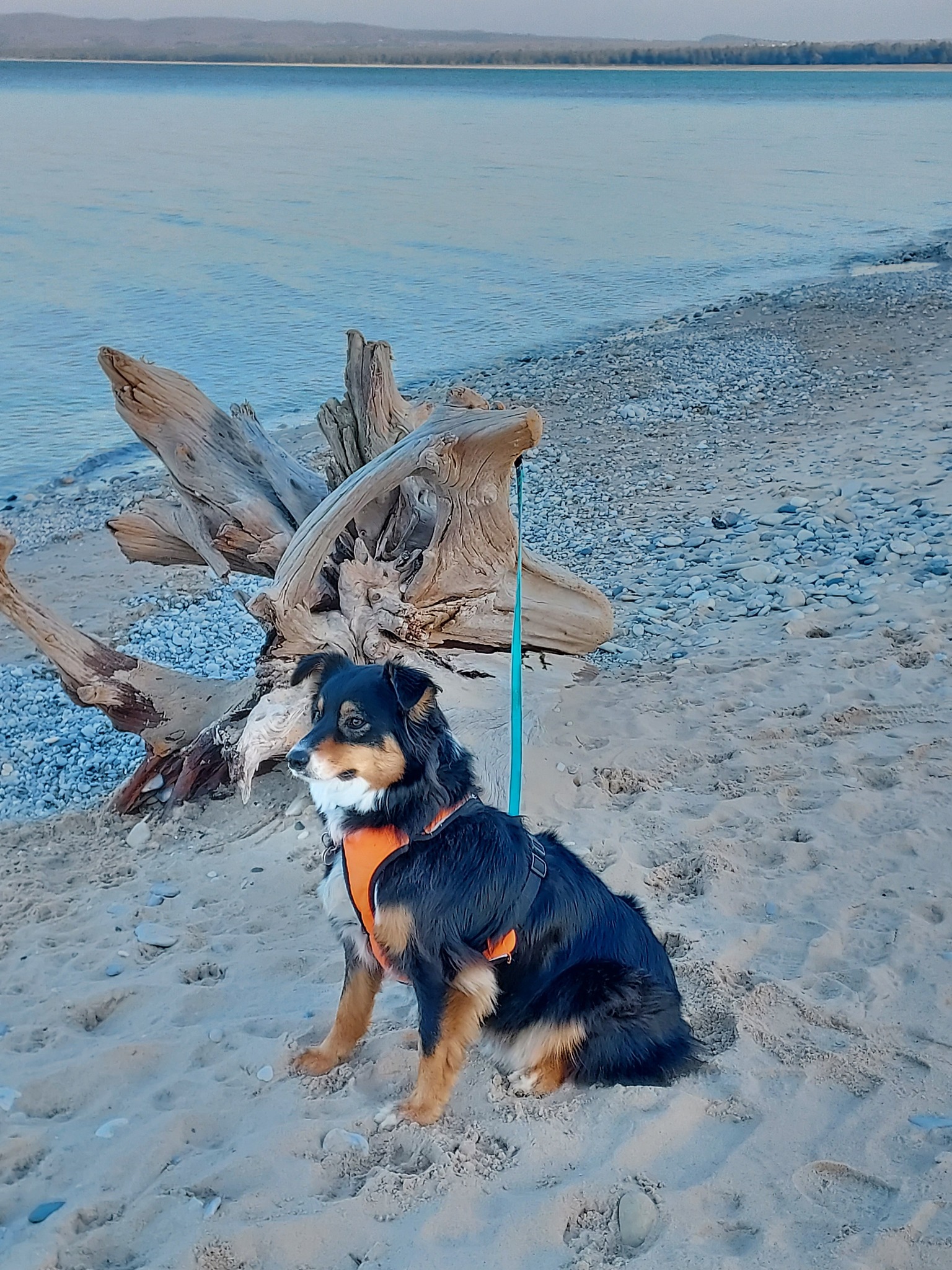
Leelanau County itself, though, provided me with antidotes to cabin fever. Monday, Presidents Day, was a bank holiday, so I had to go to Traverse City on Tuesday instead to take care of banking errands. By noon, though, I was already zipping out of town when the beautiful sunshine inspired me to detour to Good Harbor Bay, where Sunny and I walked on the beach! As close as I live to Lake Michigan, you would think beach-walking would be a frequent life activity for me, but somehow, unless I have company, time just seems to slip away. Well, not that day! I seized it!


Good Harbor, Tuesday, February 20, 2024


Again, the following day, Wednesday, the Artist’s birthday (he would have been 87, if still living), when I felt the need to do something special, Good Harbor was my choice. I'd first contemplated a stop at the Happy Hour for a beer on the way home, maybe even buying for whoever might happen to be sitting at the bar in the middle of the afternoon, but there was no way to include Sunny Juliet in that plan. And as it had on Tuesday, the sun was shining, the sky blue, so with sunset later and later every day, Sunny J. and I had plenty of time after I closed the bookstore at 3 o’clock to drive down to Good Harbor again, scenes of many memories and associations over the years.


Lake Michigan, Wednesday afternoon

Calm water


This is how I am traveling in February now. Books take me to other countries, and I take mini-vacations close to home with my dog, because, as the Artist loved to say, so often, “We live in a beautiful place,” and whatever the weather, every road of my county is saturated with memories, making it all the more beautiful. Travel time in my home county is any time, and any county drive is also time travel, my present brimming over with the past. 


Thursday morning fog -- beautiful!


Today’s postscript:


If audiobooks are your thing, please consider signing up to get yours from libro.fm – and choose Dog Ears Books as your bookstore. Your audiobooks won’t cost any more than they do if you buy from the online behemoth, but you will be supporting a small indie bookstore in northern Michigan. Thank you! And special thanks to those of you already ordering from libro.fm via Dog Ears Books!!!


Tuesday, April 20, 2021

When Letters -- on Paper -- Were Everything


Reading a diary from before the Civil War, I am struck by the number of letters the young male diarist tells of regularly writing and receiving. His lawyer brother in New Orleans seems to have written to Silas almost every day, and it was a rare day that Silas did not write to James or to Warren or to one of his sisters back home and perhaps also to the editor of a local newspaper. And all his correspondence was, of course, conducted in longhand (Does anyone still say ‘longhand’? Or was it only necessary to make the distinction when secretaries took dictation in shorthand?), with every cranny of space filled.


I have trouble considering anything a book if the words aren't on paper. Likewise a letter. E-mail messages can be important and precious -- I don't pooh-pooh them. But they are not letters. And a "diary" kept in digital format? Really?


Silas did not write in his diary every day, but when he did, it was in addition to letters he had also written that same day. The diary he kept for himself; the letters were to and for others. Way back then, without cell phones or e-mail or so-called social media, letters were the way he and others kept in continuous contact with family and friends. His letters to newspaper editors, less frequent, were a way to voice his opinions publicly, as he also did in amateur debates and public addresses.


The debates in which he participated, like his letters, were as much public entertainment as they were communication. Conversation, reading books, and playing musical instruments were ways to pass a quiet lamplit evening at home in those days, and letter-writing was another way, but Silas also made preparation for a debate or for offering a public address by writing longhand notes in the pages of his diary, another occupation that filled his evening hours and also served as preparation to reaching out to others, near and far. Back then, townsfolk and country people regularly traveled to schoolhouses, village halls, and churches for evenings spent listening to debates, public addresses, and sermons. Yes, even sermons were entertainment in those days, with visiting sermonizers critiqued afterward in depth by audience members -- often as much or more for performance quality as for theology, judging from Silas’s diary.


In our time, now the third decade of the 21st century (can you believe it?), a general “felt need” for handwritten correspondence seems almost to have disappeared. We have public forums for our every thought and deed in social media, the instant gratification of texting (often with almost instant replies), and none of it requires paper or stamps, let alone a trip to the post office. But if letters are classed by collectors as ephemera, what can digital exchanges be called? Even if the storage media are somehow preserved, is there any guarantee it will be readable in future? Whereas I can take in my hands Silas’s diary and the handful of private letters tucked into the diary pages, all written over a century and a half ago, and read them as if they were written yesterday, how many of the thoughts and experiences shared on Facebook will anyone be able to visit a century and a half from now?


As thrilling as it is for me to time-travel via Silas’s diary, it is just as thrilling or more so to find a letter in my own mailbox, written to me by a sister or a friend, bearing postage and return address and cancellation that tell of its journey and the thought that went into someone caring enough to reach out to me over hundreds of miles. I can tear the envelope open in haste or slit it carefully with a knife, read the letter immediately or tuck it away and carry it with me to enjoy later – or I can do both, reading it eagerly at once and folding it away to read again an hour later, beginning already to form in my mind the reply that will eventually becomposed and sent off, a personal, intimate, committed-to-paper, taken-time-to-write missive sent to one person alone -- although perhaps to be shared with a partner or friend at the other end, too, because once the letter reaches its destination it belongs to the recipient. The gift has been given.


Then there are the enclosures that letters may contain, as delightful in their way as the letters themselves. This old bit of "ephemera" captured my attention, and I wish I still had new snapshots every week to send with my own letters. Sadly, our photographs are another thing we rarely commit to paper any more.


The biggest problem for me with Sundays is that there is not even the possibility of finding a letter in the mailbox. Monday’s return to mundane, everyday life does not trouble me at all, because the postal carrier may bring me news and thoughts from someone I love.


One friend back in northern Michigan who shares my enthusiasm for written correspondence is doing more than writing letters: she has started a movement for slow correspondence called Leelanau Letter Writers. You don’t have to live in Leelanau County, Michigan, to join. There are no membership fees, no meetings


You may also elect to join the LLW pen pal group, but you don’t even have to do that. Just let it be your inspiration to write and mail letters. Will you write about what’s really on your mind? What will that be? You need share that only with your recipient. It's that personal. Who will receive the next letter you write? No need to tell me -- just write and send that letter. On paper.


Tuesday, October 27, 2020

We Are All on a Journey


In the nineteenth century, crossing the North American continent became a new adventure and challenge.


Narcissa Whitman was a new woman out there on the plains….


On cool mornings, Narcissa loved galloping sidesaddle ahead of the wagons on her new horse and even briefly losing sight of the party….


‘…I never was so contented and happy before…’


-      Rinker Buck, The Oregon Trail: A New American Journey


In a book published in 1952 (in England, of all places) with a story set in 19th-century Michigan, we find a fictional female character discovering, like Narcissa Whitman, the joys and freedom of travel.


If only she could feel like this always! If she never had to go back to the narrow streets of houses and the regulations and proprieties that governed every moment of her life at home! If she could stay on the road! The idea was like a burst of light. 

-      Elizabeth Howard, Pedlar’s Girl


But there were always those to whom the travelers seemed more like invaders. 


So came the winter of Plenty Buffaloes, the one the whites called 1861, the year that saw the Holy Road dark with moving men, many going to the places of the yellow metal, many running away to the mountain diggings to keep out of the war parties the whites seemed to be raising against each other.  

-      Mari Sandoz, Crazy Horse: The Strange Man of the Oglalas


 Moving or staying in place, however, life is a journey for us all. 


For me, becoming isn’t about arriving somewhere or achieving a certain aim. I see it instead as forward motion, a means of evolving, a way to reach continuously toward a better self. The journey doesn’t end. …


It’s all a process, steps along a path. Becoming requires equal parts patience and rigor. Becoming is never giving up on the idea that there’s more growing to be done. 

-      Michelle Obama, Becoming


If you don’t already live in Northport, I hope you’ll find a chance to visit this week before Dog Ears Books closes for the 2020 season. We expect and hope to be back in the spring of 2021 to serve locals and visitors alike, connecting you to books new and old, authors familiar as well as new acquaintances, and to share with you our joy of reading real books.


But we will have a couple of surprises for you in the spring, too --  maybe something you would never expect from us! Because, you see, you never know. That’s what the Artist and I tell each other every day when we wonder what the day will bring, who we might meet along the way, what stories will brighten our hours. And that’s the way I like to keep Books in Northport, too. You never know what I’ll write about next? Neither do I!


Saturday, April 18, 2020

Book Review: THE NARCISSISM OF SMALL DIFFERENCES

The Narcissism of Small Differences
by Michael Zadoorian
Brooklyn, NY: Akashic Books
Hardcover, 304pp, $28.95
Paper, 330pp, $16.95
E-book, $16.99

What did it mean to be turning 40 in 2009 Ferndale, Michigan, to be in a committed15-year-long relationship frustrating to two sets of parents because it involved neither wedding nor, more to the point, children? Joe resists selling out to a “real,” i.e., full-time job paying real money, while Ana supports them both as a creative worker in a Detroit advertising agency. She enjoys solving creative problems but is beginning to wonder if she and Joe are weird. — Or does she fear they are not? 
She didn't used to worry about being weird. Weird used to be a good thing, something she aspired to but never really achieved.

Joe’s response to Ana's stated worry is that they are a “disgustingly normal” couple. What he doesn't say to her is that in addition to being monogamous, they no longer stay out all night, rarely have sex any more, and spend much more time on work than fun. But isn’t that what normal is?

While Joe and Ana live in Ferndale, it is Detroit that takes center stage, both in the novel and in the identity of the two main characters. The couple takes pride in not living in “the affluent suburbs,” but in an “inner-ring city,” as Ana somewhat defensively describes it. The author describes Ferndale is an 

...in-between, an interzone amalgam of white and black, gay and straight, blue collar and no collar, that had enjoyed a brief period of gentrification a few years earlier, but was not suffering along with the rest of the state after the collapse of the auto industry.

Ana’s job is for a Detroit advertising agency, one fortunate enough not to have been dependent on the auto industry and thus still financially viable, while Joe concentrates on freelance work, which mostly means writing snarky capsule reviews (or “any writing job they would give him, no matter how shitty”) for the Detroit Independent as his dreams of finding recognition as a fiction writer fall by the wayside. His dream died after three literary reviews in a row folded after accepting stories from him. 

He considered writing a novel, but then thought about all the people who would be left unemployed and homeless if he happened to put down a major publisher. That was what he told himself, at least.

And that very reason Joe gives himself for not attempting a novel sets the tone for the youthful urban society Zadoorian holds up for our scrutiny. It is a society ruled by irony. As he begins to realize he’s aging out of the reigning ironic worldview and having a harder time catching the tone, Joe begins to think of it “dog-whistle irony.” But the same coffee house waiter’s comment that a job waiting tables keeps his “head straight” while he hopes for success in the music world, his real love, is an example of one of the things Joe loves about Detroit. 

It was that twisted Midwestern work ethic, the factory rat DNA that threaded through Detroiters, embedded by generation after generation of immigrants who put their heads down and ground it out in a loud, grimy, windowless place for thirty or forty years, because that was just what you did.

Does he, though, love that working-class DNA unironically? Grinding it out year after year in a factory is not, after all, what Joe does. He has been riding along on his girlfriend’s salary, as his dreams of living by journalism, let alone literature, grow ever dimmer. Finally, at one point in the story, he goes to the editor of the independent newspaper that has bought occasional pieces from him, with the slim hope that he might be hired on a full-time basis.

Once Tim stopped laughing, he filled Joe in on the realities of the situation. … “We love your work, but I can’t offer you shit. There’s only one person in editorial with a full-tie position, and that’s amazing in itself. I fear they’re trying to figure out how they can get freelancers to do my job.” 
“So there’s nothing?” 
Another deep drag on the cig. “Joe, this is an alternative newspaper. Part of ‘alternative’ refers to finding alternatives to actually paying people money."

Part of Joe’s education in the ways of the 21st century involves learning that the “independent” newspaper he loves is now owned by a giant conglomerate. Jobs are hard to come by these days in the former Motor City. 

Not too many years before 2009, Joe had written an article on “Detroit’s burgeoning underground tiki culture,” and readers familiar with Zadoorian’s previously published work will immediately recall his haunting collection of short stories, The Lost Tiki Palaces of Detroit. Why, Joe wonders about himself, is he still going to tiki parties when other people his age are at PTA meetings? The tiki theme, further developed later in the novel, harks back to a particular moment of Detroit's past, as well as reflecting on a character and a city having difficulty moving forward.

On an out-of-town ad shoot in Chicago, the line producer for the production company asks Ana,

“Isn’t it nice to get out of Detroit?” 
Maybe he didn’t mean to imply that Detroit was a hellhole and anyone in their right mind would want to escape, but that’s sure how it sounded to Ana. Even though it often was nice to get out of Detroit, considering the perennially dire situation there, she certainly wasn’t going to admit it to him. 
“Actually, I miss it,” she said. And she truly meant it. 
“Really?” 
“Yes. And there’s no need to be so surprised,” she said, not bothering to hide the anger rising in her voice. “I love where I live.” 

Zadoorian's comedy of manners gently and lovingly mocks and ridicules a generation that has grown up on irony, men and women who don’t see themselves as selling out even when they do it, as if their irony proves to them that they aren’t taking themselves seriously enough to be accused of selling out. Joe thinks of the people he has met in the advertising world -- excluding Ana, of course -- in this way:

It was as if they were saying, We are not like the people to whom we sell things. Often they didn’t seem anywhere near as evolved as they fancied themselves. Sometimes they were just people with bigger paychecks, bigger egos, better clothes, and too much cynicism for their own good.

Zadoorian’s writer’s heart, however, is too true to reduce his characters to caricatures. At their cruelest and most smart-alecky, their creator never loses sight — nor does he allow his reader to lose sight — of their essential humanity and the tender vulnerability lying beneath the shiny surface. A promotion for Ana and a full-time job for Joe move the story forward with an apparent solution to the couple’s financial problems and promises of greater opportunity for creative fulfillment in their careers. Ironically (and really, one cannot resist the word in the context of this novel), the solution creates its own problems, both personal and professional, and pushes the main characters to a cliff edge of decision.

As one reviewer said of a previous Zadoorian book, you don’t have to be from Detroit to enjoy this novel. But as well as offering entertainment, The Narcissism of Small Differences also serves, in its way, as a social time capsule for one particular part of one particular generation in one very particular Midwestern American city, Detroit, Michigan. You should visit! It's a good time for time travel right now.


*  *  *  *  *

Note: While the publication dates for many books due out this season have been pushed back, in light of the COVID-19 pandemic, the official release date for The Narcissism of Small Differences is still officially May 5, 2020. If that changes, I'll let you know. 

[Note: For my photos, with fewer or no words, go here.]