Search This Blog

Showing posts with label opportunity. Show all posts

Friday, March 20, 2020

What Do You Think You Will Remember?

My desk in December
When we arrived at our ghost town hideaway for the winter, I made notes on the route we’d taken west and the places we had stayed: Kalamazoo, MI; Springfield, IL; Sedalia, MO; Wellington, KS; Dalhart, TX; Alamagordo, NM; and finally here, Dos Cabezas, AZ, 15 miles southeast of Willcox, AZ, and about 25 beautiful, winding miles west of the Chiricahua National Monument. The first page of the same composition book was already taken up with lists of things to pack (one list for the humans, another for the dog), and it was only on our second morning in the ghost town that I began keeping a sketchy narrative history of our season here. Back then, happy to be settling in for a few months under a sunny sky filled with wintering sandhill cranes, I had no idea that my notebook would become, in time a plague journal!

I always read a lot of books during our Arizona winters … write letters … blog about my reading and about our Cochise County adventures and explorations. It just happened that this year, for the first time, I also began keeping a journal. I certainly didn’t anticipate that I would be recording historic events; I merely wanted to fix everyday small details on paper. Because those little everyday details, the stuff of short-term memory, are easily lost as days slip into the past, and my time here is precious to me. I want to be able to hold the days in my hand as it were, and look at them again and again when I am far from these mountains and this desert. 

Winter morning
So most of my mornings began, starting in December, with a session of journal-writing. The weather (no, it isn’t boring), social engagements, personal happenings (getting keys to the mailbox is a big deal to me), daily errands, and descriptions of surroundings flowed from my pen, along with re-emerging childhood memories and a few observations of the current national political scene. Quite a lot about hearing coyotes, through the night and in early, still-dark morning. A few notes on books read.

In short, nothing particularly earth-shaking. And that’s how it went, week after week.

… Sandhill crane count … first visit to the Smile4Jesus Thrift Shop … tales of my husband’s new friend in Willcox, the one I call the Born-Again Bear … brief accounts of dreams (very few remembered long enough to write down) … walks and hikes with neighbors.… 

There were only a few words on the impeachment, although I thought it would never end … and very little on presidential campaigns, debates, caucuses, as I tried to keep attention on politics to a minimum … much more on my volunteer mornings at the library bookstore and the elementary school in Willcox. Of course, the political issues bled in from time to time, from impeachment to debates to caucuses to the State of the Union, because that was the news, nonstop, on the radio and television, but I tried to keep my attention locally focussed, as much as possible, escaping from the news to the outdoors.

People I love found their way onto the pages. One of my sisters was in Mexico for two weeks. The other went through the pain of losing an old dog. We spent February 15-17 in Tucson and anticipated a return in March. The Artist had a birthday. Then in late February, my former husband, the father of my only child, was moved (after only three days) from hospital to hospice, where he died a week later, and my son and I began spending daily time together on the phone. 

In the larger world, a few of the Democratic hopefuls began to drop out of the race for candidacy, but too many yet remained, and far from business and home responsibilities in Michigan as I was, I found the world crowding in, events racing along, piling on top of each other without time to catch a breath. In many ways, the world seemed all present, minute by minute. 

Yet only on March 10 did coronavirus come into my journal, when I noted that the Tucson Festival of Books, scheduled for March 14-15, had been cancelled the day before, adding at the bottom of that page: “Politics and coronavirus — our world today.” Two days later, March 12, I recorded that the president had announced, the evening previous, a ban on travelers from Europe, Ireland and the U.K. excluded. We began hearing daily about the terrible situation in Italy. COVID-19, the virus was now called. Less than two weeks ago. And yet now, March 20 as I am composing these thoughts, just past the spring equinox — such a short time since we were first told to stock our pantries for a possible two-week emergency quarantine — almost all universities and public schools are closed, churches have stopped holding services, restaurants all over the United States are open for take-out only, grocery store shelves are near-empty in key aisles (paper products, soaps and cleaning products, the dairy case), and more and more Americans, even those not yet on “lockdown,” are “sheltering in place,” even if they have not put themselves under “self-quarantine.” That is our national language now. 

Still, though all of us are affected, each of us is experiencing these days of isolation differently. We are spread out across a very large country, and while some friends find themselves alone, far from family and close friends, others see their households expanding with schoolchildren and college-age sons and daughters home all day. I lost my volunteer jobs, but many other people have lost paying jobs, jobs they needed for basic food and shelter. “Lucky” ones see their savings “evaporating before our very eyes,” while the homeless appear at intersections, holding up cardboard signs. No one can hope to remain unaffected, from the most expendable part-time hourly wage worker to the most pampered trust fund baby whose investment portfolios has plummeting in value.

Here’s another personal note, this one I know shared by many — the strange realization that, simply because of our ages, the Artist and I are in a “vulnerable” group, members of an “at-risk” category. It was already strange enough just trying to get it through our heads that we are no longer young — hell, no longer middle-aged! — we still can’t fully believe that! — and now we are also particularly “at risk”?

For me, personally, there is the added strange feeling of being disconnected, physically, from the world that has been mine for almost 27 years, i.e., the world of books. I am not, after all, in my Northport bookstore, weighing the question of whether to entirely for the duration of the crisis or stay open to process phone and mail orders, make sales through the front door (or deliver books to local customers), and gratefully accept whatever help my little community might offer, along with doing what I might do to help the community. I’m not there. Instead of being “on the front lines,” as it were, I only read each day in Shelf Awareness what is happening with other bookstores around the country. So peculiar and unsettling! My feeling must be something like what my sister felt when Hurricane Katrina hit New Orleans just after she had moved away, that feeling of I should be there! Then added to that the uncertainty of not knowing if we will even be back in early May as planned — if that will be possible at all. 

That’s part of my story. Everyone else has a story, too, quite different from mine. The general point I’m making is that each of us is having a unique subjective experience of these times, which means that together we will have a staggering number of stories, coming from myriad different vantage points, looking through lenses offering a kaleidoscope of perspectives. 

So, are you keeping a “plague” journal? Years from now, what will you remember? What is strangely ordinary about this time for you? In what ways does the crisis seem real or unreal? What other times of crisis does it call to your mind? How is it unlike anything else you’ve ever experienced? 


What books are you reading, and what kinds of meals do you find yourself putting together? Are you able to get outdoors for fresh air and exercise? Do you listen or watch or in some way follow news compulsively, every waking minute, or do you ration what you let into your consciousness each day? Do you sleep through the night or lie awake? If you sleep, what do you dream? If awake, what are your thoughts? How do you seek out comfort, and what gives you comfort?

With how many other people are you “sheltering in place,” and how is that going? Are you spending more time on the phone, calling and texting, or on your computer, e-mailing and following friends’ posts on social media? Do you feel more or less connected to those you love? Differently connected?

What is the best and worst aspect of this time for you? I should add so far to that previous question, shouldn’t I? Because we don’t know yet what will be the best and worst in the days and weeks ahead.

When I look at my own handwritten journal and see that I only used the word ‘coronavirus’ there for the first time ten days ago, I can hardly believe my eyes, but there it is on the page, although subjectively, right now, it feels like at least a full month that we have been obsessed with this news, every waking minute, to the exclusion of almost all else. I know I heard the news from China before March 10, but at that point, as the absence of it in my journal illustrates, the danger must have seemed very remote, a foreign problem only. That’s how fast everything has been happening.

Friends, I see some of your posts on Facebook, but those “news feeds” will be superseded overnight, you know, by whatever comes next, and even a year from now we will have a hard time remembering exactly when and now the pandemic (another frequently occurring word these days) first touched us personally. And besides, as long as you are “sheltering in place,” wouldn’t you like to use some of your time to make a lasting record for yourself and those who come after you? In all human lives, there are watershed events, some personal, others part of a national or world-historic fabric, and this is one of those times that will stand out whenever, in future, we look back on our lives. If you don’t see yourself as a writer, maybe you can keep a scrapbook or a photo album or make a quilt of “plague times.” We don’t have to be greedy opportunists to find opportunity in crisis

What stories will you have to tell years from now?

We each see the world from our own little corner....


Wednesday, February 15, 2017

Keepin’ ‘em Down in the Swamp


A startling new look at our history that every American should read


Philosopher with Feet of Clay

I thought I knew John Locke. I’ve studied and taught, intensively, the second of his Two Treatises on Government (the first, also, but not with anywhere near the rigor) and felt close to the political John Locke encountered there. The empirical Locke of the Essay on Human Understanding I also found congenial. Though not #1 in my philosophical pantheon (that honor belongs to Henri Bergson), he was one of “my guys.”

Now along comes Nancy Isenberg, who shows me a horrid little man behind the curtain, “a founding member and third-largest stockholder of the Royal African Company, which secured a monopoly over the British slave trade” and the anonymous author of the Fundamental Constitutions of Carolina, a document granting “ABSOLUTE POWER AND AUTHORITY” of “every Freeman in Carolina ... over his Negro Slaves”! John Locke!

Yes, I knew that George Washington and Thomas Jefferson owned slaves, but John Locke was a philosopher. Not just any philosopher, either, but one who imagined the State of Nature as a state of perfect freedom, “wherein all the Power and Jurisdiction is reciprocal, no one having more than another.” Natural equality! A State of Nature “not a State of Licence,” but governed by natural law, every human being equal before God. Even mothers and fathers, as Locke imagined the State of Nature, would have had equal authority over their children. Nothing else made sense.

“Much better,” wrote John Locke in the Second Treatise, for human beings to remain in the state of nature than “to submit to the unjust will of another.” What democrat could resist that John Locke?

But how are two so different Lockes to yield to a single key?

Peter Laslett, Fellow of Trinity College and Locke scholar, feels that efforts to make Locke consistent through the body of his writings are doomed. Locke, Laslett believes, wrote differently when speaking for himself and when speaking for his patron, Lord Shaftesbury, another adventurer in the North American colonial enterprise.

Does chronology help at all? Fundamental Constitutions of Carolina saw daylight in 1669. Laslett believes the Two Treatises were written a decade later, in the period 1679-80 (but not as late as “established dogma” would have it, i.e., in 1688). Could Locke’s political thinking have mellowed sufficiently in ten years for him to have renounced slavery? Well, he never did so publicly, and Laslett himself says Locke is hardly the spokesperson for a rising middle class, let alone an egalitarian who would do away with all distinctions. He remained “the determined enemy of beggars and the idle poor,” and at the same time “profoundly mistrusted commerce and commercial men.”

That “unjust will of another” to which it would be so unreasonable to submit – that would have been the will of an absolute monarch. The will of a household head, a property owner, even the owner of slaves had “justice” on their side, it seems. For John Locke was, first and last, an English gentleman, with all the prejudices of his class and his era.

War Between What and Whom?

Only other philosophers and maybe a handful of political historians will be as shaken as I was by the toppling of my formerly revered John Locke, or even care about his views, but the Civil War, or War Between the States, remains relevant in American politics today, a century and a half beyond the official end of armed hostilities. And so Isenberg’s seventh chapter in White Trash: The 400-Year Untold History of Class in America bears very careful reading (though it would be a serious mistake to skip to Chapter Seven, “Cowards, Poltroons, and Mudsills: Civil War as Class Warfare” without first reading six preceding chapters, which lay a groundwork back to colonial days).

“Mudsills” was a Southern epithet used by James Henry Hammond of South Carolina to denigrate Northern democracy and a Union army made up of “a foul collection of urban roughs, prairie dirt farmers, greasy mechanics, unwashed immigrants, and ... insolent free blacks.” Menial laborers, stuck in the mud from which they would never emerge, were the base of all civilizations, in Hammond’s view of the world, but Southern slavery kept only slaves of African descent in this lowly condition, while the North “debased its own kind,” i.e., white men.

Isenberg reframes the Civil War conflict (though there is no reason to think she has distorted or misrepresented what anyone of the times thought, said, or write) as one of class rather than race or geography. As much as the South rebelled against the North, it was also those who saw themselves as aristocrats rebelling against others they saw as beneath them -- Davis “born to command,” Lincoln a “rude bumpkin,” whose very honesty was grounds for class suspicion. As Isenberg puts the Southern case against Lincoln,
His Kentucky home made him white trash, and his chosen residence in Illinois made him a prairie mudsill.

But Northerners took up the “mudsill” epithet as a badge of honor, a sobriquet of independence and stark contrast to the tired, dead, Old World aristocratic ideals of the South. Many Union officers felt the war would liberate not only black slaves but the South’s poor whites, as well. “They too needed emancipation,” declared Ulysses S. Grant. Secession, after all, except in Texas, had never been subject to a popular referendum, and the sons of large landowners (planters with 20 or more slaves) easily gained exemption from service, while the suffering of poor recruits and of their families left at home fueled discontent and led frequently to desertion. In the South, the wealthy held all the good land, slave labor made poor white farm workers redundant, and terrible poverty often resulted. The North was the land of economic and political opportunity and must prevail in the end.

Southern leaders, for their part, saw inequality as a natural condition. Large plantation owners of good bloodlines and the benefit of education were clearly born to rule. To the Southern mind, a Northern economy had poor white men working like slaves, and the Northern political system that allowed those same poor whites to vote like gentlemen was an outrage against natural law. Such a debased system could only devolve into squalor and anarchy. The South, therefore, with its culture firmly rooted in established classical principles, must in the end prevail.

And so both sides, North and South, saw the other as “an alien culture doomed to extinction.” And yet, Isenberg notes --
Little separated northern mudsills from southern trash. Neither class gained much when reduced to cannon fodder.

Over and over, it is the different groups on the bottom of the heap – be they mudsills, squatters, crackers, “white trash,” black African slaves or displaced Native Americans – who have the most in common. Over and over these groups without franchise must be kept apart, made to see each other as enemies, so that the wealthy and powerful of North and South, old East and new West, can claim their allegiance to ensure an open road ahead for their own continued self-enrichment.

Who Dwells in the Swamp?

Along the boundary between Virginia and Carolina was a large and forbidding wetland known as the Dismal Swamp. ... 
 Virginians viewed the twenty-two-hundred-square-mile wetland as a danger-filled transition zone. The seemingly endless quagmire literally overlapped the two colonies. There were no obvious routes through its mosquito-ridden cypress forests. In many places, travelers sank knee-deep in the soggy, peaty soil, and had to wade through coal-colored, slimy water dotted with gnarled roots. 
 ...  
...The Great Dismal Swamp divided civilized Virginia planters from the rascally barbarians of Carolina.
The story of the Carolinas and the reality and potent image of the “swamp” comes chronologically long before the Civil War. So now let us return to colonial times.

William Byrd II, a wealthy Virginian, had an idea: Drain the swamp! Ditch it and create farmland!  Such a wild, uncivilized country was not, however, easily tamed and became the natural refuge of poor whites crowded out of the good land. With little farming experience or knowledge, many lived in rags and starved. They certainly had no wherewithal to pay the rents demanded by landowners, who held large tracts, in absentia, by royal charter. In pockets of desperation, rebellions formed.

Enter Lord Shaftesbury! Yes, the patron of John Locke. The disorder of “Culpepeper’s Rebellion,” Shaftesbury argued, was no “rebellion” at all, since Albemarle County had no government worthy of the name and, so, remained in – yes! -- a State of Nature, and as such its inhabitants could expect no protection from civil law!

In 16th-century colonial America, the “swamp” was basically North Carolina, a buffer between prosperous Virginia plantations and the South Carolina seacoast, gradually undergoing civilization. It was inhabited by the poor, the uneducated, the hopeless and landless. Could the “swamp” have been sufficiently “drained” in colonial days, the newly homeless poor whites of its wilderness would have been forced elsewhere, along with Native American tribes, instead of remaining in their remote Appalachian communities. So much for historical precedent.

Our recent U.S. election went to a candidate who promised once again to “drain the swamp,” but with important differences in the phrase as it was used in 1728 and then in 2016. This time around, last year, the reference was to Washington, D.C. and the promises seemingly given to “forgotten” poor whites. It would not be they swept down the drain this time, but the “elites.” Did that mean the rich and powerful? Doesn’t look like that so far. Instead, career government workers and appointees with education and background in their fields are being run out of town, their places taken by a wealthy business and industry elite.

So how about the big swamp-draining promises? Will those who have been at the bottom of the heap for 400 years finally catch a break? Or will the most rich and most powerful smash to pieces the flimsy ladder of worker protection, educational opportunity, health care, and hope for cleaner air, soil, and water so painfully constructed for all Americans in the decades since 1929? Will the “forgotten” finally prosper, or will they be pushed yet deeper into the mud?

What do you hope for? What do you fear? What do you expect?

You can probably tell how it looks to me, but then, Americans have never been of a single mind on anything, have we?

References

Locke’s Two Treatises on Government: A Critical Edition with Introduction and Notes, by Peter Laslett, 2nd edition. Cambridge University Press, 1967

White Trash: The 400-Year Untold History of Class in America, by Nancy Isenberg. NY: Viking, 2016


Tuesday, January 27, 2015

Dreamers, Wherever We Go


Peak hidden in clouds


The desert invites meditation or communing with God. It invites visions. Since the same is true of mountains, it is hardly surprising that the Dos Cabezas Mountains and the Chihuahuan Desert set me to dreaming the first day I saw them, long before we reached our ultimate destination, stopped moving, turned off the car ignition, and put our feet down at last on solid ground. Very solid. Rock solid.

Because of the three-day holiday weekend commemorating the life of Martin Luther King, Jr., it was Tuesday before we were able to visit the community library in Willcox and establish ourselves with a temporary borrowing card. While David was signing us up, I went straight to the Arizona shelves and made my first selections from the subsection on nature: The Mountains Next Door, by Janice Emily Bowers; A Field Guide to the Plants of Arizona, by Anne Orth Epple (photography by Lewis E. Epple); and Geology of Arizona, by Dale Nations & Edmund Stump. Already I’d found at the Friend Bookstore an old copy of Cactus, by Laura Adams Armer (illustrations by Sidney Armer).


One of my desert dreams is to make at least a rudimentary beginning at learning the plants of this high, arid region, all the more challenging in January when almost nothing has leaves and absolutely nothing at all is flowering. Most tree guides show me leaves; wildflower guides flowers. That doesn’t help much in the winter desert. I was able to identify prickly pear (pretty easy) before looking in the books. I’m still sorting out varieties of Yucca and other members of the Agave family. For Whipple cholla (which I think should be Whipple’s cholla), a specimen found out back of the cabin, books were necessary. And here below is – ta-da! --the first cactus I have “learned” this winter:


The Bowers book is marvelous for dreaming and learning and finding inspiration. “This is the perfect book!” I exclaimed to David after I’d read only the first few pages. “Another perfect book?” he asked, adding somewhat dubiously, “How many perfect books can there be?” I explained that The Mountains Next Door is the perfect book for me, for where we are, for here and now. (And there’s another wonderful thing about books in general: so many can come to hand at just the right moment and be the “perfect” book for a reader at that time. They don’t have to come by sheer luck, either. We’re allowed to search them out.) The author of The Mountains Next Door is a botanist, and her “mountains next door” are the Rincons east of Tucson, not all that far from “my” (or “our”) mountains, the Dos Cabezas, here in our ghost town backyard. She begins by describing the Olympic Mountains in the Pacific Northwest, which to her, for a long time, were the “Delectable Mountains” of Pilgrim’s Progress. They were “real” mountains, she felt, and because she could only visit them from time to time,
Their remoteness let me romanticize them as I could not romanticize the mountains I saw from my own front yard. 
 ...Because the Rincons have never felt the sculpturing hand of glaciers, they have no looming, snowy peaks, no bowl-shaped tarns, no knife-edge ridges. Dryness is their characteristic. Clouds skim high overhead, untouchable, unknowable. Most days, rainfall is a mere rumor, a phenomenon read of in books.
The Dos Cabezas, like the Rincons, are not magnificent enough to be famous far from home, and if I can romanticize the modest mountains in my winter backyard, no doubt it is because I do not have a lifetime familiarity with them, only a scant few days’ sketchy acquaintance. But the truth is that as soon as our winter plans began to take shape, back in Michigan, the words “high desert” were dream words for me, words I could hardly pronounce without a shiver, and the same was true of the place name Dos Cabezas. How can a ghost town with adobe ruins not invite dreams?


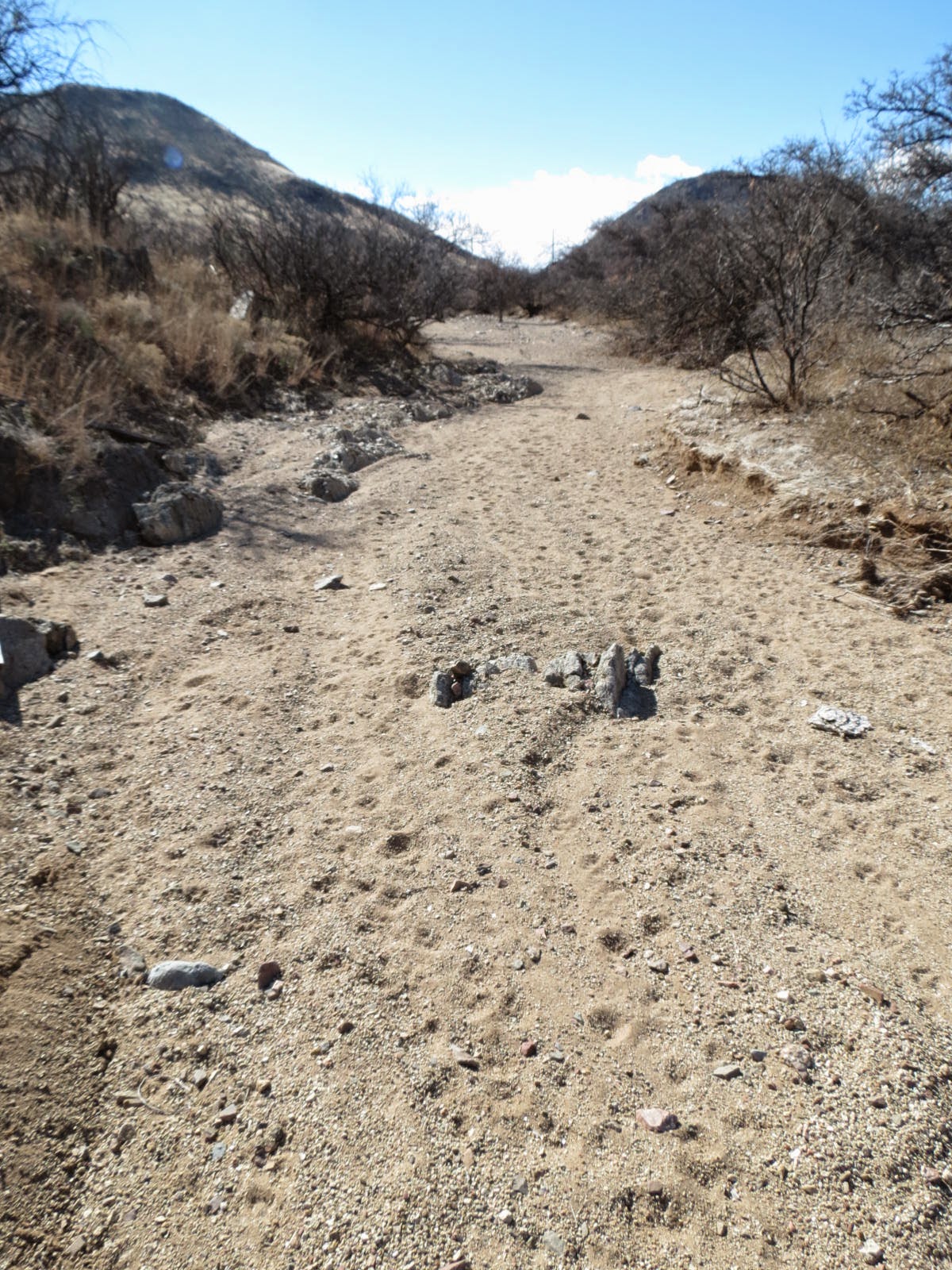
Even streams and rivers in this part of the country are ghostly most of the year. I was amused, at first, to learn that the dry washes have names, but quickly I realized that it is no stranger than our little Leelanau County creeks having names. The difference is that our northern Michigan creeks hold water (or ice) year-round, while here the washes contain only sand and gravel and rocks (and a few plants and birds and lizards and javelina and ranging cattle and such) until the rains come. (If they come.) Then, briefly, the washes are roaring creeks.


It seems, according to my reading of Bowers, that the flowering of desert wildflowers is uncertain in somewhat the way of the cherry orchard bloom in northern Michigan.
To be aware of wildflowers is to be keenly aware of time’s passing. Every January photographer friends in Illinois call to ask whether the desert will bloom this spring. Not being God, I have no absolute knowledge....
If the desert is going to bloom, when will the bloom begin, when will it be at its peak, and when should visitors time their arrival in the desert? We have similar questions at home, with everyone wanting to be on hand for peak cherry bloom, which varies from one year to the next. It’s rare year when we don’t have any blossoms, though. The desert is different. In a year of no rainfall or too little for dormant seeds to germinate (if need be, desert seeds can wait decades for enough rain to assure the continuation of their species), there may be no spring blooming other than cactus (which it seems never disappoints), and in that way the flowering of the desert is more like Michigan snowfall: some years are spectacular and memorable, record years; most are average; while a horrid few are pallid, brown, and muddy.

The natural world and visible traces of history are obvious dream sources, but David and I also dream alternative realities in – and for -- more contemporary urban scenes. Willcox shares the fate of many small towns across the country, that of vacant buildings and boarded-up windows along a stretch that was obviously once the liveliest part of the town. Nowadays an expressway bypasses the town, so most of the heavy traffic is out by the main expressway interchange, where new motels and fast food chain restaurants and gas stations give tourists and travelers a chance to stop for the night and never see the town at all. It’s too bad, I think.


The charming Old Town stretch along Railroad Street houses several businesses, as does a row of sweet little bungalows facing Railroad Street from the other side of the tracks, but even here there are vacancies. Other parts of downtown hold other handsome buildings, some with prospering businesses, others vacant.


Willcox is a friendly town, easy to get around in. I like it a lot. Uncrowded and easy to navigate, on foot or by vehicle, for my sake it doesn’t have to change at all, but since I have had a business for many years in a village that has only recently begun climbing out of a long decline, I can’t help wishing for residents and business people in Willcox a little new development, some new investment. Not too much! Not enough to turn it into a gaudy tourist trap! Just enough to make use of existing buildings and provide a few more jobs.

Chief among vacant buildings (this was true in the bypassed towns on old Route 66, also) are old motels, and one of them in particular set us to dreaming. What would be the best, highest use of this old sweetie? Low-cost studio apartments? Seasonal condos? An artist colony? Retail “picker” businesses, with an open-air flea market in the central courtyard? Assisted living units? Does a place like this ignite dreams in you? What would you do with it?


As for Dos Cabezas, I wish no change whatsoever, no development at all. It’s just fine as a ghost town. Fourteen miles to Willcox for library, post office, and groceries is a fair trade for black velvet night skies and still, quiet days.


Postscript: My book recommendation for this week, in case you couldn’t tell, is The Mountains Next Door, by Janice Emily Bowers, not only for its scientific information and the local interest (for me, here, now), but because it is beautifully written. The second chapter (or essay), “Collections,” reminded me very much of Gaston Bachelard:
We collect in order to possess: Seashells, pine cones, minerals, butterflies.... We can never have enough ...; in fact, the more we have, the more we need. They anchor us, somehow – connect us to the past or fill the empty spaces in our lives.  
We collect in order to prolong the present, as though by saving this particular leopard-spotted cowry we could hang on forever to that day on the beach....  
We collect in order to partake of something larger than ourselves....
As I wander the parched ground around the cabin here in Dos Cabezas, I pick up rocks of all kinds and sizes, dry animal bones, and worn pieces of colored glass, very much in an attempt to feel part of the vast surrounding landscape and to prolong the present moments I am enjoying here. I am reading The Mountains Next Door in the same way that I walk out into the desert – eagerly, greedily and with a deep sense of happiness.