 |
| Peak hidden in clouds |
The
desert invites meditation or communing with God. It invites visions. Since the
same is true of mountains, it is hardly surprising that the Dos Cabezas
Mountains and the Chihuahuan Desert set me to dreaming the first day I saw
them, long before we reached our ultimate destination, stopped moving, turned
off the car ignition, and put our feet down at last on solid ground. Very
solid. Rock
solid.
Because
of the three-day holiday weekend commemorating the life of Martin Luther King,
Jr., it was Tuesday before we were able to visit the community library in
Willcox and establish ourselves with a temporary borrowing card. While David
was signing us up, I went straight to the Arizona shelves and made my first
selections from the subsection on nature: The Mountains Next Door, by Janice Emily
Bowers; A Field Guide to the Plants of Arizona, by Anne Orth Epple
(photography by Lewis E. Epple); and Geology of Arizona, by Dale Nations
& Edmund Stump. Already I’d found at the Friend Bookstore an old copy of Cactus, by Laura Adams Armer
(illustrations by Sidney Armer).


One
of my desert dreams is to make at least a rudimentary beginning at learning the
plants of this high, arid region, all the more challenging in January when
almost nothing has leaves and absolutely nothing at all is flowering. Most tree
guides show me leaves; wildflower guides flowers. That doesn’t help much in the
winter desert. I was able to identify prickly pear (pretty easy) before looking
in the books. I’m still sorting out varieties of Yucca and other members of the Agave family. For Whipple cholla (which I think should be Whipple’s cholla), a specimen
found out back of the cabin, books were necessary. And here below is – ta-da!
--the first cactus I have “learned” this winter:

The Bowers book is marvelous for dreaming and learning and
finding inspiration. “This is the perfect book!” I exclaimed to David after I’d
read only the first few pages. “Another perfect book?” he asked, adding
somewhat dubiously, “How many perfect books can there be?” I explained that The
Mountains Next Door
is the perfect book for me, for where we are, for here and now. (And there’s another
wonderful thing about books in general: so many can come to hand at just the
right moment and be the “perfect” book for a reader at that time. They don’t
have to come by sheer luck, either. We’re allowed to search them out.) The
author of The Mountains Next Door is a botanist, and her “mountains next door”
are the Rincons east of Tucson, not all that far from “my” (or “our”)
mountains, the Dos Cabezas, here in our ghost town backyard. She begins by
describing the Olympic Mountains in the Pacific Northwest, which to her, for a
long time, were the “Delectable Mountains” of Pilgrim’s Progress. They were “real”
mountains, she felt, and because she could only visit them from time to time,
Their remoteness let me romanticize them as I could not romanticize the mountains I saw from my own front yard.
...Because the Rincons have never felt the sculpturing hand of glaciers, they have no looming, snowy peaks, no bowl-shaped tarns, no knife-edge ridges. Dryness is their characteristic. Clouds skim high overhead, untouchable, unknowable. Most days, rainfall is a mere rumor, a phenomenon read of in books.
The
Dos Cabezas, like the Rincons, are not magnificent enough to be famous far from
home, and if I can romanticize the modest mountains in my winter backyard, no
doubt it is because I do not have a lifetime familiarity with them, only a
scant few days’ sketchy acquaintance. But the truth is that as soon as our
winter plans began to take shape, back in Michigan, the words “high desert”
were dream words for me, words I could hardly pronounce without a shiver,
and the same was true of the place name Dos Cabezas. How can a ghost town with adobe ruins not
invite dreams?


 Even
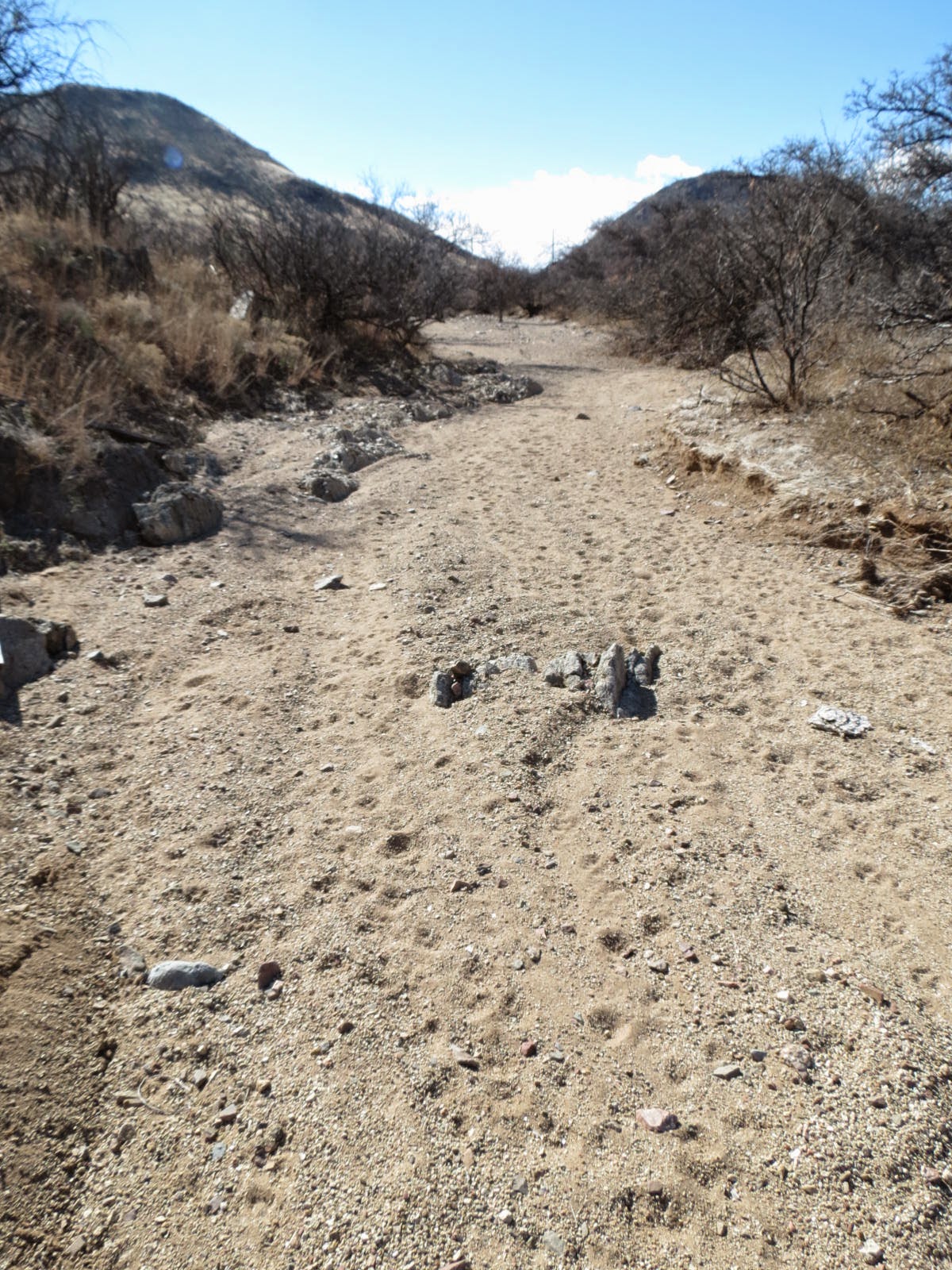
streams and rivers in this part of the country are ghostly most of the year. I
was amused, at first, to learn that the dry washes have names, but quickly I
realized that it is no stranger than our little Leelanau County creeks having
names. The difference is that our northern Michigan creeks hold water (or ice)
year-round, while here the washes contain only sand and gravel and rocks (and a
few plants and birds and lizards and javelina and ranging cattle and such)
until the rains come. (If they come.) Then, briefly, the washes are roaring
creeks.
Even
streams and rivers in this part of the country are ghostly most of the year. I
was amused, at first, to learn that the dry washes have names, but quickly I
realized that it is no stranger than our little Leelanau County creeks having
names. The difference is that our northern Michigan creeks hold water (or ice)
year-round, while here the washes contain only sand and gravel and rocks (and a
few plants and birds and lizards and javelina and ranging cattle and such)
until the rains come. (If they come.) Then, briefly, the washes are roaring
creeks. 
It
seems, according to my reading of Bowers, that the flowering of desert
wildflowers is uncertain in somewhat the way of the cherry orchard bloom in
northern Michigan.
To be aware of wildflowers is to be keenly aware of time’s passing. Every January photographer friends in Illinois call to ask whether the desert will bloom this spring. Not being God, I have no absolute knowledge....
If
the desert is going to bloom, when will the bloom begin, when will it be at its
peak, and when should visitors time their arrival in the desert? We have
similar questions at home, with everyone wanting to be on hand for peak cherry
bloom, which varies from one year to the next. It’s rare year when we don’t
have any
blossoms, though. The desert is different. In a year of no rainfall or too little
for dormant seeds to germinate (if need be, desert seeds can wait decades for
enough rain to assure the continuation of their species), there may be no
spring blooming other than cactus (which it seems never disappoints), and in
that way the flowering of the desert is more like Michigan snowfall: some years
are spectacular and memorable, record years; most are average; while a horrid
few are pallid, brown, and muddy.
The
natural world and visible traces of history are obvious dream sources, but
David and I also dream alternative realities in – and for -- more contemporary
urban scenes. Willcox shares the fate of many small towns across the country,
that of vacant buildings and boarded-up windows along a stretch that was
obviously once the liveliest part of the town. Nowadays an expressway bypasses
the town, so most of the heavy traffic is out by the main expressway
interchange, where new motels and fast food chain restaurants and gas stations
give tourists and travelers a chance to stop for the night and never see the
town at all. It’s too bad, I think.


The
charming Old Town stretch along Railroad Street houses several businesses, as
does a row of sweet little bungalows facing Railroad Street from the other side
of the tracks, but even here there are vacancies. Other parts of
downtown hold other handsome buildings, some with prospering businesses, others
vacant.

Willcox
is a friendly town, easy to get around in. I like it a lot. Uncrowded and easy
to navigate, on foot or by vehicle, for my sake it doesn’t have to change at
all, but since I have had a business for many years in a village that has only
recently begun climbing out of a long decline, I can’t help wishing for
residents and business people in Willcox a little new development,
some
new investment. Not too much! Not enough to turn it into a gaudy tourist trap!
Just enough to make use of existing buildings and provide a few more jobs.
 Chief
among vacant buildings (this was true in the bypassed towns on old Route 66,
also) are old motels, and one of them in particular set us to dreaming. What
would be the best, highest use of this old sweetie? Low-cost studio apartments?
Seasonal condos? An artist colony? Retail “picker” businesses, with an open-air
flea market in the central courtyard? Assisted living units? Does a place like
this ignite dreams in you? What would you do with it?
Chief
among vacant buildings (this was true in the bypassed towns on old Route 66,
also) are old motels, and one of them in particular set us to dreaming. What
would be the best, highest use of this old sweetie? Low-cost studio apartments?
Seasonal condos? An artist colony? Retail “picker” businesses, with an open-air
flea market in the central courtyard? Assisted living units? Does a place like
this ignite dreams in you? What would you do with it?

As
for Dos Cabezas, I wish no change whatsoever, no development at all. It’s just
fine as a ghost town. Fourteen miles to Willcox for library, post office, and
groceries is a fair trade for black velvet night skies and still, quiet days.

Postscript:
My book recommendation for this week, in case you couldn’t tell, is The
Mountains Next Door,
by Janice Emily Bowers, not only for its scientific information and the local
interest (for me, here, now), but because it is beautifully written. The second
chapter (or essay), “Collections,” reminded me very much of Gaston Bachelard:
We collect in order to possess: Seashells, pine cones, minerals, butterflies.... We can never have enough ...; in fact, the more we have, the more we need. They anchor us, somehow – connect us to the past or fill the empty spaces in our lives.
We collect in order to prolong the present, as though by saving this particular leopard-spotted cowry we could hang on forever to that day on the beach....
We collect in order to partake of something larger than ourselves....
As
I wander the parched ground around the cabin here in Dos Cabezas, I pick up
rocks of all kinds and sizes, dry animal bones, and worn pieces of colored
glass, very much in an attempt to feel part of the vast surrounding landscape
and to prolong the present moments I am enjoying here. I am reading The
Mountains Next Door
in the same way that I walk out into the desert – eagerly, greedily and with a deep sense
of happiness.

