Search This Blog

Showing posts with label murder mysteries. Show all posts

Friday, January 29, 2021

Falling Behind and, In Doing So, Making an Accidental Discovery


Snow-covered mountain


With so few demands on my time, I am still falling behind, because -- well, so few demands, yes, but those so very demanding! You know the name of one of them without my mentioning it!


Mountain, raven, dog


What I’m falling behind on, besides my Silas project, is writing on this blog about books I’m reading. It’s all been dogs, dogs, dogs and mountains, desert, snow on the blog for quite a while now. Not that I’ve heard any complaints, of course. After all, so many of you are stuck indoors with your own reading and movies and baking and knitting and whatnot that I realize the allure of vicarious outdoor adventures.


Be assured, however, that today’s indoor bookish adventure will not be a long, dry discourse on economics or history. In fact, the book I want to write about is one I picked up to “take a break” from more serious reading, a book that aided me in falling behind with book reviews I have in mind to write and post. A beat-up paperback (I taped it back together) from the outdoor 10-cent table at the Friendly Bookstore in Willcox. A murder mystery. By an author whose name faintly rang a bell in memory but whose work I did not recall ever reading before. 


Here it is,


and how could I resist the title, after our little reading circle back in Michigan initially came together years ago precisely in order to read together Ulysses, by James Joyce? The tempting volume, small in size, light in import, also seemed a perfect car book. Do you have those? The Artist and I always have one or two books apiece in the car, so one of us can read while the other is running an errand or so we’ll both have something to read on the porch at Source of Coffee -- although we generally end up in conversation on that porch instead, at least with each other when not also with a friend or two.


But I digress (digression being the prerogative of a blogger without an editor). 


In The James Joyce Murder, by Amanda Cross, protagonist Kate Fansler, professor of Victorian literature, is ensconsed in a country house in western Massachusetts, working (at the request of the heir, a cloistered nun) to determine the contents and bring order to a collection of literary letters and papers left behind by a late friend of her family. She also has the care of a young nephew for the summer. Two graduate students complete the household, one working on the collection, the other tutor and companion to the boy, and rural neighbors and academic friends fill out the cast of characters, with cameo appearances by various policemen, a car mechanic, and a publisher in New York.


Confession: I did not find the story completely engrossing. The language put me off, for one thing. “The conversation is like something in an English drawing room comedy,” I complained to the Artist. A paragraph from the protagonist’s mouth in the first chapter will serve. 


“Familial connections are always difficult to explain, and impossible to sever. Not that one really wants to, I suppose. However trying one’s family, there is some call of blood to blood which one is somehow impelled to answer. I have nothing in common with any member of my family, and yet in crisis, personal or national, one always rallies round.”

-Amanda Cross, The James Joyce Murder 


In the paragraph above, Kate is talking to a close friend, but doesn’t it sound as if she’s speaking lines in a stage play? And everyone talks that way in the novel, page after page. Too witty for belief! My credulity was strained. But the reading required no great effort, dialogue makes a story go faster, and the whole book wasn’t that long, so I kept at it, a few pages at a time. 


It took a long time before anyone turned up dead. When the corpse was discovered, it was hardly a surprise, as it was someone whose death no one seemed to mourn. Certainly her husband did not, nor any of her neighbors. (The children did not appear and so were not asked in the pages of the book.) From the first introduction of the poor, doomed character, obviously marked for an early grave, I felt the author and everyone else judged her far too harshly. She was annoying, but is that a sin, and shouldn’t people with serious, rewarding careers and the good fortune to pass their summer in idyllic surroundings have better things to obsess about than a neighbor they don’t find congenial? Still I persevered and discovered, at last, who done it.


A far more interesting story came to light when I read a brief biographical sketch of the author at the end of the book and found that Amanda Cross (some of you undoubtedly know this already) was a pseudonym for Carolyn G. Heilbrun, author of fourteen nonfiction books under her own name, the first woman to earn tenure in the English Department at Columbia (her specialty was British modern literature), Avalon Foundation Professor in the Humanities at Columbia University, MLA president in 1984, and outspoken feminist. When she “discovered” feminism in 1968, she felt she had been “born a feminist.” Married to economist James Heilbrun after they met in college, she was the mother of three children when she went on to graduate school herself. A “nontraditional” student: I could relate to that. Her strong views on feminism were matched by strong views on other subjects, as well, particularly her desire not to live beyond her usefulness, and she planned initially to commit suicide at age 70 but lived until age 77, when she took her own life without any preceding fanfare or crisis.


Heilbrun frequently skewered academics under her pen name, but The James Joyce Murder was published almost two decades before the biggest controversy in her own life, a tempest that arose when she accused (in an interview) her own English Department at Columbia of discrimination against women. To my ear, the charge hardly seems controversial by now. How, I wonder, could anyone doubt discrimination in 20th century academia? Was there any college or university department in the country that had not discriminated against women, as well as against candidates and department members of color?


Kate Fansler may have been the pseudonymous author’s alter ego, but when reading of Heilbrun’s life I saw her retrospectively in a minor character, also, that of Grace Knole, retired professor of medieval literature, and my retrospective look back at a book I just finished reading is also a look ahead to the older age of an author who published the book when she was only 41 years old. Here, anyway, is Grace Knole speaking to Kate Fansler, urging her to accept the presidency of her college. Kate has suggested that Grace should be president instead.


“I agree with you, actually. …But people these days want their college presidents young. To be frank, I can’t imagine why. It seems to me that college presidents, like popes, out to be old when appointed: they can then afford to take risks, and they can’t live on too long and get set in their ways. That, however, is not the American way.”


For 26 years prior to her suicide, Carolyn Heilbrun had gone for a daily walk with her friend, art historian Mary Ann Caws. During their last walk and conversation, amidst talk ranging from Darwin and Manet to women’s poetry and the state of the world, Heilbrun commented that she “felt sad.” “About what?” her friend asked. “The universe.” Apparently Caws did not attach particular significance to that brief exchange and confidently anticipated their regular walk the following day.


Carolyn Heilbrun had a good life – happy marriage (her husband “read every word she wrote”) and children combined with independence, friends, and a successful career – but it sounds as if she had grown tired. 


Mountain sunset


Soon I want to read one of Heilbrun’s nonfiction books, The Last Gift of Time: Life Beyond Sixty. The title sounds so familiar that I wonder if I may have read it already, but it would have an added dimension now that I know more about the author’s life – and as I move on beyond 70 myself, kept lively by a most lively-minded human partner and, for now, a more-than-lively young border collie.


Peasy!

Sunday, January 20, 2019

Mystery! Just Where Is That “Cat-Who” Country?

What's going on out there?
We met a few of the high desert ghost town neighbors the other morning for coffee, cinnamon rolls, and homemade biscotti when one of them at the other end of the table from me leaned forward to ask, “You know the ‘cat-who’ books?” I nodded. I have a bookstore, after all, and I started out selling only used books (though I have carried a pretty good selection of new titles for some time now), and the ‘cat-who’ books are murder mysteries. I always say that if you had a store of used books and sold only history and mystery, you’d have nonfiction and fiction covered for the majority of your customers. It would be a good name for a used book business, too: History and Mystery. 

So, yes, of course. Though at that very moment the author’s name didn’t leap to my mind, naturally I was familiar with the series, having always one or two of the books in my shop at any given time. And my mother had read all of them. But had I ever read one myself? That’s what stopped me in my tracks when the questioner informed me that the stories were set in my Michigan backyard. Really? “Out in Seattle, they call where you live ‘cat-who’ country.” Really? “Are you kidding me?” No, he wasn't.

This is not Michigan, any part of it

Later that same day we stopped at the Friendly Bookstore in Willcox, one of our regular stops, and I went directly to the mystery shelves, where there were two paperback books by Lilian Jackson Braun. I selected the slimmer of the volumes and went home with The Cat Who Sniffed Glue, determined to find out if Traverse City — “or, really, Northport,” the Arizona neighbor had said — were indeed the setting for the stories.

I won’t beat around the bush or lead you on. As far as I’m concerned Pickax is not Traverse City, and it isn’t Northport, either. It has features of many different Michigan towns, but it is definitely U.P., that is, the Upper Peninsula. Your clue, sleuthers, is the phrase “Down Below.” 

No one in the Lower Peninsula uses that phrase to indicate they’ve been traveling south, because the Lower Peninsula is “Down Below.” It’s below the Mackinac Bridge, the Mighty Mac, the bridge that spans the Straits of Mackinac and joins the two peninsulas. (And Mackinac is pronounced Mackinaw, by the way, even when there’s a ‘c’ rather than a ‘w’ on the end of the word.) On that much I brook no dispute. 

Perhaps, however, another word of explanation is in order for those unfamiliar with Michigan. The neighbor here in southeast Arizona who brought up “cat-who” also loaned us a couple of books set in southern Michigan, and that’s yet another distinction. Northport and Traverse City are in the Lower Peninsula, but they are not “southern” Michigan. To everyone but Yoopers, they qualify as “Up North.” Are we clear now?

As to which is the “big lake” in the Braun books, we could argue it different ways. Where I live, in Leelanau County (i.e., “Down Below”), the “Big Lake” is Lake Michigan, but the Upper Peninsula has Lake Michigan to its south and Lake Superior to its north, so where is Pickax? At one point in the story, someone mentions that Pickax is the “only harbor of refuge” on that side of the lake, but are we to take the statement literally? Is it possible there is only one harbor of refuge on Lake Michigan’s north shore, or only one on Lake Superior’s south shore? That seems unlikely, though of course there are long stretches, especially on Lake Superior, where a sailor is far from a harbor of refuge. And now, checking further, I see that there is not a single federal harbor of refuge in the U.P., and even Northport and Leland, harbors of refuge in Leelanau County, are not federal harbors of refuge. But perhaps this is muddying the waters too much.

Out West -- horses and cows
Anyway, another element that confounds literalism has to do with restaurants. — But wait, let me back up a bit. 

All the mining history in the book points to the Keweenaw (confusingly pronounced KEE-wuh-naw) Peninsula, that rocky, jutting antenna projecting in a graceful curve from U.P. into cold Lake Superior. The number of mansions strengthens the case for the Keweenaw, too, since the kind of fortune brought by mining allowed for mansion-building. So, too, there was an ethnic diversity in the history of the U.P. that would go some way toward explaining the number of interesting restaurants available to characters in the cat-who story, restaurants that would seem wildly out of place in most parts of the U.P. (though perfectly reasonable in the Traverse City region). I mean, come on! No one mentions a single Cornish pasty in the whole book! There are also a lot more farmhouses and barns than I associate with the Upper Peninsula. So where does that leave us?

I guess I could just do an online search and find the answer to my question instantly, but where’s the fun in that? After all, I could have skipped directly to the final chapter of the book to learn the identity of the murderer, too, and not read the story at all, but why? Isn’t it more fun to enter into a story and search for clues? The journey, not the destination….

If you know Michigan and if you’ve read Lilian Jackson Braun’s books, where do you think the stories are set?

One thing is certain. As I was reading The Cat Who Sniffed Glue, my mother was not far from my thoughts but always there, just across the room, smiling at me. Here I was, reading another book I knew she had read and enjoyed. And I was reading it right after reading another book, one sent to me by my sister, a book she had bought and given to my father — so that in reading that book I was constantly reminded of “the Colonel.” Reading is so much more than escape, so much more even than education. A solitary activity, yet it unites us with other human beings, even those who have passed on.

As for my Western images today, several of them represent what is for me a cow country mystery: Can horses round up cows on their own, without cowboys or cowgirls, and take the herd back to the ranch at the end of the day? If not, what was going on in these scenes we witnessed out near the Willcox Playa on Saturday afternoon?


Horses at work?

Sunday, November 18, 2018

Winter Comes to Northport


The solstice is still in the future, but we have had snow (along with books) in Northport. We’ve also had some early holiday guests at Dog Ears Books.


Saturday morning (early)
Featured Guest Aaron Stander

Saturday was the long-anticipated book signing with Aaron Stander and his #10 Ray Elkins murder mystery, The Center Cannot Hold. Such is Aaron’s popularity that even before he arrived on the scene, his fans were pouring in, eager for face time with the author.


And so, despite gloomy weather, despite the existential crisis I fear Sheriff Elkins in facing (consider the title), we had a cheerful and convivial day in the bookstore. Aaron came all the way up from Interlochen, and Saturday’s customers were from Omena and Cedar, as well as Northport.


Happy customers!
Another visitor: my son

My son, Ian, was visiting from Kalamazoo, also, having arrived on Thursday evening. As the proprietor of a bookshop, I never have a problem entertaining visitors who are book readers — and happily, all of my relatives are readers. So it was that during quiet moments at home and in the shop, as Ian and I sat reading our respective books, every now and then one of us would pause to share a passage with the other. Readers, after all, are not antisocial. We are happy to read aloud to others and often to pass favorite books along to friends. Can’t do that with a pumpkin latte.


Bruce brought me a book

Bruce Balas, my part-time volunteer of many years, recently traveled to England, Ireland, and Scotland, and as he so often does from these international jaunts, Bruce brought back a book for me. This time it was The Diary of a Bookseller, by Shaun Bythell, a day-to-day account of one little shop selling used books in Scotland.

Each day in The Diary begins with a notation of the number of online orders received, along with how many of the books ordered the bookseller and his crew were able to locate to ship out, thus fulfilling the orders — his rating with the online behemoth selling engine rising and falling accordingly. He notes ruefully that while one of the compensations of self-employment, traditionally, has been not having a boss, the behemoth “is slowly but certainly becoming the boss of the self-employed in retail.” I read that, shivered, and thanked my lucky stars I pulled out of the online selling morass years ago, as prices realized raced to the bottom with no corresponding diminution in time required to process orders. 

(An order for a six-dollar book is as time-consuming as one for a sixty-dollar book, and in an open shop, with a single person working, it makes more sense to focus on live people who have taken the trouble to come through the door. Of course, that means depending on those live people to buy books in the shop so that it can remain open and viable. Word to the wise sufficient?)

The Book Shop in Wigtown sells mostly used books, only a handful of new, and their most popular used books are on the subject of railroads. The proprietor buys considerably more books than I do from private libraries being dispersed and, as I say, is selling online daily. He has a handful of part-time employees (what would that be like?) and a bookstore cat rather than a dog. He lives above his shop. And while he doesn't mention it, I know he drives on the wrong side of the road. All these are differences between his business and mine, but so much of what he experiences is still familiar to me that I keep laughing out loud as I read.

The meat of each day’s diary entry is a narrative including descriptions of weather, stories of shop help’s eccentricities, customer requests and staff responses, expeditions to examine private libraries offered for sale, accounts of local “festival” plans, and the bookseller’s recreational activities on his days off. Following the narrative is the number of customers in the shop that day (he calls them all “customers,” whether or not they spend a shilling) and the total “take” in British pounds.

On the minus side of Shaun Bythell’s observations are the following phenomena, sadly familiar to your bookseller in Northport: people who enter with boisterous proclamations of their love of books and bookstores and buy nothing (so it is not my imagination, and I’m not the only bookseller to have noticed!); those for whom nothing is cheap enough, no matter how much they supposedly “want” it or how many years they have been searching for it; the problem of the behemoth’s pricing algorithm (comments about “cheaper online” made within hearing of the bookseller); etc.

(I am waiting to see if he will mention the dramatic souls who confide with a shudder that bookstores are “very dangerous places” for them, folks who eye me suspiciously, as if I were a dealer in illegal substances luring them, at their peril, into an ambush! And are there in Scotland bookstores the annual visitors who stop by, look around, and sail out each time empty-handed with promises to “see you again next year”? I wonder what they think keeps my bookstore in business from one summer to the next.)

On the positive, brief side of the pro/con ledger — he prides himself on being a “curmudgeon” and tends to accentuate the negative — Bythell describes some of the joys of bookshop life: children who lose themselves in books (“It gives me a glimmer of hope for the future of bookselling  … to see a child reading, their attention rapt in the book to the total exclusion of everything else.”); a regular customer who orders from the shop rather than online (you how who you are, loyal Northport friends!); exclamations he overhears about how “cool” his shop is; the thrill of selling a treasure he’s had on the shelf for a decade and that of discovering another treasure among boxes of books otherwise good for nothing but to sell by weight to a scrap dealer. Occasionally he goes off on a paean of praise for something like historic publishers of quality books or a grump-fest about a planned wind farm he fears would ruin his view. 

There are also nuggets of old-bookish information to enlighten anyone not familiar with the trade, and so, as I read and laugh and share aloud bits to anyone fortunate enough to be nearby (at present, my son and/or the Artist), I keep thinking of others who would enjoy this book. The experienced bookseller would find, as I have, a kindred soul and familiar situations; for the novice or wannabe bookseller, there are useful lessons; and anyone genuinely interested in books and bookstores and human foibles would be amused and entertained.

Books about bookstores, like books about dogs, seem to be increasing in number. Is this indicative of a new and growing appreciation for bookstores and their continued existence? One can hope.


Not that long ago....
And now, Thanksgiving is coming

As Thanksgiving approaches, I am thankful for my years of Up North bookselling, despite the occasional frustrations. Making dreams come true is as much hard work as it is joy, but for me it has been worthwhile. I’m thankful for the Artist’s steadfast support from the beginning; for Bruce’s loyal assistance over many years; and for the collegiality of fellow bookstore owners, especially in northern Michigan (real booksellers, in my book, are those with open shops, willing to meet the public face to face). 

I am ever grateful for the generosity and talent and professionalism of authors it has been my privilege to meet and know in the course of the last quarter-century; for parents who bequeathed to me and my sisters a love of reading and respect for books; for other parents and teachers who have done and continue to do the same for children in their lives. 

And always I am thankful to my customers, both local and visiting, first-time tourists and returning summer people, all who continue to show their appreciation for my bookstore by buying books in Northport, at Dog Ears Books, on Waukazoo Street. That’s what keeps my bookstore here! Thank you all! May your holiday be blessed! You have all been blessings in my life!

“Going Forward”


(As if there’s any other way we can go, eh?)

In 2015 I called my winter away from Michigan a sabbatical. I didn’t give it a name in 2018. Now, however, still working long summer and fall days as younger friends and relatives retire, I have decided that “seasonal retirement” is a more meaningful term. 

This year the Artist and I will be away from home and our places of business from December through April, our longest absence from ever. You’ll be able to follow our adventures (as in previous, shorter absences) here on “Books in Northport,” should you be so inclined. Meanwhile, for the more immediate future, here is the plan for Dog Ears Books for the remainder of November:

NOVEMBER BOOKSHOP CALENDAR

Tuesday, 11/20: OPEN 10-2:30 (need to close early to keep an appointment)

Wednesday, 11/21: OPEN 11-5 (Take a bookstore break from mixing up cranberry relish and bread stuffing and baking pies.)

Thursday, 11/22: CLOSED FOR THANKSGIVING

Friday, 11/23: OPEN 11-5 WITH BEGINNING OF HOLIDAY SALE

Saturday, 11/24: OPEN 11-5. OPEN HOUSE IN BUSINESSES THROUGHOUT VILLAGE. HOLIDAY SALE CONTINUES. VILLAGE TREE LIGHTING 6 p.m. LIVE MUSIC

Sunday, 11/25 CLOSED

Monday, 11/26: OPEN 11-5 for CIDER MONDAY — YOUR LOCAL ALTERNATIVE BY SHOPPING ONLINE! HOLIDAY SALE CONTINUES.

Tuesday, 11/27: OPEN 11-5 HOLIDAY SALE CONTINUES

Wednesday, 11/28: OPEN 11/5 HOLIDAY SALE CONTINUES

Thursday, 11/29: OPEN 11-5 HOLIDAY SALE CONTINUES

Friday, 11/30: OPEN 11-5 LAST DAY OF THE BOOKSTORE YEAR???

Saturday, 12/1: Who knows? Not sure yet! Friday, 11/30, may be our last day of the season, so don’t wait for December 1st to do your holiday shopping at Dog Ears Books!


Tuesday, July 18, 2017

Let’s Take a Break, Shall We?


It’s summer, and so much is going on! That’s one reason to take a break from serious economic and political topics, but another is so I won’t lose all my readers with relentless offerings of ponderous facts and opinions. And so, fun and photographs and coming events are the menu for today.


We had a visit from David’s youngest, which was only disappointing--everything else about it great!--in that his one-man exhibition at the Dennos Museum Center was not yet on the walls for her to see. But the paintings are now placed (after burly friends helped load vehicles, we delivered them yesterday, although the new floor in the gallery is not quite finished), and the show, because it’s opening later than anticipated, will be up through the first full week of September, and you can probably get in the door today. Wowser! We are excited!!! You will be, too, but you have to go to Traverse City to see it. I only had a chance to take photos below while staying out of the men's way.


(If you live in the Traverse City area and are not yet a member of the Dennos Museum Center, now would be a good time to join. A fabulous--only word for it--new addition will also be opening in late fall.)

My first bookstore visitors this Tuesday morning were a mother and son from south Florida, on the last day of their vacation, looking for something the boy could read on the plane ride home. He chose two Magic Treehouse books, one about sharks, the other about ninjas, and then explained to me the general idea of the series. I told him it sounded kind of like the magic I often experience through reading. This morning, for example, I was in England, riding in a pony cart on a dusty country road – and then when I put a bookmark in place and closed the book, I was back on my own front porch in Michigan.


And speaking of Michigan and the magic of books, we have an author event at the bookstore, this very Thursday! Aaron Stander, author of nine popular Up North murder mysteries, will be at the bookstore on Thursday at 7 p.m. to talk about his creative process, self-publishing experiences, and anything else our audience wants to ask him about. The evening will be casual and friendly, and we’ll all have a good time, so please come!


Monday, February 6, 2017

Book Review: GALES OF NOVEMBER


Aaron Stander’s latest northern Michigan mystery, once again featuring Sheriff Ray Elkins of Cedar County (a fictional county on the shore of Lake Michigan), may be his best so far. I stopped reading halfway through in order to get a night’s sleep but woke early to pick up where I’d left off and didn’t put the book down again until the last page.

The story unrolls in two sections. In the first quarter of the book we read journal entries, written by a female freshman student, covering a one-week high school camping trip gone bad, a winter wilderness experience in Michigan’s Upper Peninsula. It is Thanksgiving week, but these students are not going home to family, for various reasons. We then skip ahead twenty-five years, arriving on a Friday before Thanksgiving, when former campers from the ill-fated trip come together again on the grounds of their old private school for a posh reunion arranged by the wealthiest member of the group.

Both the camping trip and the reunion a quarter-century later are marked by severe blizzards. The faculty member leading the group in the wilderness went for help and never returned; the sheriff and detective have to hike in the last couple of miles after going off the road in their SUV. 

The U.P. campsite was far from roads, the private school below the Bridge located outside even a small town, and both scenes are further isolated by the severe winter storms indicated in the book’s title. 

It is a classic setup, reminiscent of Agatha Christie – a limited cast of characters, trapped together for a period of time, isolated from the outside world. But Stander brings to this classic his own gift for evoking the physical and social landscape of northern Michigan, and he is especially good capturing winter.
Even in the blizzard conditions, they could make out his jagged trail. His path ran down the steep slope toward the lake. ... Their thighs burned as they struggled to move forward through the deep drifts. In places where the wind had blown the snow cover away, they encountered steep walls of sheer ice. The hardened steel rims of their shoes cut into the surface, providing some traction, but not preventing an occasional fall....
Gales of November is the ninth Ray Elkins book from Aaron Stander. “Do you have to read them in order?” people often ask of books in a mystery series. No, of course not. The sheriff’s life and relationships develop over time, as is true of most characters that recur in a series, but each book works fine as a stand-alone reading experience, too.

Starting your Aaron Stander reading with Gales of November is no crime and will not put you in jeopardy. Another of my favorites is Shelf Ice. As I say, Stander does Up North winter very well. But start with any of his books, in any season, and you will not be disappointed -- just hungry for more!


Wednesday, November 18, 2015

If Books Were Spices, What Would These Be?


Sometimes a cliché can give rise to fresher thoughts. The cliché that came to me this morning, as I looked at the three thoroughly unrelated new books I’m featuring this week in my bookshop, was “Variety is the spice of life.”

Should I be ashamed that my first thought was such a trite reflection? Next into my head came a personal statement I can make very truthfully, so it may mean more or again it may not, which is that one of the things I love about books is their infinite variety. Books give us a variety of subject matter and writing style as great as the number of human minds who have written books in the past, write books today, and will write them in the future -- lives and thoughts and fantasies and observations – worlds and perspectives we would otherwise never know, available to us in this simple, as-yet-unsurpassed, durable hand-held technology. Wow!

Well, but then I thought more literally about spices and, by metaphorical extension, how one might link spices and books, and I may have gone too far afield with my third thought. Would Nuts and Buried be nutmeg, or is that too simplistic? Would The Mare be coriander because of the Dominican connection? What about Nineteen + Conversations with Jazz Musicians? Soul food? Maybe red pepper? But wait, where’s the cumin, and how can I attach it to one of these featured books?

Sometimes one gets carried away by a metaphor, so okay, let’s forget that one. At least it got me started writing about my Books-of-the-Week.


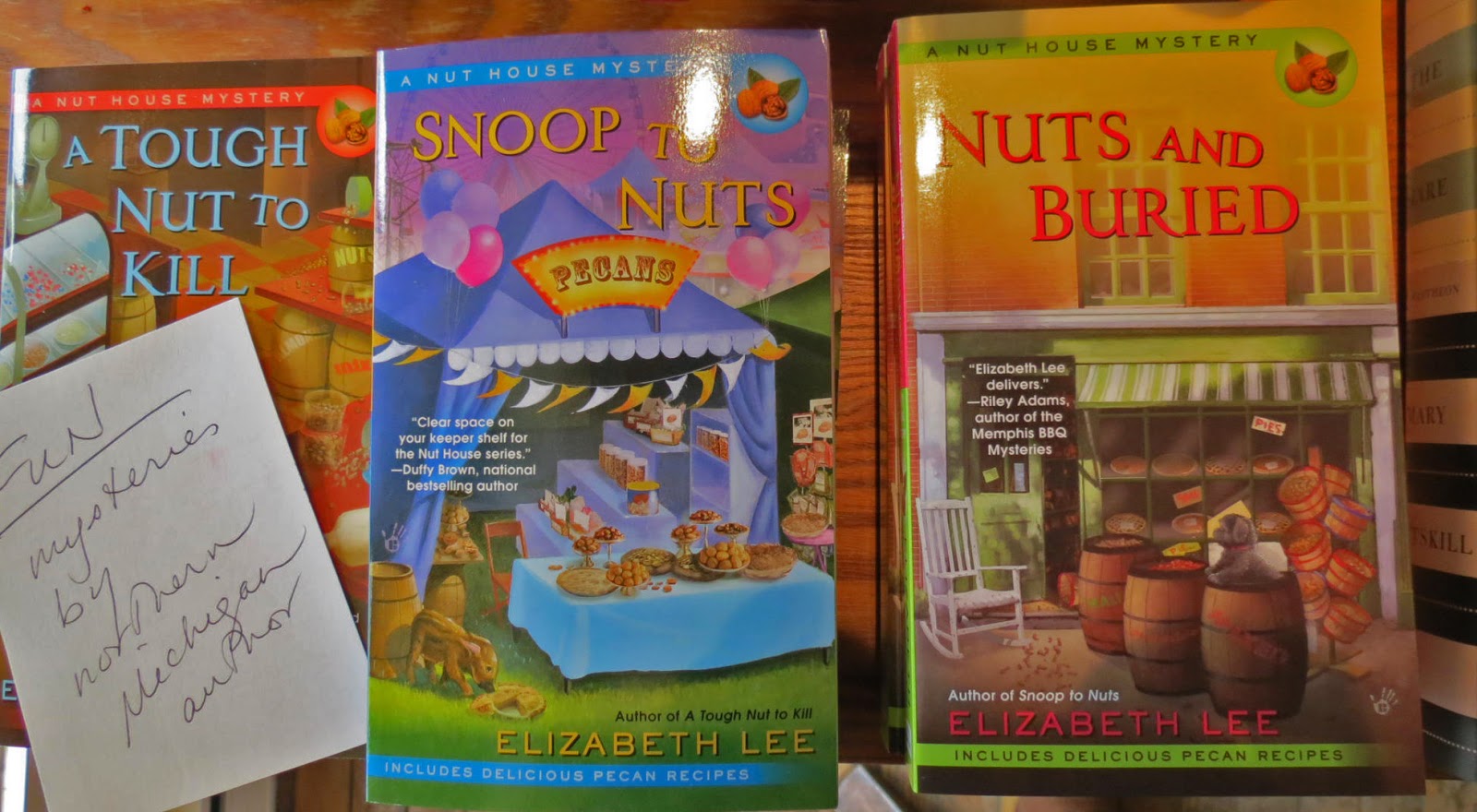
Michigan readers will remember Elizabeth Buzzelli as the author of the Dead series: Dead Dancing Women, Dead Floating Lovers, etc. I hope you also remember that she is now writing murder mysteries as Elizabeth Lee and that the new series takes place in East Texas on a pecan ranch. Want to go somewhere warm for the winter? Enjoy a vicarious getaway!

Lindy Blanchard is the first-person narrator of these funny, lively stories. With her strong university background in research science, she’s come home to develop a pecan tree that will be resistant to drought and pests, as well as to help out in the family store, the Nut House. When murder occurs, however, she and her intrepid Meemaw are right there in the thick of it, investigating and interviewing and putting their lives in danger to find the killer. Nuts and Buried is the third book in this irresistible series and a very affordable self-indulgent purchase at $7.99. Impossible to go wrong! Yea, Elizabeth!

Of my second featured book this week, The Mare, by Mary Gaitskill, I’ll refer to you my last blog post, where I wrote about it at length. (You have to scroll down through the weather and stone stuff to get to the book review.) The Mare is a hardcover novel and not cheap at $26.95, but if ever a new book was worth its full cover price, this is that book.

And now for something I’d love to call my own discovery, except that I learned about the book when a friend who is also a friend of the author sent me a copy. Garth W. Caylor (he actually goes by “Bill”) interviewed New York jazz musicians in the 1960s. He interviewed them in their homes, sometimes with interruptions by children or the telephone, so that the reader has the sense of being there in the room, and conversations ranged from music and dance, painting, literature, i.e., creativity in general, to the nitty-gritty of making a living in New York at that time, pros and cons of living in one part of the country or another or in another country altogether, to the deepest meaning of life as these creative individuals found it. These interviews are extraordinary, even to a reader (like myself) without a deep jazz background.

Here’s what makes me a little crazy, though. The author of this extraordinary book, nothing like which is available anywhere, could not find a publisher in the Sixties, after he had carefully secured permissions from all the musicians he interviews (can you imagine how disappointed they must have been?) and even after a book reviewer for Little Brown, one Ralph J. Gleason, music columnist for the San Francisco Chronicle, contributor to the iconic Downbeat (now online), and cofounder of no less than Rolling Stone, “urged” the publisher “with every ounce of conviction I have to publish it.” Little Brown sent a copy of Gleason’s review along to the author with their own rejection letter. What were they thinking? Caylor goes on to quote from Gleason’s letter (and who can blame him?)
...I have read it twice, and both times I have found it fascinating, but more than fascinating, I have found it illuminating. I would recommend it to my class and to my readers as I would recommend it to you.
And they passed it by. The mind boggles, does it not?

So now, decades later, the author has been driven to self-publishing to get his baby out into the world, and thanks to a friend in Tulsa, Oklahoma, I learned about author and book and was able to obtain copies of the book from the author and now have it for sale in Northport. I take great pride in offering it here.

But I should give you a taste of the book itself. Here’s a bit from the interview with Bill Evans, whose music I’m listening to as I compose this post. Caylor has just asked if Evans has become more “objective or detached” in his playing from early work to Little Lulu.
No—I don’t know. I still have to feel that I really like something for some reason or another. Like Little Lulu, I think, is a keen little melody. It’s not a matter of taking something which is a challenge—it just happens to be something we can work with, and happen to like. That’s the only thing. We simply enjoy it; I take it entirely seriously. It’s a humorous sounding tune, but that doesn’t mean I don’t take the humor seriously—I take it as seriously as anything else, and I try to make as much music out of it as I can.
I would love to quote the whole long section here but am refraining. Evans goes on to say that music too abstract to have a frame of reference is not satisfying to him, and both of those thoughts are important, I think, coming from a musician – the idea that enjoyment and fun are not divorced from taking music seriously and that, for this musician, some traditional frame of reference is crucial, however much freedom is introduced.

And here’s someone else, drummer Milford Graves, talking about looking at objects and needing the environment (as opposed to only looking inside himself) to build his mind:
I really enjoy the subway. Well, I’ve had to make myself enjoy it, since it’s been my only transportation; at one time it was a bad thing to me, but I can’t have anything like that causing a mental disturbance, because if that happens I can’t play the way I want to. So I try to take whatever it is that disturbs me and balance it out, so that nothing outweighs anything else. The subway is like a happening, there are so many things to see and hear, the people and the tension, it’s something to let me know where people are. Then the train itself, too. Everything caused by friction of one kind or another, and you can’t say it’s ‘good’ or ‘bad.’ You can only say it’s good if at any given moment it is satisfying a need, and you can it’s bad if at a given moment it disagrees with you.
Graves goes on to speak more and more abstractly about sound in general being without shape or style, but also insisting that music is “just sound.” Reality, illusions of reality, transformations – it’s heavy but, as Gleason recognized fascinating stuff. It's life perspectives from some of the most creative individuals in New York in the Sixties

Nineteen + Conversations with Jazz Musicians, New York City: 1065 1965 is a small book and expensive for its size. It’s less than 5”x7” side to side, and top to bottom, but there are 248 pages, with illustrations, bibliography, and index. More importantly, you just won’t find these musicians’ words and views on art and life gathered together anywhere else. You needn’t call yourself a jazz aficionado (I certainly don’t deserve the name) to find this very special, unique little book worth $32.95. Maybe for yourself, maybe for someone on your holiday gift list, but here’s something for the music lover who has everything, because it’s a sure thing they don’t have this book!