Search This Blog

Showing posts with label minds. Show all posts

Monday, November 18, 2013

A New Course of Study: Your Own Mind!


Mastermind: How to Think Like Sherlock Holmes,
by Maria Konnikova
NY: Penguin, 2013
$16 pbk.

First Impressions:

When it comes to stories of the famous fictional detective Sherlock Holmes, you’re either a fanatical follower or you’d pick up almost anything else before the desperation of a rainy evening alone in someone else’s remote cabin would tempt you to open A Study in Scarlet or The Sign of Four. Holmes fans simply cannot get enough of the master, while the rest of us politely cover our yawns when when a fan mentions his name. Yes, I admit it: I’m in the latter group. I don’t even like the movie versions much.

But hand me a book on how the mind works, and I’m as eager as a puppy with a new toy. Hand me Dan Ariely’s Predictably Irrational or Daniel Kahneman’s Thinking, Fast and Slow or anything by Temple Grandin, and I’ll be opening the book while you’re still talking. How we human beings perceive and remember and reason and draw conclusions, including our making of egregious errors, never fails to fascinate me. The promise of Maria Konnikova’s book on the mental processes of Sherlock Holmes is that we, the readers, can learn to remember better, think more clearly, thinking less like Dr. Watson and More like Sherlock Holmes. Okay, I'm in.

Because who – I ask you, who? -- wants to stand there like a chump (or like Dr. Watson), mouth hanging open, in reverent awe of Mr. Holmes? Don’t we want to come up with the solution to the mystery? I’m not out to collar murderers, but I would certainly like to know where the charger to my cell phone is hiding or figure out where the Farberware Dutch oven has disappeared to.

The “scientific method” of observation, though, doesn’t sound like my way of being in the world. It sounds so cold, so detached, so objective. Quite anti-social, in fact, don’t you think? The skepticism the author cites as fundamental to scientific observation reminds me of Descartes’ radical doubt thought experiment. Is it really possible – would it even be desirable – to go through every minute of every day doubting before believing? What could that possibly mean?

When the author makes the distinction between fast and slow thinking, I’m more comfortable. My husband says of my decision process in general, “She grinds exceeding slow, but she grinds exceeding fine.” I’m a slow thinking by nature. But not always, of course, slow enough: the default setting Konnikova calls “System Watson” is always poised to jump in quickly. Like the left brain when the person holding the pencil is asked to draw a house, “System Watson” is there jumping up and down and waving its hand in the air and saying, “I have the answer!” The left brain wants to draw “what it knows” without bothering to see what’s in front of the eyes at that moment, and “System Watson” wants to go only on the evidence of its eyes in that moment, without reference to further observation or salient memories.

My favorite way of conceptualizing Konnikova’s “System Holmes,” in fact, is to think of it as the calm, quiet, open receptiveness of meditation. In our drawing class, we learned techniques to frustrate the noisy, know-it-all left brain so it would get out of the way and let us draw what we were seeing – really to let us see. Holmes uses ‘seeing’ in a pejorative sense, but in the lexicon of drawing class Holmesian ‘seeing’ is ‘knowing,’ the left brain running forward with answers before true observation has taken place.

Here’s a true story: I had been looking for my “lost” cell phone charger for two or three days before I started reading Mastermind. Arriving at page 22, I closed the book, sat calmly for less than 60 seconds, got up and went right to where the charger had been all along.

What’s the secret? My parents had emphasized throughout my childhood and adolescence that “retracing your steps” from the last place you can picture in memory having the lost object was the key to finding it. That isn’t a new idea to me. Purging the search of panic and frustration, setting aside judgment (e.g., “I’ve already looked there; it can’t be there”), I’m discovering, is as important as the retracing of steps.

Caveat!!! Beware!!! Konnikova does not promise instant results. She might even be dismayed by my story of finding a lost object before finishing the first chapter of her book! To improve our thinking, we need, she says, to be interested and motivated. She also emphasizes that it will take practice, practice, practice to retrain our minds. Interest, motivation, practice? That sounds like learning to draw, too! I’m hooked!

Summary and Conclusions

I finally had to give up hope of keeping the pages of this book pristine. If a book is to be more than entertainment for the time it takes it read it, if it is to be a tool, I have to make it my own in some way. A library book, then, would be bristling with Post-Its, and those slips of paper would have scribbled notes on them, and there might be additional folded sheets of paper inside with more notes and page numbers. With a paperback book of my own (this applies generally to nonfiction), I may begin with Post-It notes, but the more there is to remember and keep straight, the more likely I am to make, first, discreet little dog ears, then light pencil check marks in the margins, and finally – throwing all caution to the winds – underlining madly. My copy of Mastermind went through all these stages.

The book might have been written differently, and then I might not have resorted to underlining, or at least not as much, but Konnikova makes no allowances for chatting or tweeting attention spans. This is a book, with paragraphs are long and discursive. There are occasional section headings but no numbered or bulleted lists and no graphic displays illustrating the “brain attic” in states of order vs. disarray. Shorter and fewer sentences, with more signage along the way, may have improved this book’s chances at bestsellerdom. It would certainly have made it faster and easier to read. – But would it have made the book better?

What might first seem an unfortunate shortcoming can appear as a virtue in a different light. Just as there is no shortcut to thinking like Sherlock Holmes (you don’t read this book one evening and wake up a problem-solving genius the next morning), just as leaping to conclusions can prevent consideration of important evidence, and just as stopping to reflect on how much we actually know (as opposed to everything we’re tempted to think we know), just so a book that forces thinking to slow down and forces it over the same ground again and again may be the book best suited to fulfilling the author’s promise to her readers: You can improve your thinking, but you must be interested and motivated, and it will take practice, practice, practice.

 Many of the problem-solving pitfalls cited in Mastermind will be familiar to readers of literature going back to Amos Tversky and Daniel Kahneman’s work on heuristics and biases in the 1970s and 1980s, work that has been amplified since by many other scholarly studies and popular books. Konnikova’s genius, if you will, is not only to draw all this work together but to present it in a familiar literary frame, so that the well-known characters of Dr. Watson and Sherlock Holmes exemplify, respectively, error-prone and largely accurate and error-avoiding thought. Examples from Arthur Conan Doyle’s stories that illustrate her points are well chosen.

I have a few minor quibbles. One concerns deductive logic. Konnikova is accurate when noting that formal logic is something different from what Holmes means by deduction. She is on less firm ground when explaining formal logic, which is not, as she seems to say it is, limited to Aristotelian syllogisms. The syllogism is one but not the only valid deductive form. In the same chapter she gives an example of an invalid form without explaining why the true statement in the conclusion cannot be relied on, only saying there is a problem with the reasoning. If formal logic is to be brought in at all, a paragraph or two might be added to clarify the difference between valid and invalid forms. Otherwise, it were better left out entirely.

Will this book find the audience it deserves or only the audience deserving of the book? “I’m not always known for my conciseness,” the author admits candidly in her Acknowledgements. But I have already admitted myself that too concise a Holmesian program might lead astray more minds than it improved.

Do Arthur Conan Doyle readers grab at studies by Daniel Kahneman and Dan Ariely? Maybe not, and this may be exactly the strength (in addition to the charm) of Konnikova’s book. A new audience for works on reasoning!

-- And then, on the other hand, maybe it will nudge me in a direction I’ve long resisted, back to Sherlock Holmes! 

Thursday, November 7, 2013

Seeing the World or Only the Insides of Our Own Heads?


Vase of purple asters
My six-week beginning drawing class is over, but I’m going to keep drawing. Drawing for me is diary and meditation and vacation and conversation, all rolled into one slow, low-key, low-tech activity. Paper and pencil. Or paper and pen. Enough light to see. That’s all it takes.

The drawing I did of my son during his visit I posted on Facebook as well as here on my blog. Reaction from many people (including my son) is often, “I can’t draw at all” or “I can’t even draw a straight line.” Honestly? I have trouble with straight lines myself, but that’s what rulers are for. The contours of most of the things I want to draw, it turns out, do not have straight edges.

What about you? Do you think you can’t draw?

Our instructor remarked the first evening of class that no one would expect to sit down at a piano and rip off a Beethoven sonata without advance study and practice, but people think they should be able to pick up a pencil and right away dash off a good drawing the first time around. Anyone can learn to draw, Elizabeth Abeel, our instructor, told us, but it is something to be learned, and it does take practice.

Classic book!
Abeel uses a lot of techniques from Betty Smith’s classic Drawing on the Right Side of the Brain: A Course in Enhancing Creativity and Artistic Confidence, the book that convinced me long, long ago that I (or “even I,” as I thought then) could learn to draw with a teacher using these methods. Whether you take “left brain/right brain” terminology to be strict physiological description of brain anatomy or a metaphorical distinction between two different ways of interpreting the world, the big lesson in drawing is this:
"DRAW WHAT YOU SEE, NOT WHAT YOU KNOW."
Betsy said this to us over and over, and here’s an example of what it means: If someone is told, “Draw a flag,” most beginners will have recourse to their mental symbol set. That first flag drawing, therefore, will begin as a rectangle, with stripes, stars and whatever subsequently filled in. The drawings will look pretty much like this section of a page from an atlas, only without color and without the slight wave in the lines of these flags:

Flat flag symbols 
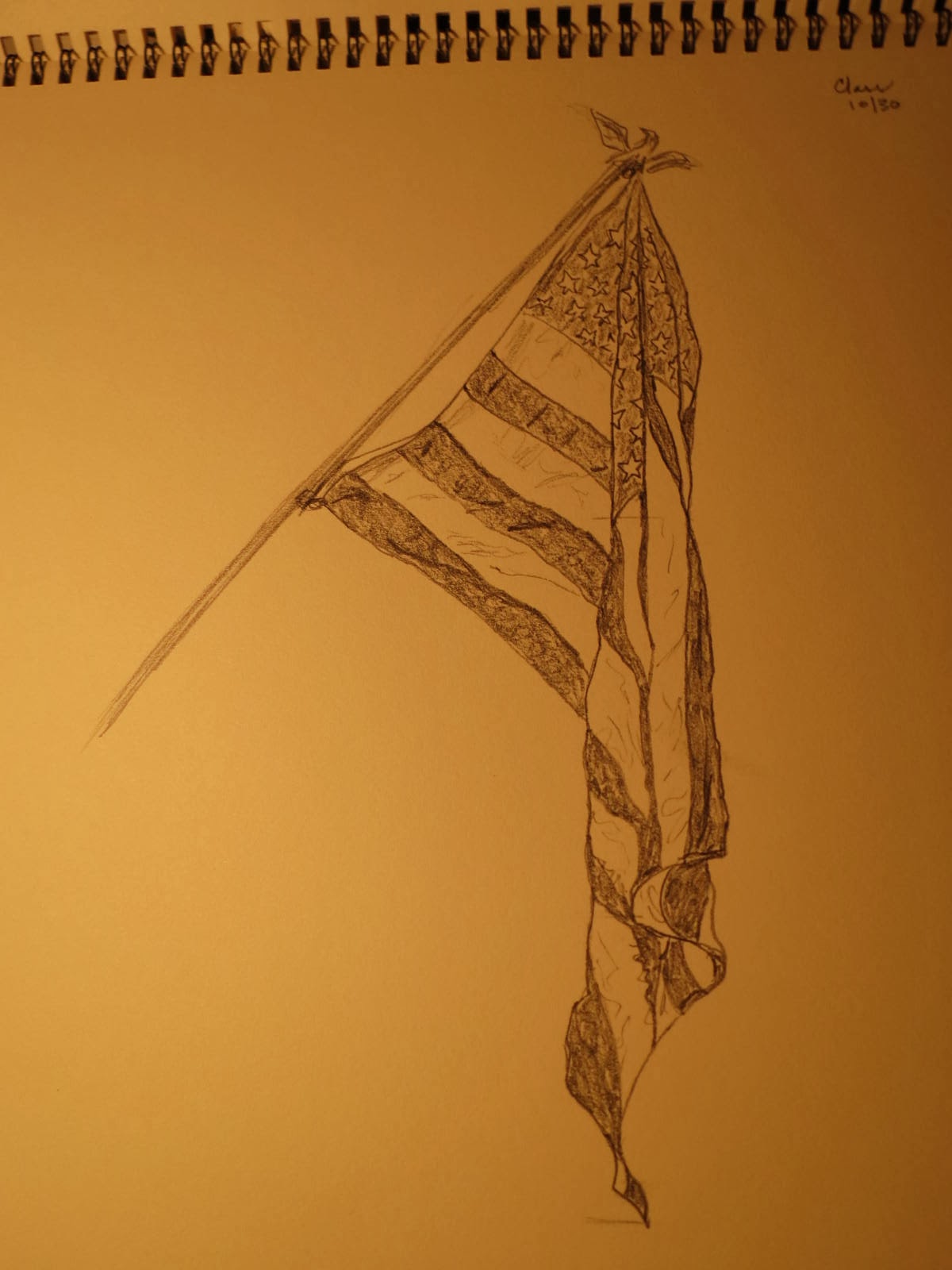
But how often do we see a flag stretched out flat? The lesson is to resist pulling out a mental symbol and, instead, to look at a real flag, hanging on a pole. Here are a couple of my efforts to draw a flag in front of me. The first is a hurried first-night sketch (I had read the book long ago and had spent time one winter and all last year drawing, so my first sketch wasn't quite as flat as is the usual with beginning students), the second our “final exam” on the last night of class.

Quick sketch, first night of class
Slow, careful study of artfully draped flag
Getting from the flat symbol to the complex rendering of reality is not instant. One of the first exercises we did was to draw “vase faces,” as our instructor and Betty Edwards call them. (This is in Chapter 4 of the Edwards book, the chapter titled “Crossing Over: Experiencing the Shift from Left to Right.”) First we drew a simple contour of a face seen from the side – forehead, indent for the eye, nose, open mouth, chin, neck. Then we drew lines extending out from the top and bottom of that curved line. Finally, we began the curved line again on the opposite side. The result is either two faces looking at each other or a single vase, depending on how you look it, but the point of the exercise is that one’s “left brain” (verbal, symbol-using, fact-obsessed) will be frustrated and give up, allowing the “right brain” (visual, intuitive, loving complexity) to take over. The “left brain” hates complexity, and the “right brain” loves complexity. You can see why it’s necessary to make that shift if you want to draw what you see and not what you know.

Another exercise was drawing upside-down, copying a drawing which we were also looking at upside-down. Again, the aim was to frustrate the left brain so that it would give up and get out of the way. Instead of the left brain being able to look at a hand and say, “I know what a hand looks like” and pull a clumsy, flat, iconic mitten out of its symbol set, the right brain was given time to concentrate on lines and relationships, without putting nametags on any of the parts. 

(Drawing, the mind bypasses names and symbols and reasons and arguments and causal chains and settles down in the moment. That’s what makes drawing such a meditative experience.) 

Another exercise was doing "pure contour" drawings. In my mind, I call them "blind" rather than "pure," because what you're doing in this kind of work is drawing an object -- say, your own hand -- while looking only at the object and never at your paper. Also, you put the pencil to the paper and don't lift it until you've finished the drawing. The idea is not to reproduce the object perfectly but to give your eye time to follow all the complicated ins and outs of the object's contour and have your hand translate its movement directly from that of your eye.

You can see all these exercises in the Betty Smith book, and in it you'll also find many examples of student work showing exciting and vast improvement in the course of a very few weeks.

A question I have – a hope I have – is whether/that what can be done for seeing can also be done for hearing. What would it take to quiet the chattering, knowing-everything voices in our heads and truly hear what other people are saying? For them to quiet their minds enough to hear us in return? For all of us to slow down and talk to, not past, each other?

Can we translate the lessons of meditation into everyday life?

Friday, March 30, 2012

Ideas and Memory as Writer’s Refuge


Thinking the Twentieth Century, by Tony Judt, with Timothy Snyder, is exactly what the title says it is. Conceived as a “spoken book” in the traditional European sense (not, that is, as an audio book but as one proceeding from conversation), it is the last written record of his thoughts by the author before his untimely death at the age of 62 of ALS. It is also a collaboration between two minds well schooled in history and particularly in Eastern European political history and drawing, therefore, on two lifetimes of extensive and catholic reading. As Judt’s conversational partner, Timothy Snyder, remarks in his foreword, “This book makes a case for conversation, but perhaps an even stronger case for reading.”

Judt’s wife, Jennifer A. Homans, says that Tony did not prepare for the weekly two-hour conversations with Tim, that he went into them without notes, and that the two men talked without a break (“Tony Judt: A Final Victory,” New York Review of Books, March 22, 2012). Toward the end of his life, this book was very much what he lived for--clarifying thought, retrieving memory.
For Tony the incentive behind the book—and it had to be a powerful one to overcome the discomfort and depression that were his constant companions—was primarily intellectual, a matter of clarification. ... Sick Tony ... was able, with Tim and through sheer mental and physical exertion, to find some relief and exhilaration in the life of the mind.
The conversations between Judt and Snyder took place in the Judt family apartment in New York City. At their first meeting, Tony was able to walk to meet his friend at the door, although already he could not open the door himself. By their final meeting, he was bedridden and paralyzed except for his head, eyes and vocal chords. It isn’t difficult to imagine how these islands of stimulating conversation must have stood out in a glow of their own for Tony Judt in his last bleak, paralyzed days. Again, Jennifer Homans—
I didn’t fully understand it at the time, but I now see that the dead can extend feelings across the divide separating the living from the ever after. But—and this is a big but—they can only do it if they think of it in advance, before they actually die.
Although the topics covered in Thinking the Twentieth Century are fully as serious as Judt’s earlier Postwar, and the background information assumed every bit as erudite, the structure here and the conversational tone make the book more readily accessible to the nonacademic reader. There are no footnotes. There is no bibliography. This is the work, basically, of a single well-informed mind, speaking to and being drawn out by another. Each chapter begins with a short autobiographical section by Tony Judt, which serves to situate his thought and its development over time. As Ian Buruma observes in the current issue of The New York Review of Books (April 5, 2012),
Passion and skepticism would always be in competition in his mind, as though he were forever debating his own enthusiasms. He has been criticized for being inconsistent in his views. But arguing with oneself, especially with one’s passions, is the mark of a real thinker. And Judt didn’t stop thinking until he drew his last breath. [My emphasis added]
Because Judt never rested dogmatically with any particular view of life or of history, he was able to to bring to his last thoughts both an insider’s and an outsider’s viewpoints on many different beliefs. He was also able to see striking similarities, of a kind indiscernible to true believers, between militantly opposed viewpoints. For instance, in the third chapter of Thinking the Twentieth Century, he spoke to Snyder of Christianity and Marxism as having an important commonality not shared by social democratic liberalism. Both the Christian and the Marxist, he said, can justify inflicting suffering in the present for the sake of a future they believe the suffering will bring—e.g., torturing save immortal souls or murdering for the sake of the Revolution.
...It is one thing to say that I am willing to suffer now for an unknowable but possibly better future. It is quite another to authorize the suffering of others in the name of that same unverifiable hypothesis. This, in my view, is the intellectual sin of the century: passing judgment on the fate of others in the name of their future as you see it, a future in which you may have no investment, but concerning which you claim exclusive and perfect information.
Put another, it’s one thing to be ready to die for a belief and quite another to be ready to kill for it, and the two kinds of readiness are not morally equal.

It was clear to Tony Judt that no one had perfect knowledge of the future and that every political or economic decision, therefore, must be based on very incomplete information. At the same time, he lived every day with the certainty of his own death. Thus, of this book, his wife Jennifer Homans writes, “Thinking the Twentieth Century was a labor on behalf of a future he knew he would not share.”

This is not a review of Judt and Snyder’s book, as I have only reached the fourth chapter in my first reading of it, but Tony Judt is one of my heroes, and it is important to me to say something about his last work before I am completely overwhelmed and rendered speechless by it. As I have been reading the book, I want to quote from page after page, so that by the time I reach the end—well, you see how that would go. So rather than choosing another few lines from the book, my last quotation today comes again from Jennifer Homans and has to do with Tony Judt’s beliefs and this book and with conversation and public debate:
...The only thing he was an idealist about was serious public debate. This was the one thing, along with love, that was always left standing no matter how much was felled by the disease, and so much was. Tony called it the core. To me it was a narrowing beam of light in the darkness that was separating Tony from us all. And if Thinking the Twentieth Century stands in the no-man’s-land between what is and what should be, as I think it does, this is in part because it was driven by the darkness but also part of the light. It was besieged, as he was.
 As is liberalism? As is democracy?


Tuesday, March 27, 2012

The Strange Phenomenon of Woman-Blindness: A Long Story with a Hypothesis Informed By Several Thoughts From a Book


Background Story (Personal)

About fifteen years ago I met a customer in my bookstore. The books he was looking for were of a kind that interested me, also, and so he subsequently became, for a while, an apparently good friend. We enjoyed each other’s company and conversation. David’s acquaintance with the man I’ll call John Q. was friendly but not particularly important—to David. Later, looking back, I saw clues I missed early on, clues that would have told me that John Q. did not consider me his equal; at the time, however, the question failed to trouble me.

Here was one such clue: I had an idea for a health care service facility built on the successful food co-op model, care to be provided to members who would pay their way either by making financial contributions or by providing hours of labor in their work specialties or by some combination of work and money. I was very excited about my idea and shared it with J. Q. Well, you know how some people can’t wait to listen to your whole idea before they start finding fault with it? I’m sure everyone has had that experience at one time or another. What I should have noticed was the particular way in which J. Q. dissed the concept that was so exciting to me: He said it would be demeaning if I, for example, had to work for my health care by weeding gardens. Huh?

I must explain here that at the time I was working part-time for a friend who had a business in garden design, installation, and maintenance. The other facts of my life—that I had a Ph.D. in philosophy, that I had taught college-level philosophy classes, that I owned and operated my own independent bookstore, and that the entire idea I proposed was originally mine (why wouldn’t he, for example, imagine me as the lead P.R. person for the co-op?)—did not seem to occur to J.Q. at all. And was there something demeaning about the gardening work I did with my friend? Not in my eyes. It was honest labor, well done. I was stunned and fell silent about my "big idea." We could still talk about other things....

Time passed, and J.Q. and I saw less and less of each other, for various reasons, but then one day he appeared in the door of my bookstore. It was (briefly!) an agreeable surprise, and I greeted him with a big, spontaneous, happy smile. “John! It’s so good to see you!” He did not return the greeting but said merely, as he continued to stand in the door rather than come any further in, “Is David around?” I directed him to David’s gallery, feeling confused, disappointed, and slighted.

There were a few more encounters of the same nature, each one hurtful, and there’s no point in recounting each little offense, but the last straw was memorable. David and I were in Horizon Books in downtown Traverse City and ran into J.Q., who joined us for tea in the Shine Cafe. The three of us visited, and then David excused himself to go to the men’s room. On the way back, he ran into other friends and saw no need to hurry back, as J.Q. and I would be, he thought, deep in conversation. And we were. John had an idea for a book. I thought it was a wonderful idea and encouraged him to pursue it, asking all kinds of questions to draw him out on the subject. We must have talked for at least 20 minutes, just the two of us. It was good. It felt like I “had my friend back.”

The next time we met, I asked J.Q. how he was coming along with his book. “Oh, did you hear about that?” he asked, surprised. “I had a long talk about it with David one day at Horizon.”

J.Q. and I had been tête-à-tête discussing his book project, but he didn’t remember that I had been there at all—instead, he remembered the person who had shown such interest and given such encouragement as David. And David hadn’t even been near the table.

What the hell was going on? What happened?

Mind Blindness

In his book Social Intelligence: Beyond IQ, Beyond Emotional Intelligence, Daniel Coleman addresses a well-known philosophical problem, “the problem of other minds,” which may be playful skepticism for philosophers (How do I know other people aren’t just robots?) but is a serious social difficulty for people with autism.
Mindsight amounts to peering into the mind of a person to sense their feelings and deduce their thoughts—the fundamental ability of empathic accuracy. While we can’t actually read another person’s mind, we do pick up enough clues from their face, voice, and eyes—reading between the lines of what they say and do—to make remarkably accurate inferences. If we lack this simple sense, we are at a loss in loving, caring, cooperating—not to mention competing or negotiating—and awkward in even the least taxing social encounter. Without mindsight our relationships would be hollow; we would relate to other people as though they were objects, without feelings or thoughts of their own—the predicament of people with Asperger’s syndrome or autism. We would be “mindblind.” -      Daniel Coleman, Social Intelligence: Beyond IQ, Beyond Emotional Intelligence (Bantam, 2006)
Mind blindness is, above all, a failure of empathy. Coleman also notes that four times as many boys as girls are autistic and that boys and men are ten times as likely to be diagnosed with Asperger’s. Hold those thoughts, please. We’re coming to a sharp curve, and I’ll have to change gears a couple times.

Selective Blindness

In a chapter called “The Dark Triad,” Coleman addresses the worlds of the narcissist and the psychopath (or sociopath), and he distinguishes between healthy and unhealthy narcissism on the basis of empathy. Unhealthy narcissists, according to Coleman, “empathize selectively, turning a blind eye to those who do not feed their striving for glory.”

Here I have to make two very important points. (1) I do not think John Q. is autistic, nor do I consider him a narcissist in any sense of the term. (2) Neither do I consider autism a moral failing.

Coleman often cites the work of Temple Grandin, who has learned to overcome many of the difficulties of autism by becoming aware of her own limitations and developing strategies to get around them, but I really want to put autism and sociopathology completely aside at this point to focus for the moment on a much more “normal” kind of selective mind blindness that I’m calling woman-blindness.

Woman Blindness

A man who is “woman-blind” sees women, of course, with his eyes. He often desires them, can describe them in detail, and he’ll converse with them, sometimes wittily and engagingly. What Coleman calls a “failure of empathy” is, in this phenomenon, more a “failure of recognition.” It isn’t that a woman-blind man wouldn’t feel empathetic pain for a suffering woman or that he would use a woman like an object, without the least compunction. It’s more that he cannot recognize a woman as his intellectual or conversational equal. He will smile and kid around with a woman, and he realizes that she has a mind, but serious thoughts he will share only with other men. And if a woman tries to share a serious thought with him, he either won’t hear it or will assume it came from someone else.

The more shocking realization—and I can remember the first time this one hit me—is that some women are woman-blind, too. At least five in my experience come immediately to mind. I will not play Freud and speculate on why this should be so. Thank heaven such women are in the minority! (Such men are in the minority, also, but their minority is bigger!) I will say that it is, if anything, a crueler shock for a woman to realize that she is “invisible” to a “sister,” by virtue of her sex. 

Friendship. That's where my story began. As an older woman, I am familiar with the experience of invisibility in many situations. But from people who call me a friend? As one of the female characters in the movie "Tootsie" said, "I don't take this shit from friends!" 

Here's an irony that is also part of my story with John Q. At the height of our friendship, we had a frank discussion about male-female friendships. I observed that for most men, their friendships with other men took precedence over their friendships with women, when push came to shove. "I'm not like that," J.Q. assured me. 

Sometimes Warm, Sometimes Cold

Coleman writes of stress as a social phenomenon. Studies show that the most stressful relationships are not those marked by uniform cruelty or constantly demeaning behavior but those about whom we feel ambivalent.
We try to steer clear of people we find unpleasant, but many unavoidable people in our lives fall into this “mixed” category: sometimes they make us feel good, and other times terrible. Ambivalent relationships put an emotional demand on us; each interaction is unpredictable, perhaps potentially explosive, and so requires a heightened vigilance and effort.
There is usually nothing hostile or in any other way intentional about the hurts inflicted by the woman-blind, and that is what makes it such a difficult phenomenon to get past. Those afflicted are unaware of their blindness, and attempting to point it out will not convince them. I find it very sad. As is the case with John Q., there are woman-blind individuals whose intelligence, knowledge, and other abilities I can admire. The trouble is that they cannot see what I have to offer in conversation or friendship. They can’t see me, and they can’t hear me. For them, I don’t exist. Not fully. Not in any interesting sense.

My comfort is that women-blind individuals, male or female, are in the minority. Most of us, women or men, can enter into conversation with minds and eyes and ears open to one another, and that is a basis for true friendship.

Wednesday, August 31, 2011

Dogs, Philosophy and Nonphilosophical Dogs


The other day I wrote a one-sentence post that implied conceptual thinking on the part of my dog. Being a philosopher, I gave careful consideration to that sentence but in the end decided to invoke literary license.

It was only one day later that I idly picked up The Philosopher’s Dog: Friendships with Animals, by Raimond Gaita. Had I read the book? Surely I would have. Opening it at the beginning pages cast doubt on my certainty, and further reading convinced me of my error. This book doesn’t belong in the pet section of the bookstore at all but on the philosophy shelves! But I couldn’t resist. I had to read more before reshelving.

Dog lovers without philosophical inclinations would find long stretches of this book tedious, but every page is interesting to me, for various reasons. For instance, Gaita quotes a long passage from J. M. Coetzee’s The Lives of Animals and subsequently makes a distinction between practical awareness and reflective understanding. If people think that dogs, let’s say, do not possess concepts, then how can they say a dog anticipates a future event? Isn’t the dog trapped in a never-ending NOW, without past or present? Gaita writes,
Coetzee appears to challenge that assumption. He also challenges assumptions about the connection between our sense of an animal’s body and of its behavior and our unhesitating preparedness to say that animals believe this or know that. He urges us to attend to the role that the living body, the body of flesh and blood, plays in the constitution of our concepts, including our concepts of belief and knowledge. Like Wittgenstein, he seems to believe that we misunderstand the importance of the infinitely subtle inflections and demeanors of the body, the many forms of its expressiveness, if we take them only as the basis for hypothetical attributions of states of consciousness....

Gaita’s last two words in the sentence I have let tail off with an ellipse are “to animals.” I stopped short of the end of his sentence because I think the case can be made—and that Wittgenstein implied the case—for humans as well as nonhuman animals.

The room Gaita makes for practical awareness falling short of reflective understanding reminds me of an old favorite paperback of mine, From Fish to Philosopher. Why is it so tempting for human beings to think that conscious must be all or nothing? If that’s your assumption, the doctrine of innate ideas makes perfect sense, eliminating any otherwise necessary leap over the chasm from nothing to all. Gaita dissolves the pseudo-problem of dog consciousness in Wittgensteinian fashion: it is not that we have justification for believing dogs conscious but rather that doubting the matter makes no sense. Belief comes before doubt, or doubt itself makes no sense.

My feeling—call it just that—about arguments for strong determinism is in this same boat. The determinist argues that we could predict every event in the future, given infinite knowledge of the past and present. But the very nature of argument rests on the possibility of convincing, of changing a listener’s or reader’s mind, and if determinism were true, the change in or persistence of belief would, either way, be inevitable. Does this possibility cohere with what we take belief to be? The arguer himself would be determined, not reasoned, in every word he utters. Is this what we take argument to be?

I no longer argue determinism, nor do I debate whether or not dogs are conscious, sentient beings who [yes, that's what I mean] feel pain, joy, satisfaction, who [not "that"] dream and anticipate. There is plenty of room for doubt in this world, but I’m saving my doubt for matters where it makes some sense. That’s one luxury of being a bookseller instead of an academic philosopher.