Search This Blog

Showing posts with label meditation. Show all posts

Monday, January 3, 2022

The Practice of Grief


Humans and Dogs


The very next morning after we said goodbye to our beloved little Peasy, a much-beloved human friend of ours took leave of this earthly life. We knew it was going to happen and had spent as much time as possible with her during the beautiful Michigan autumn of 2021, laughing, reminiscing, and also seriously plumbing life’s deepest mysteries – in short, having the kind of conversations one has with a close friend of many years. She had been through a decade of cancer treatments and had outlived her physicians’ expectations for her threefold, but now she was ready to go, and we had to continue to be understanding and supportive and strong for her. She had been through enough. It was a cruel twist of fate that had taken her own little dog from her only two months earlier.


Melanie called our weekly meetings in the fall “our special Sundays,” and we had five of them altogether. The Artist was with us for two of them, as he and Melanie had a special friendship dating back to the year her mother was dying (and died) of cancer, and David helped listen and talk her through that hard time. Melanie and I, on the other hand, when by ourselves, talked of family and friendship matters but also spent a lot of our time together talking about dogs.


“I think it’s harder when a dog dies than when a human does,” Melanie said to me one Sunday, “but you can get over losing a dog faster.” It broke her heart to lose Lulu, but even with Stage IV cancer and two broken legs, our dear Mel was seriously considering bringing another little dog into her life. And that was pure Melanie – always looking past present pain to future joy.


The only thing that got me over losing Sarah was adopting Peasy, so I think I know what Melanie was saying. Over time, the dogs we love tend to blend together in memory to a large extent, and taking a new dog into your heart crowds out the pain of having lost the one before, whereas one never really 100% “gets over” losing a family member or close friend, and the personalities of those individuals do not blur together over time. When I think of Annie or Linda or my grandmother, it is that person I want here at my kitchen table, sitting across from me, smiling and laughing and sharing stories. Melanie!


But there she was, only weeks away from the end, telling me that she thought it was “harder when a dog dies”! If she were here with me now, Melanie would not chide me for the grief I feel over Peasy but would understand it completely. A dog, after all, is an around-the-clock, constant companion. When you share your world with a dog, you are the sun and the moon to that animal. You never have to worry that the dog might have other plans for the day. He or she is there, rain or shine, whatever your mood.


Grief Practice
 

It is a new year.

The year 2021 brought countless deep losses for many people, not only us, and, as the Artist notes, at our time of life it is in the nature of things that friends will die. Another friend, blessedly (!) still alive in her 90s, made the suggestion the other day that perhaps grief is a practice. The way I heard her suggestion was understanding grief as a kind of meditation, with its own rituals, something we go to daily, like prayer.


Julia made her suggestion about grief as a practice after I had posted on Facebook a pencil sketch I’d done of Peasy. He was a beautiful, extremely photogenic dog, and I have a lot of photographs of him to use as models for sketches. Another friend (maybe the same day) shared the idea that grief is love that has nowhere to go, and that made sense to me, too. When the ones we love are alive, our love has their physical presence as its object. Now, with my little guy’s absence confronting me everywhere I look in the physical space around me, it is some comfort not only to look at photos of him but also to try to capture as many details as possible on paper with my pencils. The visual and tactile aspects of drawing give my love “somewhere to go” so that it doesn’t paralyze me. It is grief work. Soul work. 


Talk is a big part of the practice of grief, too. The Artist and I spend countless hours remembering friends no longer with us and also recalling the dear and beautiful and humorous aspects of our departed dogs. (“What do you miss about him most?” “The snuggling.” “Yeah, that was the best part.” “And his little ears, too.” The way his little rear end would wiggle with joy, since he had no tail to wag. The way he would run so proudly from one end of the house to the other with his squeaky lion.) We tell and retell stories of times spent with friends, as a way of keeping them with us. I also go back mentally, over and over, the meal menus of the “special Sundays” with Melanie: homemade muffins from my farmhouse kitchen; Polish sausage and sauerkraut from Bunting’s Market in Cedar, Indian food from NJ’s in Lake Leelanau, that fabulous “Figgy Piggy” sandwich from the New Bohemian Café; and Indian food again. Planning each Sunday meal helped to make those afternoons celebratory. And the Artist and I go over the conversations….


Talking often leads to crying, and crying is part of the value of the talk. There is no shortcut through grief, only the painful way through it, and the talk and the tears allow the feelings to be consciously and fully felt. Does that sound paradoxical? That a person could have “feelings” without feeling them? Think denying, repressing. Not a solution.


Talking and drawing invite grief to sit down next to me. I need to let myself feel the losses fully. On the social side, however, I am also forcing myself out to spend time in the world of other people rather than immersing myself in grief fulltime. Dropping out is no solution, tempting though it can be. -- In fact, quite honestly, it tempts me again and again, and I have to overcome it over and over….


Ambiguity and Dilemmas


I’m going to try to telescope and condense as much as possible other topics I wanted to cover in this post -- ambiguous loss, moral dilemmas, and negativity bias – so as not to exhaust readers’ patience or my own mental and emotional energy. 


Moral dilemmas,” the idea of them, is a large area of exploration and thought in the academic study of ethics in departments of philosophy. Some philosophers think moral dilemmas do not exist: there are only right and wrong choices, and if you don’t know what to do, you’re either not thinking clearly or trying to put one over on yourself. What world do these people live in? In my world, whether there are only two choices or half a dozen, sometimes there is no choice that comes without something to regret. 


“You had no choice,” people like to say, and yes, sometimes life decides for us, but other times we do indeed have to choose. “You did the right thing. You have nothing to regret.” Oh, yeah?


“Choosing under uncertainty” is also an area of study, not only in philosophy but also in economics. Well, aren’t we always? We repeatedly ask “What if?” questions. What if this or that consequence were to come about? Horrible! Need to avoid it! But what if it never would have? We cannot know.


A friend sent me an article on negativity bias (here is one article on negativity bias, though not the one my friend had copied and pasted into an e-mail to me) after I’d sent her one on ambiguous loss, and I’ll be reflecting on these ideas for quite a while. But putting them together, I wonder: can there also be ambiguous gains? I understand the idea that some losses are obvious and clear-cut, others hard to point to or recognize, but I’m wondering now if the same might not be true of gains and if it is negativity bias that gets in the way of our seeing ambiguous gains.


Deciding to end our young, happy, loving dog’s life out of concern for the safety of our human friends and family was a hard, hard call, and I would be lying if I were to say I am completely comfortable in thinking that I did “the right thing,” i.e., made the only ethical choice possible. It isn’t only that I miss Peasy dreadfully. It’s knowing how much he loved his life with us! His future was uncertain! Well, we “played it safe,” and he won’t injure anyone else in future (now that he has no future), but I can’t help the agony of second thoughts, the bleak, dark hours of wishing I had tried longer and harder and more wisely to rehabilitate him fully. Is that negativity? For me, I see it as trying to understand and to learn. 


Losing him was not an ambiguous loss. Damned obvious! What, though, about gains?


Pointing to the obvious gains of his presence in our life is easy (something about this, at least, is easy-Peasy!): the love we gave him and the love he gave us, all of it growing stronger and deeper all the time; the joy he took in being alive and in having a family and the joy we took in seeing him happy; satisfaction in being able to give shelter and security and a good life to the dear little creature. More ambiguous gains, perhaps, were the lessons we two human beings learned in being calm and patient and nonjudgmental. There were incidents of unacceptable behavior, but we never blamed our dog for what he couldn’t help. Can we carry this learning back into the world of other human beings? Should we try?


Now that he’s gone (and there is no getting him back again!), I don’t want to hear about all the horrible things that could have happened with him. None of those horrible things will happen now. It’s over. He’s gone. All I want to think about (if only I could control what comes into my mind! Because what keeps coming in are the second thoughts, the regrets!) is everything about my little dog-boy that was lovely, beautiful, cute, funny, sweet, joyful. His wonderful qualities were unambiguous.


So where am I now? Still alive, awash in ambiguity and uncertainty, gratitude and regret.


Books Read Since Last Listed


Here are the books I read in the last days of 2021:


174. Frank, Anne. The Diary of a Young Girl (nonfiction)

175. Benítez, Sandra. Bitter Grounds (fiction)

176. Charging Eagle, Tom & Ron Zeilinger. Black Hills, Sacred Hills (nonfiction)

177. Dillard, Annie. Pilgrim at Tinker Creek (nonfiction)

178. Diffenbaugh, Vanessa. The Language of Flowers (fiction)


(In case you’re wondering, 174, 177, and 178 were all re-reads for me.)


The first things I’ve read in this new year have been:


1. Into the Savage Country, by Shannon Burke (fiction); and

2. Le Coeur Simple, by Gustave Flaubert (fiction)

3. Fidelity, by Grace Paley (poetry)


I had read none of these three books before. New year, new (to me) books. Onward and upward --


P.S. I hope at least some of this makes sense. I am not at the top of my game these days.

Friday, March 31, 2017

Read With Your Eyes Closed (with Variation for Non-Readers)


If you never have trouble going to sleep, this post is not for you. This post is for friends and strangers who have trouble letting go of consciousness – who find sleep elusive – or who wake up in the middle of the night in the clutches of anxiety, wide-eyed – or face morning in a weary state, due to insomnia. The treatment I propose cure costs nothing to try, and I will exact no future royalties, if you need help losing yourself in sleep, for whatever reason, what have you got to lose?

First, a little background: Warm milk? Maybe, if it works for you, but the most obvious way for me, a reader, to get to sleep is to read myself into oblivion, and it usually works. That is, it works unless the story is too exciting, and I have been known, on occasion, to stay up all night over a book rather than fall asleep. That’s a potential problem. Another is the necessity, brief though it is, of rousing myself from the desired drowsy state to turn out my reading light.

We sleep with our eyes closed. Open eyes, then, are not the intuitive way to court sleep.

My ideal is to have my sweetheart read me to sleep or tell me a story until I drift off. Snuggling is a nice bonus to this method. “Tell me about when you were a little boy in Detroit” is my first ploy, but I usually have to prime the pump by asking more specific questions about that Detroit neighborhood and its characters.

But maybe you’re alone. Or maybe your bed partner isn’t in the mood to tell you a story or read to you or is already asleep. Sometimes self-care is not just an option but a necessity.

And here’s where my free, bookish sleeplessness cure comes to the rescue. If any of my blog readers are not book readers, however, fear not. I have a non-reading variation for you.

But first, for the readers --

Reading With Eyes Closed


Get as comfortable as you possibly can. Close your eyes, snuggle down in the dark, well under the covers, and tell yourself a story from a book you’ve read, either one you’ve been reading recently or a familiar book re-read many times. You know the story: someone else wrote it, and you read it, so start on the first page and picture the opening sentences. Picture the scene as well. What is the setting? Who was there? What happened? See it all, in as much detail as possible, and recall, in paraphrase, the sentences from the story’s first pages.

If the story you choose is a book you’ve read over and over, you may see the book’s pages vividly in your mind, and that can work for you. In which paragraph, for instance, on which side of the book, does his father tell Marcel of the plan to travel to Italy in the spring? What are the boy’s associations with the various Italian towns? Picture the pages, and recreate the movement of their lines, as well as the movement of the story, in your mind.

If instead you choose a book you’ve been reading for the first time, you’ll be strengthening your memory of the story as you rehearse your initial reading, retelling the story to yourself in the dark. Maybe you’ve only read a few chapters of the book so far, but that’s no problem. Start with the first action scene. The horses are toiling up the hill, the passengers trudging along beside the carriage in the dark. Who are the characters in the scene? What happens?

The first important feature of this way of inducing sleep is that the destination (sleep) is not the end (of the story). You don’t want to reach the end. You want to fall asleep long before the end. So include as much detail as you can recall, and if you realize you’ve skipped over something, go back and pick up the story with the skipped passage, retracing your mental steps. Should you reach the end (I never do), simply begin again at the beginning or start with a different story.

The second important feature is to stay with the story. As with meditation, if your mind strays onto the morrow’s to-do list, bring it back to the story. Begin again. (No scolding yourself.) The object is to lull yourself to sleep. The story is your lullaby....

Walking With Eyes Closed


My suggested alternative for non-readers – or those who want a change from reading -- is to take a walk or a drive. Either one, but take it in your mind, with your eyes closed, in the dark, under the covers. Choose a walk or a drive that is familiar, interesting, beautiful if possible but definitely peaceful.

Walking to school, long ago, might be a pleasant memory exercise, but if your walk to grade school was made fearsome by bullies, don’t take that walk! My drive to work is heavenly, but if yours is a stressful commute, don’t take that drive! What you want to do is slow down your mind, take yourself somewhere peaceful, and take in the sights along the way as if you have all the time in the world.

I like to recall my walk to grade school, leaving my backyard and cutting across a vacant lot to the narrow, shady, secret path between garages where an alley would have been, if our neighborhood had had alleys. I peer into the neighbors’ gardens, greet their cats, watch for birds....

Time is not of the essence. You are in no hurry. Picture as much detail as you can recall and see the trees and houses along the way, the dips and curves in the road. Is there a dog that always barks at a certain point? A place where roses bloom? Busy intersections to cross? Familiar faces and billboards along the way? See it all, beginning with walking out the door.

When I set out to picture my drive from home to Northport, I seldom get beyond the end of the driveway (sometimes not that far) and never more than a mile down the road. There is too much to see along the way, and it is so pleasant to dawdle at a leisurely pace, looking all around at everything along the way. Other times, when I set out to drive from the ghost town cabin in Dos Cabezas to the town of Willcox fourteen miles away, I seldom reach the playa, let alone Willcox. The sun feels so good, and the mountains and clouds are so beautiful....


Sweet Spot Words for Today

Lull: to soothe or quiet

Dawdle: to do something very slowly, as if you do not want to finish it 


Wednesday, October 26, 2016

To Every Thing, There Is a Season


Looking up Nagonaba from marina

The shift from Saturday’s heavy traffic, in Leelanau County and all around Grand Traverse Bay (my sources report), to empty parking spaces all up and down the streets of Northport comes accompanied by a change in the weather. Balmy, light-filled, summer-like fall mornings have given way to leaden skies, blustery winds, and whitecaps on the water. Zip the liner into your trench coat. Go outside. Test the temperature. Go back inside and look for a vest to wear under the coat. Even knitted cap and mittens are not amiss. But the color goes on, and I saw a shaggy mane this morning by the side of the road. Autumn is not over. This shift is not as sudden as it seems, either: it’s been in the works for a while, caterpillars and birds on the move and plants making and scattering seeds.

Black walnuts on the ground

If last weekend was peak color, how quiet will the bookstore be this week? When I couldn’t get Sarah an appointment with her regular groomer on Monday, I threw caution to the winds and set up a session on Tuesday morning, and while Sarah was being made prettier than she already was, David and I took in Jean Larsen’s show at the Dennos Museum Center in Traverse City. Yes, I had three days off in a row – Sunday, Monday, and Tuesday! And look at the improvement in Sarah’s appearance! Can you say “criminally cute”?

Before

After
Inspiration struck on Monday, thanks to clouds that kept interfering with the sun, discouraging me from committing to projects in the yard, and instead of digging up the garden I did a major overhaul upstairs, from clean sheets on the bed to moving furniture. The old mission desk (missing center drawer) on the upstairs landing had never done anything there but collect junk. I never had used that corner as a writing studio, a fond dream when we first moved into the farmhouse. So now the desk is in the back bedroom upstairs, looking out over the meadow in the direction of the sunrise, and it’s set up as a permanent drawing station, inaugurated with a session that very afternoon. I tried it out this morning for an hour, too, and it was dandy, even before sunrise.


Flowing lines, object contours, contrast of light and shade – so wonderfully wordless! No, I certainly have not given up reading! What I have done in the last few days, however, is to shift over to books that focus on nature, re-reading Tom Brown, Jr.’s The Tracker (one of my old favorites, and I have his book The Vision close at hand to read next) and an equally inspiring book I discovered more recently, Forest Gardening: Cultivating an Edible Landscape, by Robert Hart.
The essence of life should be continuous creativity: in working out creative and comprehensive solutions to one’s problems, one rises above them. They become smaller, less tormentingly insistent, until, perhaps, in time, one realizes they have just faded away.

Are problems tormenting you? Wouldn’t you welcome a meditation practice or a book that let those problems fade into the background, even if only temporarily? Forgive me for repeating myself – I’ve recommended the title before – but Frederick Franck’s The Zen of Seeing: Seeing/Drawing as Meditation combines both approaches. If you never pick up a pencil, simply holding this book and turning the pages slowly as you take in the author’s words and drawings is a calming meditation.
I draw a leaf . . . Still it is moving. Still the birds are on the wing. Still I can hear the silent falling of the snow . . . Some of the grasses are long, others are short . . .

Inhale. Exhale. Inhale. Exhale. The noisy campaigns will not last forever.

P.S. Another good idea is music, so if you are free on the evening of November 3, come get a ticket from me for Tristan Eckerson's live performance in Suttons Bay. I also have a few of his CDs left, "Leelanau Night," his original compositions on solo piano.


Tuesday, October 18, 2016

Is Riding a Bicycle Like Riding a Bicycle?


Are there things you just don’t forget how to do, if once you’ve learned them? David thinks playing the violin is “like riding a bicycle,” in that anyone who ever played the violin can pick it right up again after years of not practicing. Oh, no! I told him that playing the violin is not like that at all! Even singing isn’t like that. The voice is an instrument, too, and not practicing has consequences. Really.

For most of my life, I only dreamed of being able to draw, but then I read Drawing On the Right Side of the Brain, by Betty Edwards, and became convinced that even I could learn to draw with a teacher using these methods. At last Elizabeth Abeel offered a drawing class in Traverse City in the evening, when I could get there to take it, and so, three years ago, my lessons and practice began.

Three years ago. I kept at it through July 2014 but subsequently lost my discipline, only picking up a pencil or pen a few times during our following Arizona winter.

I’ve missed those sessions with paper and pen or pencil. Photography, another blessedly wordless activity, offers moments of relief from mental chatter, but drawing is more like yoga than it is like (amateur) photography in that regard, centering one’s focus and slowing subjective time. Really, taking time out of consciousness altogether.

It will take time, however, for me to work back into the wonderful discipline of losing myself in drawing. That’s okay. I fully intend to get back to doing it again on a regular basis – and making that decision, simply anticipating drawing, brought joy to my heart. Waking up Saturday morning, before opening my eyes, I was already seeing lines on paper – branches, leaves, facial features – simple lines growing organically into living forms. What a simply luscious way to wake up! A little later, then, driving along familiar country roads, I began seeing again as I had when morning drawing meditation was a regular part of my life. Seeing more, seeing with joy!

My hand is rusty, though. My mind still wants to jump around, and so do my eyes. What I need to do is go back to those first lessons with Betsy, drawing vase-faces and copying drawings upside-down. The purpose of those exercises is to turn off the part of the brain that has names for objects and wants to take a short-cut by producing a prototype. Oh, no you don't! We want that naming brain to shut up and let the eye and hand follow contours wordlessly.

This is going to be good medicine. I feel it already. Don't you feel the need for a break from talk-talk-talk this season, too?

...I venture to say that learning to draw always seems to help and never to harm. My students’ most frequent comment after learning to draw is “Life seems much richer now that I am seeing more.” That may be reason enough to learn to draw.
 - Betty Edwards, Drawing On the Right Side of the Brain: A Course in Enhancing Creativity and Artistic Confidence


Monday, November 17, 2014

Enlightenment vs. Proust – and Other Oppositions


Don’t allow events to leave impressions inside of you. -      Michael A. Singer, The Untethered Soul: The Journey Beyond Yourself (New Harbinger/Noetic, 2007) 
Singer’s following sentence in the book reads, “If you find yourself thinking about them later on, just let go.” I’m reading these sentences early on Sunday morning, less than 24 hours after putting up a long post on Proust’s Remembrance of Things Past (well, Swann’s Way, the first volume of RTP), and while much of what I’m reading in Singer’s book is a message coming to me at exactly the right time, just when I needed it, I can’t help pausing over certain bits and asking, Really? I mean, had Proust been enlightened throughout his entire life, we would not have his work at all, would we? Some people (and you know who you are, S.C.!) might think that a good thing, but others of us can imagine only deprivation, had Proust never written.

Singer’s basic message is that we human beings are all psychologically paralyzed by fear, by what we perceive as threats to our ability to control the world of our experience. We react by constructing what we think are protections, but those self-protective reactions actually function as walls requiring constant, vigilant monitoring, and thus we become our own prisoners. This is undeniable for most of us, I think, and I don’t fault the author for repeating his message in different form from page to page and chapter to chapter. I for one certainly need the repetition. It isn’t by hearing or reading this message once that I’ll see how to relax my guard and stop trying to control situations that threaten my sense of psychological well-being!
You will get to a point in your growth where you understand that if you protect yourself, you will never be free. It’s that simple. Because you’re scared, you have locked yourself within your house and pulled down all the shades. Now it’s dark and you want to feel the sunlight, but you can’t. It’s impossible. If you close and protect yourself, you are locking this scared, insecure person within your heart. You will never be free that way.
In our household, we refer to the constant, endless, sleepless chewing over of unresolved issues or fears for the future as “squirrel-caging.” It goes nowhere but around and around and around. It’s wildly counter-productive, and it’s painful, too – paradoxically, since its psychological object is to defend against pain. Let go of those thoughts? Escape the squirrel cage? Good idea!

Of social situations, Singer writes:
When you approach the edges [of the cage you have built to protect yourself] you feel insecurity, jealousy, fear, or self-consciousness. You pull back, and if you are like most people, you stop trying. Spirituality begins when you decide that you’ll never stop trying.
This can be interpreted also, I think, to say that “Freedom begins...” or “Growth begins....” Leave behind insecurity, jealousy, fear, and the kind of self-consciousness that stands in the way of forward movement and growth? Yes, I would like to do that, and this book has given me some tools with which to begin the task.

One thing I can’t help wondering, though, is where justice fits into all this.

Obviously, an acquaintance who hurts my feelings by failing to failing to grant me the attention I desire or feel I deserve is not doing me an “injustice,” and such an interpretation is clearly one I need to let go of, to let pass through me and evaporate in thin air, rather than clinging to it pointlessly. But what of true injustices that exist not only elsewhere on the globe, in far distant countries, but within our own communities? And what of very real and important issues threatening the future of the earth for generations to come? None of this, as far as I can see, is addressed  from the high spiritual ground of detachment and spiritual enlightenment. Seeing the world as nothing but energy and determining to “let it all go” – I can’t help thinking that while this might a sanity-saving strategy for people who feel absolutely powerless (cultural origins of religions and philosophies are always worth paying attention to: where did the idea of enlightenment arise, and what were the social circumstances surrounding it?), it can also be a convenient abdication of social responsibility on the part of materially comfortable, physically and politically safe Westerners whose only experiences of fear have been psychological and self-generated.

The emphasis on achieving endless, uninterrupted happiness strikes me as not only unrealistic but even a repulsive goal, given certain very real and horrible human (but inhumane) situations.
If they starve you and put you in solitary confinement, just have fun being like Gandhi. No matter what happens, just enjoy the life that comes to you.
When I reached these sentences, I wanted to ask the author: What if you’re not put in solitary confinement but thrown in among violent criminals and gang-raped, are you supposed to “have fun” with that? If not only your house but all your family are blown to smithereens by incendiary bombs, are you supposed to “have fun” with that? To my mind, this admonition to “have fun” with whatever happens is a slap in the face to those who suffer not through negative self-talk but through the violence of others. I would also argue that neither Jesus nor Gandhi nor Martin Luther King, Jr. practiced “nonresistance.” What they practiced and taught was “nonviolent resistance,” which is entirely different and which does address issues of justice.

And if everything in existence and process were already as it should be, what would be the point of changing even ourselves?

As a philosopher, argumentation is part of who I am, and critical thinking is not something I want to give up. While I can see that putting energy into defending my own poor little psyche is clearly a waste of time, I cannot and do not want to say the same of putting energy into opposing injustice, violence, and destruction of the natural world. “We must cultivate our gardens,” Candide says gently at the end of Voltaire’s tale. Indeed. Inconsequential as our tiny planet is in the midst of interstellar space (an image the book repeatedly asks us to contemplate), it is our only home, the nurturing environment in which our flesh and blood evolved, and it requires our active care.

Then there is art, and there is memory. Without memory, there is no art, and probably without art only very short-lived memories.

Our intrepid Ulysses group’s Fearless Leader feels that immortality consists in being remembered and that he, both as a lover of music and as a musician, participates in the immortality of Beethoven. In the same way, all of us who loved and read Swann’s Way may be said (if you accept our FL’s view) to participate in the immortality of Proust. What a privilege! To walk, in imagination, along that blossoming hawthorn hedge and tarry alongside the beautiful waterlilies in the private park of the Guermantes way! To feel in our own hearts, as we call up magical place names in our own lives, an echo of what the name ‘Balbec’ meant to young Marcel! I know that for several of my readers far from Leelanau County on this cold November morning, ‘Leelanau’ itself is one of those magic names.

“Don’t allow events to leave impressions inside of you”? Be empty of memories? Those beloved images of the past? Wouldn’t that truly be to lose time, to lose one’s very life?

I would be overjoyed to escape my foolish psychic walls but never to give up justice, art, and memory.

Doubtless, veteran seekers after enlightenment will tell me I’ve misinterpreted and misrepresented the practice. I’m open to that possibility. But I also reflect that no religion or philosophy or system of thought ever devised by mankind was completely free of contradiction, so even within my interpretation I can choose to embrace the contradiction in the idea of enlightenment, and I can let go of what I want to lose while holding onto what I value. It may not be everyone’s way, but it is mine, and I am free to choose.

The book, anyway, is worth reading and a potential springboard for wide-ranging discussion. I’d love to be a fly on the wall, listening to what other people would say!


Friday, December 27, 2013

A Raging Blizzard in My Head as Year's End Nears


The world Up North is big and white and cold


What has become of your Up North blogging bookseller’s forays into the realm of thoughtful essay? Gone by the wayside? I hope not. It’s just – I mean – it isn’t that my thoughts are exactly just lying around on the surface of life like bodies in a tanning salon with nothing to do but soak up rays. It’s more that there is too much going on right now in mind and heart and life for me to settle down, narrow my focus to a single topic, and explore it in depth. Each snowflake may be a uniquely wonderful – literally, full of wonder, or, that is, we are when we contemplate it -- work of nature, but in a blizzard, who can take the time to contemplate each one?

Holidays have been one obvious focus lately. Presents, mailing presents, calling and e-mailing and writing to and generally being in touch with family and friends, planning holiday meals, attending social events, not to mention (but here I go mentioning it) keeping up with book orders and bookshop hours. It’s all quite lovely but does not exactly encourage or allow hours of quiet reflection.
Which tree is creaking and ready to fall?
Then, this is not much of a holiday topic, but I’ve been thinking a lot about death lately. A lot. I’m remembering friends lost long ago, as well as those who have died more recently. I’m thinking about what a friend calls the mysterious “here/not here” phenomenon that makes death of a loved one so difficult to absorb, much less accept. I think about how difficult holidays are for those dealing with loss. At the same time, one does not want to deny holidays and the cheer and comfort they can bring to so many. It’s all there at once – life, in all its ambiguity and contradiction and sun and shadow, babies being born at the very moment others are dying. Those are some of my background thoughts this December, ebbing and flowing.

Books don’t stop coming at a bookseller because of the holidays or thoughts of death. Marjorie Farrell did one recent book review for me, but I have another hanging fire and another review book coming in the mail soon. I’m thinking I’ll save the former to publish after the first of the year, even though the release date is December 31, because how many of my little coterie of readers will be up for leisurely book review reading as New Year’s Eve approaches? My Christmas Day and day-after treat was reading a friend’s YA novel manuscript. I mean it. It really was a lovely treat. None of this is complaint! It is, I hope, some kind of explanation. Reading and writing can feed each other, but they can also compete for available time.

Ready?
Winter itself both encourages and discourages quiet reflection. Once the holidays are over, there will be many quiet hours and quiet days; for now, however, holiday bustle combining with frigid temperatures and very deep snow make every day and every errand a challenge. Strategies must be plotted, campaigns carefully planned in advance of effort. My sorties with Sarah into the cold world of deep snow – those alone require a lot more than just sailing out the front door. Sarah may sail, of course, but I must first bundle and then trudge and pay close attention to footing.

My one calm, contemplative winter meditation, not forsaken even during the holiday season, has been drawing. In 2012 my solitary project for the year was to go out and sit still for an hour once a week, soaking in and sketching the small world I call my home ground, Leelanau Township from roughly Fischer’s Happy Hour Tavern to St. Wenceslaus Church. It was cold going out in the winter for those stillness sessions – but easier to find time then than during spring planting or summer tourist seasons.

The new drawing project I have purposely left more freeform: no daily or weekly hours that I “must” fill or try to meet; no limits on subject matter or locale. Calling the project “Morning Drawing Meditations” set the tone I wanted to establish, and so far, beginning ahead of the new year, it’s going well. On mornings I get up too late to fit in a session, I don’t beat myself up, and whenever I do sit down with drawing pad and pencils I love losing track of time and leaving all other concerns behind.

When I draw, the blizzard in my brain subsides. I’m not in my brain or my thoughts at all, reflective or otherwise. There is simply a subject in front of me – a butternut squash, a few yams or pears, a crumpled potato chip bag, a mitten – something to look at carefully, seeing its complexity and uniqueness. Like that snowflake, you know?


Sustained reflection and even argumentation will revive again with the new year. For now, sigh ....................


Wednesday, November 27, 2013

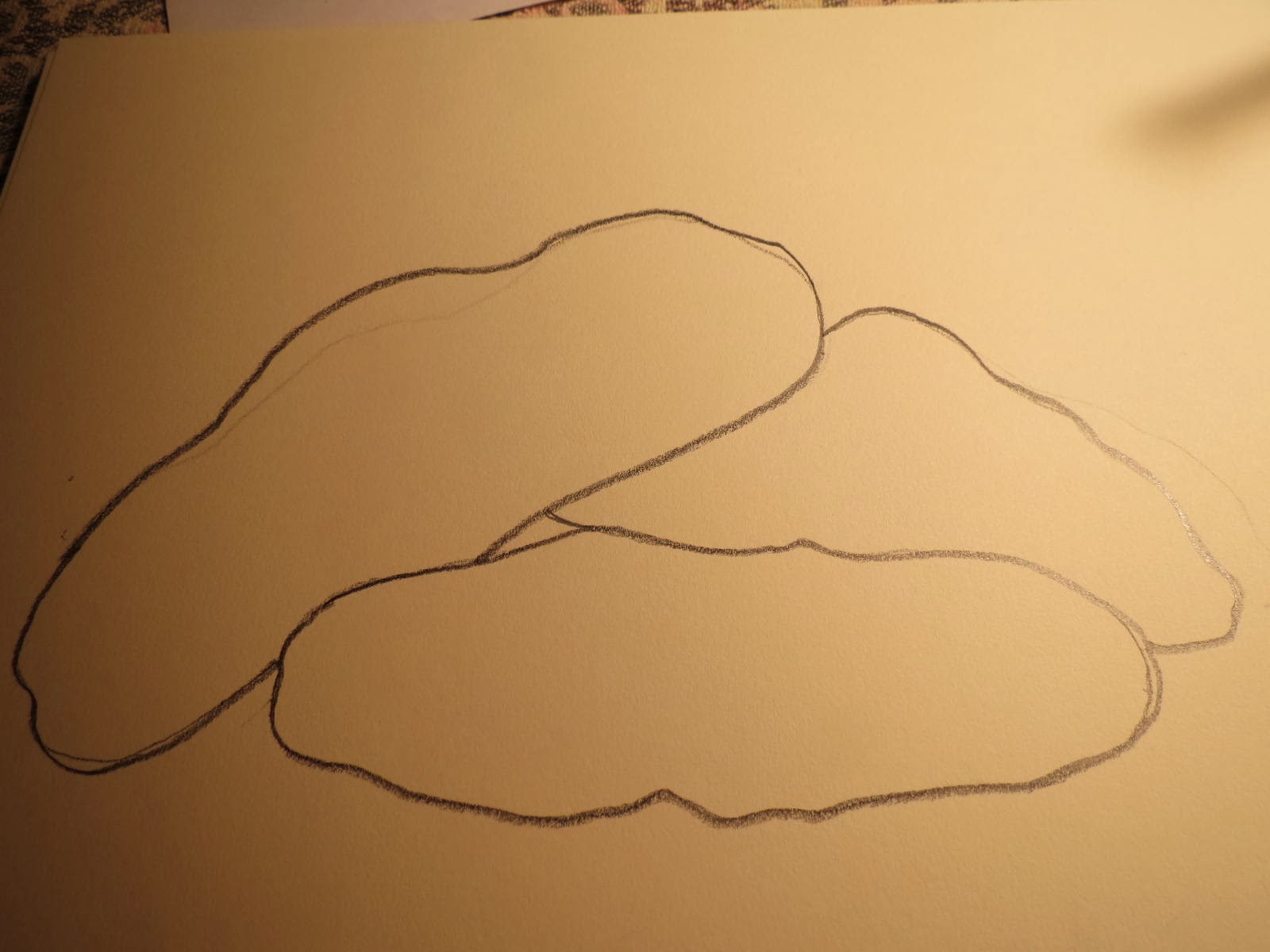
Meditation on Three Potatoes

Potatoes placed on sheets of paper on table
Pure contour drawing (done without looking at drawing while doing it)
Modified contour drawing (looking back and forth from potatoes to drawing)
Details and shading added to modified contour drawing

Shadows from light source added


Dog Ears Books will NOT -- absolutely NOT -- be open tomorrow! We're here for a while today (Wednesday) and will be here on Friday and Saturday. Tomorrow is a holiday. We're taking it and hope you can, too.

So until Friday, then, if we don't see you today, 

Happy Thanksgiving 
-- and Happy Hanukkah! 

Thursday, November 7, 2013

Seeing the World or Only the Insides of Our Own Heads?


Vase of purple asters
My six-week beginning drawing class is over, but I’m going to keep drawing. Drawing for me is diary and meditation and vacation and conversation, all rolled into one slow, low-key, low-tech activity. Paper and pencil. Or paper and pen. Enough light to see. That’s all it takes.

The drawing I did of my son during his visit I posted on Facebook as well as here on my blog. Reaction from many people (including my son) is often, “I can’t draw at all” or “I can’t even draw a straight line.” Honestly? I have trouble with straight lines myself, but that’s what rulers are for. The contours of most of the things I want to draw, it turns out, do not have straight edges.

What about you? Do you think you can’t draw?

Our instructor remarked the first evening of class that no one would expect to sit down at a piano and rip off a Beethoven sonata without advance study and practice, but people think they should be able to pick up a pencil and right away dash off a good drawing the first time around. Anyone can learn to draw, Elizabeth Abeel, our instructor, told us, but it is something to be learned, and it does take practice.

Classic book!
Abeel uses a lot of techniques from Betty Smith’s classic Drawing on the Right Side of the Brain: A Course in Enhancing Creativity and Artistic Confidence, the book that convinced me long, long ago that I (or “even I,” as I thought then) could learn to draw with a teacher using these methods. Whether you take “left brain/right brain” terminology to be strict physiological description of brain anatomy or a metaphorical distinction between two different ways of interpreting the world, the big lesson in drawing is this:
"DRAW WHAT YOU SEE, NOT WHAT YOU KNOW."
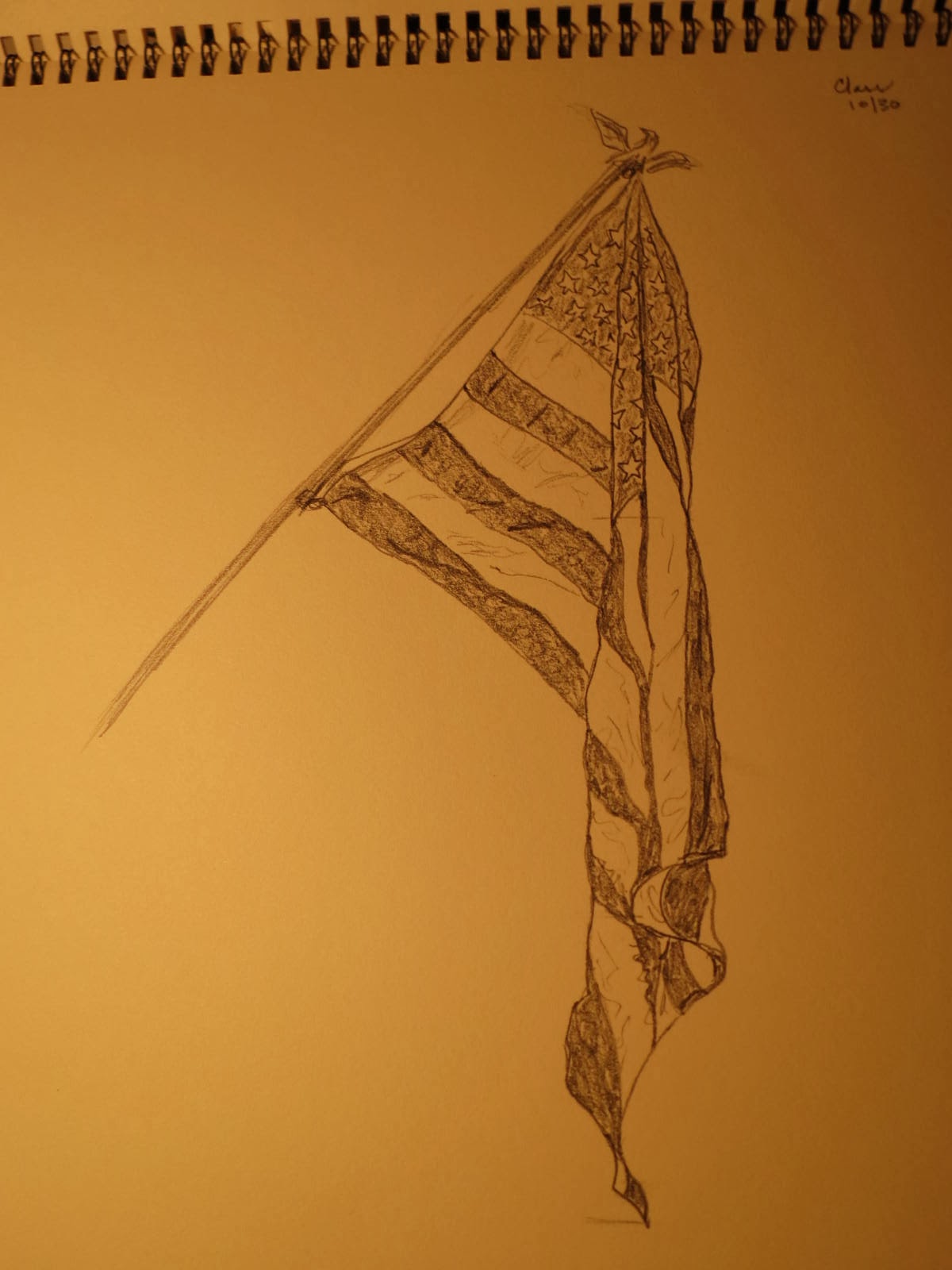
Betsy said this to us over and over, and here’s an example of what it means: If someone is told, “Draw a flag,” most beginners will have recourse to their mental symbol set. That first flag drawing, therefore, will begin as a rectangle, with stripes, stars and whatever subsequently filled in. The drawings will look pretty much like this section of a page from an atlas, only without color and without the slight wave in the lines of these flags:

Flat flag symbols 
But how often do we see a flag stretched out flat? The lesson is to resist pulling out a mental symbol and, instead, to look at a real flag, hanging on a pole. Here are a couple of my efforts to draw a flag in front of me. The first is a hurried first-night sketch (I had read the book long ago and had spent time one winter and all last year drawing, so my first sketch wasn't quite as flat as is the usual with beginning students), the second our “final exam” on the last night of class.

Quick sketch, first night of class
Slow, careful study of artfully draped flag
Getting from the flat symbol to the complex rendering of reality is not instant. One of the first exercises we did was to draw “vase faces,” as our instructor and Betty Edwards call them. (This is in Chapter 4 of the Edwards book, the chapter titled “Crossing Over: Experiencing the Shift from Left to Right.”) First we drew a simple contour of a face seen from the side – forehead, indent for the eye, nose, open mouth, chin, neck. Then we drew lines extending out from the top and bottom of that curved line. Finally, we began the curved line again on the opposite side. The result is either two faces looking at each other or a single vase, depending on how you look it, but the point of the exercise is that one’s “left brain” (verbal, symbol-using, fact-obsessed) will be frustrated and give up, allowing the “right brain” (visual, intuitive, loving complexity) to take over. The “left brain” hates complexity, and the “right brain” loves complexity. You can see why it’s necessary to make that shift if you want to draw what you see and not what you know.

Another exercise was drawing upside-down, copying a drawing which we were also looking at upside-down. Again, the aim was to frustrate the left brain so that it would give up and get out of the way. Instead of the left brain being able to look at a hand and say, “I know what a hand looks like” and pull a clumsy, flat, iconic mitten out of its symbol set, the right brain was given time to concentrate on lines and relationships, without putting nametags on any of the parts. 

(Drawing, the mind bypasses names and symbols and reasons and arguments and causal chains and settles down in the moment. That’s what makes drawing such a meditative experience.) 

Another exercise was doing "pure contour" drawings. In my mind, I call them "blind" rather than "pure," because what you're doing in this kind of work is drawing an object -- say, your own hand -- while looking only at the object and never at your paper. Also, you put the pencil to the paper and don't lift it until you've finished the drawing. The idea is not to reproduce the object perfectly but to give your eye time to follow all the complicated ins and outs of the object's contour and have your hand translate its movement directly from that of your eye.

You can see all these exercises in the Betty Smith book, and in it you'll also find many examples of student work showing exciting and vast improvement in the course of a very few weeks.

A question I have – a hope I have – is whether/that what can be done for seeing can also be done for hearing. What would it take to quiet the chattering, knowing-everything voices in our heads and truly hear what other people are saying? For them to quiet their minds enough to hear us in return? For all of us to slow down and talk to, not past, each other?

Can we translate the lessons of meditation into everyday life?