Search This Blog

Showing posts with label fantasy. Show all posts

Friday, March 22, 2019

Balm to the Soul, Piscean or Otherwise

On bank of San Pedro River
Philadelphia Wash
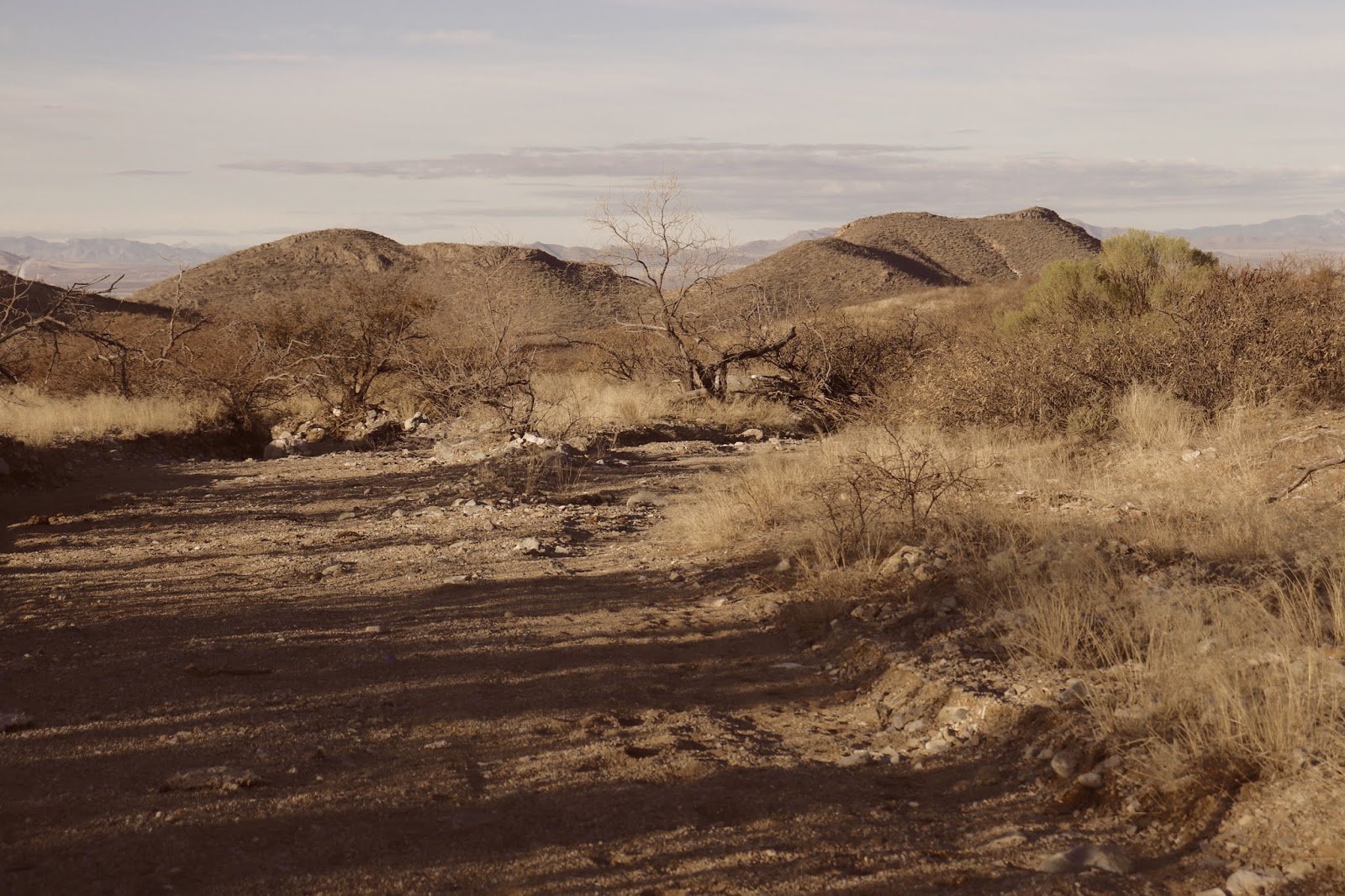
 The Artist is a Pisces, the fish loves water, and Arizona is, as its very name suggests, a pretty dry state, an arid zone. Outside our ghost town cabin, the Philadelphia Wash (named for the defunct Philadelphia Mine back in the Dos Cabezas Mountains) is a dry wash for all the months we’re in residence. When summer thunderstorms arrive, the wash will rage with flash flood torrents, but we won’t be here to see it. And so we plot expeditions — you might even say we make pilgrimages — to places with water. And we visit an old monastery over on the other side of the Dragoon Mountains so often we might be mistaken for postulants. 

Trinity Monastery, a Benedictine establishment, in recent years saw its last four monks moved elsewhere, but the property is still managed as a retreat center and spiritual refuge. As for the monastery waters, when we visited in previous years the Artist and I knew only the small pond in the meditation garden, with the spring (we assumed it was a spring) that fed the pond from higher ground, but the garden was a jewel we cherished, because as much as the Artist’s soul is fed by water, mine is nourished by trees. A friend of mine from Tucson was also charmed by the monastery when she and I visited it together last year, and she and I made a return visit, also, earlier this year. The gated garden surrounding the pond is provided with benches, facilitating meditation, prayer, reading, or quiet conversation, but this year my friend and I explored instead the birding trail along the San Pedro River. As spring came near, the Artist and I returned to do the same, grateful for a narrow channel of running water sparkling in the sun. Our monasterial (my word) horizons were widening.

Sargent Cypress from California?

There is a little thrift shop on the monastery grounds and another, smaller building announcing with a simple sign “USED BOOKS.” From the beginning, we have been patrons of both. My Tucson friend and I also find treasures in the official “Bookstore” and office building, the first encountered on entrance, where pecans grown on the property are for sale, as well as bread baked on the premises, honey, pistachios, religious books, cards, medals, and beautiful notecards with watercolor scenes. 


And this year the Artist and I happily made a new discovery. Up a short path from the parking area is a sanctuary within a sanctuary, consisting basically of a much larger, more open pond set aside especially for birds. (Did St. Francis whisper this idea to st. Benedict?) Giant cottonwoods stand at the far end, their great size and huge missing limbs giving them an ancient look, with plenty of shade along one side and benches strategically placed to take advantage of it. Here, besides all the reasons one might seek repose in the meditation garden, birds are a major attraction. American coots glide and dive for food. A great white egret often shares a small island with a statue of the Blessed Mother. Smaller birds flit and call and sing among the greenery. Also, up a slope from the pond, hidden from the parking lot by a beautiful chapel, is a sweet little cemetery. In a turbulent world, every aspect of the monastery grounds exudes peace and soothes the soul.


Walking around the pond for the first time on our most recent visit, we were delighted to discover Asian carp, “just like the ones at Versailles!” Now the Piscean soul really came alive! Actually, both of us were energized and at the same time calmed by the sight of these graceful beauties. We watched them for quite a long time. I also watched reflections of clouds on the surface of the pond.


On the sunny side of the pond is a beautiful building in Southwest style that we approached for the first time on our most recent visit, having previously only admired it across the water. The Artist wanted to explore at closer range. I hung back at first, employing my camera from below, but when he assured me the building was not currently in use I joined him on the patio. How lovely! 


The individual doors on the right leading to — cells? Was this the monks’ residence? Left of the open-air corridor is a courtyard. Is the building now used for retreats or not at all? “Wouldn’t this be just perfect?” I couldn’t help exclaiming. Everything was there — sunny Mediterranean warmth, beautiful water reflecting trees and clouds, the birds, the fish — surely there would be room for a couple of horses somewhere on the grounds!


We really could live there, the Artist and I. Not “could” in the sense that there is any possibility of it, but in the sense that it would be a dream come true, yes, that’s what I mean. Luckily for us, we have always had a rich fantasy life, and we return to our simpler life not discontented with it but all the more richly satisfied with our lot for having briefly imagined another life.


Monday, December 10, 2018

Reading Other People’s Lives

Playing in the snow with the first dog of my life
As years go by, more and more older browsers in my bookshop tell me they love reading biographies. Is it more true of women than men? Maybe so, and probably more men read straight history than women. Across the gender gap, however, it seems that many of us, as we get up in years, turn increasing to nonfiction. 

In girlhood, I read nonfiction very sparingly. I found most history and biography written for young people too much like school lessons. What I looked for when reading for pleasure (which I did voraciously) was to be transported to other worlds, to be able to slip out of my own skin and away from my family and to live vicariously a very different life. Peter Pan, Alice in Wonderland, The Borrowers — early on, fantasy worked for me better than true-facts kinds of books.

My break-through, the first nonfiction story that succeeded in unlocking another real person’s life was — and the simple title emphasizes my point — The Story of My Life, by Helen Keller. Another girl-child, but with such a different beginning! Almost unimaginable obstacles between that young girl and the larger world! Her curiosity, her frustrations, her hunger, and the unfolding of the world around her, as she explored and discovered it, held my young inquisitive reading self in thrall. Later would come The Diary of Anne Frank, which I read at about the age she had been when writing it. 

The magic of a story well told and of a reader entering into that story is that we readers do take on, vicariously, the experiences of a character or narrator while we read. We leave ourselves behind, in one sense. — In another, of course, we remain ourselves and can only “have” the other’s experiences in translation, as interpreted by our own more familiar experiences, experience remaining, always, a subjective, first-person phenomenon, which is why I used those scare quotes around “have” earlier in this sentence. But really, what is it like to be someone else? Don't we all wish we knew?

And so, autobiography and memoir stand out for me against the more objective biographies written by someone other than the person who lived the life that is the subject of the book. The best biographies, of necessity, must be filled with speculation. Even if the subject told the story to the writer, another layer of translation has be added between subject and reader. Writers of memoir and autobiography are translating their lives for us, too — that I admit. Whether years afterward or in daily writing sessions as life is being lived, what is written is a matter of perspective, selection of facts to be reported, varying emphases, and interpretation of the world (including other people) that formed the environment for that life. Die lebenswelt, phenomenologists call it. But I feel closer when the subject is the writer.

And here my own bias deepens: I am generally more interested in writers’ accounts of childhood than in their stories of later life. Alfred Kazin’s A Walker in the City moves me much more than his later New York Jew, and Simone de Beauvoir’s Memoirs of a Dutiful Daughter has for me an immediacy I don’t find in her later autobiographical books. I could go on and on listing examples, but the question is, why would it be? Why do I prefer — and find more interesting — the stories of childhood?

When famous people write autobiographies or memoirs, accounts of their later lives tend to be filled with other famous people, and too often whole pages come across, for me, as tedious name-dropping. Well, aren’t those other people interesting (even fascinating!), also? Perhaps so, but often the mention of them and their intrusion into the story gets in the way of the reading experience I want to be having. 

Here we might digress to ask the question I already set up above: What is interesting? Who is interesting? 

Well, whatever you take an interest in is, for that very reason, interesting to you. Just so, what I take an interest in is interesting to me. So as I see it, being “interesting” is not a quality of an object or a body of knowledge or any particular field of inquiry or individual human beings.  Some people have more obviously exciting lives than others, but what makes the story of a life interesting is not the plot line but how the story is told — and, for me, how much room the memoirist manages to make for me, the reader, to get inside his or her experience. 

I’ve never pushed my inquiry further until this morning, but now what I’m thinking is that “how I saw and discovered the world” is the story of every childhood, and for me that story is subject to as many variations as there are human beings in the world, so it can never not interest me, while the story of famous adulthoods, on the other hand, tends more toward “how the world saw me,” a very kettle of literary fish. The childhood story lets me, the reader, inside the writer’s life — we see the world together — while the adult story keeps me at a distance (“Look at me!”), relegating me to spectator status. 

Spectator. Audience. There are occasions when that position is both necessary sufficient. Reading history that covers decades or centuries, a reader necessarily views the pageant from a distance. The Frontier in American History does not invite me into any particular individual’s life experience but captivates by its broad sweep and by the development of an argument that engages me as I read. I do not slip into that writer’s experience. That is not the point at all. Instead my relationship is with the writer, not exactly as a partner in conversation, because he is the one onstage, giving a lecture, but I can question and disagree in my mind, as one may press a speaker after a talk in Q&A. If, however, I were reading the story of the author’s life, the life of Frederick Jackson Turner, as told by himself, I suspect I would find my interest lessening as he neared the ripe old age of 30. Just so, when reading Alfred Kazin on literature or Simone de Beauvoir on philosophy, I do not expect to inhabit their skins and lives, only their minds! And that only in a limited sense. But when they are writing of their own lives, I feel closest to them when they were discovering the world rather than being concerned with their own places in it.

As readers, we all have idiosyncratic biases that influence how certain books attract us and hold us through numerous re-readings and how others put us to sleep. What are yours?


Tuesday, January 28, 2014

The Dead of Up North Winter: Survival and Escape

January driving conditions
[There is a book review in the second section of this post. Anyone eager to cut to the chase can scroll quickly through my description of the farmhouse in winter and get to the book review further on.]

Waking in the dark is an escape from snow-shoveling dreams.

"It's getting dangerous for us to live here in winter," he tells me, and reluctantly, against my will, I begin to agree. I don't want to understand him, but I do. Falling doesn't count, though. One can fall as easily in town or city as in the country. A daughter-in-law's fall on black ice in her dentist's parking lot resulted in a compound fracture, but here in the country, our paths are like animal trails, and we keep to them when we venture forth from our burrow, so if we fall, it's onto snowbanks, not pavement.

The landscape is a blur....
We haven't lived here all our lives, but just the same, the way I see it, we are the old kind of country people. For one thing, our old farmhouse hides behind a hill instead of ruling from on high. Giving up an expansive view, our house has gained in privacy, but the wind finds us all the same, sweeping down the back of the hill, drifting our paths closed, sifting fine snow between door and sill to fan across the porch floor, and when our truck gets stuck or won't start, or when the drive drifts closed again after the plow has opened a lane for us through walls of snow, like old country people we stay home. Most of our living takes place in one central room -- eating meals, reading books, drinking tea, writing letters, darning socks, and listening to the radio. "This is how old Joe and his wife spent the winter," he tells me. Except that they had cows to milk and hogs to slop and chickens to feed. We don't. But there's plenty of physical exertion to be had, with all the snow. No need to lament being unable to get to a gym when one lives in the old country way.

Bills this winter are going to be crushing. That's where winter really hits hardest: fuel bills and plow bills. So we close doors and shrink our footprint, and piles of projects tower and spread, filling the smaller living space until we are like mice in a nest, snug in excelsior. In the morning dark, to rescue me from endless dreams of snow (day's repetition extended through the night), the dog comes to the side of the bed, wanting up, and I pat the covers to issue the invitation she awaits. New country people have queen- or king-sized beds in spacious bedrooms with enormous windows looking out and down onto water or vineyards. Our small, cold, crowded farmhouse bedroom holds an old-fashioned double bed, and three is a crowd in that bed, but it's comforting, too.

The wind will always batter this corner of the world, as far into any future I can imagine, but we're here now. Wind and snow and cold and isolation haven't done us in yet. We're here now. That's my mantra: We're here now.

Wind sweeps down the hills....
Darning socks by lamplight is a calming domestic task. Mug of hot tea close at hand and dog at my feet, I feel connected to previous generations of women who survived harsh Michigan winters, survival an important concept during stormy days and nights. But sometimes the concept with more appeal is escape! So where is that ARC that arrived in the mail in December? Ah, here!

The Collector of Dying Breaths, by M. J. Rose
NY: Simon & Schuster, 2014
On sale April 8, 2014

This is total escape! Complete, riveting fantasy! Once again, mythologist Jac L' Étoile, daughter of an American mother and French father and heiress to a famed house of Parisian perfumes, is plunged into a whirlwind of mysterious history (16th-century Italy and France this time around) and present danger. Once again she yearns to connect with the man she has always loved but is held back by fear for his happiness and safety. The visions she experiences -- are they memories of past lives or evidence of a brain malfunction? Either way, concern for Griffin North gives her pause, since in all her visions of a past concerning a man who seems like Griffin and a woman she seemed to be, she was responsible for his death!

Now. Here's where I confess that I am not usually a reader of fantasy, apart from Wind in the Willows and Palmer Brown's The Silver Nutmeg, and that romance-suspense is not a genre I generally find appealing, either. And there's more. Belief in reincarnation, religious or otherwise, has no hold on me, and I can become downright irritable when subjected to talk of "past lives." So how does M. J. Rose do it? How does she pull me in time after time? This is the sixth novel in a series, and I've read three of them, which is an extraordinary record, given the subject matter and my reading preferences. How to explain it?

One aspect of these stories often mentioned by reviewers is their wealth of sense detail. Rose's descriptions involve not only the sense of sight but also, tellingly, the senses of smell and touch, much less frequently utilized by fiction writers. Aromas and textures draw readers into Jac's world, and we are so grateful for the sumptuous sensory banquet that we accept all kinds of literary excess. In The Collector of Dying Breaths, for example, the character of Melinoe Cypros, in her old castle outside Barbizon, France, is completely over the top, a kind of cartoonish Cruella DeVilla on the page, with her long tunics and pounds of jewelry and white wings of hair. Everything about her spells DANGER in huge, flashing lights, and it is incomprehensible that Jac will go forward with Melinoe's crazy project! And yet she does -- and we follow with bated breath!

Another, very clever way Rose keeps us hooked in is with Jac's own reluctance to buy into reincarnation. Throughout the series the protagonist moves between flat-out, hard-headed, rational skepticism (rationality always emphasized) and weakening resistance to the temptation of belief. Jac's doubts allow a doubting reader to accompany her on journeys that we skeptics would otherwise have no interest in taking.

So that's life Up North these days, during a brutal Michigan winter. It's a kaleidoscope of adventure and retreat, comfort and hardship, survival and escape. Thank you for joining me in my world today.

Our parking area when the sun came out four days ago....


Saturday, December 21, 2013

Guest Book Review: CITY OF LOST DREAMS


City of Lost Dreams, by Magnus Flyte (Meg Howrey and Christina Lynch). NY: Penguin Books, 2013. This is the second book in a series (City of Dark Magic was the first) telling of the musical European adventures of  Sarah Weston and her friends, a lot of ghosts, and a bit of sex.


Sex, drugs and classical music—not to mention eons of ghosts viewed only by those under the influence of said drug, or who have the gift—all in modern-day, staid Vienna.

In City of Dark Magic we met musicologist Sarah Weston in Prague, following in the footsteps of her beloved dead mentor who was, in turn, following in the footsteps of Beethoven seeking his Immortal Beloved.  While, perhaps unwisely, ingesting a drug given to her by a 400-year-old dwarf (Nico), Sarah saw Beethoven at the apex of his creative genius, fell in love with an American prince (Max), befriended a sickly ten-year-old music protege (Pols)  and solved at least one murder.

Now in City of Lost Dreams Sarah and her friends move on to Vienna in the hopes of finding “The Golden Fleece.”  The fleece they seek is not the colorful mythological sheepskin but a cookbook of sorts, a book of alchemist recipes, some purporting to bring immortality -- or cure it.  (Her dwarf friend was the victim of one such experiment.)  Another recipe purports to induce visions in which the participant can travel through time and interact with long-dead (or maybe not) historical characters.  Yet another is supposed to cure incurable illnesses. Sarah's mission this time is to find a cure for the gravely ill Pols. 

The book is fast paced and filled with scientific and historical references to purpose, place and time, all of which become blurred under the influence of the time travel drug.  I found myself constantly torn between putting the book down to Google a scientific theory or historic place, event or character and wanting to keep reading, to run through the book as fast as Sarah and her friends to find The Golden Fleece or the ending of the story.  The novel is a mesmerizing ride through Vienna’s golden age with Sarah, Nico, Max, Pols, Beethoven, Mozart, Mesmer and a time-defying villain bent on centuries-old revenge.

Though mainly in the fantasy genre, this series so far spans romance, mystery, intrigue, historical fiction, science, and science fiction.  Now they have another time-traveling companion—a ancient rat rescued by Nico from a mad scientist's lab, and I look forward to another book continuing their adventures in history, mystery, science and alchemy. Will Sarah, like Beethoven, finally connect forever with her Immortal Beloved?  If so, in what century?  Does she still need the time-traveling drug, or has she finally found her own strength and power to move throughout time and dimensions?  We can only breathlessly await the future.  And the past.

This richly textured book is steeped in history, cutting edge science and speculative fiction at its finest.

*  *  *  * 
Marjorie Farrell is an avid reader of most anything put in front of her, but especially of science fiction, fantasy, art history and mystery. When she finds a book such as City of Lost Dreams which includes all of these genres and areas of interest, she is spellbound.  She is a graduate of the Clarion Writers Workshop, formerly at Michigan State University, and holds a BA in art history.

Marjorie gave me the information in the paragraph above, but let me add that she is a very creative fabric artist and craftsperson, as well, and you can see -- and purchase -- some of her work at Red Mullein, next door to Dog Ears Books.

Friday, November 9, 2012

Book Review: Fairy Tales for Grownups


Fairy Tales From the Brothers Grimm: A New English Version, by Philip Pullman (Viking, 2012). Hardcover $27.95

My introduction to reading fairy tales for myself came in a volume from a set of books called “The Young Folks’ Library.” (Was there an apostrophe on the bindings? I don’t remember.) The set contained everything from poetry to biography, and while I read every page in every volume, some I read more eagerly and more often than others, and the fairy tales volume was a special favorite.

The Brothers Grimm have had a hold on the Western world’s imagination for a long, long time. How many versions of those collected fairy tales have there been in 200 years, since the first edition came out in Germany in 1812? (Six more editions came out during the Grimm Brothers’ lifetimes: Wilhelm died in 1859, his brother Jacob in 1863.) “Children’s and Household Tales,” the stories were called back then—Kinder- und Haus-Märchen. 

Well, now Viking has brought out a new English version in which Philip Pullman, author of the wildly popular “His Dark Materials” trilogy (The Golden Compass; The Amber Spyglass; and The Subtle Knife) has chosen 50 of his favorite Grimm tales in honor of the 200th anniversary, retelling them and adding a brief commentary of his own at the close of each one. There are no illustrations in this new edition, and some of the commentary would have set my eight-year-old head awhirl, e.g., when Pullman notes after his telling of “The Boy Who Left Home to Find Out About the Shivers” that “Marina Warner, in From the Beast to the Blonde, suggests a sexual interpretation of the bucket of minnows.” (To my adult mind, the suggestion seems superfluous.) The book has read-aloud potential, but little children primed to beg, “Let me see the picture!” may prefer pages more specifically aimed to their tastes. This is not criticism, just the facts of the matter in one bookseller’s view—although, according to Wikipedia, even the first edition was not considered suitable for children, both for its content of the stories and for the scholarly additions. Inote, however, that Elizabeth Kennedy’s commentary on the tales is found under the 4-8-year-old tab on About.com. Make of all that what you will. Given a little discretion in choosing tales and times and audience, here is a book with almost boundless appeal.

As an adult reader, I find Pullman’s retellings delightful. His introduction is informative and sets the tone by reminding us that fairy tales are about stock characters and that they are, first and foremost, storytellers’ stories. The pace is quick, description minimal where it exists at all. In his retelling, therefore, he notes that the best he felt he could do was to aim for “clarity.” No invention is necessary: the story is already there, freeing the storyteller to improvise. At the close of the introduction, this storyteller makes the lovely statement that the finest of fairy tales “have the quality that the great pianist Artur Schnabel attributed to the sonatas of Mozart: they are too easy for children and too difficult for adults.” I interpret that “too difficult” to be saying that one has never done mining the richness of fairy tales, and I don’t think what I’m calling richness argues against Pullman’s characterization of them as clear, fast-moving stories peopled with stock characters.

There are surprises in some of the tales themselves. An early surprise for me came with the “The Frog King, or Iron Heinrich.” I know the basic story as “The Frog Prince,” and the princess who promised the frog a reward for retrieving her golden ball was familiar. The character of “Iron Heinrich,” the prince’s servant, says Pullman in his commentary, “is nearly always forgotten.” Also, because this character “appears at the end of the tale out of nowhere” but with a striking image (one I will leave to your discovery), Pullman notes that a separate story seems almost warranted for Heinrich. Also—prepare to be shocked—the princess does not kiss the frog to return him to human form! Instead she hurls him against the wall of her chamber in anger and disgust! No matter. The charm works, anyway, and the spell is broken, returning the frog to princely form.

After beginning at the beginning and reading several tales in order as Pullman presents them, I let my curiosity off the leash and turned back to the table of contents. Ah, “The Musicians of Bremen,” an old favorite. Yes, yes, it is as good now as it always was—perhaps better, now that I am getting a bit long in the tooth myself. The old animals, no longer valuable to their masters, take to the road to find new careers as musicians. Do you remember what happens? I love this story! It involves no mutilations, no deaths, and the old greybeards come out on top. Yes!!!

Which Grimm tale is your favorite? “Cinderella,” “Little Red Riding Hood,” and “Snow White” are all here, along with tales less often told, such as “The Shoes That Were Danced to Pieces.” I’m not going to give away every surprise in this book, but I can’t help saying that the happy ending of the danced-to-pieces shoes gave me considerable satisfaction. The prince did not choose the youngest of the twelve princesses for his bride. Sssh-sh-sh! Enough said!

Pullman’s language in these stories is casual and conversational, so I see a lot of read-aloud possibilities for friends, lovers, and families. Although it might not be the best book version for reading tiny ones to sleep at night (and some of the stories would work fine for that, if the tiny ones don’t insist on pictures), this book would definitely be my top pick for groups of mixed ages, from toddlers through the oldest elders. Maybe Thanksgiving evening, when the dishes are all done, the big game over, and the last pieces of pumpkin pie are being passed around? I can imagine very spirited discussion among all ages following each story. Doesn’t that sound like fun for the holidays?

Then, of course, there are the Pullman fans (of all ages), along with a whole crowd of young people who will be meeting most of these characters and settings for the first time in Pullman's version. What a treasure trove this book will be for them! Finally, another, more specialized group of readers sure to appreciate the new Grimm version will be writers. Like the Bible and Shakespeare, fairy tales offer infinite inspiration, and I can easily imagine a writer trolling through the stories to find a way around writer's block, real or imagined. Yes, fairy tales--a must for every writer's reference shelf. 


Wednesday, October 3, 2012

Fiction and Judgment


Lately I’ve read some very compelling novels, no one of them like the others. The Concise Chinese-English Dictionary for Lovers, by Guo Xiaolu , was a glimpse into a world of experience completely different from my own, the narrator a young Chinese woman come to London to study English for a year. Quickly, impulsively, and through an initial misunderstanding (she thought his suggestion of a visit to his flat was an invitation to move in), she falls into a highly sexual relationship with a much older Englishman. They share passion and curiosity but cannot really understand one another, either culturally or as individuals. One of the most unusual and fascinating aspects of the novel is the focus on language, both English and Chinese--different parts of speech, tenses, large concepts and idiomatic expressions, as well as the difference between an alphabetic writing system and one based on characters that evolved from pictographic representations. At my suggestion, David has been reading the novel and, as I was, particularly enjoyed the young narrator’s assessment of how verbs live within the two languages:
Chinese, we not having grammar. We saying things simple way. No verb-change usage, no tense differences, no gender changes. We bosses of our language. But English language is boss of English user.
To see ourselves as others see us!

A friend loaned me an Icelandic novel, Under the Glacier, saying he couldn’t make head nor tails of it, and, frankly, neither could I. Tempting as it was to throw it aside halfway through, I finished it—and then wondered why I’d bothered. What on earth had possessed Haldor, Laxness, whose Independent People, written in 1946, won the Nobel Prize for Literature? Susan Sontag wrote a generous and thoughtful introduction to the Vintage paperback edition of Under the Glacier, tracing its myriad antecedents and influences in the following genres (I kid you not): science fiction; tale, fable, allegory; philosophical novel; dream novel; visionary novel; literature of fantasy; wisdom literature; spoof, sexual turn-on. She also called the work “wildly original, morose, uproarious,” but doesn’t the list rather suggest a jumbled hodge-podge?

Then came The Tiger’s Wife, by Téa Obreht. And yes, yes, I admit it: I am one of those snobbish readers skeptical of best-sellers. That’s probably why I took the path through the forest of used books, to begin with—for the sweet, secret pleasure of discovery. But fortunately another member of one of the reading groups I’m part of (the smallest one, the one hardest to schedule, the one of which we always wonder, Will it ever meet again?) chose The Tiger’s Wife for our fall discussion, because I’m so glad I didn’t miss this story! It begins with two young women, doctors, crossing an armed border to take medical supplies to what was recently part of their own country. The story probably takes place in “the former Yugoslavia,” although the country is never named, and that nonspecificity adds to the book’s power. The narrator has had a phone call from her grandmother, saying that her grandfather has died, and thinking of him brings forth all kinds of memories from her earlier life, as well as memories of the stories he told her from his own life, as far back as childhood. Some of the stories merge into primeval rural legends. Fact and fantasy entwine, along with dream and reality. Reality itself often makes little sense. Usually, I would be put off by fiction with these elements and impatient, during the tall tales sections, to return to realism, but not with this novel. It carried me along seamlessly, compellingly.

What, then, is the difference between Under the Glacier and The Tiger’s Wife? Why is one (in my opinion) a mess and the other a success? I don’t know if Obreht plotted her entire novel in advance or let the story lead her where it wanted to go, but my sense was of a writer who knew what she was doing, an author who could be trusted. With Under the Glacier I never had that sense at all. I felt like the butt of a long, pointless bad joke.

And this, finally, brings me to my main topic of the day: judgment. In what ways is it appropriate to judge fiction? Writers of fiction? And should an author judge his or her characters? To put it all together, should a novel and its characters and its author be judged on moral grounds?

The other day I had a conversation with a friend who was very upset about a novel she had just read. My friend did not like the choices that the main character made in her life. She, my friend, thought the writer was advocating the character’s way of life, since, after all, “she was the one in control of the character.” My friend took a Kantian view of the protagonist and felt that society could not function if everyone made the choices that character had made. I couldn’t help asking, “So you’re saying the author should have written a different book?” Mostly, though, I tried to listen without arguing. After all, my friend felt strongly, and there is no arguing with feelings. (This is a lesson I’m trying hard to learn.)

There was so much going on in her judgment. Is an author “in control” of fictional characters? Are they like marionettes, with the writer pulling the strings? My own limited experience with writing fiction suggests otherwise, but really, this question detours away from the main road I want to travel and explore today....

The plain truth is that my friend and I are both very judgmental individuals. For instance, when I drive into Northport and the driver in front of me fails to signal turns, you can bet I’m passing judgment!a minor example to show how leaping to judgment is second nature to me, as it is with my friend.

One very popular view in American culture today holds that it’s wrong to be judgmental, and young people who hold this view (I got strong doses of the view in the community college philosophy classes I taught) take it as inseparable from freedom. But the opposite view was held historically: Because we are free, we must judge ourselves and others. Any time I choose, whenever I take action, I have judged—whether after considered reflection or spontaneously (i.e., from my character as it has been formed through life). To judge another to have acted wrongly is to say, in effect, “I would not think it right to do that” or “I would be wrong were I to do that” or (more generously) “I hope I would not behave in such a way in that situation.” To judge that a person made a morally correct decision is (or should be) to think, "That's what I would do" or "I hope I would be able to act in such a way myself." In Kantian ethics, the standard I apply to others I also apply to myself. 

Kantian or utilitarian, or whatever religion or no religion, altruistic or totally ego-driven, because we are creatures who must make choices, we are also creatures who must judge. It is a necessary aspect of our nature.

Still, do we overdo it? Do we leap to judgment unnecessarily, after the fact, when nothing hangs any longer in the balance and when condemnation adds nothing of value? These are rhetorical questions, not real questions, because I believe the answer is Yes, and I hope my explorations into Buddhism will help me accept and understand more often than I condemn.

But my question of the day has to do with fiction, so let’s come back to our sheep, as the old French proverb has it.

Should an author judge her characters and present only characters making "moral" choices, and should we as readers judge an author by his or her characters’ choices and actions? Do we apply the Kantian moral imperative to fictional characters and, by extension, to their author? I told my friend that the main character in one of my short stories is a bigamist, but that hardly means I am advocating bigamy! It’s fiction, not a political platform. In each of my ten Burger Shack stories, there is a character either at an important moral crossroads or one who has gone through a crossroads without seeing it. Another way I think of characters in fiction is that there are people who might sit next to you on a long bus trip, and you’d find their company a nightmare, but if you read about that person as a character in a novel, given the author’s insights into how that character came to be the way he is now, your understanding might lead you to feel at least some sympathy, if not liking. That is part of the power of fiction.

In The Concise Chinese-English Dictionary for Lovers, for example, the narrator is well aware that most people she meets don’t like her. She is one of the least popular students in her English class, known for what others see as her insufferable rudeness. When we read her story in the novel, we see her differently, from the inside. We see her in her complexity, her depth. In that way, fiction can teach us—if we let it—how to be more understanding of people in our everyday lives.

Many writers and critics insist that writers should not judge their own characters--that doing so turns fiction to melodrama and/or propaganda. Realism, science fiction, murder mysteries, fantasy—all are richer if the characters are more like us, multifaceted, flawed, struggling. Sometimes I do judge a writer because of characters presented, though, because a novel with nothing but thoroughly reprehensible characters engaged in criminal, violent, or otherwise heinous activities is not a novel I want to read. I have to feel some sympathy and understanding. I have to care about at least one character, or I won’t go far with the story. So yes, to that extent I do judge an author’s choices.

The subject came up because my friend was so troubled by violence in a novel she had just read, one that I loved but knew would be a problem for her. I asked her what she thought about what I call “supermarket” novels—those popular, best-selling paperback action stories people consume like potato chips. Does she not find their popularity appalling? And if not, why is it all right for those books to wallow in violence? "Oh, that’s different," my friend said. “That’s not the real world.” But any novel we find compelling is “real” during the time we’re reading it, and although one of my friend’s objections was that the novel she was troubled by did not depict “the real world” (it isn’t the world of Northport), clearly she accepted the character as “real” when she objected to the her choices. So is it okay for male writers to write about male characters being violent but different if a woman writes about a woman? Why? How can we apply a double standard to literature? Are fictional women allowed only interior adventures, nothing that involves action in their fictional worlds? That bothers me a lot. If women cannot be fully human in fiction, how on earth can they be fully human in life?

But I go back and forth on this myself, and viewing fiction moralistically is a difficult call. I remember reading the Greek tragedy “Antigone” in high school and having no trouble whatsoever judging Antigone as completely in the right and Creon as completely in the wrong. When I learned that the play was about the dilemmas of conflicting rights, I was aghast. Creon’s responsibility for the state and Antigone’s refusal to consider the political repercussions of her actions had flown right under my adolescent radar. I’d judged the characters simplistically, not seeing that both were right and both were wrong, and therein lay the tragedy. Seeing the complexity in that story was an important part of my growing up.

Tonight is the first discussion session of our group reading Moby-Dick together. What will we all make of Ahab? And what will we think of Melville for having created Ahab?


Thursday, August 16, 2012

Guest Blogger: A Writing Challenge in Six Weeks--with Cherries!


This guest post was graciously contributed by Marjorie Farrell. When she told me about the writing challenge she had accepted, I thought it would be great for Books in Northport, and she rose to that challenge, as well.

Meeting the challenge!
A Writing Challenge in Six Weeks, With Cherries

Fourteen years after first attending the Clarion summer-long writing workshop (then at MSU, since relocated to UCSD), I reconnected with the group.  They were running a fundraiser Write-a-Thon competition for scholarship money, helping other students to afford the expense.  It was not a competition against other writers, but a competition against yourself.  The challenge was a promise to write for 43 days—the length of the actual UCSD workshop.  We could choose to promise a specific number of hours, days, words or stories.  Supporters could pay any amount per unit.  On a whim one morning I emailed the request to a friend who attended the same workshop. “Let's do it,” she said.  Now I had to back up my brave talk.  Could I do it?  I have written haphazardly over the years, never feeling anything was good enough to send out.  My stories never made it past the first draft.  Was this to be an awakening, a trial abandoned by week two, or a fresh start?

Below is a week-by-week summary of my journey.

Week 1:  Sent e-mail to potential sponsors.  Set writing goal so sponsors would know I was working to earn their money.  I'm a busy person.  I figured I could swing 1 hour a day.  I spend that much time making coffee, drinking it, eating a morning snack. I can write at the same time.

Where to start.  I've thought of nothing new.  Check my various notebooks, sketchpads, backs of envelopes.  Still nothing appealed.  Inspiration didn't jump out of the hedge and embrace me over the weekend.  I had counted on that happening. In desperation I grabbed a copy of a short story I wrote last summer in a mystery writing class at the Old Arts Building in Leland, MI.  I couldn't use the story itself for a starting point.  It had been given to us as a map to lead us into character writing.  The plot wasn't mine, but the final characters were.   I plucked two of them whole out of the story, set up my locale (Leelanau Peninsula) and tweaked the characters a bit.  As I don't have a plot, I decide not to write in linear fashion, but rather write scene by scene, character backstories, and to research events as they occur to me.

Week 2:  I still need a plot.  By midweek I don't have one yet.  I'll write the characters, I thought.  Maybe they will give me the plot.  Two people.  One, a young man new to the area, looking for work.  He is heavily tattooed.  Why?  Symbolizes his search for something.  They tell reader he is an outsider.  The sheriff is female.  I name her for my friend in New York who says Northport, MI, looks like Cabot Cove, ME, in Murder She Wrote.  I have no name for the guy.  I like the name the teacher gave him, but can't use it.  I write up a list of names.  No good.  I try naming him after my husband.  No.  I am in Naming Hell, having a devil of a time.  This never happens.  I am good at names.  Oh, I need a literal Devil in the story.  Name him after my husband?  No.  The young man's name comes to me.  He lives in the Midwest, his mother was a flower child.  She named him Prairie.  When she moved here in the 1970's she legally changed her last name to a small Midwest bird.  Perfect.  Nothing silly like warbler or chickadee.  I try out Wren or Sparrow.

Week 3: I need a plot.  One still hasn't shown up.  I write the devil-arriving-in-the-community scene.  Why is he coming here?    I read an article about early summer weather in March leading to a poor cherry crop.  I write the young man character.  Why is he here?  What about all the tattoos?  I need a crime to solve.  I need 2 crimes--one real world, one alternate world.  The town has 2 levels of characters.  The Devil will be in disguise.  The Devil doesn't just show up in the real world with tail and pitchfork.  Maybe he is a devil, not The Devil.  This has become a fantasy/magical realism/mystery story.  The Sheriff and young man are mother and son.  Bingo.  She is an Earth Mother.  He is Genius Loci, protector of the region.  Devil is threatening what?  Loki (or is it Loci) are Norse.  What culture are my other alternate reality characters?  Is it OK to mix them?  Are there two Loki?  One is the protector, the other is a wicked, mischievous Loki.  He causes trouble because he can.  It is his nature.  In mythology, Loki caused the death of a beautiful god by tricking a blind man into shooting the god with an arrow wrapped in mistletoe.  That is hardly a mischievous act.   My first reader (husband) says that Genius Loci is normally a benevolent, protective spirit.  The idea of an evil one is interesting, but mixing of Loki/Loci seems odd.  I must find a reason for these similar named, but different spirits to be here at the same time.

Week 4:  I need a plot.  I have a crime, maybe.  The wicked Loki causes strange weather to hamper cherry crop.  Why?  Genius Loci needs to win.  How?  I need a chase scene with loaded cherry truck.  The cherries splash out of the bins in the truck bed onto the car behind, just like what happened to us.  Is there a bet with the Loki?  Maybe a chase scene and Genius Loci wins.  Look up how to drive a truck.  Find out why cherry bins are not lidded for transport.  I feel like writing more about relationship of mother and son.  I email a snippet of the story to my Write-a-Thon group.  I get interesting responses.  Two people say the mom/sheriff/earth mother is the most intriguing character. I decide to have her live in an old church, like I do.  Our Fearless Leader says then the church becomes a character in the story.  I like that idea.  I had planned to have the strange weather be a character.  Sometimes reading groups can be helpful.  I usually don't feel that way.  On reflection, I like the idea of 2 Loki characters battling each other.  Change devil to wicked Loki.  I've have given myself a headache.   I'll work out the cultural/mythological details later.

Week 5:  I need a (real world) plot.  A crime.  I read newspapers, magazines.  No crime I feel like solving.  I am unhappy and bored.    I clean my house.  I miss my company of the last week.  I go to Northport shopping.  I go to Leland shopping.  Again, I notice the cemetery that has a lakefront view.  It has intrigued me for years.  How did a valuable piece of land become a cemetery instead of a home site?  Isn't someone losing tax money on it?  Are cemeteries taxed?  When was this cemetery started?  Was there originally a church next door?  I go home and look it all up.  No, cemeteries aren't taxed. I continue to research the history of that cemetery.  I have an idea for a real world crime.  Someone wants that piece of property to develop it.  Who?  What will they do to get it?

Week 6:  I have two plots.  One real world, one alternate.  I make notes on how they will cross.
  
End of Write-a-Thon assessment:  my story is rough, has gaps, too many scenes not put into story yet, but it is a good start.  Now I will fill in the holes, tie up the ends and SEND IT OUT.  I give myself until Thanksgiving to finish it and send it out.

I begin to think there might be a novel in it.  I daydream.  Maybe a series?  What about a mini series for TV?  A movie?  Anime?  Action figures?  Come back to reality and realize I still have to finish and polish the darn thing.  AND SEND IT OUT. 

We attended the Traverse City Film Festival during last week of Write-a-Thon.  I wrote early in the morning for one hour before leaving to stand in hours long lines to see great movies that likely will never show up in major theaters.  I think about incorporating Alfred Hitchcock's first movie (a silent film) in the story line.  The wicked Loki has a small part in the movie.  Purpose?  It lets the reader know he is long-lived and recurring, other worldly.  I need to write a small scene or two to create his back-story.  Then, decide how much to include in the story.  Inspiration is truly everywhere.

What I have learned: 
1.  Most important for me was building the habit of writing.  I put it at the top of my to-do list everyday.  One hour.  I try to make it first thing after breakfast.
2.  It is mostly all there in my head already.  If it is not already there completely, it is out there waiting for me to find it, or it is easily researched. 
3.  Keep a pen and notebook by my computer.  Random thoughts about the story will pop up out of sequence.  Also, random thoughts about birthday cards, groceries and hair appointments will pop up—always when the phone and the calendar are across the room.  If I get up, I lose the writing rhythm. 
4.  I carry a notebook and pen with me so I can write notes to myself about things that I see or hear.
5.  Read newspapers, magazines, other books.  Look around me, pay attention when I am out doing the day-to-day stuff.  I find characters, plots, inspiration everywhere I look.  I only have to open myself to it.  I saw a woman wearing a t-shirt.  It said, “Be careful what you say in front of me. You may end up in my novel”. 
6.  Then I only have to write it and SEND it out to magazine publishers.  A novel may come, a series may come.  Finishing a short story and sending it out is the first step.  I cannot swim if I don't get in the water.

In total, I wrote 72 hours (I count research as writing), nearly doubling my 43-hour goal.  In addition to writing those six weeks, I also:

Cleared out my Mother-in-law's house to put it up for sale.  She passed away in April. I held a two-day yard sale at my Mother-in-law's house.  We plan to put the waterfront property on the real estate market before summer's end.   Readying the house and running the sale is harder to do than I expected.  Everyone knew her and has stopped by.  I thought I could write while running the yard sale.  Ha.

I cleaned our house in preparation for a visit from the great-nieces, or as we call them, The Great Nieces. I write extra to make up for time I will play tourist with them.  We have a fun time with The Great Nieces visiting.   I make lists of places and events we visited which I may want to include in the story.  I was hoping to show them the cherries slopping out of a truck onto our car, but that didn't happen.  Guess you can't plan something like that, no matter how cool the visitors are.

I cleaned house thoroughly for Northport Home Tour to raise money for scholarships.  I finished planting the meditation garden in the front yard.  I visited nurseries to buy pots of plants to set on deck and steps.  I never got around to planting them myself.  The day of the Home Tour we had 271 people through the house in 6 hours.  It was fun.  We love to talk about our art, music and our old church house.

In six weeks I have proven to myself that I can write.  I can write and I can get a lot of other work done, at the same time.  It isn't all one or the other.  I learned to prioritize.  What has the earliest deadline?  Always make sure the hour (or more) of writing gets top priority.  Life really is a movable feast, to slightly misquote Hemingway (another Michigander, I learned). I  have to pick and choose.  Time is included in that banquet.  I simply have to choose when.  I'm 65 now, 14 years older than I was when I attended the writing crash course.  I am 14 years stronger, experienced and wiser.  That time is now.

Marjorie Farrell, long-time reader, writer, photographer and general bon vivant artist, has retired with her husband to Northport.   They have family here and have been long-time visitors.  They love the Peninsula and now proudly call it home.  Her favorite word is joy.  Her favorite fruit is peaches, sadly not cherries.  She has no favorite color.   Or maybe, it is cherry.