Search This Blog

Showing posts with label faith. Show all posts

Tuesday, June 3, 2025

My Unexpected Vacation Day

Orchard road

[In China] I took deep interest … in the farming problems of our neighbors, the difficulties of raising crops…. I watched the turn of seasons and was anxious with the farmers when there was no rain and yearned with them in their prayer processions and was grateful when sometimes the rain did fall.


-      Pearl S. Buck, My Several Worlds: A Personal Record


Up North, when days finally grow long and bright again, the question asked between people meeting for the first time in this new year is always the same: “How was your winter?” 


My answer this year: “In retrospect, it went fast.” 


I admit that individual days sometimes felt long, and yet, each week, as I looked back on it, seemed to have flown by. Spring’s arrival, however, seemed reluctant as back and forth it went, a yo-yo season, giving us hope only to dash our optimism the following day. Yet difficult as were those days of March and April, they were cold spring days, January now only a memory.


Cherry blossom was unspectacular this year in my immediate neighborhood. We had ice and rain and wind, and though trees bloomed, I missed the usual rolling acres of brilliantly white flowering trees in the spring sun. Either I missed it, or the wind and rain tore the blossoms untimely from the boughs. If I'm correct about there having been a shorter flowering time, will it affect the harvest? Farmers need a lot of faith to keep going, it seems.
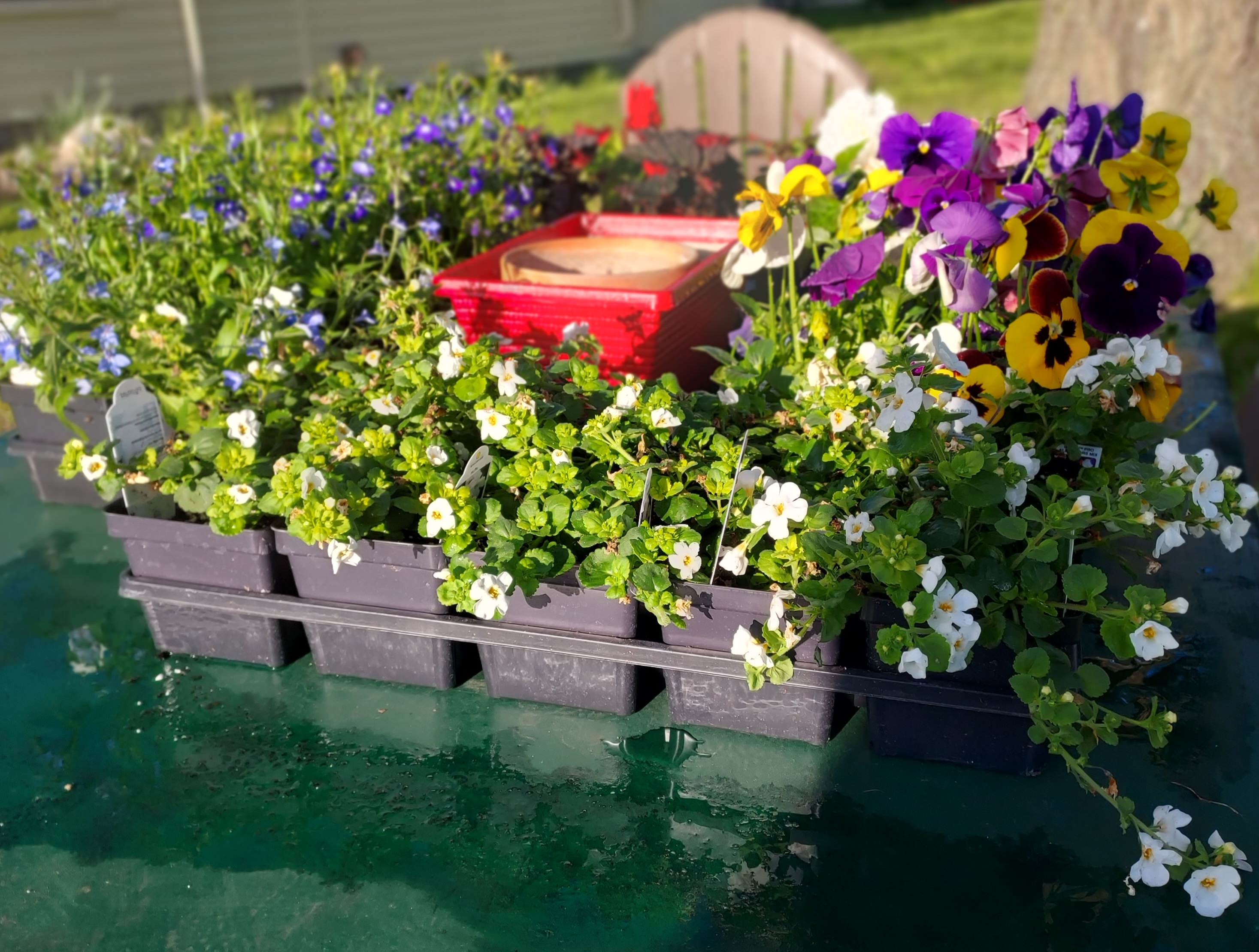
 

Annuals to add POP to perennial borders

One of the garden centers where I buy flowering annuals changed hands this past year, and when I asked one of the new owners how things were going he remarked—this was last Sunday morning—that people were biding their time, reluctant to plant with the weather as cool as it still was. I had risked bean seeds, and they came up, but then a chilly morning nipped part of a row. I filled in the row with new seeds. Does that take faith? I don’t know that I'm brimming with faith, but I plant and hope for the best and am delighted (by what seems a miracle!) when seedlings emerge from the soil.


Now—suddenly, it seems!—it is June, and there are no more slow days. Between sunrise and sunset we have more than 15 hours, so the days are long, but each one speeds by. As illustration and evidence, I offer below images of trees leafing out in late May. First, a roadside woods at that all-too-brief impressionist stage, the spring day when I always long for a ‘pause’ button so as to drink my greedy fill of this delicate, tender, fleeting time that is gone too soon. Then, our Leelanau woods only two days later. The first green of spring: Now you see it, now you don’t!

One spring day --

Two days later --

And THEN!  It's a jungle!

My personal and business life take on the speed of the season, which is why my recent trip to Kalamazoo was only an overnight turnaround. I could stay there for a month and still not have enough time with family and friends, but too much awaits my attention at home, so home I came the next day to tend to it all: planning for bookstore events with book orders and publicity, and planning for summer visitors to my home (and for my own stolen moments of leisure) by getting yard and gardens in shape for the season. Marilyn Zimmerman's book launch is next week!!!


Mark your calendar for June 10, Dog Ears Books, 5-7 p.m.!
 

In the midst of all this, the disappearance of my billfold, holding driver’s license and credit cards, was a minor crisis. Did I leave it somewhere? Drop it somewhere? Was it in the house “in plain sight” and I just couldn’t see it? Over and over I mentally retraced my steps ... called places I’d been on Friday and Saturday ... looked and looked and looked ... through every bag, under car seats, at home and in my shop. It is so maddeningly tedious, having to give over mental energy to such a boring, repetitive task, don’t you find? 


But on Monday morning my car had to go in for a brake job in Leland, and since I could make no progress on the search while the car was in the garage, I put the whole problem on the back burner, walking from Van's garage down Main Street to Trish’s Dishes to get a coffee to go, encountering a couple of friends along the way, and then making my leisurely way back to the river to find a perch on the dock of a shanty belonging to friends there in Fishtown. I'd texted Charlie that I would be there but hadn't had a reply, so I just made myself at home, as the Artist did so many times over the years.


Looking lake ward


A glorious morning! The sun was shining, and the breeze was alive with that wonderfully familiar, fresh-fishy aroma of the river. Men were at work on the dock opposite, where a few early morning tourists strolled. Passengers gathered to board the Mishe-Mokwa for a day trip to South Manitou Island. Gulls flew overhead, and song sparrows sang. Now and then a duck paddled about near the pilings. 


It was very near here, just south of the river mouth, that the Artist spent a night on the beach long ago and wandered into town the next morning to the Bluebird, where Grandma Telgard said immediately to a member of her kitchen staff, “This boy needs a cup of coffee!” That was years before we met, but in later years together we spent many, many hours in, around, and near Fishtown, only a pleasant walk from our old Leland home.


Back to the present. Now, in 2025, for weeks and weeks I have been carrying my sketchbook with me everywhere I’ve gone, along with a set of drawing pens sent to me by a friend for my birthday. The last serious sketches made in the book were from 2015. A whole decade ago! How is that possible? Finally, there on the dock, I took out sketchbook and pens and applied myself to the scene. The results were laughable, but results didn’t matter. I was there and nowhere else, practicing drawing as meditation. Perfectly content.


Life proceeds at a different pace on the river, I remembered then, whether one is working or relaxing. 


“I beg your pardon,” said the Mole, pulling himself together with an effort. “You must think me very rude; but all this is so new to me. So—this—is—a—River!”


“The River,” corrected the Rat.


“And you really live by the river? What a jolly life!”


“By it and with it and on it and in it,” said the Rat. “It’s brother and sister to me, and aunts, and company and food and drink, and (naturally) washing. It’s my world, and I don’t want any other. What it hasn’t got is not worth having, and what it doesn’t know is not worth knowing.” 


-      Kenneth Grahame, Wind in the Willows


Illustration of Rat and Mole by E. H. Shepard

Since I’d seen no car, I thought Charlie and Sandy must be away, but it turned out that Sandy was home, and after a while she joined me outside on the dock with her own coffee mug, and the two of us caught up on each other’s lives in leisurely fashion. I showed her my sketchbook, and she showed me her tiny portable watercolor kit, small enough to fit in a handbag, and after a couple of hours we walked up to Main Street and over to the Cove, a restaurant on the north side of the river, to meet her visiting grandson and his wife and their almost-three-year-old son for lunch. 


I’d told Sandy about my missing billfold but was feeling no stress or panic. It would show up, or it wouldn’t. I had put a hold on the credit cards the day before, and although replacing cards and driver’s license would not be much fun, it was just one of those things. One foot in front of the other. Deal with it. That's life. 


Am I calmer because I’ve learned not to panic? Or is it simply a lessening of energy that comes with age? Or am I become so calm, so unlike my younger self, because after losing the love of my life nothing else that happens to me feels all that difficult? Maybe all are partial explanations.


Later, back home, I dared to plant seeds for tender annuals and vegetables. Launched tennis balls through the air for Sunny Juliet. Searched one more time through my car for the missing billfold and contemplated necessary next steps if it didn’t turn up. But the day was too beautiful for worry. I’d mowed grass on Sunday, and my yard, fresh and green, was orderly and inviting as I puttered about the perennial borders, grateful for my Michigan country life.


Sunny likes Michigan, too.

And the icing on the cake was that I found my billfold in the grass, right there at home! Now I don’t have to think about that any more! 


But have I been stingy with pictures of Sunny in this post? How about a recent scene at the dog park, Sunny and friends, with all dogs in happy motion. There! Satisfied?


Dogs having fun!

Monday, February 24, 2025

Not Just Waiting Around For It

Enough of dark and cold!

Oh, where to begin? A random plunge? 


Above is the title (perhaps no longer appropriate?) that I used for a first draft, now discarded—lengthy paragraphs that wound on and on, giving excessive background on my experience with unsought joy, revisiting at length past days of happiness (back in “the old Vienna,” as the Artist loved to say) before arriving, at last, to the place where I find myself now, where being open to the possibility of joy and ready to welcome it when it comes is not enough. In the present place intention is required. I need to seek joy out with the expectation of finding it.


Sunrise again -- that's better!


That, briefly, was the theme I had in mind, but my intention took a beating, even after having been written down and gone over repeatedly, pen retracing the words over and over, the words spoken aloud, visualization effected—the whole nine yards. All that, and yet joy eluded me. Irritability, not joy, was my companion. Rats!


Have you ever had meditation go sour on you? My intention session itself was fine, but joy did not (shall we say) manifest. And irritability is not much of a muse! No one wants to hear about it! We don’t need that from each other, do we? So I held off posting anything new here—especially after a comment from one reader about how he came to Books in Northport for “positivity”!


What brought on the bad mood? A combination of factors. For me personally, this is a difficult month, with a string of three-year-old milestones lying in wait on the calendar, but there is also the dark, dark cloud hanging over our country and the world, a cloud impossible to dispel and very difficult to put out of mind for long. 


Then, too, I was in the midst of a reading slump! Whether that was cause or effect of the mood, I cannot tell. I only know that Mark Twain’s The Innocents Abroad, after an evening spent with it, struck me as silly and pointless and that I subsequently abandoned Anne Brontë’s The Tenant of Wildfell Hall halfway through, after the introduction had filled me with eagerness for the story. Eschewing literature after two or three impatient nights, I spent a couple of evenings with one of Lillian Braun Jackson’s Cat-Who mysteries and a big bag of potato chips, wallowing in escape reading and junk food.


(It really wasn't much of a party.)

My next reading choice, The Personal Librarian, was a relief and a step up. Authors Marie Benedict and Victoria Christopher Murray kept me turning pages in their engrossing work of historical fiction, and I have now ordered a biography of Belle da Costa Greene to see how known facts of her life stack up against the fiction. As J.P. Morgan’s personal librarian, Greene occupied a unique position in the world of art and book auctions of the period, her uniqueness taking on added poignancy 49 years after her death, when it was discovered that her birth certificate identified her as “colored.” It’s that secret identity that drives The Personal Librarian, certainly a fascinating aspect of the woman’s life, but I would like to know much more about how she learned about rare books and am hoping the biography will tell me that.


What really turned the tide of my mood, however, was the novel Black Cake, by Charmaine Wilkerson, a spellbinding story of a complicated family with complicated secrets, all connected by a recipe from “the island” that was their ancestral home. It was a book that carried me away and, finally, lifted me up. Awake half the night over its pages, only turning out the light after the book repeated fell from my hands as sleep overtook me, I had a happy reason to wake up in the morning: I had that book to finish! 


Have you ever had that feeling in the morning? Remembering as you came awake that an irresistible book was right there waiting for you? (So much better than only waking once again to the continuing nightmare of the current American political scene!) Now I see that Charmaine Wilkerson has published another novel, Good Dirt, and I am eager to get my hands on that, confident I will not be disappointed. 


Most highly recommended!

Switching gears for a moment: Meanwhile, when was the last time Sunny Juliet and I went to the dog park? When did poor Sunny last see anyone other than her dog mom? We’ve been alone too long!


This is her impatient face, between barks. Sigh!


What with bitter cold weather and then five days without our plow guy, it was a siege of togetherness, but I remedied that sorry situation for my girl on Sunday (though I rarely get photos at the dog park and didn’t on Sunday). On the way back through the village, I stopped at my bookshop only intending to snap one photo for my other blog, but then a family appeared, outside, gazing wistfully through the windows. I went to the door. “Would you like to come in?” They would! We visited, talked dogs, and they bought books—altogether a perfect encounter!


Back to reading: I’ll mention one more book here today. I’d ordered two copies of it, apparently, and then for the life of me could not remember why. The title, Faith, Hope and Carnage, seemed to threaten politics, but the content was actually a lengthy interview with an Australian musician whose work was entirely unknown to me, Nick Cave. (I know, I know—I’m totally out of it!) In an attempt to refresh my memory, I opened the book.


Not knowing what to expect, I am drawn in.

Even knowing nothing of songwriter-performer Cave’s work, I was taken by the way he talked about his creative process. Improvisation with collaborator Warren Ellis, he is quick to point out, is a lot more and something completely other than “winging it” (the interviewer’s suggestion).


No, that’s really not the case. We weren’t just two guys who don’t know what they’re doing. There’s a deep intuitive understanding between the two of us and, of course, twenty-five years of us working together. It’s an informed improvisation, a mindful improvisation. 


This theme of experienced, mindful improvisation comes up again. 


…[For] magical thing to happen, there has to be certain things in place. It can’t just be a couple of guys who don’t know what they’re doing, sitting around bashing shit out.
 

Cave’s seriousness about his music came clearly through his articulate statements, and without knowing anything of his music I was fascinated, but that wasn’t all. In the interview, he also talks a lot about God, about faith and doubt.


…[O]ne way I try [to find deliverance from suffering] is to try to lead a life that has moral and religious value, and to try to look at other people, all people, as if they are valuable. … I guess what I am saying is—we mean something. Our actions mean something. We are of value.


I thought of a friend of mine and a book she and her late husband worked on for years. She will recognize their work’s conclusions in Cave’s words, I know. 


And still there was more. This famous person completely outside my ken had, it seems, lost two of his four sons to death, losses that greatly informed both his music and his religious beliefs, and he has given a lot of consideration to grief and how it changes us—one of the major themes of my own life for the past three years, as you know. He speaks of the physicality of grief as “a kind of annihilation of the self—an interior screaming.” But he also speculates that “perhaps God is the trauma itself,” words that need a little more explanation: 


That perhaps grief can be seen as a kind of exalted state where the person who is grieving is the closest they will ever be to the fundamental essence of things.


He speaks of grief as “transformative,” in which we may be “essentially altered or remade.” Another friend will perhaps be reminded by these words of our conversation on Sunday evening.


More of the book remains for me to read than what I have read so far, but I will definitely continue with it, as the themes resonate perfectly with this month of milestone days in my life—my husband’s hospitalizations, surgeries, his birthday, our last days together, and his death. 


Perhaps searing memories and my current reading of creativity and God and faith and grief in words from a musician who has had no part whatsoever in my listening life will not strike any of you as the joy my carefully worded intention sought to manifest, but it is what has come, and I am welcoming it. Taking it in. Seeing where it will take me in my improvised life during this last week of February as temperatures rise into the 30s, bringing rain to erode our mountains of plowed-up snow.


How long will this mountain last?


Where will the next weeks take me?

Tuesday, December 20, 2016

They Light Our Way Along the Arc


Photograph by Marjorie Farrell


An essay's conclusion, writes William Dereshewicz, is not something we refer to as a fact but rather as wisdom. He allows that the ideas in an essay are “often openly impressionistic and provisional, colored by feeling, memory and mood,” going on to say,
But the essay draws its strength not from separating reason and imagination but from putting them in conversation. A good essay moves fluidly between thought and feeling. It subjects the personal to the rigors of the intellect and the discipline of external reality. The truths it finds are more than just emotional. – William Dereshewicz, “In Defense of Facts,” The Atlantic, January-February 2017
Not every reader is as fascinated by the essay form and its history as I am, but anyone who has been awake this past year realizes that there have been bloody assaults on truth and facts, and many of us find that cause for concern.

Although my new Atlantic arrived last Friday, it wasn’t until Sunday afternoon that I got around to Dereshewicz. I’d started the morning with the longest piece in the issue, “My President Was Black,” by Ta-Nehisi Coates. Mine, too, I want to tell Coates, and I have a lot more to say about that, but I’ll save it for another time. For now let me just say that all my readers who don’t subscribe to The Atlantic should go right out and buy the current issue, because the Coates article alone is worth the cover price. After you read the whole issue, you’ll probably want to subscribe. I hope so.

Here are a few lines from the editorial in the current issue:
Obama is not an unalloyed idealist. He has complicated feelings about the nature of humanity, and harbors few illusions, in particular, about the moral systems that govern many other countries. But he has always seemed sincere in his belief that America is a place that possesses a unique capacity to become better, and then better again. “The arc of the moral universe is long [my emphasis added], but it bends toward justice,” he often said, quoting Martin Luther King, Jr., but he really meant that America’s arc bends toward justice.
That stopped me in my tracks. Light dawned, belatedly, in one bookseller’s brain! The title of Kathleen Stocking’s book: The Long Arc of the Universe – that was her reference!

Originally I didn’t care for the title. It seemed vague and having little to do with the content of the essays – but only because I had completely missed the allusion! When I’d shared my initial misgivings about the title with the author, she kindly refrained from pointing out my ignorance. I wish now she had not been so careful of my feelings!

Because now it makes perfect sense. It captures perfectly Stocking’s optimism in the future, a clear-eyed optimism she shares with President Obama, despite hard truths both have faced in this world.

Neither Obama nor Stocking is optimistic because they live in ivory tower isolation. Both have served – Obama in Chicago activism, the Illinois Senate, and the White House; Stocking in country schools, California prisons, and in the Peace Corps – in ways and places demanding a pragmatic, hands-on, the-buck-stops-here approach to problem-solving. Neither can say that the problems they tackled are now only historical footnotes. That should go without saying. Problems persist. The world is hard on people, and it’s harder on some than on others. But, like President Obama, Kathleen Stocking continues to have faith in the human capacity to become better and to make the world better. And both can say they put themselves on the line, personally, to do something toward that end.

Obama is quoted in the Coates article as saying, elaborating on the statement of Martin Luther King, Jr.,
To be optimistic about the long-term trends ... doesn’t mean everything is going to go in a smooth, direct, straight line....
Well, if optimism had to mean that, there couldn’t be an optimist anywhere in the world, could there? Kathleen Stocking wrote me in an e-mail, following the November election:
Ruth Gruber died today. She was 105. She was in Germany hearing Hitler's rants in 1932 and sounded the alarm, but no one heard. She photographed the people in the camps, the boats of refugees turned away by the British warships from Palestine, and so on. It can happen again. And it can happen here. There's no doubt at all in my mind about that. But I also believe, with Obama (that whippersnapper, that youngster) that history is not a straight line. Our species is evolving toward greater and greater consciousness, but there is backsliding, detours, and the process is slow, in any event. Julian of Norwich had to pretend she couldn't read and write and that everything was coming from heaven and had to be translated. Because any woman who could read or write was in league with the devil. As we all know.
But as she writes in her most recent book of personal essays, The Long Arc of the Universe: Travels Beyond the Pale:
The hard thing about living anywhere, I decide, and traveling in general, is that one can never live long enough or see enough of the world to fully understand the long arc of the universe and make sense of it. Little bits are all we get, and it’s never enough to see the big picture.

Holiday decorations by Kathleen Stocking

I do not call myself a pessimist. At the same time, I often find it hard to be optimistic about “the big picture.” Little corners, yes. Pockets. Certain stretches of time here and there. But it’s true that none of us gets to see “the big picture,” the “long arc.” Kathleen Stocking and President Obama, however, remain optimistic in their long views, and they have seen much more than I can claim to have seen, so I’m taking their words seriously.

The philosopher of my heart is Henri Bergson, who lived in France from 1859 to 1941. In his heyday, he had been the equivalent of a rock star. The public swarmed his lecture hall at the Sorbonne – it was the place to be! – and finally a section of seats had to be cordoned off and reserved for students, because socialites had started coming in to the lecture preceding Bergson’s to assure themselves seats for the star.

Never a novelist, always a philosopher and teacher, he was nevertheless awarded the Nobel Prize in Literature in 1927, but by 1940 his star had faded, and he lived quietly, out of the limelight. Then came the Occupation. Bergson’s earlier glory was not forgotten by those who had assumed power. Eager to piggy-back on his reputation, they offered him blandishments, their recognition – which apparently they thought would be an irresistible inducement. Bergson said no.

The immediate cause of his death during the Nazi occupation of Paris was bronchitis, but I have always suspected heartbreak. Ill for many years with crippling arthritis, on the arm of a caregiver he left his sickbed to register as a Jew, despite Nazi assurances that he was “exempt” from the new, odious racial laws. Again, he could have sold out, but he didn’t.

Bergson died on the fourth of January, 1941, and I have always imagined him on a cold winter day, in the city he loved, arriving home exhausted to die of a broken heart – in part because he had been a most optimistic philosopher, sure that the human spirit was evolving in something higher and finer -- and whenever I have told the life story of Bergson to someone unfamiliar with his name, it has been hard for me to keep tears from my eyes at the end. But the truth is that I wasn’t there. I did not know him. And the day he died was probably not, as it has always been in my imagination, the same day he stood in line to register for his yellow star.

Undoubtedly he felt deep, wrenching sorrow for what had come to Europe in his own last days, and I cannot imagine that his heart did not ache, terribly -- for the Jews, for France, and for the world. But that he chose to show solidarity with the persecuted, though he had never practiced the religion, was a choice entirely in line with his philosophy and his entire life. By his own definition of freedom, that is, arrived at as early as his 1889 doctoral dissertation (Essai sur les données immédiates de la conscience), his was a free act in 1941, neither mechanical reflex nor directed from anything exterior to his own soul. It came out of everything he was, out of his entire life leading up to that moment.

And exercising his freedom would have been, necessarily, for him, an affirmation and demonstration of the possibility of freedom. Would he also have been able to maintain, amidst the horrors of that time in history, his faith in the evolution of the spirit?


Ready now for holidays
Richard Leakey of Kenya, when entering political life, was asked by an interviewer, “Are you willing to give your life for this country?” Leakey is a white man whose home is a black African country, and the subtext of the question was that in running for office he might risk death. His answer, however, spoke not to the risk of death but to commitment: “What else does any of us have to give?”

It is not for us to question life, Viktor Frankl wrote. Life questions us. How will we answer? An amazing, inspiring person! He saw the absolute worst of the twentieth century and somehow kept faith in humanity.

How do these people do it? How do they maintain faith and optimism, despite all they see first-hand that could drive them to despair?

There will always be those in the moral universe who blatantly steal and rob from others, as there will always be the less obvious free riders, who simply manage not to pay their legitimate dues. But at the same time there will also be, besides the mass of responsible dues-payers, those who not only pay their own dues but who move mankind forward (or at least keep us from being forever lost in the abyss) by being extraordinary, by doing more than their share, by achieving wisdom and by serving as models for the rest of us.

Moral progress, if there is such a thing, is not a smooth, direct line. Okay. There will be backsliding. All right. But does it exist at all, this moral progress? Is the human spirit evolving into something better? Was Henri Bergson able to believe that still as he closed his eyes for the last time?

Martin Luther -- not my favorite guy! -- thought faith a matter of grace: You are given the gift, or you’re not. But what if faith, like any virtue in the Aristotelian sense, is a matter of practice? You get up every day, regardless of circumstances, despite difficulties, and you do what you can. You’re as frightened as the next person, but you choose not to let fear paralyze you. And doing what you can, one day at a time, despite fear, strengthens your faith in the future and in your fellow human beings. Do you think it might work that way?

It’s the only way I can make sense of it – moral progress not as a matter of inevitability, not operating blind like the evolution of the physical universe, but as something created by human choices and actions. Because if the long arc of the universe is to bend toward justice, is it not up to each of us to do our part, though all we can see is our little bit of here and now?

Warmest holiday wishes, my friends. Keep the faith! And thank you for being in my life!

P.S. 12/23/2016 - Here is a very inspiring essay. My sister Bettie sent me the link. Merry Christmas, Happy Hanukkah, all!


Photograph by Marjorie Farrell

Thursday, June 14, 2012

Trusting the Wellspring


No definitions today, no argument or debate. A couple of very personal thoughts.

First thought has to do with self-publishing. Everyone, it seems, is doing it. A few hold themselves to the highest standards of research, writing, editing, design, etc. Over the years I’ve seen a handful of excellent self-published books. At the other end of the spectrum are poorly written, in-need-of-editing, cheaply packaged vanity offerings, the bane of any bookseller’s existence. And of course there is a wide range in between.

Well, I’m self-publishing my stories, and (as is the case with my blogs) without benefit of an editor, but my stories are not on paper, not between covers, and you don’t have to pay to read them. I’ve been putting them here on my blog (most recent on previous post), tossing them out into the world like messages in bottles cast out upon the waves. They may sink, or they may swim, but anyone can read them or not, like them or not, all without spending a cent or taking home another book to crowded shelves. If I had a publisher, I’d also have an editor and a publicist and a book designer and more, working on my behalf to make my book worth its cover price. Don’t have that. Am not asking for money. Am not competing with writers who have given their lives to the hard work of writing. (I have given my last 19 years to the hard work of bookselling, and I’ve learned a lot about writers’ lives in that time.) For now, my primary identity is as a bookseller.

Second thought occurred to me years ago in another context and was reinforced by my recent reading of William Stafford’s Writing the Australian Crawl. That is, the quickest way to kill one’s inner creative spirit is to be afraid that “It will never happen again!” I could hold onto these ten stories and nurse the dream that someday they might be published between covers under the aegis of a real publishing house, keeping them in a drawer until then, out of fear that these stories might be all I’ll ever write, but I need to have more faith in myself than that. I need to trust whatever mystery gave them to me in the first place. 

I don’t know where these stories came from. All I know is that the first morning I woke up in Florida two years ago, the character of the first story was already in my head. I got up and started writing, and in two months I had all ten stories. They were not planned. Even the final story, the one that brings the rest together, was not something I saw ahead of time. So what I have to trust is that when my life is once again, for however long a stretch of time, free of scheduled obligations, more characters and stories will emerge from the mysterious deep. 

Letting go of these, letting them out in the world without expecting a return from them, is my leap of faith.


Monday, April 2, 2012

Tony Judt: Much More Than Just “Amazing”

I don’t think I quite grasped it at the time, but “understanding” was becoming for me an increasingly central objective: harder, deeper and more enduring than merely “being right.” – Tony Judt, Thinking the Twentieth Century, with Timothy Snyder (NY, Penguin, 2012)
How to begin to describe the mind of Tony Judt? That is the question that came into my mind yesterday. In current parlance, one would automatically say “Amazing!” But then, everything is “amazing” these days, isn’t it? A new jacket, a movie, a hairdo? So to use the word in a serious (let alone a casual) context is to say nothing at all.

First of all, his mind was “well stocked.” The phrase is his own, as he referred to the memories he used to construct the essays in The Memory Chalet. That writing was reflective and impressive, along with being personal, even deeply intimate, but in Thinking the Twentieth Century we see more clearly yet the extent to which Judt’s mind was stocked not only with personal experience but with a lifetime of reading and intense engagement with both experience and ideas.

His mind was engaged. It is clear from reading this book that his mind was always engaged and that the engagement ended only with his death. He didn’t just “talk his way” through this book. He and Snyder talked it, and then Judt edited each chapter, continuing to clarify his ideas about our world in the twentieth century, because it mattered to him. Thinking was not an idle game for him but an activity of crucial importance. He cared about his world and felt a responsibility to the present and to the future.

He thought critically. He did not easily give his assent.His was not a mind to acquiesce easily, either in the pronouncements of others or to his own initial responses, and he continued to question others, the world, and himself as long as he drew breath. But neither was he one to dissent merely to be different, to gain attention, or to play devil’s advocate lightly, as a diversion. Again, he analyzed and reflected endlessly but never as a game—always because he saw thinking as important work.

His thinking and expression had a style all their own. Analytical by temperament and by training, Judt retained a poet’s love for the sensuous details and the great romance of the world about him. Anyone who has read The Memory Chalet knows this. Whoever has not read it, should.

For the remainder of this post, I want to highlight a few passages from Thinking the Twentieth Century, beginning with the somewhat unromantic (most would say) of economics. Judt identifies the Reagan-Thatcher view, “that the right to make any amount of money unhindered by the state is part of an unbroken continuum with the right to free speech,” and he goes on as follows:
It is perhaps worth reminding ourselves that this is not what Adam Smith thought. And it was certainly not the view of most neoclassical economists either. It would simply never have occurred to them to suppose a necessary and permanent relationship between the forms of economic life and all other aspects of human existence. They treated economics as benefitting from internal laws as well as the logic of human interest; but the motion that economics alone could supply the purposes of human existence on earth would have struck them as peculiarly thin gruel.
On the role of the historian, a topic of great importance to him, he is particularly eloquent.
The task of the historian, if you wish to think of it this way, is to supply the dimension of knowledge and narrative without which we cannot be a civic whole.
Has anyone ever described the job better? A couple of pages later he is more precise:
I would break that thought into two parts. The first is simply this: the job of the historian is to make clear that a certain event happened. We do this as effectively as we can, for the purpose of conveying what it was like for something to have happened to those people when it did, where it did and with what consequences. This rather obvious job description is quite crucial. The cultural and political current flows in the other direction: to efface past events—or to exploit them for unrelated purposes. It’s our job to get it right—again and again and again. The task is Sisyphean: the distortions keep changing and so the emphasis in the corrective is constantly in flux. But many historians do not see it this way, and feel no responsibility of this kind. In my view, they are not real historians. A scholar of the past who is not interested in the first instance in getting the story right may be many virtuous things, but a historian is not among them. However, we have a second responsibility. We are not merely historians but also and always citizens, with a responsibility to bring our skills to bear upon the common interest. ... We are never free of that.
 Accordingly, we must operate in two registers simultaneously....
Critical as he was of all national political agendas, Judt was very clear in his mind that before students can criticize history, they must learn it. Facts first. Without facts, “criticism” becomes a hash of opinions slung about willy-nilly. And, in thus making history irrelevant, in making it chaotic, “we [historians] lose any claim upon the civic conversation.”

He thought a lot, also, on the distinction between history and collective memory:
...I profoundly believe in the difference between history and memory; to allow memory to replace history is dangerous. Whereas history of necessity takes the form of a record, endlessly rewritten and re-tested against old and new evidence, memory is keyed to public, non-scholarly purposes: a theme park, a memorial, a museum, a building, a television program, an event, a day, a flag. Such mnemonic manifestations of the past are of necessity partial, brief, selective: those who arrange them are constrained sooner or later to tell partial truths or even outright lies—sometimes with the best of intentions, sometimes not. In either event, they cannot substitute for history.
I could quote endlessly from this book but give these samples only in the hope of inducing hunger for more, so the last passage I have chosen for today is one from my previous post, and it has to do with faith and judgment:
...It is one thing to say that I am willing to suffer now for an unknowable but possibly better future. It is quite another to authorize the suffering of others in the name of that same unverifiable hypothesis. This, in my view, is the intellectual sin of the century: passing judgment on the fate of others in the name of their future as you see it, a future in which you may have no investment, but concerning which you claim exclusive and perfect information.
Tony, his wife tells us, believed in two things: love and serious public debate. That is, love and informed conversation. Both require that human beings care.

Monday, August 30, 2010

He Decided to Make a Difference, Part II

A few excerpts from Jack Orchard’s Extra Hands: Grasping for a Meaningful Life (2007):
“I am on my deathbed now, and the same age as Pascal was when he died at age thirty-nine. Unlike him, I feel no conversion coming. No bright lights, no Biblical voices. Just the ordinary sights and sounds of St. Louis, Missouri, where I have chosen to live my last days. Yet, like Pascal, as I approach death I can now reflect on the memorial moments and lessons learned that have informed my way.”

“With a few exceptions, like the well-paying jobs I had helped create in Moscow, I had spent most of my life working to improve my own prosperity. I didn’t think this was intrinsically wrong, from a moral perspective, because I planned to address it later in life. My long-term plan had been to make enough money not to have to think about it anymore, and then apply the experience I had gained from building new companies, especially raising money for them, in some charitable context. When I thought I had another fifty years to fulfill that plan, I saw nothing wrong with my choices. But what if it was more like three to five?”

“I had never looked for [meaning in my own life] through spirituality. Even when the neurologist handed down my death sentence I felt no urge to withdraw into faith. But still I needed to know that my life, however short it might be, had meaning.”

“For me, the simplicity of the Extra Hands model held vast potential to reach across religions and dissolve dividing lines between people of different belief systems. In fact, that is what I found most compelling about it. I realized then that if I could use my gifts, those ALS would not strip from me, to build something that would enact this simple philosophy and draw in people of all beliefs, I would be able to die with the knowledge that my time had been purposeful....”

“In my condition now, still and silent, I ask myself what I believe every day. And each day I feel more certain that I have found no new revelations. Instead, I have grown every more convinced that, working together, we are capable of magnificent acts of courage and fortitude to improve our individual and collective lives. It’s called humanism, the belief that we need only to look to ourselves in the search for answers to questions big and small, empirical and theoretical, experiential and ontological.

“Yes, humanism—with its commitment to the use of reason and scientific method in fashioning solutions to human problems, its steady quest for objective truth, its pursuit of principles of ethical conduct without a divine inspiration, and its concern for the fulfillment and enrichment of the lives of the individuals and their communities—is the source of my strength, the foundation of my faith.”

Jack Orchard died on July 4, 2009, at the age of 41. His work lives on.

He Decided to Make a Difference

Both as a reader and as a bookseller, I approach self-published books warily and have written about this topic in an earlier post. Too many such books are badly written in the first place and/or don’t get the editing they need, and even the best-produced can fall stillborn without a good marketing and distribution plan, also often lacking. A couple of northern Michigan mystery writers, Aaron Stander and Robert Underhill, are among the exceptions that prove the rule, but there are others, and yesterday, completely by chance (digging through a box of used books someone dropped off at the store), I came upon a nugget of gold, Extra Hands, by Jack Orchard, and very, very early this morning after half an hour sitting out by the meadow under moonlight and stars, I finished the story. Next obvious step was to go online, where I was not surprised that my search turned up the news that Orchard had died a year ago July (2009) at the age of 41.

What’s important and inspiring about entrepreneur Orchard’s story is not his illness, not his death but his decision to create a meaningful life, while he had time, by doing for others. Here is an excerpt from his obituary in the St. Louis Beacon, his hometown newspaper.
One of the most improbable things Mr. Orchard did was write a 183-page book after most of his body had ceased to function, including his fingers and his voice. He wrote his memoir, “Extra Hands-Grasping for a Meaningful Life,” with his eyes. He learned to use Eyegaze, a special computer that tracks eye movements and types the letters on a screen, at the highest speed possible. Proceeds from “Extra Hands” were used to fund the nonprofit foundation he founded, Extra Hands - ALS, that paired high school and college student helpers with people living with ALS because, he said, ALS can be a lonely disease.

He founded Extra Hands for ALS and the Jack Orchard ALS Foundation. His faith was humanism, and he lived it.