Search This Blog

Showing posts with label Nassim Nicholas Taleb. Show all posts

Tuesday, September 24, 2024

Shifting of the Gold

Goldenrod & bracken have both gone dull.


Although goldenrod’s bright color has already dimmed in Leelanau, I look forward to the near future gold of tamarack. Anomalous among conifers, tamarack trees change from green to gold and then, acting like leafy deciduous trees, shed their feathery needles as winter approaches. By the time the tamarack trees are bare, bracken fern on the ground will have gone from green to yellow to brown, from spring soft to fall stiff to winter brittle. (In hunting season, bracken crunches underfoot.) Some Leelanau bracken has a head start on that seasonal change.

Tamarack in U.P.

I made another quick run up over the Mackinac Bridge on Sunday, rewarded by a porch visit with my dear friend, author Ellen Airgood, who took half an hour away from cookie baking for our chat. Cool U.P. air plus rain called forth my sweatshirt. When last up to see my friends in June, I hadn't taken a warm jacket, which Ellen rightly branded a "rookie mistake." I was better prepared this time around.

Hot cocoa at the Uglyfish Baking Company hit the spot, too.

It was great to catch up with Ellen, talking dogs, books and reading and writing, plans for cozy winter days, and life in general. My drive back south felt longer than the drive north, with pouring rain from Newberry to Traverse City, but the trip was worth it to have time with my friend, and I was safely home in bed by 9 p.m. with book and dog.

My current bedtime reading is a Library of America volume that includes all four of Albert Murray’s semi-autobiographical novels, starting with Train Whistle Guitar. Besides fiction, Murray wrote quite a bit about jazz and blues, and much of his writing has a jazzy quality to it that is simply delightful. This writer won me with his very first paragraph:


There was a chinaberry tree in the front yard of that house in those days, and in early spring the showers outside that window always used to become pale green again. Then before long there would be chinaberry blossoms. Then it would be maytime and then junebugtime and no more school bell mornings until next September, and when you came out onto the front porch and it was fair there were chinaberry shadows on the swing and the rocking chair, and chinaberry shade all the way from the steps to the gate. 


-      Albert Murray, Train Whistle Guitar


Despite the heavy rain I drove through farther north, I learned the next day (a bright, sunny Monday) that Leelanau had only gotten a fraction of an inch, and the weather app on my phone showed no hope of further rain until next week. But then during the day on Tuesday, the wind shifted, and with that the weather forecast also changed: Rain on Tuesday evening, rain Wednesday, rain Thursday? Dare we hope? I write this on Tuesday evening, waiting for rain…. Hearing coyotes....

Having done a little mowing and raking on Monday, I did more raking Tuesday evening and a little edging around my perennial border, with frequent breaks to launch tennis balls for Sunny Juliet, and after supper we went outdoors again for Frisbee and agility. She is figuring out the weave poles! Her Frisbee catching is improving! She loves any activity that we do together, and while she eagerly accepts little treats for a good performance, sometimes it seems the activity itself is sufficient reward, which of course is the best scenario possible. Do what you love; love what you do.


My reading of Nassim Nicholas Taleb’s Antifragile had me so excited that I signed up to “follow” him on Facebook, but I should have known better, because just as I enjoy conversation more with one or two or three people than in larger groups, I’ve never been a very good follower, either, and by halfway through Taleb’s Skin in the Game I had fallen out of love -- possibly for trivial reasons, but aren’t reasons for falling out of love often trivial? 

For one thing, Taleb seems to think no one could really enjoy Proust but would only carry the books around to impress people. Is that the only reason why people carry around the Wall Street Journal or the Economist or a book by Nassim Nicholas Taleb? Some, I’m sure, but really, is it too much of a stretch to acknowledge that different people have different interests and pleasures? 

Then – and this is really trivial! – in his list of all the ways people he does not admire show themselves to be wimps, he notes that they never curse on social media. Well, if cursing is such a sign of superiority, why does he spell ‘bullshit’ in his book ‘bull***t’? Prithee, why so coy? I don’t often read half a book and quit but probably will with this one. Like Sartre’s Being and Nothingness, I’m finding the going repetitive, the repetition self-indulgent. 

My advice: Read Antifragile. It’s worth reading. If you want an introduction to it, you can start with The Black Swan, but Antifragile is meatier, and you can get the black swan idea there. As for Skin in the Game, the book’s basic point is that you shouldn’t take advice from people with nothing to lose. Naturally, there are sub-propositions and logical inferences, but you can read a few chapters at the library. Or, if you want to buy a paperback copy from me, I have two available at the cover price of $20.

(I had a third trivial reason for falling out of love, but who cares?)

Still in love with: Michigan! My life as a bookseller. My dog. Proust. My country life. My friends!

There she is, writer and cookie baker extraordinaire!

THIS SATURDAY: Northport’s annual street fair, LEELANAU UNCAGED!!! 

Get ready. Get set. --

Wednesday, July 31, 2024

Incidents and Intervals from My Summer Life

Country morning scene

Dog and Gardens and Local Happenings


It’s been a beautiful summer so far and a busy one, too, but Sunny and I got to our agility session on Monday with Coach Mike and did better than we had done the week before. Mike says a lot of people don’t want to believe that when the dog makes a mistake, it’s almost always the handler who is at fault. I believe it! I know "our" mistakes are almost always mine!


The flying puppy!

Sunny doesn’t make mistakes when I give her the right cues. The problem is that every little move I make is a “cue” for her. But it’s a good workout for us both.


It's time for phlox and daisies in my front yard, while the backyard garden peas are finishing up and purple-podded beans coming on strong. I like the purple beans because the flowers are pretty and the beans easier to see when it’s time to pick but turn green when cooked.


Color contrast is helpful sometimes.

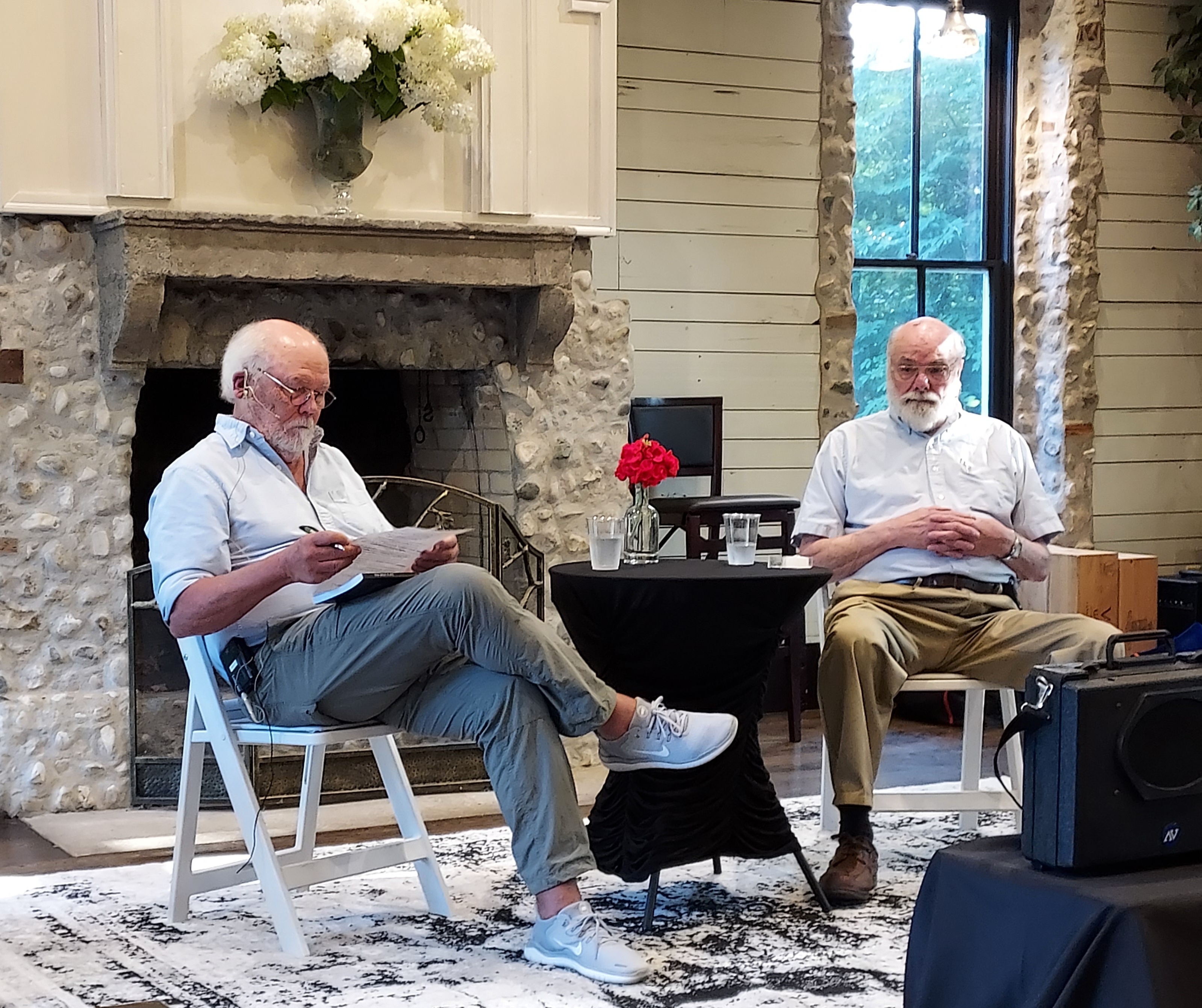
Tuesday evening was the last of four events in the Summer Writers Series sponsored by the Friends of the Leelanau Township Library, all held at the beautiful Willowbrook Mill in Northport. Featured author this week was Stephen Lewis, his latest book a historical novel set in 17th-century New England, From Infamy to Hope. 

Once more at the lovely
Willowbrook Mill - before the event

Stephen Lewis and sound guy Al Noftz - great silent exchange!

Author-interviewer Greg Nobles and guest author Stephen Lewis


Stephen Lewis pointed out that many of the issues of pre-Revolutionary America face us again today, the large, overarching one that of the separation of church and state. Anne Hutchison was found guilty of heresy, excommunicated, and banished from Massachusetts for daring to argue (intelligently) with Governor John Winthrop. Our Founding Fathers thought they had protected us from a return to religious autocracy, but time and the November ballot box will tell if their plan for our freedom will endure.


Meanwhile, Bookstore Daze


One day last week a little boy seemed entranced when given a bookmark to go in his newly purchased book. He told me solemnly, “I never had a bookmark before” and thanked me profusely. On his way out the door, he called back another hearty “Thank you!” Who would have thought such a little thing could make such an impression? His first bookmark!


On Saturday, when a woman asked me for a book of poetry with woodcut engravings, I pulled something right off the shelf that suited her to a T. “You made my day,” she told me, adding, “and I hope I made yours.” I replied, “Your saying that made my day!”


Then there was the man whose wife looked dubiously at the book he had selected and asked him, “Couldn’t you find it online?” Did she think it would be cheaper online? I kept my mouth shut. He bought the book.


When was it that I started reading Antifragile: Things That Gain From Disorder, by Nassim Nicholas Taleb? My reading was done in stolen moments between bookstore customers, so it took me quite a while, but it was a most satisfying experience! I was also quite satisfied to find for myself the exact quote from Henri Bergson that Taleb could not give word-for-word on page 308 of Antifragile. Taleb says he often “follows” what he calls “Bergson’s razor,” as if it is a rule, when actually it is a description of a lifetime search for clarity of an idea. What would these two have made of each other, Bergson and Taleb, had they been able to sit down over dinner for conversation? Thoughts like this, along with literary quests, keep my mind active – as does figuring sales tax in my head, which would be harder except that it's been 6% ever since 1993 when I started in business.


The very day after the foregoing thoughts, I discovered a copy of The Black Swan and dove into it, finding in the prologue another Bergsonian idea: namely, in Taleb’s words, 


What are our minds made for? It looks as if we have the wrong user’s manual. Our minds do not seem made to think and introspect…. Consider that thinking is time-consuming and generally a great waste of energy, that our predecessors spent more than a hundred million years as nonthinking mammals….


Bergson had this insight over a century ago. As active creatures, we did not evolve brains for metaphysics but for survival. Alas! Again I find no entry for ‘Bergson’ in the index to The Black Swan, which is a minor quibble but only goes to illustrate Taleb’s point that individuals who “got it right” are often not remembered for their prescient contributions when labels of “greatness” are being distributed ex post facto.


And as a matter of randomness, a random thought occurs to me about a woman who was just here looking for one specific title she hoped to find (always a long shot). She asked about it, and when told I had never seen that book, she left without so much as a glance at the books all around her – depriving herself of the opportunity to meet with the unexpected and wonderful. Some people are on such narrow missions (while on vacation!) that they deny themselves the possibility of serendipity.


But then there was the young woman who told her father, as he was paying for her book along with his own, “Libraries and used bookstores are the backbone of our country.” At my urging, she wrote her spoken words in my guestbook. When I sometimes feel discouraged, it’s good to read comments left behind by real book people. And really, I've had more words of appreciation this summer that ever before. "This is the highlight of my vacation," another customer told me, and that kind of mutual satisfaction makes my life's work worthwhile.


But now, without further ado, my Books Read list for July 2024. July is busy in the shop in Northport and busy at home in the yard, and while the days are long, there are never enough hours in them for reading, so these books are only #110 through #116 on my list for the year. 


Books Read, July 2024


Woolley, Edward Mott. Roland of Altenburg (fiction). Heir to the throne of a small European principality comes to America disguised as a commoner and falls in love with a young woman who is already engaged to someone else. No one knows the prince’s true identity. He is loathe to return to his constrained and formal life but must when his uncle, the reigning monarch, dies. Fast forward: The young engaged woman comes to visit Altenburg. Any reader can see that she and the prince will end up together, but who could have foreseen all the melodramatic cliff-hangers that precede the happy ending? Published inb 1904 by Herbert S. Stone & Co. in Chicago, my copy was printed by R. R. Donnelly & Sons, famous for their Lakeside Press editions. There are “classic” paperback reprints available online, but who would want one of those?


Patterson, Susan & Susan DiLallo with James Patterson. Things I Wish I Told My Mother (fiction). When I am buried alive in old books in Northport and have (beloved) weekend company and have, besides, a couple of editing jobs at home for understandably eager (not to say impatient) clients, I look for easy bedtime reading, and this novel filled the bill, although when I started reading it, I had been expected a memoir and was surprised by the style. Oh, well, it was very entertaining. Good way to end a summer day after an afternoon at the beach with my sisters. Can you say "minivacation"?


Hannah, Kristin. The Women (fiction). Hannah knows how to tell a gripping story and does so in this novel. The central character is a young woman who enlists in the Army to follow her brother to Vietnam, having not a clue what awaits her there. American re-entry after two tours of duty as a nurse is almost as traumatic as was her time “in-country,” but when she looks for help she is told over and over that “There were no women there”! This story could hardly have been told better if the writer had been through it all herself. It reads as though she had been.


Yourcenar, Marguerite. A Coin in Nine Hands (fiction). Is this a novel or a collection of interlocking short stories? The semirealistic setting is Rome in the eleventh year of Mussolini’s dictatorship. There is an assassination attempt. A ten-lira coin passes from hand to hand and links one character to another, sometimes tangentially, other times in more essential ways. Yourcenar, first woman admitted to the French Academy, also wrote Memoirs of Hadrian, an amazing fictional tour de force that no serious reader should miss.


Perelman, S.J. The Last Laugh (nonfiction). Ah, yes, the humor books of yesteryear! What wonderful comfort reading they make, especially when the writer is as witty as Perelman!


Adams, Katharine. Red Caps and Lilies (fiction). Historical fiction ‘romance’ (in the broad sense) was good bedtime reading during a busy, busy week. Remarkably light reading, considering the time period – the French Revolution! Also remarkable was the author’s ability to sympathize with both aristocrats and revolutionaries, though not with the Terror.


Taleb, Nassim Nicholas. Antifragile: Things That Gain From Disorder (nonfiction). Although my beloved Henri Bergson rates only the briefest of mention in Taleb’s book, I cannot overemphasize my fascination with and appreciation for the ideas expressed in Antifragile. It would have helped me in the early pages had I realized there was a glossary at the end of the book (I have not yet read Taleb’s bestselling earlier work, The Black Swan, and so was unfamiliar with much of his terminology), but I persevered and feel enriched and -- in a sense, in some aspects of my life – even vindicated by not only his insights into risk management, but also his expressions concerning the choices all of us make in our lives. Despite his analytic approach, this author does not believe that if something is legal (read, “not illegal”), nothing can be said against doing it. He believes in courage, and he believes in shame. What a breath of fresh air in these times of so many shameless cowards in public life! But read the book! Please! And/or any of his others, which I will be reading, also. 


For now, remember the idea of antifragility. (I wrote about books as antifragile in a previous post.) That idea pervades Taleb’s work, as duration pervaded the work of Henri Bergson, the philosopher who wrote, 


A philosopher worthy of the name has never said more than a single thing: and even then it is something he has tried to say, rather than actually said. And he has said only one thing because he has seen only one point: and at that it was not so much a vision as a contact: this contact has furnished an impulse, this impulse a movement, and if this movement, which is as it were a kind of swirling of dust taking a particular form, becomes visible to our eyes only through what it has collected along its way, it is no less true that other bits of dust might as well have been raised and that it would still have been the same whirlwind. Thus a thought which brings something new into the world is of course obliged to manifest itself through the ready-made ideas it comes across and draws into its movement; it seems thus, as it were, relative to the epoch in which the philosopher lived; but that is frequently merely an appearance. The philosopher might have come several centuries earlier; he would have had to deal with another philosophy and another science; he would have given himself other problems; he would have expressed himself by other formulas; not one chapter perhaps of the books he wrote would have been what it is; and nevertheless he would have said the same thing. 

― Henri Bergson, The Creative Mind: An Introduction to Metaphysics


Sunrise,


Sunset....

Friday, July 26, 2024

Evenings Out, Mornings Outdoors, and Books as AntifragileTechnology


Evenings Out


It is rare for me to go out in the evening, other than outdoors in my own yard, but July is the month when the Friends of the Leelanau Township Library hold their Summer Writers Series, featuring one Michigan author a week for four weeks. The third week of the series this year was author and farmer and chef Abra Berens, and not only was she FOLTL guest author on Tuesday but the following Thursday she prepared a special chef’s dinner, also at the Willowbrook Inn. Two nights out in one week!


Abra Berens at the Willowbrook Inn

Sommelier du soir

The Willowbrook is a magical event venue, elegant and at the same time simple and old-fashioned. Mimi DiFrancesca and Joel Heberlein, in transforming the 140-year-old building, have only added to its charm, such that it is always a joy to be there. The windows invite the outdoors in, giving the feeling that one is in a very grand and spacious treehouse. And this time, of course, there was Abra’s wonderful menu, served by friendly faces, many of them familiar. Quite the evening out!


Also noteworthy is that a portion of ticket sales from Thursday’s dinner went to Food Rescue, people doing much-needed and important work in northern Michigan.


My role in the program came following dessert and was – no surprise! – selling books that Abra happily signed for her satisfied diners. Sunny Juliet was ready for play when I got home, and I was ready for sleep, but we worked it out.


Books are my life.

Sunny amusing her dog momma at bedtime --

Mornings Outdoors


In my life, mornings mean outdoors, and while that’s usually in our own yard, sometimes Sunny Juliet and I go farther afield. Friday we did what I call “Go for a ride, go for a walk,” where we get in the car and have a leash walk (or two or three) somewhere other than our familiar home grounds, with stops also simply to give the dog momma a chance to photograph lovely sights. 


That pond on Alpers Road again --


Books as Antifragile Technology


Nassim Nicholas Taleb (and my, how that name keeps cropping up in my posts lately!) does not have an entry for ‘books’ in the index to his book Antifragile, but because BOOK is an important topic in my life, not only as a reader but also as a bookseller, I have added the term to his index, noting the number of each page where books enters the discussion. First, in the chapter on “Via Negativa,” he notes that “the future is mostly in the past,” by which he means that the longer a technology or a way of doing things has survived, the longer it probably will continue to survive. This means that, contrary to human beings, with technologies and ways of doing things, the older will typically survive the younger. Following that logic (and he gives several examples), we can predict with some assurance that the continued life of the printed book will greatly surpass that of the e-reader.


“No one reads books any more,” people told me when I opened my bookstore 31 years ago – hence my new motto: 


Surviving skeptics for over 200 dog years


 -- though I’m happy to say the skeptics seem fewer in number with each passing year, as more and more people seem to rediscover books and realize that paper and print are here to stay. In fact, I rarely hear the dismissive, skeptical claim about books so often voiced three decades ago.


Oldest on the premises -- at present

Taleb distinguishes between the perishable (objects) and the nonperishable, the latter having what he calls an “informational nature to it.”


A single car is perishable, but the automobile as a technology has survived about a century and a half (and we will speculate should survive another one). Humans die, but their genes—a code—do not necessarily. The physical book is perishable—say, a specific copy of the Old Testament—but its contents are not, as they can be expressed into another physical book [my emphasis added].


In this passage we deal with the technology of the book in a different way, not predicting the life of the technology but the “imperishability” of the information it carries. 


What of the perennial human craving for novelty, for whatever is “new and improved”? Anything that has an electronic on/off switch, Taleb thinks, is something that can induce neomania in us – the feeling that we have to have the very latest model – whereas what he calls “the artisanal” (and I take it this could be a book as well as a painting by an Old Master or a piece of furniture, examples he cites) continues to be satisfying even as newer items are available all around us. Thus the artisanal is antifragile, the electronic fragile to time and change. 


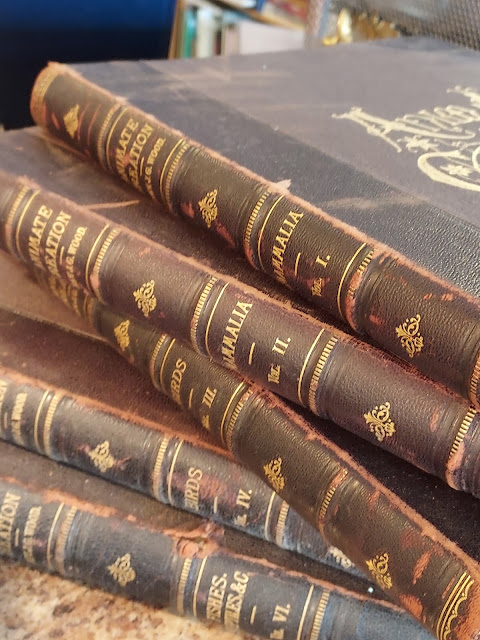
The e-reader is fragile in another way that the book is not. Accessibility to electric power, battery life, and the general fatigue that overtakes computerized parts all make the e-reader more fragile than the bound, printed volume. How many laptops have you gone through in the past 30 years? But do you have a paperback book from college days in the Sixties? I do – and it still “works” perfectly, as do these volumes from the late nineteenth century.


These have endured.

Taleb received a letter from a historian Paul Doolan in Zurich, asking how young people could be taught skills for the 21stcentury, since we have no way of knowing what skills will be needed. Taleb’s perhaps surprising answer (perhaps not, if you’ve been reading his work) is to have those young people read the classics. This is where the sentence appears: “The future is in the past.” 


We cannot return to the past, and few of us would choose to do so. The wisdom of the past, however, the accumulated knowledge of our culture is the legacy to us of all who have lived before, and we can avoid many errors by learning what hasn’t worked out well for our human ancestors. 


What is success, for an individual, a corporation, or a culture? Taleb tells us the most important factor is the avoidance of unsurvivable error or the unforeseeable, rare but unsurvivable event. Mere survival does not insure success, but there is no success without survival, so it is crucial to avoid that fatal misstep.


We cannot learn from what has not (yet) happened or what might happen, only from what has happened.


History: Learn from it.