Search This Blog

Showing posts with label Cervantes. Show all posts

Monday, October 30, 2017

How Many Pages Are Too Many?


Midnight’s Children, by Salman Rushdie, was a difficult book for me. My problem was not the exotic locale or unfamiliar names but the kind of story-telling employed.

If I cannot help comparing Rushdie’s Midnight’s Children to Vikram Seth’s A Suitable Boy, that’s only in part because both novels are set in India and focus on the time of the country’s independence. Other similarities lie in the novels’ daunting number of pages and a stunning number of characters and settings. In the end, however (and “in the end” here can be taken literally as well as figuratively), although Rushdie’s novel was less than half as long as Seth’s, with Midnight’s Children I kept looking to see how far along I was in the book—not halfway yet! now at the halfway mark! still, how slowly it goes!—and over and over again I set it down and picked up something less demanding for the remainder of the evening, returning to Rushdie the next morning with a sigh and a sense of determination.

In other words, this reading experience was completely different from my happy immersion in A Suitable Boy, a book that captured me on the first page and held me in its steady thrall, although it took me nearly a month to get through its 1400 or so pages. I’ll go so far as to say the length was essential to the spell it cast, because I lived in that book for the time I was reading it.

The truth (about me) is that in film, on the stage, and in the pages of fiction, I gravitate towards the various forms of realism. Material may be romantic, comedic, serious, or tragic, as long as its fictional world is coherent with reality as I know it. By the same token, the further the story moves away from a plausible (if new-to-me) reality, the higher my resistance, which I think is why most works of science fiction and fantasy fail to hold my attention. I tried and tried, for instance, to read The Hobbit, for my son’s sake (at a certain age, it was his favorite book), but while my eyes went dutifully over the book’s lines of type, my mind kept wandering. I never did get very far with it. Station Eleven, on the other hand—yeah, I could see that happening.

The way I see it, at least in Midnight’s Children (I confess to never having tried The Satanic Verses), Rushie is not a modern realistic novelist at all but a fabulist. In addition, he has quite a bit of the early teen bad-boy, Almodovár-like scatalogist in his sensibility, and for me a little of that goes a long way. All of which is to explain why it was that I did not really “get into” Midnight’s Children, a 533-page book in Penguin paperback, until I’d read over 300 pages.

But I did, finally, enter into the fable, falling in with the narrator’s pretense that his own life and its events, from his birth in the same moment as that of India’s independence, were tied to Indian politics and, in fact, brought about the events that befell the country, its leaders, and everyone whose life he touched, which was, of course, everyone! Yes, it’s a lot to swallow! Now imagine (if you haven’t read the book) swallowing not only that basic premise but a world-flood of details large and small, reminders and repetitions, revelations of what has not yet been and will not for sometimes many pages ultimately be revealed (in its own good time and in all its detail), and perhaps you begin to see the challenge a reader is given to get through this book.

I’m glad that I read Midnight’s Children, and I really enjoyed the last 150 pages. Things went better for me then because I at last stopped struggling against where the author was trying to take me.

I’ve always thought it was unfair to criticize an author for not writing a different book than the one he or she wrote. The question to be asked, rather, in this case of Rushdie, is whether or not he succeeded in the task he set himself, and as I closed the book on the last page I thought that he had.

In a way, I thought, as I was finally starting to enjoy the story, Midnight’s Children is reminiscent of Don Quixote. Rushdie, like Cervantes, asks us to believe unbelievable events, and both writers drag readers through numerous passages detailing excretory functions and unlikely mishaps to body parts. I also remember a member of our reading circle saying that she would have liked Don Quixote twice as much if it had been only half as long.

Would I have had a more positive impression of Midnight’s Children had it been only 300 pages long? I don’t think so. Since it took me over that many pages to enter the author’s world, I would have finished a shorter version more quickly but probably have closed the book shaking my head and dismissing the work as sophomoric.

N.B. What I have written today is not a book review! It is not a critical analysis! You might call it a literary confession. But most of us as readers, I think, have personal limitations that affect our reading—style prejudices, genre preferences, interest or lack or interest in certain topics, etc. I’m not talking only about “comfort zones,” but that’s part of it, I guess. Whatever you want to call my resistance in this case, I feel that pushing myself to read Midnight’s Children was the right thing for me to do, and reading all the way to the last page was, for me, its own reward.


Wednesday, June 3, 2015

What is "Unreachable"?


Our intrepid “Ulysses” reading group met three times to discuss the classic novel Don Quixote, by Miguel de Cervantes. We read Edith Grossman’s recent and highly readable translation. Opinions on the work varied, but we were all glad we had made the glorious effort to reach that star of sixteenth/seventeenth-century Spain.

Don Quixote did not make its author rich. He was buried in an unmarked grave after a life of military service, injury and disability, years of imprisonment and slavery, extreme poverty, and a childless marriage. But he wrote Don Quixote, a work still read over 400 years later. Little satisfaction to him that people in the 21st century, all over the world, are reading and laughing and being moved to tears by the tale, but, as we say in our house, “He got his work done. He paid his rent in the universe.”

On the morning after our final DQ discussion meeting, I came to the last page of a much duller book, Beyond Life, by James Branch Cabell, a strange story – more lecture, or at least essay, than story – in which one “character” (Bartleby identifies “Charteris” as the author’s alter ego) supposedly talks all night long to a friend who has dropped in to sit by his fireside. When morning comes, the talker is dismayed to realize that his listener has missed the entire point: the listener thinks Charteris has been talking about how to write books, when all the while his real point was about life itself. Charteris evinces, if you accept his point of view a thoroughly gloomy assessment of life. All of us, beggar and pharaoh, are doomed to dust and oblivion. Nothing will last. Thus, life is pointless. All our strivings, even all our achievements. Pointless. Since life is pointless, however, we need a vision of life where what we do makes sense, where our lives take on purpose, where the “glorious quest” does have some point. This vision is the Romantic, and Charteris finds it not only in literature but also in religion.

Chivalry (to return to Don Quixote) was nothing if not romantic. Many claim that romantic love was first conceptualized – even that it first began – with the courtly love of the Middle Ages. Certainly in the novel it is clear that Don Quixote has invented Dulcinea. Don Quixote’s devotion to his ideal woman was founded on nothing more than his imagination but gave him the necessary motivation to seek adventures and strive to be, himself, a hero for the ages. In the end, he regains his senses and dies sane, Dulcinea dropping out of the picture completely. Is all romantic love and all striving to make the world better nothing more than self-deception? Is this the message we are to take away from Cervantes?

I was once accused, by a thorough-going skeptic, of “romanticizing my life.” My country life, my old farmhouse, my romantic partner of decades (the love of my life), my dream-come-true bookstore – all of it, the skeptic suggested, was nothing more than a run-of-the-mill existence. Perhaps he even saw it as somewhat shabby. James Branch Cabell, a.k.a. Charteris, would certainly see it as pointless. My reply was that I had (and have) nothing to gain by giving up my romanticism. Why would I want to look objectively and cold-bloodedly on my one unique passage through what others choose to see as a “vale of tears”?

There were years, decades ago, when I despaired of making my dreams come true. Poorer then than now, locked (or so it seemed) into a series of confining and unsatisfying jobs that had nothing to do with the potential I felt within myself, dissatisfaction making cruel inroads into the thrills of romance – those were difficult times. I could not then imagine the life that lay ahead of me: happy marriage, doctoral degree, literary life, country home. What seemed impossible came to pass – certainly not without effort, but then, Don Quixote did not sit home and wait for adventures to come to him, either.

The thing is, if my romanticism is madness (as I put it to the skeptic), what have I to gain by sanity? I still have unrealized dreams – literary and pastoral -- and am still reaching for them. “Crazy, he calls me. Sure, I’m crazy.” What else would you have me be?


But now I come back again to Don Quixote and Cervantes, the author of the famous knight-errant’s being. Don Quixote, dies “sane” at the end after his long madness, renouncing chivalry and its impossible, bookish ideals. It would hardly be surprising if Cervantes underwent a similar change of heart. After all, what did he get for his life of service to king and country?

Ah, but there is his glorious book! There is that wonderful figure of a skinny, aging, deluded seeker of not only fame and glory but also just causes and victory over cruelty and evil. A man with a noble quest!

Cervantes knew whereof he wrote. What Don Quixote suffers in the legend, Cervantes suffered in life, and yet he managed (pace Vladimir Nabokov, who was as squeamish and offended by the novel’s violence as a Puritan would be over modern passages of sexual content in literature) to make an amusing and entertaining tale of it all. More importantly, we do not simply laugh at the deluded would-be knight. We admire him. He lifts our spirits. Cervantes may have been laid to rest feeling his life had been wasted, and that would be sadder than the fictional knight’s return to sanity, because Cervantes was, after all, a real man, but from our point of view he did not waste his time on earth at all. He bequeathed to the entire world Don Quixote, a gentle, noble soul, and thus he more than paid his rent in the universe.

I am thinking about Cervantes and his gentle knight and remembering a teacher of philosophy who spent his last days feeling he had wasted his life. Depressed in his final illness, he refused visitors and died, it would seem, an unhappy man. And yet his students, of whom he had hundreds over the years, adored him! He taught them how to think, how to question, how to value, and many looked back on their classes with him as the most important of their time spent in college.

Maybe it is not for anyone on earth to be the final judge of his or her own life. Surely religion would remind us that we are not to be. But even the nonreligious would perhaps do well to live as if their lives mattered, as if what they do made a difference in the world – because it just very well might, whether for one other person or for millions.  


Thursday, May 7, 2015

Intrepid We Are Still and Tilting at Windmills


In short, our gentleman became so caught up in reading that he spent his nights reading from dusk till dawn and his days reading from sunrise to sunset, and with too little sleep and too much reading his brains dried up, causing him to lose his mind. -      Miguel de Cervantes, Don Quixote
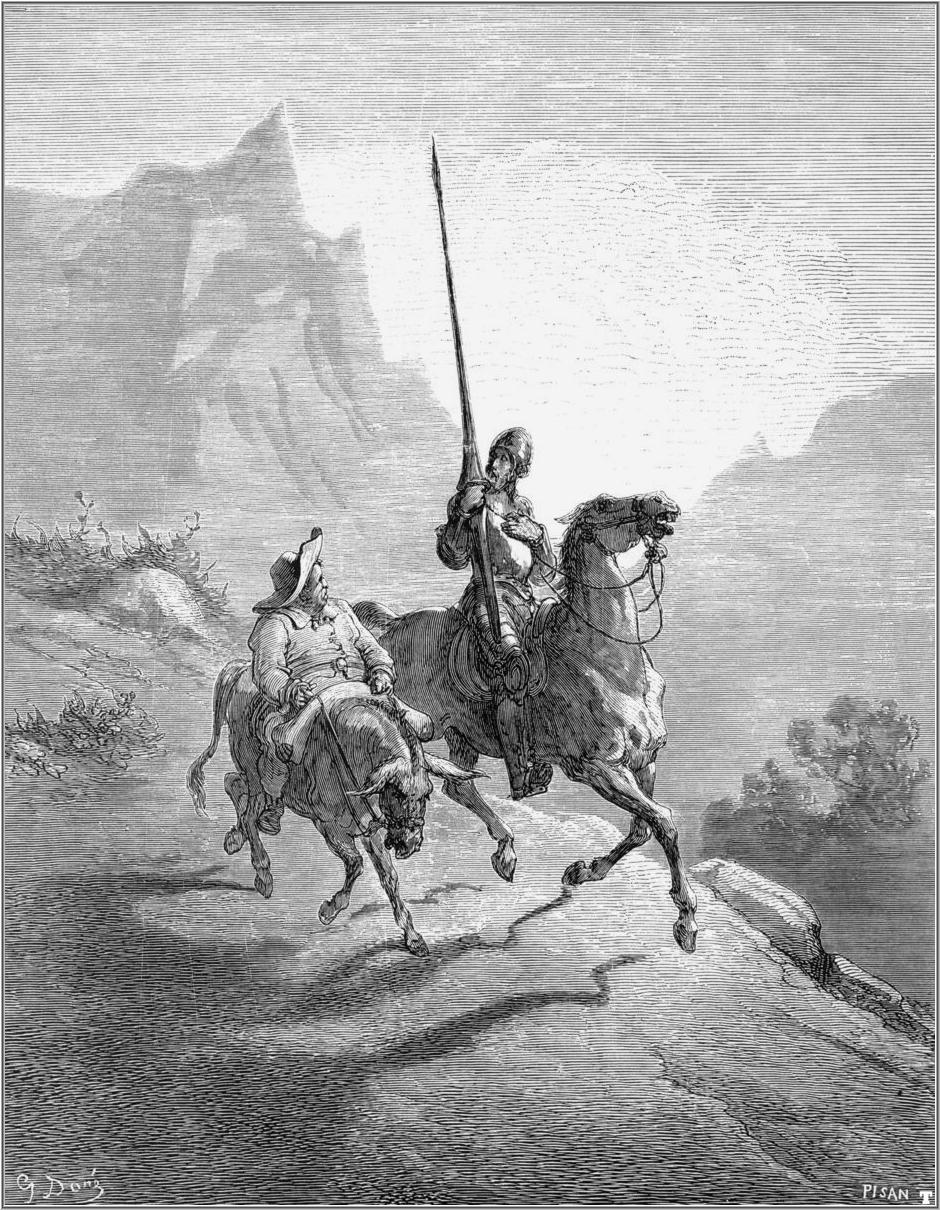
Our intrepid Ulysses group met at the home of our Fearless Leader the other evening for the first time this season to discuss the first 400 pages of Cervantes’ masterpiece. Our FL had persuaded us last winter that we could cover the work in only three sessions rather than four, biting off almost half at our first meeting, since “we’ll have all winter to read it.” Well, intrepid we may be, but most of us did not join Don Quixote and Sancho Panza for their adventures until well into April, and most found 400 pages daunting. The book is funny, pace a quick tempo, the many stories in it amusing – and yet, as one group member said, “there are too many words.” Too many pages. The writer rambled on and on far too long.

I defended Cervantes. He had, after all, written much of the book in prison, and what else did he have to do? Another group member strengthened the defense: Since another writer had published what purported to be a continuation of Don Quixote, the true author was no doubt at pains to bring his version to the public as expeditiously as possible, putting editing very low on his list of priorities.

This morning I’m rethinking the whole business of the book’s length. For those with leisure to read in the early seventeenth century, it is probable that no book could be too long. At this time in history, didn’t people pay “visits” to one another that lasted for months or even years? That, anyway, is something for me to ponder further; meanwhile, a couple group members have settled the question by giving themselves permission to read some bits and skip other bits. That way, they can enjoy the writing and the characters without turning the reading into a chore.
The truth is that when his mind was completely gone, he had the strangest thought any lunatic in the world ever had, which was that it seemed reasonable and necessary to him, both for the sake of his honor and as a service to the nation, to become a knight errant and travel the world with his armor and his horse to seek adventures and engage in everything he had read that knights errant engaged in, righting all manner of wrongs and, by seizing the opportunity and placing himself in danger and ending those wrongs, winning eternal renown and everlasting fame.
A word of truth from my own life: Until beginning the reading of this book (we are reading the Edith Grossman translation, by the way), my only acquaintance of the character of Don Quixote came from cartoon depictions, the phrase “tilting at windmills,” and that song “The Impossible Dream” from the musical version of the story, “Man of La Mancha.” And I never saw or heard or read the musical libretto, either, so my acquaintance of the stage character comes only from the song.

Thus I was taken aback by Don Quixote’s desire for fame, as if public acclaim were the only reason to go about righting wrongs. He has quite a temper, too. Even when not enraged, he can be surprisingly irritable. That is, I was surprised at this trait in his character. Sancho Panza’s motive is more common. He agrees to be the squire of the Knight of the Sorrowful Face in hopes of becoming wealthy, and he endures many beatings and other indignities with this end always in mind.

Sancho is not, however, a complete patsy. One of my favorite parts of the story so far came in Chapter XXV, where he protests against the embargo Don Quixote put on his speech. Deciding that the relationship had become more familiar than was proper, Don Quixote had forbidden Sancho to talk, and for a while the squire held his peace, but finally the restriction was too much for him.
“Señor Don Quixote, our grace should give me your blessing and let me leave, because now I want to go back to my house and my wife and children, for with them, at least, I’ll talk and speak all I want; your grace wanting me to go with you through these deserted places by day and by night without talking whenever I feel like it is like burying me alive....”
His master relents, and the two return to familiarity, shared delusion, and occasional verbal abuse of one another when things go wrong.

One important feature of this work of literature is its stories-within-stories structure. The main narrative tells the adventures of Don Quixote and Sancho Panza, but other characters they encounter along the way have stories of their own to tell, and the main narrative is set aside time after time, often for several chapters, while a secondary character’s story is recounted. At first it seems that both the adventures and the secondary stories will simply follow one another in an endless, unrelated series. Mercifully, such is not the case. Characters from earlier adventures and stories reappear in later chapters, joining the main narrative as the two adventurers collect more and more fellow travelers. Fellow travelers but not fellow believers. Except for Sancho, the others are so far from buying into the knight’s vision that they have plotted together to return him safely home.

And there we left them last night, with a little over half the book to read and two more meetings in which to discuss the story, the author, and how to read this work and others.

David and I watched a documentary recently about a man attempting to right what he saw as the world’s most dangerous wrong. “The Island President” is a movie I recommend, both for its central figure and for the fight he waged. P.S. 5/9: At the end of the movie, we learn that the president resigned. I wanted to know what he did and what happened to him after his presidency, and here is the answer I found. 

I’m not nearly as convinced by the Texas blogger who claims that her cause is the defense of free speech. From what little I’ve heard of the story, her way of mounting a “defense” was clearly inflammatory. Was it also a bid for public attention, attention more for her than for her avowed cause? I’ll have to look into this further, but right now I’m just sorry that lives were put at risk and that simple respect and good manners have come to be seen by too many around the world as enemies of free speech. It doesn’t have to be this way. That I truly believe.

At the same time, it's spring, and the woodland wildflowers are in bloom, and they are beautiful. But can I help it if reading Don Quixote has influenced even how I see the flowers?