Search This Blog

Showing posts with label singing. Show all posts

Thursday, May 5, 2022

My Own Personal “Song of the Open Road”

A windy day in New Mexico

One of my Arizona neighbors suggested that I could listen to podcasts and/or audiobooks all the way across the country. I told her I usually have the radio off on long trips, but that sometimes I sing as I drive along. One of the songs from “The King and I” was in my head all across New Mexico, finally ceding place to an old pop song or two. And then came “The Red, Red Robin,” which I like to perform (mostly to myself, in solitude) in a slow, plaintive, bluesy rendition. Often, though, the songs were playing only in my head, over and over, and anyone seeing me at the wheel would have noted nothing more than silent stoicism or perhaps a few escaping tears, because everything the Artist and I had seen before triggered memories, and I missed him every minute, every mile. This trip was, for me, a kind of pilgrimage but not to one particular destination: the entire length of the journey was its point.

Sunny was seeing this picturesque ruin for the first time.

Vaughn, NM: Position still not filled? I could do that!

My route on Day One took me east on I-10 from Willcox to Las Cruces, 70 through the San Augustin Pass to Alamagordo, and then U.S. 54 to Tularosa and on to Santa Rosa, New Mexico. The stretch from Tularosa to Santa Rosa became a favorite road for the Artist and me, starting with the first time we traveled it (top photo of this post is from that stretch), and since Santa Rosa was also a favorite New Mexico town, it made sense to stop there for my first night.


Evening in beautiful Santa Rosa, NM


Little Sunny Juliet and I covered over 450 miles that first day and 515 miles the second day, finishing up Day Two with a visit to a big, beautiful dog park in Winfield, Kansas. 


And if the name “Kansas” brings to your mind a flat, empty, boring landscape, you don’t know Kansas at all. I left U.S. 54 at Meade and dropped down to U.S. 160, a very narrow two-lane road but very light on traffic and heavy on gorgeous scenery. Often the road ran straight ahead of me to the distant horizon, but it had many deep, rolling dips and rises that it reminded me of ribbon taffy. The vistas off to either side were monumental and breathtaking, too; unfortunately, without any road shoulder, pulling off to photograph the land was close to impossible. Just think for a moment about all the hill regions of Kansas: Red Hills, Flint Hills, Sand Hills, Gypsum Hills – and those are only the ones I know. There are more.


The morning of Day Three began well – but then! – well --! 


Getting a tow

At Duke's Alignment & Tire, Winfield, KS


Well, the good news was that (1) I carry AAA road service; (2) I was still in Winfield, a town large enough to have towing and tire services; and (3) though I had bought four new tires in Arizona before leaving (and was not happy to have ruined one of them so soon!), I had also given car room to one of the old tires so I would have a real spare in case I needed it. So while I lost three hours of travel time that morning, the situation could have been much, much worse, and I was grateful to Cole, the young guy who handle the big towing rig so easily, and to Duke, the guy who got me in and out with my spare mounted as quickly as he could. And as I've said, Sunny and I had visited a fabulous dog park in Winfield on Monday evening, and we made it there again before the tire incident, so we were pretty well pleased with Winfield overall, and I had no regrets about my chosen route.


Winfield was very, very good to us.


Tuesday afternoon did not see us covering us a lot of ground, either, what with construction stops and detours, but this is how it goes sometimes on the road, and once I gave up the idea of making any kind of distance record for the day, I found myself stopping over and over with my camera. Because, why not? (And bear in mind that the photographs I take with my camera are only a small fraction of the ones I see to be taken but drive right by.) For instance, when I stopped to text my sister that I was finally in Moline, Kansas, she texted back that the oldest swinging suspension bridge in the country was there. I looked up and saw a sign on the other side of the road directing me down a side street to the bridge, and here it is. The road itself was originally a Cherokee trail. It seemed well worth the time to make that little detour.


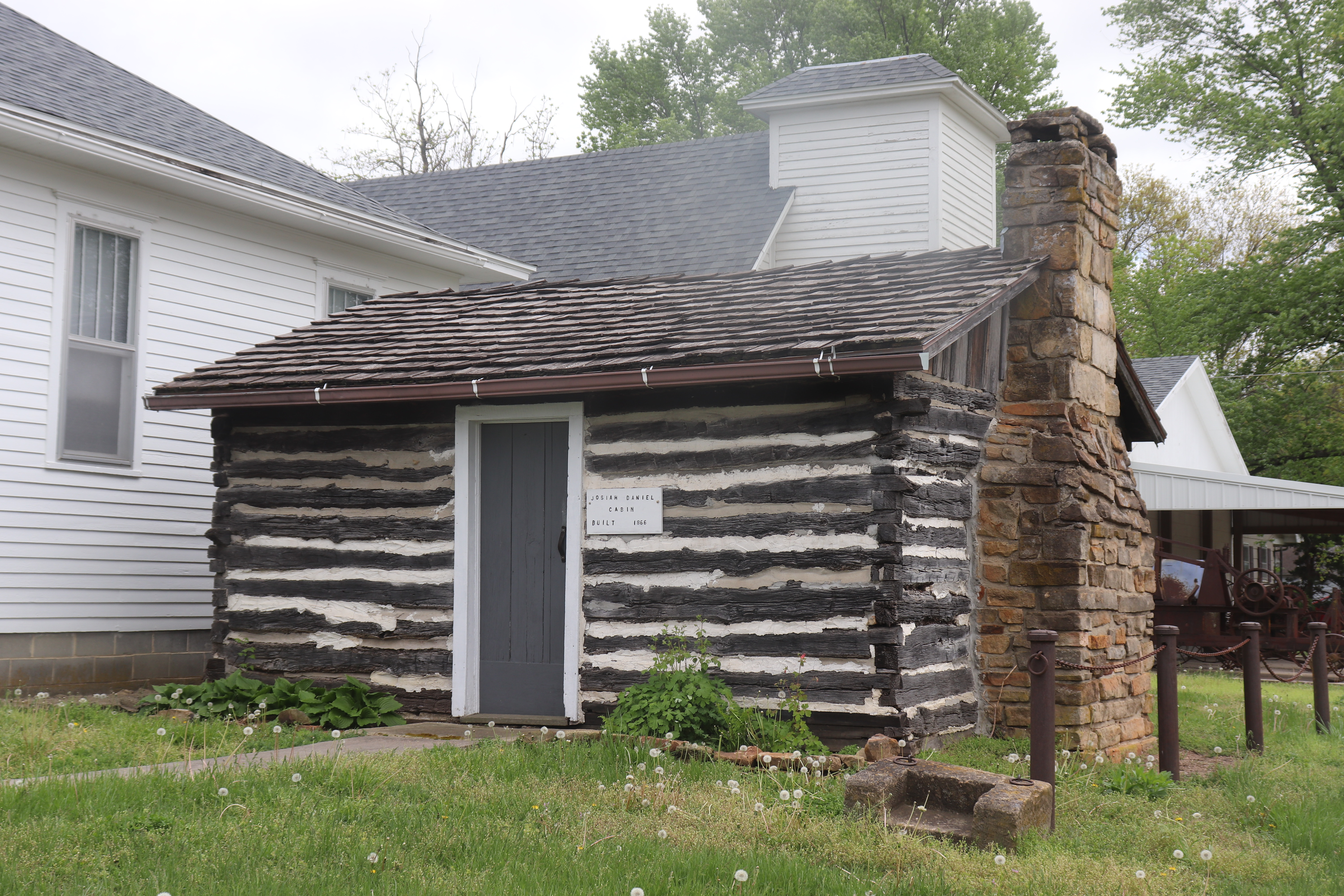
What town was I passing through when this cabin caught my eye? Surely I made a note of it in my road atlas....


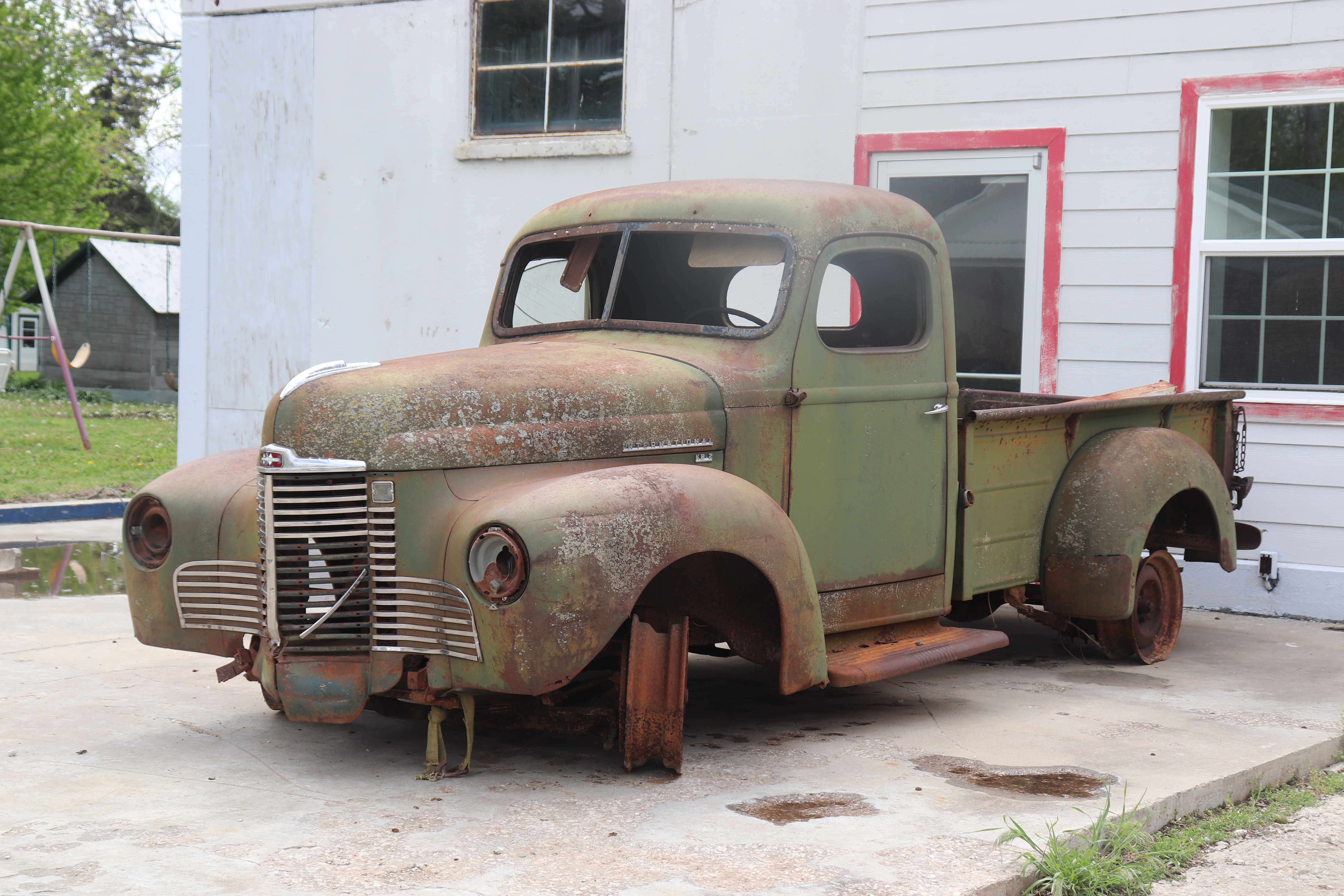
Right across the street from the old log cabin was this very photogenic old truck. 


And who wouldn't have stopped for a picture like this?


Eventually, of course, despite the tire problem, road construction stops, detours, and numerous photo opps, the puppy and I made our way across Kansas to and across Missouri. Redbud trees in bloom against spectacular rocky road cuts, and U.S. 54 rolled for many miles as a limited access in Missouri, divided highway rather than two-lane, making for easy cruising; however, I didn’t mind at all the twisting, curving two-lane stretches that preceded and followed the easier divided road. Day Four would be an easy distance: El Dorado Springs, Missouri to Springfield, Illinois, and so, reaching Louisiana, Missouri, by noon and knowing I was only about an hour and a half from Springfield, I decided to explore the town of Louisiana. I had an ulterior purpose. Because --.


The Artist and I crossed the Mississippi River together many times. We crossed often at St. Louis, which I always considered a “nightmare,” due to very heavy traffic and all the converging and intersecting expressways at that point, a true crossroads of a very busy country, all of whom seem to be on the move when you are threading your way through that maze. My preference was to cross at Hannibal. The river town famous as the birthplace of Samuel Clemens draws heavily on that history for its tourist business, but it’s still a small town, and the last time we came through there we explored around a bit and had lunch rather than simply rushing through.


Louisiana was a different story. 


The only time we crossed the Mississippi at Louisiana, Missouri, we were on our way east. I was at the wheel, and when I saw that very old, very narrow, old iron bridge ahead, all I could fixate on was getting safely across it! The Artist said, too late, that he would have liked to see something of the town. “Do you want me to go back?” “No, we’ll save it for another time.” But “another time” never came, and so this time I would see Louisiana for both of us.


…Comes into my mind now another song, “The Water Is Wide,” an old Celtic folk song. Ah, my love and I! Our love never waxed cold, never faded away....


What do I do in the car besides sing, silently or aloud? On this trip, I shed many tears. Not only for shared memories that are now mine alone, but for sights my love and I thought we would have time to see but never did see together. How he would have loved this river town, too! As my emotions ran a rollercoaster gamut, over and over, from excitement to pangs of grief, I kept turning corners in Louisiana, Missouri, and going around blocks and exploring farther and farther from my designated route, jumping out of the car over and over to photograph scenes I wanted so much to share with my beloved partner, the Artist. -- So many scenes that I am going to put them in a separate post and leave this one with an image of dogwood in blossom in the soft Illinois prairie rain. Good night for now.


Dogwood blossoming in the prairie rain....


Friday, January 22, 2016

On the World Stage, Opinions Are All Over the Map


Years ago I heard for the first time, so memorable it never afterward left me, on Interlochen Public Radio’s Saturday morning call-in request segment, the tenor and baritone duet from Bizet’s opera “Les pêcheurs de perles” (“The Pearl Fishers”). For only the second time in my life (the first was a violin piece by Paganini), music on the radio stopped me in my tracks so that I had to sit down and do nothing but listen, with tears in my eyes. I knew nothing of the opera’s story. Subsequently I borrowed a CD from the library with music from “The Pearl Fishers” and listened to it over and over. Of all the operas in the world, this is the one I most wanted to see and hear live.

The New York Metropolitan last staged “The Pearl Fishers” in 1906. Even before I had any idea it had been such a long time since they’d done it, when I heard that the Met was mounted a production this month, I had to see it. That dream made possible by the fact that the production would be available to patrons of the State Theatre in Traverse City through HD simulcast (as well as by a good friend who, unlike me, doesn’t mind ordering tickets online). Many people we know regularly attend the opera simulcasts at the State Theatre. It would be our first time David and I had gone.

Were my expectations impossibly high? Was disappointment inevitable?

Saturday became increasingly complicated. I had already planned to take care of fairly urgent banking business in Traverse City when David got word of a friend’s funeral to be held that morning in town. We drove in early, and I dropped him off at the church, going on to credit union and bank by myself. It was a snowy winter day.

On Division Street (U.S. 31 South) another driver insisted on following practically on my rear bumper. The highway was snow-covered and slippery. Apprehensively glancing between windshield view and rearview mirror, I missed my turn and had to circle around, crabbier by the minute.

Driving back into town along West Front Street, not far from my old (as in “long ago”) neighborhood, I thought about driving on snowy Traverse City streets back in 1970-71 and how much has changed since then, the “City” part of the town’s name much more appropriate now. And yet, back then all streets, sidewalks, and alleys, not only downtown but throughout residential neighborhoods, were plowed 24 hours a day, much to my initial astonishment that first winter. “I miss it the way it used to be,” a friend said to me last spring. Sometimes I do, too.

But heaven forbid that irritability should ruin a day so long anticipated! Back in the 1970s, after all, the struggling State Theatre had a very outdated sound system and didn’t show many movies I wanted to see. Once again, “Something’s lost, and something’s gained,” as Jonie Mitchell sang in “Both Sides Now.”

I was still nervous about picking David up at the church, getting downtown in time, parking the car, and meeting the friend who had booked our tickets, but all went well, and once we found our seats I could relax and look around in good spirits. So many friends in the audience! And soon we were transported to New York City (where the people in the audience at the Met looked pretty much the same as the one in Traverse City). David and I tried to think of people we knew in New York to look for them in the audience. Later I heard that one of the couples we’d thought of had been in the audience, though we couldn't spot them onscreen. The wife told me they found it “amazing.” Same here!

The opening sequence of the opera was a spectacular technical tour de force, lyrical and captivating, but I was impatient for the full stage and the appearance of the singers. For me, there were no disappointments.

I loved the opening set with rickety wooden seaside docks and pilings, the ensemble of singers (villagers from the little pearl-fishing community) and the way they moved onstage with the music, the colorful but down-to-earth costumes, the mix of traditional and modern elements that felt like such a realistic portrayal of life in that part of the world, but always – above everything else – the beautiful music and exquisite singing. Not for a single moment did I feel the slightest hint of tedium. The voices of tenor Matthew Polenzani and baritone Mariusz Kwiecien, singing Nadir and Zurga, seemed made for their lyrical duet, and soprano Diana Damrau’s delicate, soft seemingly effortless trills made me hold my breath. We were also impressed by Nicolas Testé and the way he inhabited the role of the high priest, Nourabad. Throughout, the music swept me up, held me, and carried me away. In fact, days later, the magic is still with me. A couple friends from our group spoke of similar responses.

So imagine my shock when I looked online for a review, in hopes of finding someone in the larger world who shared our delight, and found one of the most negative opera reviews I’ve ever read, in which the reviewer actually calls the production “tawdry”! He liked almost nothing, from the composer’s music to the work of the set designer. I could only imagine what terrible things must have been going on in his personal life. Another reviewer, the second I found, raved about the singing and acting and the sets (thank God!) but faulted the story of the opera for its thin plot and contrived ending.

Okay, I'll admit it straight out – I am a naive opera-goer. My parents’ love of opera failed to capture me at an early age. I’ve never studied the musical genre and have attended very few performances in my life. But others in our group of ten greatly surpass me in musical sophistication, and we all loved what we saw and heard, so I hardly think my enjoyment can be chalked up to nothing more than naiveté.


As for “contrived”? Opera is contrived! The artificiality of it is the main reason I was immune to its charm for so long! Accepting contrivance now as part of the package, why would I be disappointed in a thin plot or an unrealistic ending? It’s the music, the music, the music, the voices, the voices, the singing -- and I was enraptured by the music of these voices from start to finish.

Told the New York Times had a positive review, I went over to read it. Thank heavens! Someone who saw and heard the same opera that thrilled me!

I still feel sorry for that poor Spectator reviewer, for whatever prevented him from feeling the magic, and as for history’s opinion, cited by the Guardian, that the promise of this opera of Bizet is “unrealized,” I can only be grateful to the Met for ignoring history’s opinion and staging their triumphant production in spite of it.

Bravo, les artistes! Et merci mille fois mille fois!


Friday, December 13, 2013

To Rest or Not (Yet) to Rest?


On one's laurels, that is. The question does not admit of a universal answer. Everyone must come up with a personal response. There are different ways to ask the question, too. Perhaps, “Have I earned the right to ...?” or “Am I now comfortable with the decision to ...?” This post is about dreams, about making them come true, and about putting them back on the shelf.

Throughout my adolescence, I dreamed of a career on the stage. Sometimes I planned to become a serious actor, other times a folk singer or a blues singer, and occasionally I imagined myself combining singing and acting on the musical comedy stage. As a young girl, whenever I was alone I was almost never not singing. I would sing my way (very dramatically) down the sidewalks between my high school and downtown after my half-day finished up at 12:30 or so with orchestra practice, only closing my mouth when another pedestrian came within hearing range.

Because here’s the dirty little secret about dreams: They’re easy to have. They cost nothing and involve no risk of public exposure. Making dreams come true – daring to make dreams come true – ah, that’s another matter!

Well, eventually, butterflies in stomach and heart in mouth, I went public with the performance dream. My sister and I, she in her first year of high school when I was in my last, made a couple of appearances as a folk duo, granny dresses and all. I tried out for plays and landed parts. Then in my 20s, first with a jazz quartet and later with a honky-tonk piano player, I sang at parties and in clubs in Lansing, Traverse City, and Kalamazoo. There was never a time I wasn’t nervous beforehand, but as long as I didn’t have to talk to the audience (I’d warned my piano player ahead of time that he would have to provide all the patter) I got through those evenings just fine. Enjoyed them. Felt “in my element.” Where I belonged.

When I decided to take a break from performing, that’s really all I had in mind – a little break – but I never did go back. What surprised me in later years was that I had no regrets. The thing is, I had those gigs. Had I never gone public, only harbored a secret, unfulfilled dream, I’m sure I’d have regrets aplenty. But no. At this stage of life, I’m resting on my vocalist laurels, content with having, for a while, dared to make that dream come true.

Another dream took me away from the drudgery of office work and into another world altogether. I came to philosophy late in life but did not keep that dream hidden in a closet, either. It took years, but I finished my undergraduate and then my graduate degrees and subsequently taught part-time, off and on, at Northwestern Michigan College in Traverse City. College teaching was no more a lifetime career for me than singing, but I’m proud of having achieved at least a modest reality for that dream, and so yes, I rest on my teaching laurels, too.

Years ago, when we lived in Kalamazoo, David and I made regular weekend trips out to the nearby village of Paw Paw. From late spring to early fall, the flea markets were a main attraction, but we had friends in Paw Paw, we made many paddle and float trips down the little Paw Paw River, and always we dreamed of having a bookshop downtown. Paw Paw would be perfect, we told each other – less expensive rents than Kalamazoo but close enough to the city attract faculty and students from Western Michigan University and Kalamazoo College. Fast forward (through a long, winding, complicated history that has no place here) to 1993 and the birth of Dog Ears Books on Waukazoo Street in Northport. Another dream come true! A dream now in its twenty-first year of life (and don’t think that fact doesn’t still amaze me).

No independent bookseller, however, can afford to rest on her laurels and keep her business alive. Every year a bookseller learns many new things, and every year the business changes and there are more new things to be learned. Being the only bookstore in a small village is no guarantee of a local clientele, either, because it’s easy for people in cars to drive by the same businesses day after day without stopping. They need reasons to stop, reasons to visit, reasons to come back, and it’s up to the bookseller, i.e., the bookstore owner, to be constantly generating new reasons for people to come in.

This blog has more than one purpose. It’s a quiet little avenue of self-expression, a place for me to try out thoughts and ideas, as well as a bulletin board of sorts for local events and somewhat of an online diary, but it’s also an attempt to keep my little Up North bookstore from fading out of customers’ consciousness when they are elsewhere. Long ago someone said to me mournfully, “You just can’t compete with Borders, can you?” He didn’t get it. Borders was a chain, and Dog Ears Books was and is unique. That’s what I thought at the time, and then, when Borders stores closed all across the U.S., my first thought was, I’m still standing. I’m still here.

Life comes with no guarantees. Each of us, one by one, we make our choices, and we take our chances. We keep dreaming, keep learning, keep daring, keep moving -- or we’re not alive at all.

So when it comes to bookselling, I’m not resting on my laurels. Things are going to be quieter at the bookstore for a few months, that’s all. Glenn Wolff was our big December event star, and now we won’t be doing events until spring, but the bookstore will be open, five days a week through the end of the year, closed Sundays and Mondays. (In January we’ll decelerate, going on a four-day schedule, Wednesdays through Saturdays, 11 a.m. – 3 p.m.) And this blog will continue through the winter, too, wandering through book reviews, snowy dog walks in the woods, news from my authors and  reading groups and the art world and the local community and, well, whatever other camels get their noses under the tent.

Making a dream come true and then keeping it alive takes much more than simply “having” it. Actualizing and sustaining a dream takes continued attention and dedication. You have to want it, yes, but you have to do more than just want it. Cost can be measured in countless ways -- in hours of sleep lost, for instance.

It’s too soon to know if I’ll someday rest on my bookseller laurels (there is that chicken dream, after all) or simply die in harness. All I know right now is that the time of resting has not yet come.

For all of us, there are always more leaps off the cliff to be made, as long as life and health hold out, but it’s good to stop from time to time and pat ourselves on the back for what we’ve accomplished, too. What about you? What dreams are you proud of having dared to make true? Which ones are still going strong ones, and which have you retired, accepting for your accomplishment a laurel crown?


Tuesday, March 12, 2013

Do Not Mistake Me For Alan Arkin

Looking Back to Where I've Been

At five, acting was already a fever in my blood, and somehow I knew, even then, that the decision was made and there would be no turning back. ... I never changed my mind.- Alan Arkin, An Improvised Life: A Memoir
No one would mistake Alan Arkin for bookseller P. J. Grath! It's pretty unlikely, too, that anyone would take me for him, coming up to me at a restaurant and asking, “Mr. Arkin, may I have your autograph?” But I’m reading his memoir, An Improvised Life, struck by his deep insights about acting, and at the same time thinking about e-mails a friend and I have been exchanging, reminiscing about our respective high school years, I can’t help comparing Arkin’s lifelong obsession with acting to my youthful performance dreams.

For me, a long life on stage and on celluloid unrolled only in imagination. Clearly, then, my ambitions did not burn as brightly or as steadily as those of Alan Arkin (or Jodi Foster, Meryl Streep or Denzel Washington), but years ago, for quite a while, I was the female, teenaged Walter Mitty star of many exciting daydreams, enjoying in advance a fantasy future that I never, as it turned out, seriously pursued much past the age of eighteen. Who now would ever guess?

Piano lessons began for me at the age of five but lasted only a year. I could handle half an hour of practice a day, but when the teacher upped the ante to an hour I dug in my heels. My parents shrugged and decided I must not want to take lessons very badly. All my life I have wished that teacher and parents might have consulted me before that decision was made. Maybe the adults would have realized that 30 minutes a day for a six-year-old was plenty, or maybe we could have compromised on three-quarters of an hour. In any case, it didn’t happen. I was clearly not destined by Fate to be a pianist.

I had, however, a completely unfettered imagination, and whether on long vacation trips or simple errands near home, the car window was my proscenium window, through which I projected myself into complicated scenes unrolling in the passing landscape (cornfields or suburbs, mostly, with occasional railroad tracks), scenes that would have astonished my parents, blissfully ignorant up there in the front seat. At home, our big old backyard apple tree was sometimes a tropical island, sometimes a spaceship. I also practiced different expressions in the bathroom mirror, imagining myself in the wildest of situations. (Doesn't everyone?) And years before the term “Drama Queen” was in common use, my mother felt its need when confronted by my histrionics.

Fortunately for my mother’s sanity, the city school instrumental music program came to her rescue. In fourth grade came try-outs for band and orchestra, and I was selected to be a violinist, a path I followed for nine years, all the way through high school graduation.

Playing in a large junior high and then high school orchestra gave me experience in rigorous practice, group discipline, and individual effort, with the heady rewards of performance success. Our junior high band and orchestra made a once-in-a-lifetime journey by train to the National Music Festival in Enid, Oklahoma, living on our chartered train during the festival and coming home to be greeted by the high school band, in uniform, playing for us at the station. In high school there were numerous contests at the district, regional, and national levels, and one year a cultural exchange with a high school orchestra from Toronto, Ontario. The orchestra room, for me, was what the locker room must have been to the school jocks. We too worked hard and traveled to compete against other schools. In addition, we had the music. We made the music. It was thrilling. I belonged to something serious that was bigger than myself, something that drew me out of my books and imagination and forced me to deal the reality of other living, breathing humans.
For the most part I had become an actor so as to hide, to find my identity through pretending to be other people.
And yet, while I prepared for and competed in solo and ensemble contests, along with all the regular rehearsals and twice-yearly concerts, I never dreamed of becoming a career violinist. Carrying my violin case to and from school, I was a secret singer and actor living in the borrowed identity of an instrumentalist!

Here’s how it went my freshman year: the one public high school for the township shared its campus with the township junior college, and we baby boomers were practically bursting the seams of the beautiful old limestone block building. The swimming pool was converted to a classroom to house three homerooms, one of which was mine, and still there was not space enough for all of us. The solution was to put freshmen on half-days. The early part of the freshman alphabet began at 7:30 a.m., and when this group was dismissed at noon – no lunch on campus for freshmen – the latter half of the alphabet started its half-day. Overlapping the early and late halves of the day was the period and a half when band, orchestra, and choir met. So my French class started at 7:30 a.m., and when the rest of my morning group left school for the day I went to orchestra.

That year I had my first date with a boy who drove a car, so that we did not have to be driven on the date by his mother or father. I think he was a junior., but it was not a long, memorable romance. The one evening stands out in my memory not for the boy but for the occasion: he took me to the senior class play, “The Curious Savage,” the first live stage play I’d ever seen. I was completely stage-struck! As the audience flowed out after the final applause, I was rooted to the spot, still staring at the now-empty stage, where a new world had opened to me. I had no desire to leave that scene of magic.

Another highlight was the annual “operetta,” as we called it. My freshman year the operetta was “Showboat,” and playing in the pit orchestra, in an old-fashioned, honest-to-God orchestra pit in front of and below the stage, added fuel to my performance dreams. Singing and acting! That was the ticket! Shows in succeeding years were exciting, but nothing surpassed or even equaled “Showboat” in the thrilling impression it left.

When our orchestra prepared for a concert, the woodwind, brass, and percussion sections were augmented by instrumentalists borrowed from the band, but the line between those who sang and those who played instruments was a border never crossed. Since all three music groups practiced during the same hour and a half, students had to choose. Choir members could not be part of band or orchestra, and students who played in one of the instrumental groups could not join the choir. As an orchestra member, therefore, I was not eligible to try out for a singing role in the annual musical stage production, but that was no barrier at all to my fantasy life.

Leaving school after orchestra, the morning students long gone and the afternoon students already deep into their second hour of class, I was not part of a rowdy mass exodus (my best friend and neighbor went to school in the afternoon) and enjoyed a solitary daily walk through what I remember as mostly a warehouse and small manufacturing district, under the railroad viaduct, and through downtown to catch the city bus that would take me out to home on the edge of town. On these long walks I would sing aloud with great dramatic abandon, falling silent only on the rare occasion that I noticed another pedestrian within hearing distance. Downtown and on the bus, I would again fall silent, but once out on the edge of town, walking from the bus stop to our house on the last street before fields of corn and alfalfa began, my voice would soar again. Hymns, popular songs, musical comedy, my own improvisations on childhood themes – I was not quietly humming to myself but giving my all to an invisible audience. How amazed and astounded my schoolmates would have been to see and hear me in what I took to be my true identity! In my memories of these musical walks, it is always spring. “It Might As Well Be Spring,” in fact, was one of my favorite songs, but there were hundreds of others. “Summertime” was another.

By my senior year, popular music on radio was well into the folk music revival. Somehow I got my hands on an inexpensive acoustic guitar and learned a few chords, and somewhere my sister and I found cheap, full-length “granny” dresses in bright cotton prints. My sister did not share my devotion to Joan Baez (“Someone dies in every one of those songs!” she pointed out with a meaningful look), but we had been singing together in the kitchen, in the car on vacations, and in church choir all our lives, and now that she was a freshman we were in high school together, so we worked up an act for the school talent show and subsequently took it “on the road” to a hootenanny at the Catholic high school in a nearby town. In the summer we hit the beaches of Lake Michigan with mournful Appalachian tunes. I dreamed of a recording career, spending unbelievable amounts of time mentally writing and rewriting liner notes for the albums of my future work.
[As a member of a group of folk singers,] in my naïveté I thought singing . . . would be an entrée into the theatre. But of course no such thing happened.
An English teacher had encouraged me to try out for one-act plays in my sophomore year, and the apex of my high school career was a role in “Camino Real,” by Tennessee Williams, a play we took up through district and regional levels to win first place at the state level. Illinois! And we were not even a Chicago school! We were crazy with disbelief and drunken joy, and nothing in my life up to then compared to the intoxication of being part of that ensemble and that triumph. It was an experience that solidified my longing for the stage.

I sent away to New York for brochures from the American Academy of Dramatic Arts, but when they arrived my mother put her foot down. No acting school – out of the question – I would go to university or nowhere. So I went dutifully to university, my dreams still secretly intact, where I joined the University Chorus and signed up for a class in voice and articulation. A major in “speech education” let me take classes in acting and other aspects of stagecraft.

. . . Ah, but then I married early, dropped in and out of college, had a baby, and the years began speeding by. I did a couple stints singing with bands and a little community theatre when my son was small. . . . Went back to school and studied drama for a while (my son helped me learn lines and was stage-struck in his turn by his first experience of live theatre) but then was seduced by philosophy. . . . Now, all these years later, I cannot even bring myself to commit to a community choir and never consider trying out for community plays. It is no longer part of my life.

For me, then, performance turned out to be the road not taken. So Alan Arkin and I don’t have all that much in common, do we? And here my little story sputters and coughs and loses momentum and grinds to a limping halt. . . .

And yet, and yet.... Does any passionately imagined dream ever die completely? (Ask Walter Mitty!) There is enough of mine left that I read books like Arkin’s hungrily, gleaning insights very meaningful to my undeveloped actor’s heart. “And who knows?” I say to David. “Someday I could be the Grandma Moses of American cinema!” Bless his heart, he thinks I could, too! But no, it's more likely those old melodies will find their way into my writing.

(“What are you doing?” David calls from the living room. “Reading Alan Arkin. I love Alan Arkin!” “I like him a lot, too,” David answers, adding, “We should have him over sometime.”)

It always amazes me that some people can know from childhood or even figure out in high school or by their college years what they want to do for the whole rest of their lives. I can trace easily in retrospect the path that led me to becoming a bookseller, but it isn’t a destination I saw far in advance. Writing – in my case, far less than a career but much, much more than a hobby -- is the only thing I’ve always done and still do that means the world to me.

How is it with other people? When you were five years old, what future did you imagine for yourself? Did other dream careers come along later? Are you living your dream? If not, is that all right? Maybe better than what you dreamed?