Search This Blog

Showing posts with label self-publishing. Show all posts

Tuesday, June 2, 2015

Miscellany: Poetry in the Mail, Workshop Offering, and Back to the Movies


Mystery Poet Strikes Again – and Again!

When the post office started cracking down on mail addressed incorrectly, I feared I would never again receive a missive from the mystery poet. After all, he (I’m guessing at the gender) always used the street address of the bookstore, rather than the post office box number, and he never uses a return address, so it the mail did not get delivered to me, how would he even know? Well, somehow he figured it out. And I’m guessing he’s a regular reader of “Books in Northport,” too, or how would he have known to send mail in the winter using an old Gadsden Purchase stamp? The friend picking up our mail in Northport got that one to me in southern Arizona. Nice surprise! The second arrived in late May.

These two poems are similar in length and subject matter. Here they are:


Thank you, mystery poet.

Will My Workshop Be a “Go”?

In graduate philosophy classes, we students ran into one philosopher after another who claimed to be going back, for a fresh starting point, to self-evident truths, and we often commented to each other that it wasn’t always evident what was self-evident. This observation extends beyond philosophy. What’s “obvious" to one person isn’t necessarily obvious to another, so when it comes to being “clueless,” about whatever the topic may be, we who are clueless haven’t a clue that we are so. And it’s a cinch that every single one of us has some area of cluelessness. (What’s mine? You tell me!)

Most recently I’ve been mulling over, yet again, the business of self-publishing. It’s so “easy” to do these days. That is, it’s easy to pay someone to print and bind your words and sentences and paragraphs into a book. Then what? My message is this: Self-publishing is publishing. Publishing is a business. The decision to self-publish is a decision to go into business. Are you ready?

Because the decision is not one to make lightly or impulsively or without information, I developed a hands-on, practical workshop, which will be offered for the first time on June 10 through Continuing Education at Northwestern Michigan College in Traverse City. “Is Self-Publishing for You? A Bookseller’s Perspective,” EECO 341, will bring to those who enroll my 20 years of practical experience in the form of short written exercises, class discussion, and Q&A. The workshop will meet for one evening only, from 6 to 9 p.m. – That’s if (and only if) enough people sign up.

The need exists. I have seen it again and again. Tell your friends.

Back to Willcox Once More


I found my little brochure with the map of the historic downtown, so now I can tell you the name of the street at the beginning of the car-train sequence in “Red Rock West.” It’s Stewart Street. Nicholas Cage is driving east (west is at the top of the map) on Stewart Street, and we see his car at the intersection of Stewart Street and Railroad Avenue. He goes straight, toward the tracks. A train is speeding toward the intersection from the south (right end of the map). Cage swerves at the last minute, and his car runs along parallel to the tracks, at last overtaking the train and jumping the tracks in front of the train where Maley Street crosses the tracks. Look quickly at this point of the movie sequence, and you’ll see the sign for the feed store. That’s Maid-Rite Feeds, Willcox, Arizona. Yep, we were there.


Thursday, May 28, 2015

Is Self-Publishing For You? Sign up for my NMC workshop and find out


EECO 341: Get introduced to the challenging experience of selling a self-published book to bookstore owners and managers. Through a series of hands-on writing exercises and group discussion led by Pamela Grath, an independent bookstore owner, you’ll explore the complex business venture of self-publishing and decide it it’s the right course for you to pursue. Arm yourself with a real-world experience perspective and be much better prepared for what lies ahead if you decide to move forward with self-publishing.

If you're considering the question, you can't afford not to explore further.

To enroll, go to NMC’s continuing education classes for spring. The workshop is scheduled for June 10, 6 to 9 p.m., at the University Center in Traverse City. 

Cost is $45.


Monday, May 11, 2015

Read This Book!


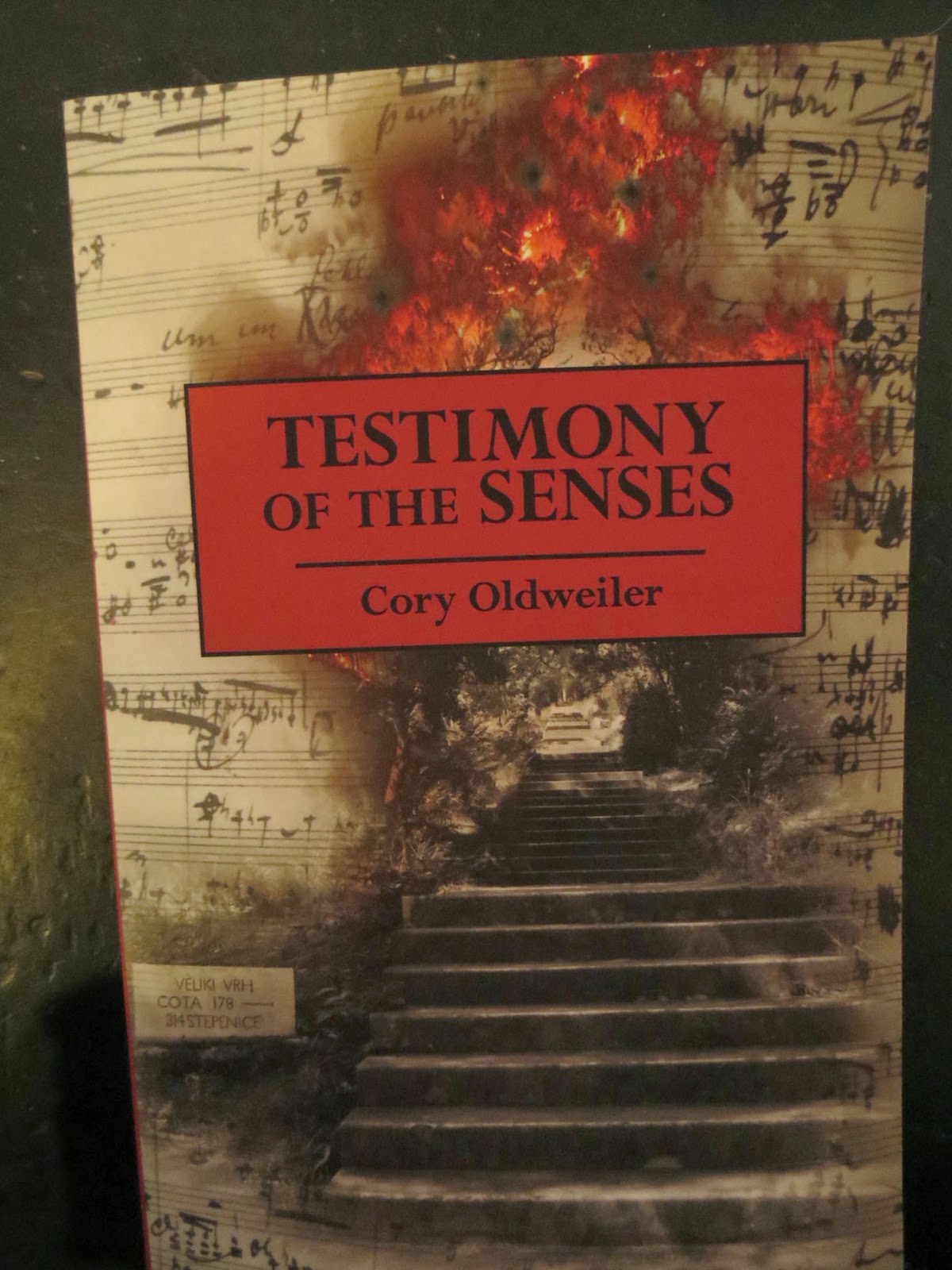
Cory Oldweiler of Leland, Michigan, has written and self-published a magnificent debut novel. (He also designed the striking book cover.) Beautifully and powerfully written, this tragic story of a young man’s search for truth and for a place in the world is compelling and transporting.

The novel begins with the first-person narrator near the end of his story, looking back over the path that led him to the cafe in Croatia where he is searching both paper maps and his own memory. As he recalls images from the past, he tells us that his entire life’s structure was prefigured years before his birth in Gustav Mahler’s Symphony No. 7 in E Minor, and so the symphony provides the novel’s structure, beginning with the Adagio of earliest memories and proceeding to the Rondo-Finale at an allegro tempo accelerating mercilessly in the book’s last pages.

Emilio is an only child who grew up in a neighborhood of Italian immigrants in Corona, Queens, New York. Told from earliest childhood that his father was killed by a hit-and-run driver five months before his own birth, Emilo -- later to become Milo and eventually Miles -- made no close friends during his years in school. He and his mother had an apartment, but it was more dormitory than home, while his paternal grandparents’ bakery and their apartment upstairs formed the early emotional limits of the boy’s fatherless world.
For the first six and a half years of my life, Mamma and I were never physically far apart. Most mornings began before dawn when she would gently shake awake Caro Emilio, mio carino and moments later carry him (me), still benighted, somewhere between swaddled and smothered in nightshirt and sweatpants, feet stuck hastily into socks and boots, down the stairs and out onto the still slumbering streets. Once outside she would set me down and, in a somnolent haze huddled beneath the folds of her heavy woolen cloak, one arm wrapped tightly around her leg, I would blindly make the four-block walk to Due G’s, the bakery....
While helping out in the bakery, Milo makes the acquaintance of Jerzi, an older man, a symphony violinist with a passion for opera. For a time Jerzi becomes for the boy a strong and important father figure and dispenser of wisdom. It is Jerzi who introduces Milo to the language of music, where notes can name feelings too deep for words. But eventually Milo discovers Jerzi in a series of falsehoods he cannot forgive.

Following what he perceives as a terrible betrayal by his mentor, on his seventeenth birthday Milo learns that his father is alive. He was not killed: that was all a lie, too. With the shock of discovering he has been deceived by everyone he trusted, Milo erupts in rage. His rage propels him out into the world, first as an aimless and desperate runaway and later on a somewhat random, haphazard but very emotionally focused search for the runaway father who abandoned him before he was born.

The author’s knowledge and deep love of music permeates Testimony of the Senses. Another kind of structure is provided by classic literature, specifically Ovid’s Metamorphoses, when the narrator discovers a two-volume bilingual Loeb Classics edition that had accompanied his father to the battlefields of Europe. The father, Carlo, was seventeen when a member of the U.S. 163rd Signal Photographic Corps during the Second World War, and he tucked into the pages of Ovid a series of photographs bearing written descriptions testifying to the horrors of war.
Most of the notes are inscribed on the backs of photos, mainly black-and-white four-by-fives taken with his Speed Graphic, although several smaller prints made with another camera or taken by another photographer are included as well. The pictures are filed throughout the compact hardcovers, whose pages are not much larger than the photos themselves, usually at specific spots that Carlo felt were relevant to what he wanted to say, either in his shot or in his words or in the combination of the two. The volumes are robust and, despite the added thickness, only bulge slightly, as if they have adapted to the task of telling Carlo’s tale. 
There is also a neatly pressed dead lizard midway through Book V, where various words are covered with what, to my untrained eye, appears to be blood....
By coming to know the photographer’s point of view through the photographs and notations and passages from Ovid, Milo learns to recognize his father’s continuing journalistic work in contemporary newspaper stories that provide clues to where in the world his father might be found.

No synopsis or selection of excerpts can ever do complete justice to a book, but I feel the inadequacy more than ever in the case of this stunning novel. It is original and erudite and at the same time lyrical and passionate. Strong background in music history or opera or Latin classics will add layers of appreciation, but readers with none of that background will still be spellbound by the characters and their stories.

All I really want to say is – Buy it! Read it! Then tell me if you think I have praised it too highly. I’ll be amazed if anyone does.


Thursday, September 18, 2014

Book Review: FROZEN MOON


My previous post focused on perils faced by booksellers if they open the door indiscriminately to self-published books. It is only fitting that I now introduce a recent outstanding exception that came my way. My mini-review (250 words) of Frozen Moon appears in this week’s Northern Express, but 250 words cannot begin to encompass all I have to say about this book.

It started with an e-mail from a friend of the author:
I read your MI Bookmark in the last issue of Northern Express Weekly and I wondered if you are interested in looking at a couple of books by a friend of mine – David Greenwald. He is a self-published Michigan author who is writing a series of 3 books based on the search and rescue dogs involved in different missions.
As always, I was leery, but -- Michigan author, dog story? The author’s friend closed her message asking if I would be willing to take a look if the books were sent to me. Again, Michigan author, dog story? How could I say no? I wasn’t promising to read an entire book, if it started off badly, much less review or stock it, just “to take a look.” The book arrived. I opened it and began reading....

Frozen Moon: A Jenny-Dog and the Son of Light Novel,
by D. M. Greenwald
Parker, CO: Outskirts Press, 2013
Paper, 263pp, $14.95

“It was the worst damn winter storm the sheriff had ever seen.” So begins Greenwald’s tale of suspense and outdoor survival in the frozen North.

While adult skiers get in one last run for the day, a resort employee is keeping an eye on three young children at play in the snow. A ringing telephone calls her away for a moment, and six-year-old Kelly Martin vanishes. Panic quickly ensues. Did Kelly wander off into the storm, or could she have been kidnapped? Immediate searches of hotel and grounds turn up nothing.

Faced with a lost child and a fast-building storm, Sheriff Sam Hanson calls the State Police to send in dogs, but also, long before the official police dog handler gives up, Hanson has another tracker and his dogs flying in from Wisconsin. From Wisconsin to Vermont, in severe weather conditions, with airports closed? How can Joshua Travis and his dogs possibly get there and find Kelly in time? Even if the little girl is still alive, outdoors alone, in sub-zero temperatures, lost in the blizzard, how long can she be expected to survive? The nail-biting race against clock and storm begins on page one, and the action and suspense never let up.

Greenwald brings convincing detail to passages dealing with flying, driving, dogs, preparation for rescue, and survival’s practical challenges. He doesn’t neglect the thoughts or emotions of his characters, either. Men and women will be equally spellbound from start to finish.


He also knows how to write about winter.
Outside, the cold hit him with a crack. The wind tried to race through his body. The difference between conditions inside and outside the shelter was incredible. The storm raged on. Snow was coming down in sheets, even in the woods. The frozen tree crowns rocked and shook and sometimes shattered, sending giant wooden shards crashing to the ground. These woods were not a safe place to be....
I was so impressed by this book that I wanted a second opinion and asked a friend to take a look. She brought it back the very next morning, saying, “It’s your fault I didn’t get anything done yesterday! I couldn’t stop reading this book!”

Running parallel to the main story line, the rescue, are a couple of sub-narratives featuring characters in other parts of the country. No spoiler here: you'll have to read the book to learn more. I’ll only say there is a mystical element that may not appeal to all readers but will fascinate some. I read quickly through those passages myself; my friend said they added a lot to her enjoyment of the book.

Bottom line? If you pick this book up and start reading, you’ll find it hard to stop for meals. And when you do reach the last page, you’ll want to share it with a friend. It’s that good. I look forward to meeting the author one of these days.


Monday, September 15, 2014

Reply to Duncan on the Role of Traditional Publishers


This post began as a comment to be published on Duncan‘s blog, but as my intended comment grew longer and longer it seemed to me that posting it on my own blog, with links, would make more sense. So here’s the post that sparked my response and will give a clearer picture of what follows below.

15 September 2014

Dear Duncan,

As you and I are both booksellers with open shops, and you are in addition a working writer with your own books to sell, I’m always interested in comparing your perspective on publishing and self-publishing with mine. As I’m sure you know, best-selling author Stephen King did experiment with self-publishing an e-book but then turned back to the traditional road. Here’s a link with a brief discussion of why King and others might not want to self-publish.

My own bookstore experience with a majority of self-published authors continues to be fraught with difficulties. Not always—the self-published titles I carry in my shop are clearly exceptions!--and more often than not I give self-published books, whether brought to me in person or hawked to me by e-mail, a cool reception. For me as a bookseller, there are two big large, distinct problems, and here they are:

First (and labeling one “first” and the other “second” is completely arbitrary), all too many self-published book authors want to be writers but don’t realize that by self-publishing they are also going into business. Let me repeat: Publishing is a business. If you’re going to self-publish, you’re going into business. Instead, most of the authors who come to me (there are exceptions, thank heaven) are neither prepared for nor interested in accounting, advertising, bookkeeping, distribution, marketing, publicity, or any of the myriad other business aspects of getting their books into readers’ hands and keeping track of even the most modest paperwork. “I just want to write books.” And so they bring their books into my bookstore without any kind of basic written consignment forms or invoice forms. The serious writers among them do better or quickly learn their lessons, but as the wannabes increase in number, the problem grows rather than diminishing. You suggest that a distributor take on this problem – who would want to? Herding cats and taking on responsibility for litter boxes? Distributors, like publishers, like booksellers, need their businesses to survive. The writer who has an agent as well as a publicist still has to do a lot of personal appearances and other kinds of marketing these days, but being with a legitimate publishing house smoothes the way.

My second (or should I say simply “other”?) problem with self-published books, be they fiction or nonfiction, is that way too many  are very poorly edited, even in cases where the author has paid someone for “professional” editing. Yes, I use the scare quotes intentionally, because I often wonder, other than charging for editing a manuscript, what other professional qualifications were brought to the job? Editing problems range from the level of words and sentences (e.g., misspellings, inappropriate word use, run-on sentences, bad punctuation) to the level of narrative (e.g., undeveloped characters, confusing transitions, or even a “story” in which little if anything happens at all).

Your own willingness to rewrite and rewrite, tightening up your stories and bringing your characters to life (as I read in many of your blog posts) is admirable. If only this willingness were more widely shared among those who dream of becoming book authors! (Readers, Duncan writes very forthrightly about his own writing, as will evident to you if you read some of the older posts on his blog.)

It’s child's play these days to have a book "designed" and those dearly beloved pages bound – easier still, perhaps, and probably cheaper, to throw it out into the world in e-format. Regardless of investment, however, most self-published authors don’t want only to see their book in the marketplace. They also want readers. And that’s where offering a product that has recognizable value, along with offering it in a professional, businesslike manner to make it worth the while of intermediaries, makes all the difference. As a bookseller, I am much more comfortable dealing with traditional publishers through traditional book distributors, whenever possible, for these reasons. 

Tuesday, May 21, 2013

Guest Book Review: SPARROW MIGRATIONS


SPARROW MIGRATIONS, by Cari Noga
Paperback, $14.95
Reviewed by Marilyn Zimmerman

When Canada geese take out both engines of a passenger plane -- not just one, as is usually the case -- the lives of three families impacted by the emergency landing on the Hudson River in January, 2009, change in ways they could never have imagined.  Cari Noga’s first novel, Sparrow Migrations, puts the reader on three intersecting life paths: on one of the rescue ferries with an autistic adolescent and his loving but often frustrated parents; on the wing of the plane where icy water creeps up the ankles of an infertile woman (infertility her biggest ongoing life challenge) while her husband stands next to her texting the lab where he works; and back on the ferry with a minister’s wife and her female lover, who have no idea the television cameras have captured their image and will broadcast it to the world. 

The story follows these three families beginning on that dramatic day. For the autistic boy, the bird strike becomes a connection with his father and a window out of which he can view the world; the infertile wife learns that her sister has a rare genetic disease and must then make her own decision about genetic testing and in vitro fertilization; while the minister’s wife must wrestle with her own truth and what its exposure does to her family.  As these diverse characters struggle with deceit, infidelity, and issues of communication, their lives change, and they come ever closer to encountering one another again, this time in quite a different setting,. The common feature in the second intersection is, once again, birds.

The author’s bio tells us that Cari Noga is the mother of an autistic son, and her experience with the subtleties of that condition resonate clearly in this well-written story.  Images of Robby with the hood of his Detroit Lions sweatshirt pulled tight around his face, his noise-muffling headphones underneath, his annoyance with his well-meaning parents, his obsession with numbers (of the geese in the river, their flight speed, the outside temperature, and later, counting birds for the local Audubon chapter), and his need to be in control of his environment, stayed with me long after I had finished the novel.  Noga’s insights about this boy’s mind and his view of the world ring true and leave the reader with a sense of what it must be like to live with this kind of autism.  She gives the reader a poignant gift with the character of Robby Palmer. 

Noga’s other characters in Sparrow Migrations learn lessons about difficult and unsought choices parents must face.  Besides the obvious challenges of raising an autistic child, the idea of giving birth to a child who could carry a disabling genetic condition, as well as the balance between living one’s own most authentic life or giving it up for a child -- or something in between -- are all explored with insight and realism. 

Like sparrows, ordinary birds we might easily fail to notice but each one, we are told in Scripture, important to God, the seemingly ordinary parents in Noga’s graceful book learn to cope with the changes life brings their way, and, through their struggles and insights, each character becomes significant to the reader.

Marilyn Zimmerman is a former elementary school teacher, a retired attorney, a lover of books, and a writer.  She lives on a farm outside Northport with her husband and their very spoiled cat named Marmalade.

*  *  *  *  *

Bookseller's Postscript: Cari Noga, whose Road Biking Michigan was published in 2005, this time around has self-published Sparrow Migrations, her first novel, but she has also done something I’ve never seen done before: In addition to the novel, she has also self-published an excerpt from it as a stand-alone book, this shorter story titled Plover Pilgrimage. Glenn Wolf did the cover illustration. Slightly over 40 pages, Plover Pilgrimage contains the story of the visit Robby and his parents make to Sleeping Bear National Lakeshore in plover nesting season. Sparrow Migrations is $14.95 in paperback, Plover Pilgrimage only $4.95. It’s interesting to me how many people decide to buy both, even knowing that the smaller book is an excerpt of the complete novel. They buy the complete novel for themselves and the shorter story to send to friends. Thus Plover Pilgrimage will introduce new readers to Sleeping Bear National Lakeshore and to the fiction of Cari Noga at the same time. Clever author! - pj