Search This Blog

Showing posts with label sabbatical. Show all posts

Friday, April 10, 2015

Adios, Dos Cabezas – Hola, El Camino

Morning hits the mountain


How do you feel about saying good-by to Baja Arizona? I feel sad to be leaving the scene of so many happy recent memories but eager to see friends and family along the way home. I’m curious to know what home will look like and feel like when we get there, too. Will there still be snow? Will our old things and haunts and loved ones greet us with gladness and not reproach us for the long absence? My emotions are in turmoil, mind jumping back and forth across the continent. So much to remember, so much to anticipate! Our old farmhouse, my dear bookstore, our beloved back country Michigan roads! But I won’t deny it’s hard to leave here.
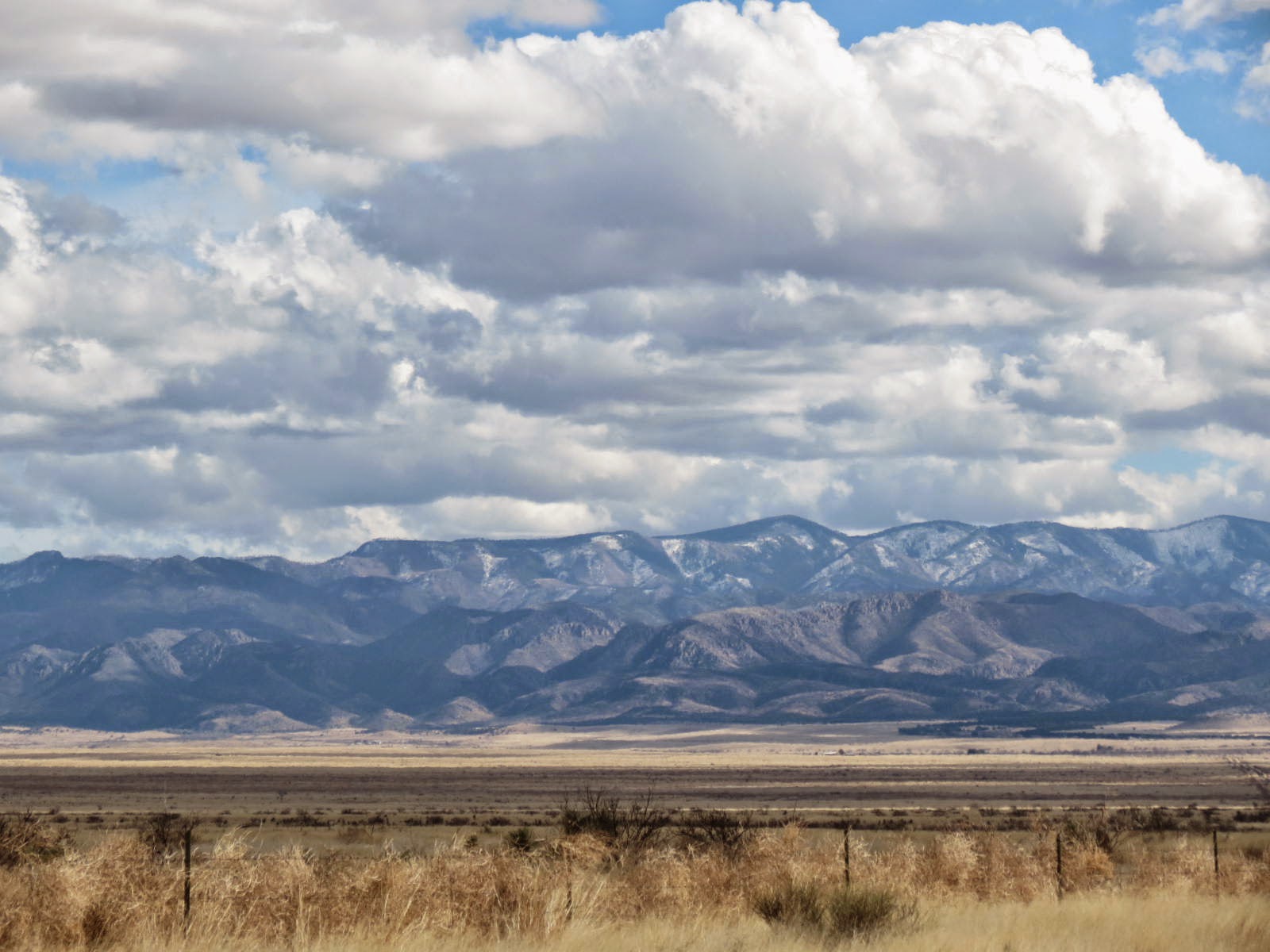


What will you miss most about Dos Cabezas and Willcox? I will miss, in general, the austerity and vastness of the mountains and desert, and the way this Western land, dry and barren in its superficial appearance, holds so many secrets and so much life – the wonderful, tiny details in the vastness. And while we did not forge deep relationships, I’ll miss the easy friendliness of strangers, the open smiles of greeting, the helpfulness we encountered everywhere we went. 

Our coffee place on Railroad Street in Willcox

More specifically, I’ll miss the characteristic Dos Cabezas smell of dust and cows, the daily sight of horse trailers on the streets of Willcox, the whole ranch and cowboy culture. It isn’t empty legend out here: it’s real life. And horses and dogs are very much a part of it all, I’m pleased to report.


To focus for a moment on the sabbatical aspect, how did your writing go? I’m happy with what I’ve done and with where I am now, despite having scrapped the 17,000-word beginning from a month ago and started over almost from scratch. I can’t even call the new version rewriting, because other than keeping a couple of good sections, I truly began anew. So “happy with  ... where I am now,” in terms of word count, is barely at the 6,000 mark, which may not sound like much to show for three months, but it feels very satisfying, because I like those 6,000 words. As I put it to David, my story is no longer wandering around looking for itself. Instead of filling in some conventional form called ‘novel,’ it has found its own shape. Better to make slow progress on the right road than push ahead on a wrong road until a dead end is reached. I’ve found the right road and have started down it.

So you would call the sabbatical a success and you’re glad to have spent the time where and how you did? There is a line in one of Wilfred Thesiger’s books that I used to know by heart and can only paraphrase now, something about how he was never happier in his life than riding the train from Djibouti to Addis Ababa. The other evening, when David and I were riding in the car between Dos Cabezas and the Chiricahua Mountains, taking in the beautiful scenery we have both come to love on a heartbreakingly lovely spring evening, I told him I felt like Thesiger in the train on the way to Addis. But the truth is I have felt equally happy on countless occasions during our stay here – at the livestock auction, at the junior rodeo, visiting our old friends in Patagonia, having the cows lowing around the house at night, exploring the environs with Sarah, sitting on Beverly’s old front porch in the shade with David and watching trains go by or sitting quietly behind the cabin, watching birds and lizards, looking off at distant horses and up to the mountains -- and on and on and on.

What have you learned from your time in Arizona? Well, for someone often more attuned to impressions than facts, I’ll be taking a lot of new information home with me. First there was the Cactus and Succulent Phase, then the Geology Phase, followed by the Bird Phase, and finally the General Botany Phase. In each phase, I read hungrily for knowledge of an environment entirely new to me. Also, from the very beginning, there was a hunger for history – first, for 19th- and 20th-century regional Arizona history, and now, more recently, for the entire long history of the borderland, la frontera, the area along the border between the United States and Mexico. That last, I’m sure, will be an ongoing area of study.


Any more personal learning? Finding that wannabe-cowgirl left behind at age 12 has been an important revelation. What it has to do with the rest of my life at this stage, I cannot say, but it feels right and good to come back to my girlish love of horses. Sometimes simply being around them makes me think my whole life from the age of 12 until now has been one long detour, but that cannot be true. Each life begins, I’m sure, without a destination, and only as we live do we create our path. I am just grateful that mine brought me to a little Arizona ghost town for this past winter. And now the time has come to leave. Volver? Espero que sí, pero no sé. “The future’s not ours to see....”

El camino


Friday, April 3, 2015

Cowgirl-in-My-Dreams Getaway Rating System

Cow at foot of driveway, morning light


Someone long ago – so long, long ago that who it was no longer matters – introduced me to a rating system for Caribbean resorts that took me quite by surprise. When this person said he would never stay in a hotel with less than a 4T rating, a T being the system’s equivalent to a star, I was curious and, thinking about the old lumberjack hotel my husband and I love in the U.P., where we have stayed for so many years, I asked what sort of primitive accommodations one might expect with a single T. “For instance, would you have to share a bathroom? Would you not have air conditioning or TV?”

He looked at me as if I had suddenly gone insane and then, realizing my questions were serious, stated emphatically (with a still-scandalized expression) that all of the T resorts had private bathrooms, color TV, air conditioning, etc.

“So what do you get with more T’s?” I asked, lack of experience with Caribbean resort hotels severely limiting my imagination.

He rolled his eyes and sighed patiently as he began to tick off desirable amenities. “Private beach. Golf on the premises. Shopping on the premises. Gambling on the premises.”

Indeed! It was an entirely new concept to me, and, I admit, one I did not find appealing – that of flying to a foreign country and spending an entire vacation in a commercial compound, never exploring the country or mixing with the indigenous population, seeing nothing outside of the hotel property. Realizing that people do this – and enjoy it -- was a startling revelation to me, but chacun à son gout, as the old lady said when she kissed the pig. To each his own. Just so I don’t have to do it.

Sabbatical involves work, while vacation leaves work behind, but change of scenery is key to both, along with getting away from routine, freedom from daily job or business and social commitments, and luxuriating in unstructured time, all of which I have found this winter in Dos Cabezas, Arizona. I could not have asked for more.

Morning over the mountains

Thursday morning, a calm, quiet, sunny, beautiful morning, when I ventured outdoors, there were cows down by the road, cows in the side yard, and more cows wandering peacefully through the dry wash behind the cabin. Their presence made me very happy. “How many places could we have gone this winter,” I asked David with a blissful sigh, “where cows would come right up to the house?” He pointed out that most people would not put “cows in the yard” (much less cow pies in the yard, which charm both of us) on their list of priorities for a seasonal rental, that most people would be more likely to look for a golf course or swimming pool. But I know what I like, and this is it!

So here, presented for the first time ever, is the Cowgirl-in-my-Dreams (CD) getaway rating system, applicable to sabbatical or vacation. The lowest number is a minimal amenity, with each successively higher number including and building on lower numbers by offering greater pleasure and satisfaction. My priorities would not be everyone’s, but I offer them from a full and grateful heart, happy to have found such peace and beauty here in the high desert.

Willcox across the railroad tracks

CD1: Friendly nearby town with basic necessities – post office, groceries, hardware, mechanic, library, etc. Don’t need or want to be necessarily in the town, but having it within daily reach is good. It doesn’t have to be fancy. It’s better if it isn’t fancy.

Field of blue toadflax

CD2: Open range or (in a different climate and habitat) otherwise open, undeveloped space where the CD and her dog can enjoy walks in a natural setting, i.e., “Nature in Abundance” (to steal the motto of Grand Marais, Michigan).

Last light of afternoon, Philadelphia Wash

CD3: Hardworking, unpretentious, friendly but unintrusive neighbors within walking distance and not too close for comfort. Handyman? Check! Mechanic? Check! Sources of neighborhood and historical information? Check! Happy, happy, happy!

CD4: Working ranch or farm environment, with cattle and horses part of everyday life – the closer, the better. Cows in the yard a definite plus. Horses in the yard would be a cup-overfloweth situation, but even seeing them at a distance from the back porch is pretty darn good, and having more down the road in either direction is very good, too.


CD5: Absence of Internet or cell phone signal to reinforce solitude and peace. Love it!!!

I could make a longer list, but those are my ghost town basics, and you get the picture.

Now that we have made exploratory day trips throughout most of Cochise County and forays up into Graham County (Safford) and over to Santa Cruz County (Patagonia), David and I find ourselves, as “the days dwindle down to a precious few,” spending more and more time sitting quietly in the shade behind the cabin, looking back at our “home” mountains, drinking iced tea, reading and writing, and watching cattle and wildlife. One little lizard entertained us for many hours. The lizard comes out to sun itself every afternoon; the rock squirrel was a fun surprise. “Do you think we’re finally settling in?” my darling asked with a smile.


Having begun again at the beginning with my novel-in-progress, I am no longer counting words written and have cast off that horrid Big Bird fussiness of overworked transitions (“He went here and he went there and he walked and he walked and he walked”), concentrating instead on key scenes in my characters’ development. “What are they up to now, these people you hang out with?” David asks after I’ve been writing for two or three hours in the morning. I am “hanging out” with them. They are always on my mind, wherever we go, in foreground or background, and the hardest part about going home is knowing that they will be pushed more and more to the background as normal working life makes incessant demands. But I have had this time, and I am immensely, deeply grateful for it.


More and more green comes to the high desert every day. There are so many things we will not be around to see, since we leave in a week, and so my desire to identify what is happening now grows more urgent with each passing day. Two small former botanical mysteries gave up their secrets recently, thanks to a beautiful book David bought for me, The Audubon Society Field Guide to North American Wildflowers, Western Region, my camera, and clues from the plants themselves. I can now say with confidence that the white flower from Patagonia Lake (my photograph of it more artistic portrait than clear representative of the species) was desert chicory, and that the charming tiny flowers in the yard here in Dos Cabezas (the fruits were my clue) are Dove’s Foot Geranium, a close relative of crane’s bill.

desert chicory

dove's-foot geranium

I cannot say why this knowledge is important to me; I only know that it is.

No, wait. Maybe it’s this:

I did not simply pass through this place. I did not just touch down and bounce away again. I was here. I was really here. And David was right beside me.


Click here for more new photographs of neighborhood horses.


Monday, March 23, 2015

Seriously, I Really Am Working: Progress Report from Dos Cabezas


Some of my friends must be wondering, after so many posts about horses and cattle and history and botany and day trips to exciting places, just how serious is my notion of a sabbatical? Aren’t I, really, just having a long, extended vacation? The short answer is: I really have been working -- steadily, every day. A longer answer follows, for those interested; whoever prefers pictures can switch to my other blog and see some of what’s blooming these days in baja Arizona, plus some fantastic rock formations in the Dragoon Mountains.

Writing

My focus for this winter’s sabbatical has been long fiction – not short stories (though I did manage to wrap up one that had been simmering a while, and that felt good) but a novel. I didn’t expect to have a finished book manuscript in three months but vowed to get as far as possible with a good, strong first draft. And so I’ve been getting up before the sun every morning here in Dos Cabezas, my quiet little ghost town, and sitting down and work. (Work: getting up and sitting down. Funny!) At first the morning program was coffee and writing. That has been expanded to include a bit of yoga, but the main thing is still the writing.

Around the beginning of March, out of curiosity, I did a word count. Output to that point was eleven chapters and over 17,000 words. It was a slower accumulation than I’d hoped for but steady progress.

Then, unexpectedly, I hit a wall. I was stuck only 48 hours (and tried not to take it out on the world, i.e., David and Sarah), but for two days I was silently fretful, disappointed, and irritable, stewing in self-doubt. Maybe the project was beyond my ability and doomed from the start?

Let me be clear. I had no problem generating words, which is what I think most people have in mind when they use the phrase “writer’s block.” Words kept coming. Unfortunately, I was not seeing value in my words, so I intentionally stopped writing.

There’s a passage in James Baldwin’s Another Country where the character Vivaldo is frustrated by the novel he’s trying to write. His characters seem wooden, and he feels like he’s pushing them around mechanically rather than bringing them to life. Vivaldo’s impasse came to my mind but didn’t exactly describe what I was feeling. My characters, as far as I was concerned then and still am now, are very much alive. I believe in them and even (for all their shortcomings) like them.

So what was the problem?

The answer woke me up in the middle of the night: I was fussing way too much -- fussing over the timeline, fussing over the scenery, fussing over every little logistical detail. Like a nervous, first-time playwright/director, trying to control everything, I was keeping my perfectly competent characters sitting around backstage on folding chairs instead of letting them get up and act! I needed to get out of their way!

It was such a relief to see the problem clearly that instead of jumping up to get to work I went back to sleep. In the morning, over coffee, having decided to take the day off, I talked over my epiphany with David, so he would know what was going on with me and wouldn’t worry. “It means I have to start all over at the beginning,” I told him, “but that’s okay.” Then the next day, clear about what needed doing, I got back to work and now, having started over, I’m three chapters into a new, much more satisfying version.

It may be slower going from now on – or maybe not, I really don’t know. Either way, though, it’s all right. Piling up words on a schedule is not the object. The story is the object. Telling it well.

The other day after asking David if he wanted to read my new first chapter, I realized that until then I’d let him read no more than the prologue. That told me that already, somewhere inside, without acknowledging the fact, I knew all along those words weren’t measuring up.

Now, having been introduced to one of the main characters in my new first chapter, David asked the next morning, after I’d worked for a couple of hours, “What’s the Wild Man up to now?”

Me: “He’s on his way to the U.P.”

David: “If he’s going to Canada, I hope he has a passport.”

Me: “He doesn’t.”

David: “I didn’t think he would.”

This is the kind of guy the Wild Man is. He doesn’t think ahead. And I’ve gotten him across. (“I didn’t think he would.”) Very satisfying!

Big question: were the last two months “lost” time? Wasted time? If what I wrote in that time isn’t going in the novel, after all? I say no.

When I reached dissertation stage in my graduate program, I wrote and rewrote my first chapter for a couple of years, then finally put it aside, plowed ahead, wrote all the other chapters, and in the end went back and wrote an entirely new first chapter, with maybe one sentence from all my previous drafts. (It might have been only a footnote.) But none of the time spent on all those unused versions of a first chapter was wasted, because it was all part of the process, or what one dear person in my life calls “the journey.” I got where I am now by going through everything that came before.

This is important. There are no shortcuts to the novel I want to write, because (and this is so Bergsonian!) the “endpoint,” the finished novel, has no pre-existing reality. Only by way of the working-through does it come into existence, and whatever that working-through involves and however long it takes will be what is necessary.

(I’m guessing what I’ve said here is even true for formulaic genre novels. What do you think?)

I’ll confess that I’m a little leery about my winter sabbatical coming to an end. I can’t help wondering how much room in my very busy, full Michigan life I’ll find to move ahead with this project that means so much to me. At the same time, I have to say that since starting over from page one, I have now have more faith (‘confidence,’ if you prefer) in how my story is unfolding and am not as nervous about the end of sabbatical as I was a month ago.

This morning David asked me, "What are they up to now, those people you're hanging out with?" I am hanging out with them: I wake up in the dark, and they are already there, in my mind, ready for me to pay attention to them.

Planning for Summer in Michigan

If you’ll look at the right-hand column for author events 2015, you’ll see that I have not entirely neglected my role as bookseller. Two authors have committed to dates in June, and I’m very excited about both, as I know my Northport customers and bookstore fans will be, too. There will be much more about Ellen Airgood and Holly Wren Spaulding as spring unfolds. By June I may even have firm dates in August for that month’s writer guests. As always, stayed tuned....


Monday, March 2, 2015

Being Here Is More Than a Vacation


Earlier this winter, when I announced here in “Books on Northport” that David and I would be taking a sabbatical, one of my readers (and you know who you are, BB!) asked about the difference between a vacation and a sabbatical. Actually, before he raised the issue he’d done a little homework and looked up a definition of sabbatical. Basically, a sabbatical involves some kind of professional creative work and time to “recharge the batteries,” often in a setting away from home. The away-from-setting may be chosen for its research possibilities, but that’s not always a necessary consideration.

But wait – isn’t an ordinary vacation supposed to “recharge the batteries,” too?

In the academic world, faculty members long for time to do what each calls “my own work.” Teaching, of course, is the primary job of most college and university professors, but they are also expected to (and usually want very much to) produce their original work – scientific research, creative writing, works of art, inventions, or whatever – and that can be hard to do simultaneously with the demands of preparing classes, teaching, grading, and advising students. Hence the sabbatical.


In our regular Michigan lives, I have a bookstore, which in summer is open seven days a week. The schedule isn’t quite as rigorous the rest of the year, but business is still a constant presence in my head, the first thing there when I wake up each morning.

David is not quite so tied to his gallery -- since the bookstore is right next door, he can come and go more freely, knowing I’ll keep an eye on things -- but he, too, although he produces more painting in his gallery than I get writing done in my bookstore, feels the pressure of business concerns on a daily basis. And naturally our days off are consumed with personal, household, and business errands.

Four years ago, down in Aripeka, Florida, I wrote ten short stories, and David made between 20 and 30 new paintings. It was an extremely productive winter for both of us. But that was four years ago, and while he has been productive since then, I have felt stagnant. So when the opportunity came along to rent this little cabin in southeast Arizona, even before we left Michigan my mind started recharging! I began a novel. I looked back at an unfinished short story. And then we started driving across the country....

my corner

Now here we are. I have finished the short story, and I written eleven chapters of the novel. It feels good.


David is having second thoughts about writing he’d planned to do and isn’t pushing himself to write, but that’s all right. He bought some new brushes and has the beginning of some new work underway, both drawing and painting. I’ve not been as diligent at my drawing as I’d anticipated but am not pushing myself in that direction. Getting as much writing done as I have been is the main thing; for me, drawing is meditation, not “my own work.”

The vastness of the Western landscape had us both overwhelmed for the first few weeks. It is so BIG! The effect gained by being here depends on being surrounded by the desert and mountains. But just being here, driving around and looking, sitting and looking, soaking it in, looking, looking, looking – all that is energizing, all of it refilling the wells of creativity.

It’s that kind of recharging, I realize – not electric, as with an engine or batteries, but more profound, as with an aquifer.


We’re reading a lot. David was thoroughly absorbed in Huffington’s biography of Picasso and read every word of it hungrily. He and I both read a fabulous book on coyotes and are now sharing a book on horses and racing by Jane Smiley. If you want to know what else I’ve read since our arrival, just look over at my “Books Read 2015” list, but my point is this: We read and discuss; we look at everything and talk about what we see; we pay a lot of attention to cloud formations, as if we are children again, lying on our backs in the summer grass. My short story was set in Scotland, and my novel is set in Michigan. Some of David’s drawing is figurative, nothing to do with landscape at all. That doesn’t matter. We’re working, and it feels good.

MANY books added since this photo taken!
Having a home base is important. During the day we are free to go out exploring, and then we come home to the cabin every night -- nesting, building our sabbatical libraries, and organizing and reorganizing our work spaces, secure in the knowledge that we have weeks in which to spread out and concentrate on work that is very personal to us and involves no one other than ourselves. 

Not everyone has the luxury of taking months away from work. I realize that. At the same time, since neither of us has a regular job or a position with benefits, we cannot look forward to ordinary retirement, either. Instead of the retirement other people have, we have this -- unpaid sabbatical time we have arranged to give ourselves and each other.

I wouldn’t have it any other way.