Within the fixed limits of its allotted hours the sun is supreme.
It does not yield to passing clouds, for much of the time there are none.
Nothing can deny the sun’s omnipotence or detract from its authority. Step into
its presence and you are flooded with light. All the world around you is
immersed in its radiance.
- Walter Collins O’Kane, The Intimate Desert
In
the morning, we went to town (Willcox, that is) to do errands, winding up with
coffee on the front porch of our regular coffee spot before coming home for
lunch, so it was nearly midafternoon before we set off on our first visit to
nearby Chiricahua National Monument. Only 21 miles from Dos Cabezas, the trip
took us east of home on 186 for the first time.
It
was exciting to see snow-capped mountains ahead in the distance and to know that was our
destination for the day. Clouds – yes, that day there were clouds -- made
constantly shifting dark shadows on the mountains and intervening seas of
grass, the grass tall and golden under a bright blue sky like the coat of an
immense animal covering many square miles.
We
hadn’t gone far into the park when a roadrunner suddenly appeared and ran
crazily along the road, zig-zagging in our direction, before disappearing again
into the vegetation. At the visitor center, I mentioned it to the ranger,
prefacing my reportage, “This probably won’t sound thrilling to you...,” but
she said it was
thrilling, because “we don’t get a lot of roadrunners up here.” More luck! And
it kept coming, too, because Chiricahua no longer charges an entry fee. I put
the money saved toward part of the price of a state road atlas from the gift
shop. I like maps with detail, with every dirt road shown.
But
this day was all Chiricahua. And here, in large part, is the text from the
first informational sign we encountered:
The Apache called this area “The Land of Standing-Up Rocks”....
Chiricahua resembles an oceanic archipelago – a sea dotted with
islands – only here the desert is a hot desert grassland. We call these
isolated mountain ranges “sky islands.” The Sonoran and Chihuahuan deserts, and
the Rocky Mountain and Sierra Madre ranges all meet here. The convergence of
these four homes makes the area unusually rich in biodiversity.
Chiricahua National Monument was established in 1924 to protect the
fantastic rock formations known as “the pinnacles.” In 1934 the Civilian
Conservation orps began the job of improving the road and constructing the
trails and many park structures, including the visitor center.
In 1976 Congress decided to further preserve the land by
designating 86% of the monument as Wilderness. This precludes any development
and human intervention, thus ensuring the preservation of the geological
formations for future generations.
Another 6 miles along the Bonita Canyon Drive will transport you
through oak, cypress and pine forests to the summit at Massai Point, where you
will get a true sense of being atop a sky island.
And
so we set off, up the mountain road. It was not at all easy to photograph the
“standing-up rocks,” either with the light directly on them, so that they
tended to be overexposed relative to surrounding sky and trees, or when they
were plunged into deep shade and the sky behind them flooded with light. I
thought Photoshop would save me, but success was elusive – limited, at best.
Also,
as the road climbed more and more steeply, my anxiety got in the way of camera
work, too. I kept asking David to slow down. He wasn’t driving fast, and he was
driving very well; it just felt fast and scary to me. Lucky (again) that I
hadn’t known ahead of time how terrifying the road up to Massai Point would be,
with all those drop-off edges, or we might have missed some these
heart-stopping long-distance views.
Again,
sharp contrasts of light and dark made it impossible (for me, I should say;
suggestions are welcome) to capture both nearby mountain rocks and lowlying
background rangeland together. Try imaginatively to put together in your mind’s
eye the two photographs above to see what we actually saw.
But
we were really there, 6,870’ above sea level! Some peaks in the Chiricahuas, I
should note, are higher than 9,000’, but almost 7,000 is as high as I feel the need to go!
Can
you tell I was quaking in my boots? And doesn’t David look relaxed?
We
met a couple from Louisiana, painters who now live in Benson, Arizona, not far
from Willcox. David talked painting with them. Sharon and I compared
geographical notes. Looking off in the direction I correctly identified as
northeast, she told me we were looking toward the Gila range and New Mexico.
The light in that direction was kind and gentle.
The
name for the geology of this SE corner of Arizona is range and basin (yes, as
in John McPhee’s book title), and I admit I’m more comfortable in the basins or
in the foothill regions between basin and peaks. Coming back down from the
dizzying heights, when I was able to look up at the rocks again
and feel more comfortable, we found a picnic spot and caught our breath and ate
apples and drank water and spotted an acorn woodpecker high in a tree. The
acorn woodpecker is “common,” but it’s the first one I’ve ever seen, so it was
thrilling to me, and I’m including its picture, despite the poor quality of the image.
The
light was gentle as we left the mountains behind. We will return often to the
Chiricahuas, I’m sure. It is very close and very beautiful. Also, there is a
lot to explore at my preferred lower altitudes.
 |
| (Looking back) |
On
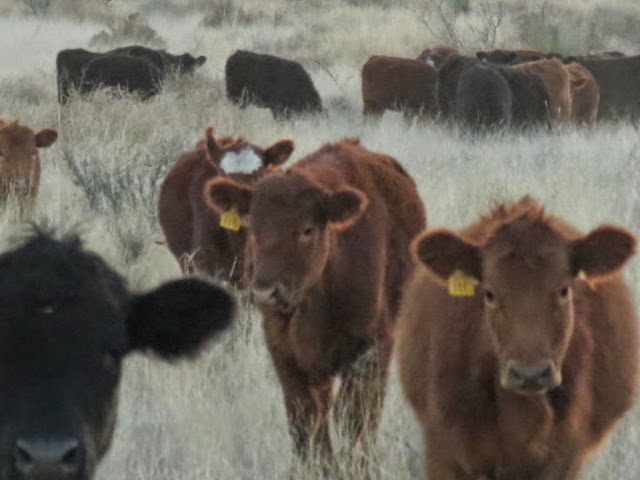
our way back west, I wanted to stop to get a better look at some grazing
“cows,” as all cattle (mostly steers) are called out here. When I got out of
the car, the animals ambled over to the fence, seemingly curious.
 |
| All are curious and want to get in on the action! |
Blue
sky with clouds, golden grasses, a lovely new stretch of road with almost no
traffic, a roadrunner, fantastic mountains, terror, delight, beauty, an acorn
woodpecker, and cattle up close -- what more could such a beautiful, thrilling
day offer, if not a spectacular sunset from our front door in Dos Cabezas?