|
| I'll explain this further down. |
Here I am (since November) in what is at present my winter home, far from Michigan, a little rented cabin in an Arizona ghost town in the Sulphur Springs Valley, mountains looming all around, where a beautiful sunrise occurs just about every morning and a breathtaking sunset at the end of each day. Southeast Arizona’s landscape is austere and can seem unforgiving, forbidding, even foreboding, but in fact, the land is characterized by indifference rather than hostility, and I find comfort in Nature’s absence of malice. I also enjoy, here in the ghost town, sufficient distance between human habitations that we don’t often rub up against each other the wrong way.
My own small living space, large enough to share with my canine companion, in previous years accommodated me, our dog, and my dear husband, the love of my life. Now, there’s just me and the dog, and I miss David every minute! Make no mistake about that! Although in many ways he is still here, all around me -- in his paintings, his hats and boots, his books on the shelves with mine, unlimited memories, and constant thoughts. Every day I wear his watch and one of his favorite belts, and often I’ll reach for one of his caps or pull on a pair of his socks.
 |
| Me and my girl |
On the morning of Christmas Eve, my neighbor and I took our usual long morning dog walk with Sunny Juliet. We hiked high enough in the foothills to reach ocotillo territory, and then quickly turned downhill again so Sunny would not disturb cows that had climbed high on the slope for the first sunlight of the day. Due to Midwest weather, my friend’s December 22nd flight to Detroit was cancelled, and I’d been reading books featuring travels in Mexico and Spain, re-igniting what had been until recently fairly dormant wanderlust. And so it was, as we compared notes on travels planned and desired, we decided on the spur of the moment to drive down to Whitewater Draw that very day to see the wintering sandhill cranes.

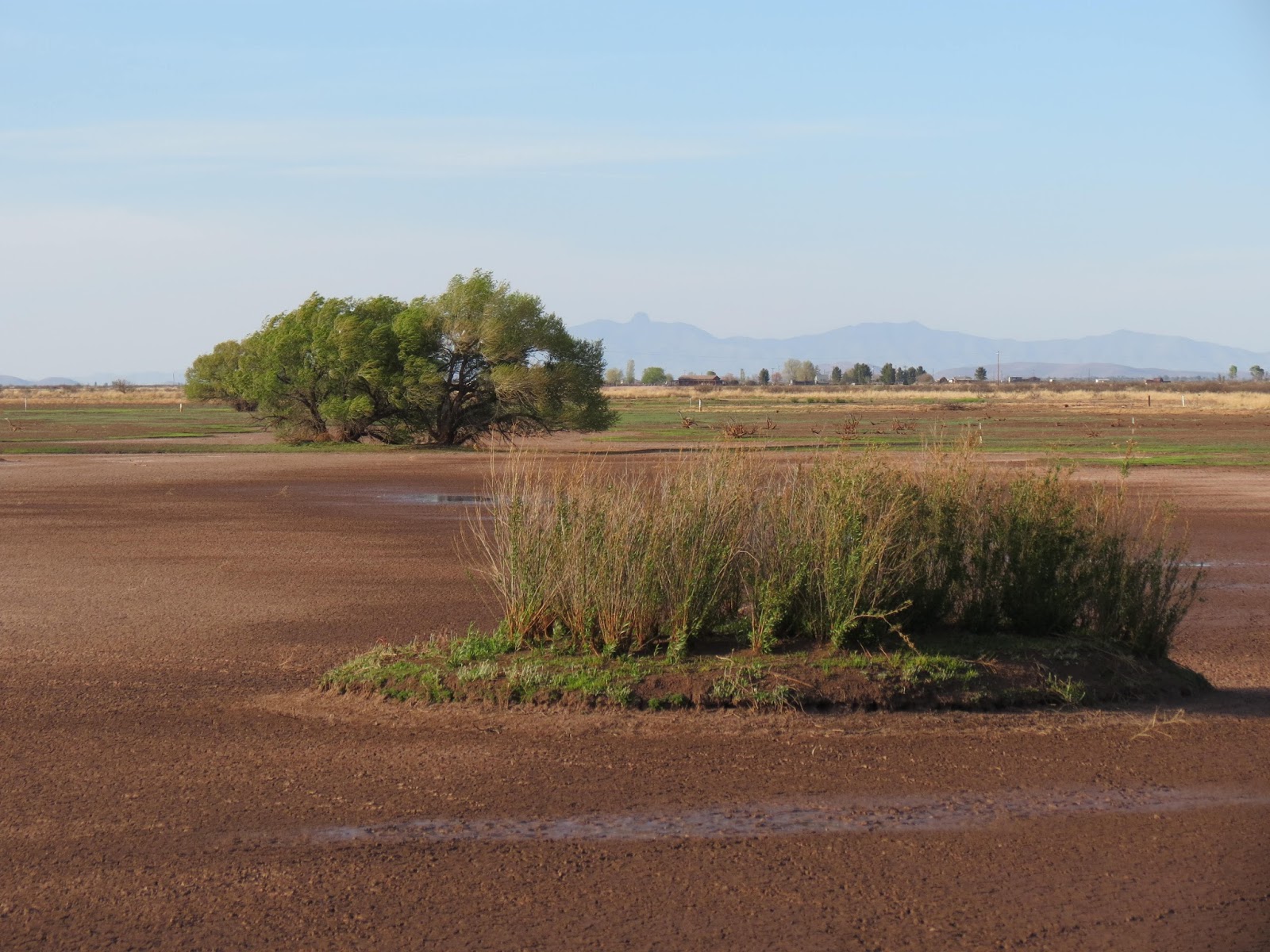
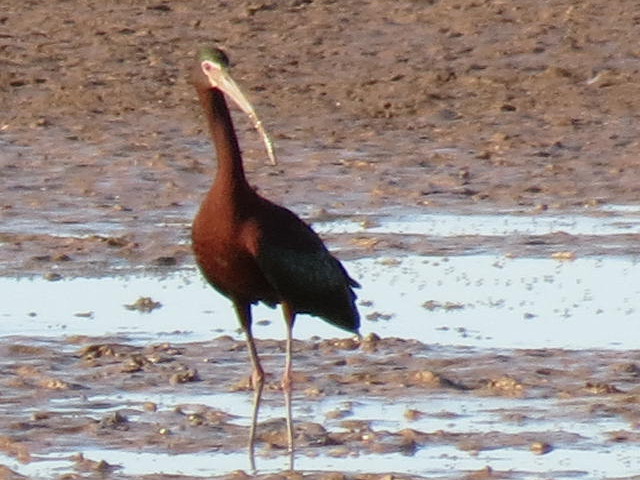
Cranes by the thousand are very noisy, but I have always found their clattering, purling calls joyful and comforting. There were many other birds to see, as well. American shovelers, both male and female, have coloring reminiscent of mallards back in Michigan, though with much longer bills. Sweet little black coots scoot along with bobbing heads and then dive. My friend’s sudden excited cry of “Red bird!” drew my attention to a vermilion flycatcher. One waterside tree held a woodpecker (Ladderback? We didn’t have binoculars with us!), and if you look closely at the sign in the photograph below you’ll see what I think is a black phoebe.
 |
| Need telephoto for good photo of black phoebe, if that's what this is! |
 |
| Long trail to largest flocks.... |
At the very far end of the longest path, even without the binoculars we had forgotten (along with field guides we’d also forgotten, so eager were we to get on the road), we were able to see a long line of about 100-150 snow geese, hunkered down near another even larger crowd of more sandhill cranes. I don’t ever remember seeing snow geese before, here or anywhere else, so that was exciting.
 |
| That white line in the distance is a flock of snow geese. |
Whitewater Draw was one of the Artist’s favorite places in Cochise County, its water scenes so reminiscent of the watery landscapes he loved to paint, that whenever we were there together he would ask me repeatedly to photograph certain scenes. He never painted directly from photographs, but he liked looking at them for inspiration, so on that sunny Christmas Eve afternoon I kept stopping to photograph scenes for him, a habit I’ll probably never break.


That night I made the oyster stew (just for myself) that I’d planned for Christmas Eve supper. Lots of cubed potatoes, sliced celery, onions, mushrooms, evaporated milk, a little coarse kosher salt, and a small can of oysters. It was good. I had a second bowl. Then on my way to bed, rather than turning off my Christmas tree lights, I picked up the big platter that holds the tiny potted Norfolk pine with its battery-powered tiny lights and moved it over to the bedroom corner of the cabin where I could look up from my nighttime reading and see it from pillowland. In the morning I brought my 5 a.m. coffee and a cold blueberry pancake back to bed and shared the pancake with Sunny. “I’m glad you’re here,” I told her. “What would I do without you?”


My Christmas morning reading was the second chapter of The Mays of Ventadorn, by W. S. Merwin, a journey and exploration into a particular strain of troubadour poetry but, for me, also the story of Merwin’s finding a home away from home in a part of France that I too fell in love with.
…My vocation as a tourist has always been dubious. Reading a guidebook and then glancing up to identify what the resume has been summarizing is likely to seem to me, quite soon, like an exercise in alienation. I am more given to imagining what it might be like to spend time in a given spot, to get to know the sounds and the light, the people and the faces of the buildings, and how some of it had come to look the way it did.
- W. S. Merwin. The Mays of Ventadorn
This is the way I have always loved to travel and the way the Artist and I traveled together, “imagining what it might be like to spend time” here and there, which is why having a vacation “home base” – a hotel in Paris or in Michigan’s Upper Peninsula, the ghost town cabin here in Cochise County, Arizona – and making daily explorations out from that base was our perfect idea of travel, enriched and expanded always by armchair travel with our beloved books, often read aloud to each other, in whole or in part.
On the afternoon of Christmas Day, my regular hiking partner and I walked over across the highway for dinner with other neighbors and later walked home under a new moon in a lavender sky.

Then only two days later, again without planning ahead to do so, we took one of our longer, more ambitious hikes here in the ghost town environs, gaining about 400 feet in elevation and reaching an entirely different life zone, where green-leafed oak trees flourished. It was so exciting! Sunny proved herself an able rock dog, too -- explanation for my first photograph on this post.

And the day after that I accompanied my friend on a long, rainy, stressful expressway drive – to pick up her new puppy! All in all, quite a week!

Now as 2022 draws to a close I look around this little cabin at my modest belongings and feel comfortably at home, lucky to be here, safe and warm, lucky to have little Sunny Juliet, to have good neighbors and blue skies, enough to eat, more than enough to read (no such thing as “too many books” in my lexicon!), and family and friends who keep in touch across the miles. It would be easy -- and sometimes, I admit, the temptation is more than I can resist -- for me to look at 2022 as a catalog of loss, but I guess if I have a single resolution for 2023, it is to continue to count my blessings daily and to recount them whenever I start feeling blue. But here's the tricky thing. Although people say, “Count your blessings,” they generally say it when a person is feeling more blue than blessed -- because why would you need reminding otherwise? – and yet it’s when I’m already feeling blessed and contented that I am more likely to enumerate positive reasons for good feelings. Does that sound familiar to anyone else? It’s those blue hours and moods that are difficult, although heaven knows -- and I am certainly aware -- that in this life I have been a very lucky woman.

Last Books (Almost!) Read in the Year 2022
129. Steinbeck, John. A Log From the Sea of Cortez (nonfiction)
The pattern of a book, or a day, or a trip, becomes a characteristic design. The factors in a trip by boat, the many-formed personality phases all shuffled together, changing a little to fit into the box and yet bringing their own lumps and corners, make the trip. And from all these factors your expedition has a character of its own, so that one may say of it, “That was a good, kind trip.” Or, “That was a mean one.” The character of the whole becomes defined and definite.
Steinbeck’s chartered boat expedition with Ed Ricketts and crew to collect marine specimens in the Sea of Cortez between Baja California and the Mexican mainland in 1941 is as full of portraits of nature and philosophical topics as it is observations of the land and people encountered. Did you know that Steinbeck studied marine biology in college? Any fan of Cannery Row will find this book fascinating!
130. Lee, Laurie. As I Walked Out One Midsummer Morning (nonfiction)
Ever since childhood I’d imagined myself walking down a white dusty road through groves of orange trees to a city called Seville. The fantasy may have been induced by the Cotswold damp, or by something my mother had told me, but it was one of several such clichés which had brought me to Spain….
Laurie Lee’s writing is magical. He walks from his home village to London, travels by boat to Spain, walks across Spain – like a mad dog Englishman, without a hat, courting sunstroke! But who else has ever written like this?
I was awakened next morning by the high clear voice of a young boy singing in the street below. The sound lifted me gradually with a swaying motion as though I was being cradled on silken cords. It was cool crisp singing, full-throated and pure, and surely the most painless way to be awakened – and as I lay listening, with the sun filtering over me, I thought this was how it should always be. To be charmed from sleep by a voice like this, eased softly back into life, rather than by the customary brutalities of shouts, knocking, and alarm-bells like blows on the head. The borders of consciousness are anxious enough, raw and desperate places; we shouldn’t be dragged across them like struggling thieves as if sleep was a felony.
131. Merwin, W.S. The Mays of Ventadorn (nonfiction)
…I was twenty-six, with no money at all and a house in the depths of the country in France. In all the years that followed, the house, the remains of the farm, the village, became a constant, insistent part of my life, invaluable, cherished, demanding, inescapable.
(from late in Chapter 2)
…One attractive element in the farming life that had evolved by then in the Quercy was an unobtrusive independence of spirit, a quality rooted in the practice of polyculture – the growing of more or less everything. It was an immemorial system encouraged by the variations of the crumpled landscape with its small irregular fields fitted into the stony contours, but deplored by theorists as inefficient…. Most families possessed a few hectares of upland woods, a few hectares of open pasture in different places, a few hectares of arable land, which they farmed on a careful four-year system of rotation, a sizable number of ritually tended walnut trees, at least one vineyard, and at least one vegetable garden…. They grew much of what they ate, and all that they fed to their animals. They sold walnuts, plums, milk, wool, calves, lambs, cheese, and they raised tobacco some years as a cash crop. They thought that was the way it had always been….
(from early in Chapter 3)
You can see how for me, this was another book with subject matter and language to work magic on my soul.
All three of the books I’ve quoted from above are books I could quote from endlessly, so I have restrained myself and leave you only with these scanty passages to illustrate, I hope, the wonders provided in these priceless works by John Steinbeck, Laurie Lee, and W.S. Merwin.
132. Smith, Betty. Maggie-Now (fiction). I have read Maggie-Now almost as many times as I have read A Tree Grows in Brooklyn, the author’s most famous novel, and I love them equally. Highly recommended, both!
133. Robertson, Thomas A. A Southwestern Utopia (nonfiction). An excessive accumulation of facts that nevertheless failed to cohere into any kind of convincing atmosphere. Disappointing but no doubt important reading for researchers into experimental utopian communities.
December disappointment: holiday lights and decorations in Willcox taken down way too soon!
Unexpected thrill this last week of the year: Western bluebirds at my feeders here in Dos Cabezas!
Life -- it is a mixed bag, my friends!

Happy new year
and
happy reading in 2023!!!