 |
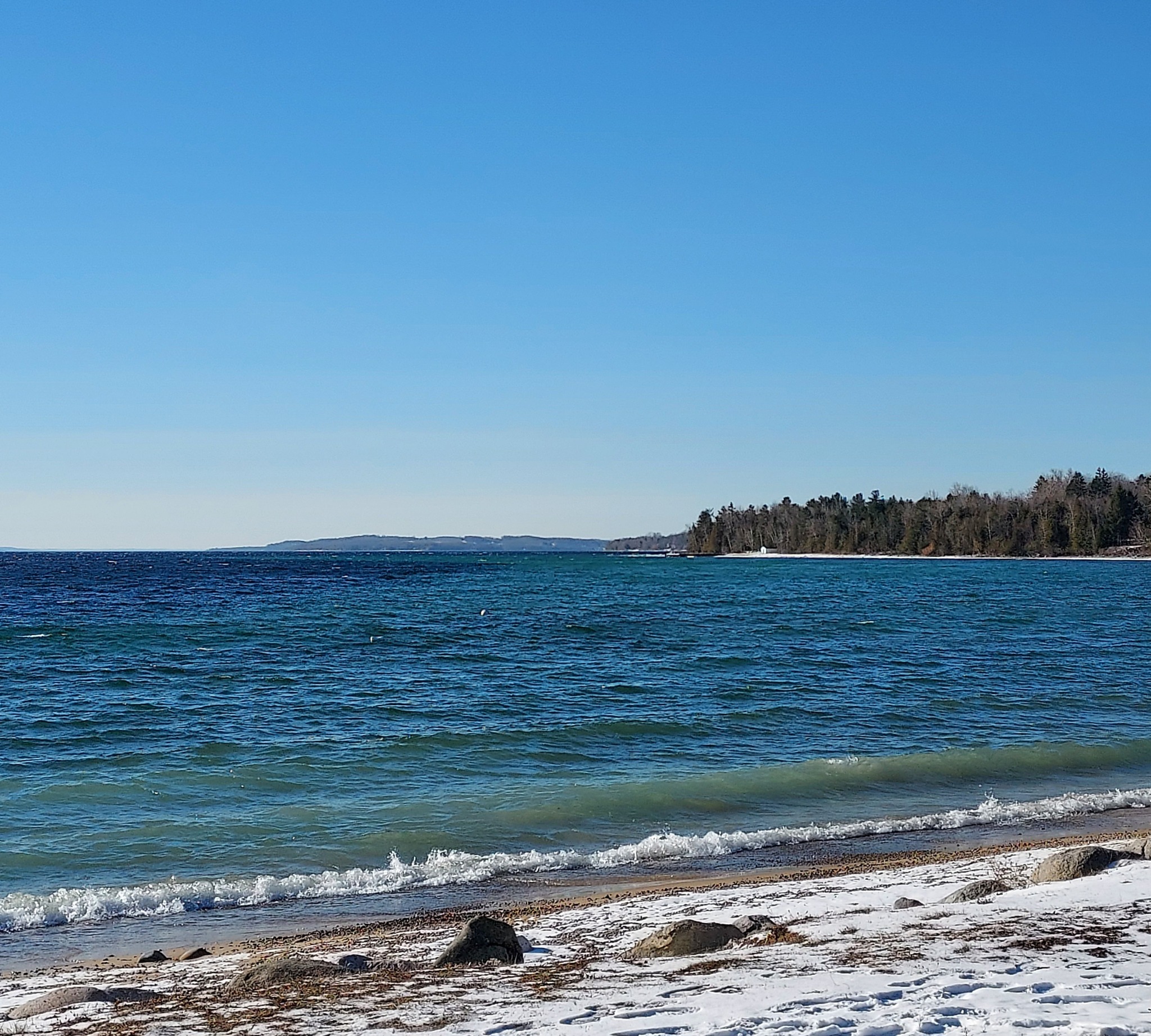
| Omena Bay: blue sky, blue water |
It was a gorgeous morning! The only problem was, for me, that there were no daffodils to be had, for love nor money, anywhere in northern Leelanau County! You see, March 1 is the Feast Day of St. David, patron saint of Wales. (In Welsh, the Hebrew name David becomes Dafydd; either way, ‘beloved’ is the meaning of the name. Dafydd ap Llywelyn was Prince of Wales from 1240 to 1246, others claiming the title through the years.) And as a day to remember the saint canonized in 1120, and also to honor Wales, the feast day is marked with bright yellow daffodils and green leeks.
 |
| Leeks were twice the price they should have been, but I bought them. |
So I'll make do with images of daffodils from old posts, for today I am remembering my late husband, the Artist, David Grath, and also my late friend Annie Pritchard, who was Welsh to the core, both still beloved by many in their absence.
 |
| 4/27/2013 |
Books Read in February 2024
20. Wallace, David Rains. The Turquoise Dragon (fiction). A mystery, the story naturally begins with the discovery of a dead body, and from there complications sprout and multiply. Descriptions of hiking (not for pleasure) in California mountains had me picturing every step, but after all the suspense and hair-raising situations, escalating as the number of pages left diminished, I have to say I was disappointed in the way the book ended – or, rather, stopped. I inspected the binding thoroughly, thinking that final pages must have been left out or removed by a previous reader, but no, apparently not. Many loose ends. Rats! Authors! Denouement, please!*
21. Shoemaker, Jan. Slow Learner: Essays (nonfiction). I met the author when she visited my bookstore with her previous book of essays, Flesh and Stones: Field Notes from a Finite World, and was very happy to receive this new volume in the mail. I devoured it much faster than I should have, always saying to myself at the end of one essay, “Just one more.” Shoemaker writes beautifully of life in her corner of the world, which of course connects to all other corners in one way or another.
22. Horowitz, Anthony. Magpie Murders (fiction). Something light and entertaining for the weekend, I thought, and it was that, but it was also much more. A murder mystery within a murder mystery, the ‘outer’ story (as it were) is told by the editor of the author of the ‘inner’ story. Horowitz did not make things easy for himself when he concocted this tale, but his skill is equal to the challenge.
23. Westover, Tara. Educated (nonfiction). I couldn’t recall if I’d read this book before but remembered a friend raving about it. About halfway through it began to seem familiar, but by then I couldn’t stop, of course. Kept away from doctors and out of school, with no birth certificate until she was nine years old, Tara’s hunger for learning had enormous obstacles to overcome, but overcome them she did. Now with a Ph.D. in history from Cambridge, what will she do next?
24. Deloria, Vine Jr. God Is Red: A Native View of Religion (nonfiction). Basically a history of Western Christianity and comparison of that to Native American religions, the latter being place- and community-specific, the former claiming universality, this is a serious theological treatment and not a book to be skimmed. Well worth reading; highly recommended.
25. Gibbings, Robert. Coming Down the Seine (nonfiction). Any book by this Irish writer and artist is a peaceful escape from all that ails. A solo traveler, he made friends everywhere along his way, and his ways were as various as dreams. The illustrations in his books are his own and as lovely as the writings.
26. Doyle, Brian. One Long River of Song (nonfiction). Celebratory essays on the wonder of ordinary things, the final volume from this author before his death. Surprises on every page. Sometimes you are caught sideways and laugh out loud when you least expect it.
27. Mosley, Walter. All I Did Was Shoot My Man (fiction). This is one of the author’s Leonid McGill series and, while not among my top favorite Mosley novels, engrossing enough that I couldn’t put it down as McGill seeks to make amends for past sins and finds nothing but more trouble for himself and others.
28. Theroux, Paul. Millroy the Magician (fiction). I kept hoping the narrative meander would develop an arc, but it never did. Lolita without either the sex or the insights. Desperate finale hardly seemed a conclusion. Theroux has written some wonderful books, but this isn’t one of them.*
29. Short, Wayne. This Raw Land (nonfiction). The author brought a bride to Alaska in the mid-1950s, where they began their married life fishing together for salmon. In the winter, Wayne and his brothers camped and trapped far from home base. Eventually, he and his wife and two young sons spent a winter of isolation on Murder Bay, where Wayne had taken on the job of dismantling a canning factory for the lumber to build a larger house for his growing family. Alaska became a state, and change was in the air….
30. Jance, J.A. Paradise Lost (fiction). I am a total sucker for Jance’s Sheriff Joanna Brady series, set in Cochise County, and this one will keep you guessing until the end, as a good mystery should do, but I also love it for the locales: the road to old Fort Bowie was just 8 miles from my beloved ghost town, and the Chiricahua Mountains less than 20 more down the road. Even Onion Saddle gets into the story! I felt right at home.
31. Merrick, Leonard. A Chair on the Boulevard (fiction). Light, humorous stories featuring a host of impecunious artists (painters and writers) and artistes (performers) in Montmartre in the days before the arrival of the horseless carriage. English dialogue presented as literal word-for-word translation from French exaggerates the comedy.
32. Shaw, Irwin. Paris! Paris! (nonfiction). Wonderfully illustrated by Ronald Searle, in this book Shaw looks at Paris through his own experiences over many years, beginning with the exciting chaos of the Liberation in 1945 and through many changes in the city. Whether you know Paris or simply wish you did, this book will fill you with longing.
33. Proulx, Annie. Fen, Bog & Swamp: A Short History of Peatland Destruction and Its Role in the Climate Crisis (nonfiction). As a longtime lover of “swamps” (I had no other words as a child for various types of wetlands), I felt called by this title. I was a bit afraid it might be too full of dates and numbers to be readable, but such was not the case. Proulx is a lover of wetlands herself, hence the book. A bibliography would have been helpful.
34. Herman, Mimi. The Kudzu Queen (fiction). Mystery without murder, suspense without gunfire or car chases, this book kept me up way past my bedtime. Fifteen-year-old Mathilda, called Maddie, seems an unlikely candidate for a beauty pageant, but the golden-haired, smooth-talking Kudzu King has turned her head. Where will it all end? Now, is the story 100% believable? Does it have to be? I willingly suspended disbelief. A real page-turner!
35. Dionne, Karen. The Wicked Sister (fiction). Psychological thriller suspense is not exactly my genre (I wouldn’t call this novel a murder mystery), but with a Michigan author and a story set in the U.P., I gave it a shot. As far as mystery goes, it was what a friend would call “a thin bowl of soup” (i.e, not mysterious), and there are loose ends aplenty, but the author has clearly set us up for a sequel down the road.
36. Coetzee, J.M. Waiting for the Barbarians (fiction). If you’re looking for lightweight escape reading, this is not for you, but the beautiful writing of a gradually unfolding brutal parable, which could almost be set at any time, past, present, or future, ensures that once you read this novel, you will never forget it.
37. Gibbings, Robert. Lovely Is the Lee (nonfiction). Thanks to books, we can travel back into the past and faraway visit places in their most lovely and most peaceful times. How did people live in Ireland in the mid-20th century, and what stories did they tell? The author’s illustrations add to the spell.
38. Smith, Alexander McCall. My Italian Bulldozer (fiction). A Scotsman’s plan to finish his book in the Italian countryside takes a surprising turn when no rental cars are available. Pure, gentle delight! For all who love Italy … or think they would … or simply need a break from the harsh edges of the nonfictional world.
39. McGinley, Patrick. Bogmail (fiction). A pub owner in rural Ireland murders his barman and buries him in the bog, then begins receiving blackmail letters. Which of the pub regulars is the “bogmailer”? One of the locals or the Englishman? Lyrical landscape writing, detailed Raskolnikovian account of the murderer’s increasingly unsettled state of mind – and a most unsatisfying finish, with loose ends galore, a fault shared with #20 and #28 in this list.*
40. Van Gulik, Robert. Celebrated Cases of Judge Dee (Dee Goong An) (fiction). Not one to be gentle with those he suspects, Judge Dee lands on the criminal every time. Illustrated. Tortures in the courtroom and grisly varieties of capital punishment but an interesting look into a different historical period and culture.
41. Yu, Charles. Interior Chinatown (fiction). What parts are real life, and how much is acting? When a dream comes true (Generic Asian Man becomes Kung Fu Hero) but fails to fulfill, what then? The author brilliantly plays off Erving Goffman’s Presentation of Self in Everyday Life (nonfiction) to create a dramatic novel whose characters you’ll love. Serious and fun at the same time.
42. Whitehead, Colson. Zone One (fiction). Post-apocalyptic fiction is not usually at the top of my list, and I have never read a book about zombies before, but I couldn’t resist a novel by Colson Whitehead. What an amazing writer! I kept thinking how much David Foster Wallace would have appreciated this masterfully written book. I also wondered whether I should take it as fantasy (in which case, zombies don’t scare me, since they don’t exist) or as an allegory for our times – in which case, it is terrifying!
43. Leon, Donna. Friends in High Places (fiction). Leon’s are not formulaic murder mysteries. Set in Venice, the stories are presented by the author as realistic episodes in Venetian life, where government is rife with corruption, the Mafia is strong, and murderers are not necessarily brought to justice. The 1960s idealism of Commissario Brunetti and his professora wife, Paola, have taken a beating over the years, but Brunetti holds to what shreds of justice he can find in his police work.
 |
| Daffodils from May 6, 2014 |
For David and for Annie, Jane, and Curig --


