Search This Blog

Showing posts with label Sherlock Holmes. Show all posts

Tuesday, July 1, 2014

Guest Book Review: A DESPERATE RUSE


A Desperate Ruse,
by Robert Underhill
Paper, $14.95

Readers of Robert Underhill’s previous books will find this one significantly different, since this is a period piece, located in London, England, in the late 1800s. It’s also different in that it is centered around a quasi-historical character, the famous detective Sherlock Holmes, creation of the Englishman Arthur Conan Doyle.          

In the Doyle story “A Study in Scarlet,” the great detective is first introduced, along with his partner, Doctor Watson, and Holmes’ brother, Mycroft.  These three are the main characters, along with two police detectives who work with Holmes to solve the mysteries that arise in Victorian England.

Sherlock Holmes and his new method of using “deductive reasoning” to solve crimes became immensely popular in that period in England, and since then his popularity has spread all around the world.  For example, in the past few years here in the U.S. there have been a new film and several TV programs with him as the main character.   The main feature of these exciting adventures, aside from the use of deductive reasoning, is the relationship between the emotionless, cerebral detective, his stolid, unimaginative doctor assistant, and the two bumbling detectives who can’t find a clue even when it’s right in front of their faces. 

Doyle wrote many short stories and novelettes featuring these characters.  His creations became so popular that Londoners would line up to get newly released stories, much as kids did recently when a new Harry Potter adventure came out.  In fact, the character Holmes became so popular that when Doyle became tired of writing about him and killed him off in what he intended as the “final” Sherlock Holmes story, the furor was so great that Doyle had to bring his hero back to life and write even more stories.

Now Robert Underhill, a popular local mystery writer, has done something interesting and new with Sherlock Holmes.  Many authors have written new Sherlock Holmes stories, but most have kept the familiar characters and simply introduced a new mystery.  Underhill does the reverse. He makes a significant alteration in the personality of each character and then re-tells the original story, observing the changes that result. For instance, what if Holmes wasn’t as brilliant as originally designed? What if the doctor was the imaginative one?  What if the detectives weren’t bumbling but rather intelligent police officers?  If these altered characters were to face the same mystery, for example, “The Study in Scarlet,” would the mystery still be solved?  Would the result be the same?  

If you are not a Holmes reader, you will still enjoy this Victorian period mystery. Perhaps it will even lead you to delve into the Holmes stories written by the great writer Arthur Conan Doyle. If, however, you are fortunate enough to be a Holmes enthusiast already, you will be delighted to see how cleverly Underhill alters the personal history of these characters and, as a result, how their motivation changes.  Then you’ll see how the motivational changes affect the solving of the mystery.  It’s almost as if it were written by a psychiatrist!                                   
                                                              
Bruce Balas, June 2014

Omena resident Bruce Balas is a long-time volunteer and bookstore angel at Dog Ears Books. He’s pulling your leg (something he often does) with that last sentence of his: Robert Underhill, as many of you (including Bruce) already know, is a retired psychiatrist.

Saturday, November 23, 2013

November, Indoors and Out


C’est la neige qui nous arrive! La neve in Italian, la nieve in Spanish. Oh, those Romance languages and their kissing cousin words! Our English word originates further north: Snaw, snie, sne, Schnee, snö, snjór. Whatever you call it, it’s beautiful – and can be treacherous. 

Friday morning roads were slippery in Leelanau Township, and in the village of Northport pedestrians were stepping cautiously. By afternoon streets and sidewalks were clear, but the cold, so different from yesterday’s balmy air, remained. Is it winter? Is it here? Were the deer hunters happy this morning with snow on the ground? Will there be a reprieve before Thanksgiving for the rest of us? There was no reprieve on Saturday. The snow was not heavy (yet!), but the wind was sharp and bitterly cold. That early morning customer stocking up on Steve Hamilton mystery novels had the right idea for the weekend.


(Picture for Dawn P., who requested it)
Another good idea
Once autumn leaves have fallen and days are dwindling down toward that day in December that will be the shortest one of the year, the indoor world beckons. It’s time to find all those containers of frozen summer berries and juice and turn them into jam and jelly and maybe try out a new recipe, like cranberry chutney, before this year’s supply of fresh Michigan cranberries is all sold out. Don’t use raisins in that chutney, though. Michigan dried cherries are the Up North choice. Won't it go well with Thanksgiving turkey?

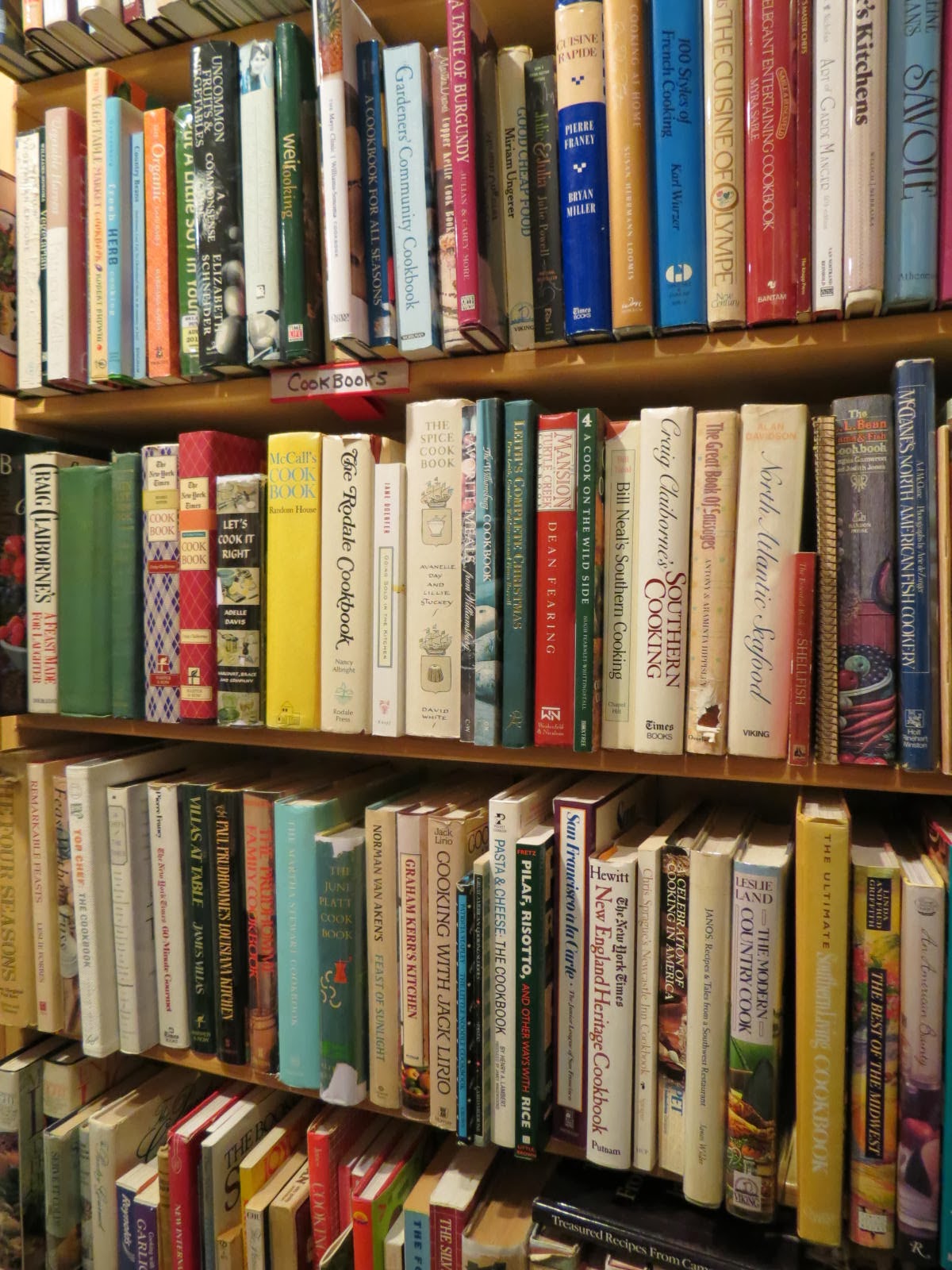
A particular kind of reading seems to go with these first snowy days. I can’t resist pulling out cookbooks and dreaming over recipes of slowly simmered soups and stews, eggy-rich cakes drenched in honey and dusted with powdered sugar, astounding pickles (we are addicted to pickled okra; now if only I could succeed in growing it in my garden!), anything at all involving apples, or any noodle recipe whatsoever. Could a sweet noodle kugel, I wonder, be served with homemade spiced applesauce? Why not? Imagination feeds on cookbook dreams as the weather turns cold.


But those tidy volumes, new and old, I must admit, are in my bookstore. At home, the shelves are not as well arranged (though much better than before we did a massive rearranging), and some of the volumes, taken from the shelves, reveal themselves to be downright disreputable.


Cold weather that tempts us to the fireside is great weather for any kind of reading. I really, really did read recently (despite my earlier protestations of lack of interest) The Adventures of Sherlock Holmes, “complete and unabridged,” and enjoyed the stories very much. This morning I started in on Algerian Chronicles, a collection of essays by Albert Camus, many translated into English for the first time, the rest re-translated, by Arthur Goldhammer. At the bookstore this cold Saturday afternoon I fell into Cathy Johnson's On Becoming Lost: A Naturalist's Search for Meaning, and was exclaiming out loud over the first page of the introduction, "This is me! I was just writing about this!" Here are some of the sentences from Johnson that so resonated with me:
Being lost is not a negative concept. Like the earth-shadowed moon, like night and day, being lost carries within itself its opposite: being found. Being lost simply means we are wandering; is that so bad? 
... 
The loveliest lost of all is that I choose myself -- lost in the crowd, lost to the world, lost, perhaps, to my own incessant self-awareness and able to see what's beyond the end of my own nose. I am forced to look elsewhere for answers and I love it. Being in possession of all the answers holds no appeal at all, but owning a good pocketful of unanswered questions is to me like bread to the starving.
This is a book I will devour hungrily. It has already given me an appetite.

Our Intrepid Ulysses Group will discuss Lorraine Hansberry’s A Raisin in the Sun in December and then – just maybe – we’ll take on the first volume of Proust’s Remembrance of Things past as winter really sets in. As one member of the group said with a nonchalant shrug, “If we got through Ulysses, we can get through anything.” Another person said, “It’s going to be a long winter. We need a long book.”

Here’s the big question: Will the first volume, Swann’s Way, be long enough to last the winter, or will we bold and happy readers be led further and further down the course of the narrator’s life, until finally he recaptures the past he thought was lost to him forever?

Full disclosure: In the past I cheated on Proust, reading the first volume and half of the second before skipping ahead to the last. 

More questions: And now? How short is life? How fast fly the winter days? Is there time to read all of Proust?

Stay tuned in -- or tune in later in the winter -- for the answer to these burning questions.