
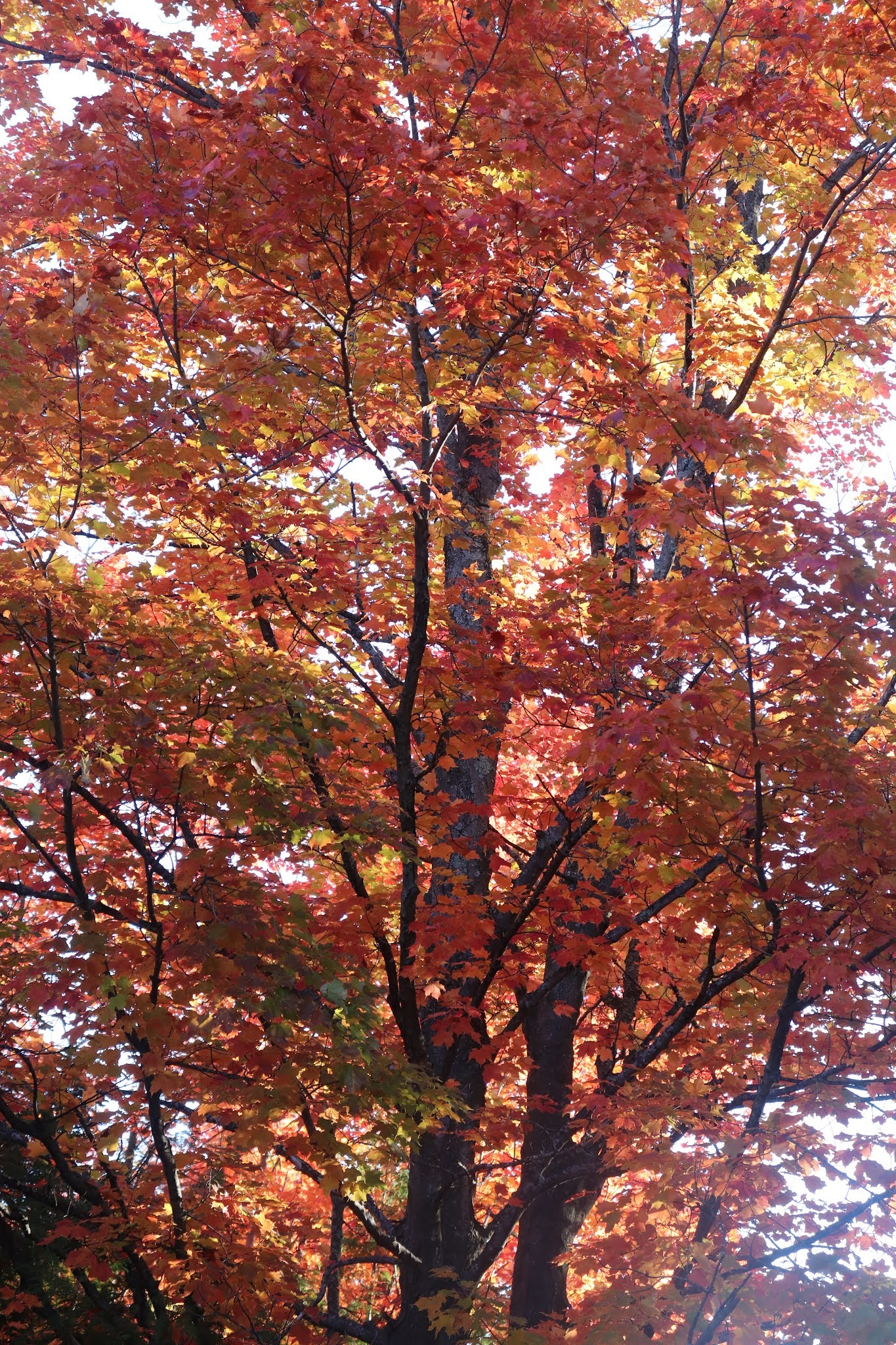
Note: I wrote this post over the course of a few days, so as to give mini-reports along the way to make my book-hopping lack of pattern more obvious. And then this morning I took long, leisurely outdoor time to walk with Sarah and photograph today’s beautiful Thursday world around me.
Tuesday afternoon

For me, once again, it’s sometimes one and sometimes another, and I go from one kind of reading to another, skipping between often totally unrelated books with no apology whatsoever. Crazy Horse, by Mari Sandoz, is both informative and beautifully written, as was Isabel Wilkerson’s The Warmth of Other Suns. Wilkerson’s migrants did not find a perfect society in the North, but for the most part they were glad they had made the move, and I devoured that book to the last page quickly, eager to see how their lives turned out. It’s different with Crazy Horse. Since I know there will be no “happy ending” – and there are plenty of tragedies before the end, also – I keep setting that painful saga aside, taking breaks with something easier on the spirit.

Steve Hamilton’s A Cold Day in Paradise, the first of his Alex McKnight mysteries, was a re-reading experience, a little self-indulgence I frequently give myself in the best of times (which these are not). Even when I remember more of a story than I recalled from my first, long-ago reading of A Cold Day in Paradise (first memorably read in a motel in St. Ignace, cover to cover in one night), there is always a lot that I’ve forgotten and that seems fresh and new, whatever the book.
The Boy, the Mole, the Fox and the Horse is a children’s book and generously (and beautifully) illustrated, so reading that story took me only very briefly away from the world of challenging reality and challenging reading. Native Tongue, the first volume of Susanne Haden Elgin’s feminist speculative fiction trilogy, interested me without completely fully absorbing my attention. I would call it a novel of ideas rather than a character- or plot-driven work. But it did offer escape from political campaigns and COVID-19 concerns.

Sometimes the way a book falls into my hands is complete serendipity. Such was the case with Jimmy Carter’s Why Not the Best? But I wrote about Why Not the Best? in my last post and won’t repeat myself here.
The Uncalled, by Paul Laurence Dunbar, published over a century ago, was something chosen more deliberately. Familiar with Dunbar’s name because of his poetry (Maya Angelou took her title I Know Why the Caged Bird Sings from a Dunbar poems), I hadn’t realized he also wrote novels. Interestingly, though Dunbar was perhaps the first well-known black American poet, there is nothing of race in the story of The Uncalled – at least, so far. I’m only halfway through this little book.
And now already I’ve found something else that seems worth reading. My Brilliant Career, by Miles Franklin, made a big splash when its teen-aged author published her novel in Australia in 1901, but then it was out of print until 1966. Despite the book’s initial success, Franklin felt there was no place for her in the new, very male, nationalistic Australian literary world; she was also unhappy with some of the interpretations laid upon her work.
Australia – now that’s an escape from my everyday world!


Our brave little reading circle, the one that convened years ago to study James Joyce’s Ulysses together, is now committed to reading and discussing for November William Faulkner’s Absalom, Absalom! Faulkner will be a stretch for me, as I am in general not a fan, but the book covers the same period as Margaret Walker’s Jubilee, so it will be interesting from that standpoint, and I need to challenge myself, anyway, which was this group’s original mission – to read together books we might not have read on our own.
Some (but not all) of us took on Proust one fall, and I’ve been reading him again recently, in French, a few pages at a time. I’m not sure whether to classify Proust “difficult” or a familiar and comforting refuge. He is probably the latter for me. Not an “easy” read, but his writing is luxurious – especially the opening scenes of childhood, both at the grandparents’ house in Combray and in the parks and streets of Paris. These long-ago, faraway scenes carry me away from the present, away from worry and strife -- and isn’t that how we define escape reading?

Wednesday morning
I finished The Uncalled last night and fell asleep over early pages of My Brilliant Career. Of the former, I can say it is very much a Victorian novel, with only a couple of places that one might, if informed of the author’s life, see something of his own experience as a black man in [that long-ago] turn-of-the-century America. Paul Laurence Dunbar’s parents, I read, were born in slavery, so he and his siblings were the first generation of the family born free, but as the orphan protagonist of The Uncalled, however, realizes so strongly, there is more to freedom than not being held in bondage. The fictional character longs to break away from his guardian’s very strict religious household (where baseball is considered as great a sin as dancing) and her plans to make him a preacher. Like Dunbar himself, young Brent longs for the freedom of the writing life. When a friend in the seminary warns him of that life’s agonies, Frederick Brent listens with no change of heart.
“This is your story,” said Brent; “but men differ and conditions differ. I will accept all the misery, all the pain and defeat you have suffered, to be free to choose my own course.”
Besides several volumes of poetry, for which he is chiefly known, Dunbar’s only other published book was Tales from Dixie, a collection of short stories featuring African-Americans before and after emancipation. This may be his least sentimental, most realistic work, and I would like to read it sometime. Sadly, the writer died young, only 33 years old, but he earned success while he lived, which is more than many poets, black or white, can say.
Not having more Dunbar on hand last night, I curled up in bed with My Brilliant Career but laid it aside to watch “Dark Waters” with the Artist, taking it up again after the movie and falling asleep before getting very far into the story. And earlier this morning, over the first cup of coffee, somehow I became embroiled in old e-mails, clearing out as many as could be deleted, filing others, re-reading and re-living days COVID and pre-COVID.
Here at the bookstore now, I’m pleased to have restocked many of Jim Harrison’s fiction titles; Katey Schultz’s brilliant Still Come Home (which every American should read); and to have some charming new children’s books now in stock. October will be the last full month of the 2020 year for Dog Ears Books (let’s be clear: we do plan to be back in the spring!), but it isn’t too early to get some of that holiday shopping out of the way, and I’ll be glad to help with that.
Wednesday afternoon
Continuing with My Brilliant Career, I am intrigued by the fact that the adolescent author, while complaining of her own fate when times grew hard for the family, managed to recognize her parents’ difficulties, as well, and even to see their life in the greater national context.
…Household drudgery, woodcutting, milking, and gardening soon roughen the hands and dim the outside polish. When the body is wearied with much toil the desire to cultivate the mind, or the cultivation it has already received, is gradually wiped out. Thus it was with my parents. They had dropped from swelldom to peasantism. They were among and of the peasantry. None of their former acquaintances came within their circle now, for the iron ungodly hand of class distinction has settled surely down upon Australian society – Australia’s democracy is only a tradition of the past.
I wonder, is My Brilliant Career considered an Australian classic by now – does it still fall short of the Australian male nationalist literary tradition?
Thursday morning
The world forced itself upon me last night. The event was the vice-presidential “debate,” and I steeled myself to listen, confident that it could not sink to the level of the presidential candidates’ horror show circus. Fortunately, I am blessed with generally low blood pressure.
Everyone listening (or watching, as more probably did) will have a different impression of the performances. My impression of Pence – a cipher in my mind beforehand – was that he is a very slippery, sneaky little man. He pretended great politeness and respect at the beginning of each two minutes allotted him (“Thank you, Susan”) but then talked on past his limit again and again, while the moderator tried to stop him with “Thank you, Mr. Vice-President” over and over. He also interrupted Senator Harris more than once. In short, he was as determined as the president not to be hemmed in by the rules but maintained a surface demeanor of civility and normality.
How many questions asked by the moderator were actually answered by either candidate? Once Pence asked that the record show that Harris had not answered a question – this after he, Pence, had evaded countless previous questions! I wish Harris had challenged him on that hypocritical remark, as well as on his repeated admonition to her, “You are entitled to your own opinion, but you are not entitled to your own facts.” This was a fiendish ploy, as the very phrase “alternative facts” was invented in the White House to excuse lies told by the president! The vice-president took the administration’s own guilt and painted the senator with it, and Harris let him get away with it!
I still have no clear answer on the Democratic position on fracking. I believe fracking should be banned, for strong scientific reasons, but now it seems both parties have decided that fracking is something holy -- if anything, more sacred than a fertilized human egg. Will people be talking about fracking today? Will that issue get any attention at all? For me, it was the most worrisome take-away, other than the revelation of the vice-president’s character.


And so this morning, waking once again to the political take-over of my brain, I fled to Australia with Miles Franklin, and during the day I will no doubt read a few more poems by Jane Kenyon (because Lord knows I need poetry right now and will probably need it more and more in the less than four weeks ahead!), but before the bookstore I spent time in the beautiful outdoors with my dear old dog.
I am not, you see, doing a complete ostrich act and avoiding reality or succumbing to an escape addiction, but neither am I willing to let every waking moment be taken over by those aspects of reality that do nothing but heighten anxiety and/or plunge me into depression. I'm no good to anyone like that. Regular reading of other times and places is part of my life, anyway. The difference now is that I do it for sanity’s sake.
Measured doses – reality, escape – I seek some kind of mental balance. A beautiful, sunny fall morning doesn’t hurt, either.


